

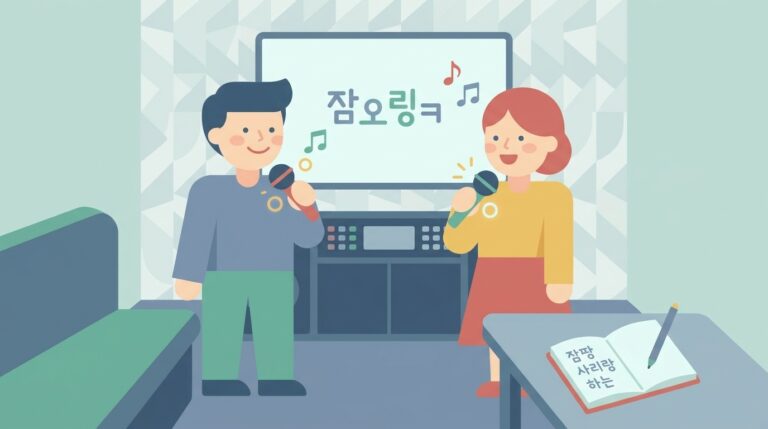
Conquering the Noraebang Mic: Essential Korean Phrases to Rock Karaoke Like a Local
Phase 1: Empathy & Story-Driven Opening
안녕하세요! 매일한글 에디터입니다. (Hello! I’m your Daily Hangul editor.)
Imagine this classic K-Drama scene: You are sitting in a vibrant Korean noraebang (karaoke room) surrounded by glowing neon lights, tambourines shaking, and an oversized remote control lying on the table. Your Korean friends or coworkers are hyping everyone up. Suddenly, someone holds up the wireless microphone and looks around the room: Who wants to go next? You have been practicing your favorite K-pop track for weeks, your palms are sweaty, but your mind goes blank. How do you politely grab the mic without sounding greedy? What if you’re too shy and want someone else to sing first?
Walking into a Korean karaoke room for the first time can feel overwhelming, especially when social etiquette (nunchi) comes into play. Based on feedback from hundreds of our global learners, taking the mic is one of the most exciting yet nerve-wracking social hurdles in Korea. But do not worry! In this guide, you will master the exact A2-level conversational tools to step up, pass the mic, cheer on your friends, and enjoy every single high note with confidence.
Phase 2: Top 3 Core Expressions In-Depth
1. 제가 먼저 불러도 돼요? (Je-ga meon-jeo bul-leo-do dwae-yo?)
- Pronunciation: [Jay-gah mun-juh bool-luh-doh dway-yo?] (Think: ‘dway-yo’ rhymes with saying ‘way’ with a soft ‘d’ in front!)
- Meaning: Literal: “May I sing first?” | Actual Nuance: “Do you mind if I take the first turn?”
- K-Culture Moment: When the room gets awkwardly quiet at the start, stepping up with this phrase makes you the ultimate mood maker (bunwigi-meikeo).
- Editor’s Insight: The pattern
-도 돼요?(-do dwae-yo?) is the friendliest way to ask for permission at the A2 level. It sounds polite, modest, and approachable.- Situation Spectrum: Casual: ✅ | Semi-formal: ✅ | Formal: ⚠️ (Use -도 되겠습니까? for strict business dinners)
- 🤔 Think About It: In many Western parties, whoever grabs the mic just sings. In Korea, asking permission shows respect for the group’s shared rhythm. How does asking before acting change the group vibe?
2. 마이크 넘겨주세요! (Ma-i-keu neom-gyeo-ju-se-yo!)
- Pronunciation: [Mah-ee-keu num-gyuh-joo-seh-yo!] (Sounds like ‘num’ as in number + ‘gyuh’ as in regular)
- Meaning: Literal: “Please pass over the microphone!” | Actual Nuance: “Pass me the mic! It’s my turn!”
- K-Culture Moment: Your reserved song’s intro music just started blasting through the speakers, and someone on the other side of the sofa is still holding the mic.
- Editor’s Insight:
넘기다(neom-gi-da) means to pass or hand over. Adding-주세요creates a gentle command that works wonderfully among peers and colleagues.- Situation Spectrum: Casual: ✅ | Semi-formal: ✅ | Formal: 🚫 (Use 마이크 전달 부탁드립니다 in formal settings)
- 🤔 Think About It: Notice how Korean uses polite suffixes even in fast, high-energy party settings. Why is politeness kept alive inside casual fun?
3. 다음 곡 누구예요? (Da-eum gok nu-gu-ye-yo?)
- Pronunciation: [Dah-eum gohk noo-goo-yay-yo?] (Gok sounds like ‘gawk’ with a crisp, stopped ‘k’ at the end)
- Meaning: Literal: “Next song who is it?” | Actual Nuance: “Whose song is coming up next?”
- K-Culture Moment: The screen switches to a new song, but everyone is busy eating snacks and checking their song list.
- Editor’s Insight:
곡(gok) is the counter/noun for musical pieces and songs. Using누구예요?(Who is it?) keeps the interaction light and interactive.- Situation Spectrum: Casual: ✅ | Semi-formal: ✅ | Formal: ⚠️
- 🤔 Think About It: Asking this question helps quiet friends not miss their reserved song. It reflects the Korean spirit of taking care of everyone in the room.
Phase 3: Textbook Korean vs. Real-World Korean
Situation 1: Offering the microphone to a friend
- 📖 Textbook Korean: 당신이 노래를 부르시겠습니까? (Dang-sin-i no-rae-reul bu-reu-si-get-seum-ni-kka? – Would you like to sing a song?)
- 🗣️ Real Korean: 먼저 부르실래요? (Meon-jeo bu-reu-sil-lae-yo? – Do you want to go first?)
- 💡 Why is it different? Real Koreans rarely use the second-person pronoun ‘당신’ (dangsin) in spoken conversation because it sounds overly dramatic, confrontational, or translated directly from English. Using
-ㄹ래요?creates a natural, gentle invitation.
Situation 2: Asking someone to pass the remote control or mic
- 📖 Textbook Korean: 그것을 저에게 전달해 주십시오. (Geu-geos-eul jeo-e-ge jeon-dal-hae ju-sip-si-o. – Please deliver that to me.)
- 🗣️ Real Korean: 마이크/리모컨 좀 건네주세요! (Ma-i-keu/Ri-mo-keon jom geon-ne-ju-se-yo! – Could you pass me the mic/remote please?)
- 💡 Why is it different? Words like ‘전달’ (delivery/transmission) belong in formal announcements or corporate meetings. Adding ‘좀’ (jom – a little/please) softens any request instantly.
Phase 4: K-Culture Deep Dive & Non-Verbal Manners
4-1. Noraebang Nunchi & Mic Etiquette
- The Two-Handed Handover: Even in a fun party, hand the microphone over with both hands (or touch your forearm with your left hand while passing with the right) if giving it to an older friend or colleague.
- Avoid Mic Hogging (Dok-jeom): Reserving three of your own songs in a row without asking is considered bad nunchi. Share the screen queue evenly!
- The Tambourine Spirit: When someone else takes the mic, pick up the tambourine (tem-beo-rin) and shake it to the beat. Enthusiastic reactions (tae-do) will make you the most popular guest.
4-2. The Golden Noraebang Culture Code
In K-dramas, karaoke scenes mark major emotional turning points—colleagues bond after a tough work week, or lovers realize their feelings through a ballad. Noraebang is not a performance contest; it is a shared space of emotional release (heung). Don’t worry about pitch accuracy—energy and sincerity win every time!
Phase 5: Real-World Roleplay Scenario
Setting: Hongdae Luxury Su Noraebang on a Friday night with your Korean language exchange partner, Minwoo (민우).
- Turn 1 (Minwoo): 🎭 [Switches on the disco ball and hands you the thick songbook] “자, 오늘 스트레스 다 풀고 가자!” (Ja, oneul seu-teu-re-seu da pul-go ga-ja! – Alright, let’s blow off all our stress today!)
- Turn 2 (You): 🎭 [Nodding with a bright smile] “좋아요! 신나게 놀아요!” (Jo-a-yo! Sin-na-ge nol-a-yo! – Sounds great! Let’s have fun!)
- Turn 3 (Minwoo): 🎭 [Pointing the remote at the screen] “누가 먼저 시작할래?” (Nu-ga meon-jeo si-jak-hal-lae? – Who wants to start first?)
- Turn 4 (You): 🎭 [Raising your hand politely] “제가 먼저 불러도 돼요?” (Je-ga meon-jeo bul-leo-do dwae-yo? – May I sing first?)
- Turn 5 (Minwoo): 🎭 [Handing over the mic with both hands, cheering] “오, 좋아요! 마이크 여기 있어요! 무슨 노래 할 거예요?” (O, jo-a-yo! Ma-i-keu yeo-gi iss-eo-yo! Mu-seun no-rae hal geo-ye-yo? – Oh awesome! Here’s the mic! What song will you do?)
- Turn 6 (You): 🎭 [Taking the mic and typing song number] “케이팝 신나는 노래요!” (K-peop sin-na-neun no-rae-yo! – An exciting K-pop song!)
- Turn 7 (Minwoo): 🎭 [Grabbing two tambourines enthusiastically] “완전 기대된다! 탬버린 장전 완료!” (Wan-jeon gi-dae-doen-da! Taem-beo-rin jang-jeon wan-ryo! – So excited! Tambourines loaded and ready!)
- Turn 8 (You): 🎭 [Speaking into the mic with energy] “같이 불러요!” (Ga-chi bul-leo-yo! – Let’s sing together!)
🔀 Interactive Decision Point: Your song just finished! What will you say?
- Option A: “마이크 여기요! 다음 곡 누구예요?” (Here is the mic! Whose song is next?)
- Feedback [Best Choice]: Perfect! You share the microphone smoothly and keep the energy circulating to the next person.
- Option B: “제가 5곡 더 예약했어요!” (I reserved 5 more songs!)
- Feedback [Bad Choice]: Mic hog alert! Taking over the queue without asking breaks group harmony.
- Option C: “노래 그만할래요. 집에 갈래요.” (I want to stop singing. I want to go home.)
- Feedback [Risk]: Abruptly cutting off the party mood without an explanation can cause awkwardness.
Phase 6: 10-Second Emotion Shadowing Drill
- Drill 1
[😊 Excited & Confident]
제가 / 먼저 / 불러도 돼요? / (Je-ga / meon-jeo / bul-leo-do dwae-yo?) - Drill 2
[🎉 Playful & energetic]
마이크 / 빨리 / 넘겨주세요! / (Ma-i-keu / ppal-li / neom-gyeo-ju-se-yo!) - Drill 3
[👀 Curious & Attentive]
다음 노래 / 누구 거예요? / (Da-eum no-rae / nu-gu geo-ye-yo?) - Drill 4
[🙌 Cheerful & Inviting]
우리 / 같이 / 떼창해요! / (U-ri / ga-chi / tte-chang-hae-yo!)
Phase 7: K-Culture Mini Dictionary
- 마이크 (Ma-i-keu) | Microphone | Used everywhere from karaoke rooms to presentations. In casual speech, people say “마이크 잡아!” (Grab the mic / Sing!).
- 선곡 (Seon-gok) | Song selection | Choosing a track. A good seongok matches the room’s mood.
- 취소 (Chwi-so) | Cancel button | The button on the remote used to skip or stop a song early if needed.
- 떼창 (Tte-chang) | Crowd sing-along / Choir effect | Singing the chorus together in unison—the ultimate peak of Korean karaoke joy!
Phase 8: Traveler’s Noraebang Survival Kit
TOP 3 Survival Phrases
- 템포 좀 올려주세요! (Tem-po jom ol-lyeo-ju-se-yo! – Please speed up the tempo!) -> Pro Tip: Use this for upbeat dance covers!
- 물 좀 갖다 드릴까요? (Mul jom gat-da deu-ril-kka-yo? – Shall I bring some water?) -> Pro Tip: High singing dries out your throat; sharing water earns big brownie points.
- 서비스 시간 더 주셨어요! (Seo-bi-seu si-gan deo ju-syeoss-eo-yo! – They gave us bonus free minutes!) -> Pro Tip: In Korea, karaoke owners often add free extra minutes (service) near the end of your session.
Editor’s Travel Note
Before hitting local karaoke spots in Gangnam or Hongdae, download the Naver Map Navigation App on iOS and Android to easily check room rates, coin noraebang (Koin-noraebang) booths near subway exits, and user reviews. Most modern rooms accept international credit cards and T-Money transport cards!
Phase 9: Stepping Deeper (Cultural Reflection)
In Korean society, the microphone is not just a tool for singing; it is a temporary stage where hierarchy softens. During after-work dinners (hoesik), even the most reserved junior employee can lead the entire room in song. Holding the mic with humility while offering it generously reflects Korea’s collectivist warmth (jeong).
💬 Your Turn: Have you ever felt nervous singing in front of new friends? What is the #1 song you would pick if someone handed you the mic in Seoul today? Let us know in the comments below!
Phase 10: FAQ & Avoiding Common Mistakes
Q: Can I go to a Noraebang alone in Korea?
A: Absolutely! Look for a 코인노래방 (Coin Noraebang). You pay per song (usually 500 to 1,000 KRW for 2 songs) and can sing solo comfortably in private individual booths.
Q: What should I do if someone is singing a slow ballad?
A: Lower your tambourine volume and listen attentively, or turn on your smartphone flashlight and wave it side to side gently to support them.
Q: How do I find English songs on the remote?
A: Look for the button labeled 국가별 (By Country) or 팝송 (Pop Song) on the oversized remote control.
🚨 Common Mistakes & Quick Fixes
- Mistake 1: Pressing ‘시작’ (Start) before checking who reserved the song.
- Correct Action: Look at the top corner of the screen or ask, “다음 곡 누구예요?”
- Mistake 2: Holding the mic directly in front of the speaker boxes.
- Correct Action: Keep the mic pointed slightly away to avoid loud screeching feedback.
- Mistake 3: Cutting off someone’s song halfway by accidentally pressing ‘취소’ (Cancel).
- Correct Action: Only hit cancel on your own songs, or ask “넘길까요?” (Shall I skip it?) first.
Phase 11: Action Mission & Engagement
- 🥉 Bronze Mission: Say
제가 먼저 불러도 돼요?out loud 3 times in front of your mirror with a friendly smile. - 🥈 Silver Mission: Share this post on Instagram or X with your dream Korean karaoke playlist and tag @DailyHangul.
- 🥇 Gold Mission: Visit a local Koin Noraebang or record a 10-second voice clip passing the mic to a study buddy!
- 🎮 K-Culture Mission: Watch any variety show (like Running Man or Amazing Saturday) and spot the moment a cast member grabs the microphone.
Phase 12: Interactive Quiz Challenge
Test what you have learned today!
- Situation Question: Your reserved song just appeared on the screen, but the mic is across the table. What do you say?
- A) 당신 노래하세요.
- B) 마이크 넘겨주세요!
- C) 취소해 주세요.
- Fill in the Blank:
“다음 ( ) 누구예요?” (Whose song is next?)- Word bank: [ 곡 / 밥 / 집 ]
- True / False: In Korea, it is polite to reserve 5 songs in a row without asking others in the room. (True / False)
👉 Click here to check the answers and explanations!
- Answer: B (마이크 넘겨주세요!) – Perfect for asking someone to pass the microphone smoothly.
- Answer: 곡 (Gok) – ‘곡’ means song or musical track. (다음 곡 누구예요?)
- Answer: False – Reserving many songs consecutively without checking with the group breaks karaoke etiquette (nunchi). Always take turns!







