

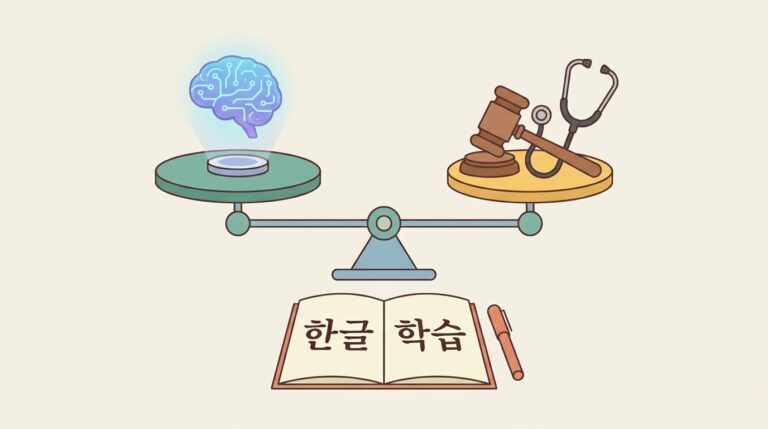
Navigating AI Ethics in Korean: Debating AI Judges and Medical Diagnosis Like a Local
Phase 1: Empathy & Story Opening
안녕하세요! 매일한글 에디터입니다. (Hello! This is your Daily Hangul editor.)
Imagine you are sitting in a hip café in Gangnam with Korean colleagues or university peers, discussing the latest hit legal sci-fi K-drama. The topic suddenly turns to whether AI should replace human judges in the courtroom or make life-or-death decisions in university hospitals. You have brilliant arguments in English, but the moment you try to voice your stance on ethical dilemmas, liability, and machine bias in Korean, your words feel clumsy and overly literal.
At a C1 level, expressing nuanced ethical viewpoints requires more than dictionary definitions—it demands culturally resonant rhetoric and intellectual vocabulary. Many advanced learners stumble when trying to balance persuasive logic with polite Korean discourse markers. This guide is crafted directly from real mentoring sessions with advanced learners who wanted to hold their own in sophisticated panel talks, university seminars, and late-night intellectual debates. Let’s master the art of discussing AI ethics naturally and convincingly!
Phase 2: 3 Key Expressions Deep Dive
1. 알고리즘의 편향성을 간과할 수 없습니다
- Pronunciation: [Al-go-ri-jeum-ui pyeon-hyang-seong-eul gan-gwa-hal su eop-seum-ni-da] (Sounds like: al-go-ree-jeum-we pyon-hyang-seong-eul gahn-gwah-hahl soo op-seum-nee-dah)
- Meaning: Literal: “We cannot overlook the bias of algorithms.” | Nuance: “We must address the inherent algorithmic bias before rushing into full implementation.”
- K-Culture Moment: Used by sharp defense attorneys or tech ethics researchers in courtroom dramas when challenging automated evidence.
- Editor’s Insight: The verb ‘간과하다’ (to overlook/neglect) elevates your speech instantly to an academic, C1 debate level.
- Situation Spectrum: Casual 🚫 | Semi-formal ⚠️ | Formal ✅
- 🤔 Think About It: How does phrasing this as a double negative (“cannot overlook”) add diplomatic weight compared to simply saying “algorithms are biased”?
2. 최종 책임 소재가 불분명해집니다
- Pronunciation: [Choe-jong chaek-im so-jae-ga bul-bun-myeong-hae-jim-ni-da] (Sounds like: chweh-jong chek-eem soh-jeh-gah bool-boon-myong-heh-jeem-nee-dah)
- Meaning: Literal: “The location of final responsibility becomes unclear.” | Nuance: “It blurs the lines of ultimate accountability.”
- K-Culture Moment: Frequently heard in medical tribunal scenes when an AI diagnostic system misidentifies a malignant tumor.
- Editor’s Insight: ‘책임 소재’ (locus of responsibility) is a crucial collocated phrase in Korean governance, law, and corporate ethics.
- Situation Spectrum: Casual 🚫 | Semi-formal ⚠️ | Formal ✅
- 🤔 Think About It: In Korean corporate and legal culture, pinpointing ‘책임 소재’ is paramount. How does this compare to accountability discourse in your culture?
3. 인간미와 정서적 교감이 배제될 우려가 있습니다
- Pronunciation: [In-gan-mi-wa jeong-seo-jeok gyo-gam-i bae-je-doel u-ryeo-ga it-seum-ni-da] (Sounds like: een-gahn-mee-wah jong-suh-jok gyo-gahm-ee beh-jeh-dwel oo-ryuh-gah eet-seum-nee-dah)
- Meaning: Literal: “There is concern that human warmth and emotional rapport will be excluded.” | Nuance: “We risk stripping away the human touch and empathy essential to justice and healthcare.”
- K-Culture Moment: Emphasized by veteran doctors or compassionate judges in dramas who argue that clinical data cannot capture a patient’s emotional pain.
- Editor’s Insight: ‘인간미’ (human warmth) and ‘정서적 교감’ (emotional rapport/resonance) are foundational Korean humanitarian concepts.
- Situation Spectrum: Casual ⚠️ | Semi-formal ✅ | Formal ✅
- 🤔 Think About It: Why is emotional connection considered a legitimate metric alongside technical accuracy in Korean decision-making?
Phase 3: Textbook Korean vs. Real Korean
Situation 1: Expressing skepticism toward AI sentencing
- 📖 교과서 한국어 (Textbook): AI 판사는 기계라서 감정이 없어서 공정할 수도 있지만 실수를 할 수도 있습니다. (Because AI judges are machines without emotions, they might be fair, but they could also make mistakes.)
- 🗣️ 진짜 한국어 (Real C1): 기계적 판결이 지닌 한계와 온정주의의 필요성을 균형 있게 살펴볼 필요가 있지 않을까요? (Shouldn’t we take a balanced look at the limitations of mechanical verdicts versus the necessity of compassionate justice?)
- 💡 왜 다를까? (Why the difference?): Real-world intellectuals avoid simplistic “it is good / it is bad” sentences. Instead, they use balanced rhetorical questions (
~살펴볼 필요가 있지 않을까요?) to persuade listeners smoothly.
Situation 2: Discussing AI medical diagnosis errors
- 📖 교과서 한국어 (Textbook): AI가 의사보다 수술이나 진단을 더 잘하면 의사는 필요 없습니다. (If AI diagnoses or operates better than doctors, doctors are not needed.)
- 🗣️ 진짜 한국어 (Real C1): AI는 훌륭한 보조 수단일 뿐, 임상적 직관과 최종 결단은 여전히 의료진의 몫입니다. (AI is merely an exceptional assistive tool; clinical intuition and the final decision remain the medical team’s prerogative.)
- 💡 왜 다를까? (Why the difference?): Using expressions like
보조 수단(assistive measure) and~의 몫(someone’s duty/prerogative) sounds far more precise and professionally grounded.
Phase 4: K-Culture Deep Dive & Non-verbal Manners
4-1. 눈치 (Nunchi) & Gestures in Intellectual Debates
When debating sensitive ethical topics in Korean:
* The Head Tilt of Consideration: Before delivering a counter-argument, gently tilt your head and say “그 점도 일리가 있습니다만…” (That point is valid too, but…). This validates the other person’s status and preserves relational harmony.
* Open Palm Cushion: Avoid pointing fingers when criticizing a viewpoint. Instead, use an open hand gesture directed toward the center of the table when stating, “이 부분에 대해서는…” (Regarding this specific point…).
4-2. Cultural Code: The Debate on ‘Inganmi’ (인간미)
In Korean society, technology is adopted at breakneck speed (think smart hospitals and AI automated counseling). Yet, Korean jurisprudence and medical philosophy place immense value on ‘정상참작’ (considering extenuating circumstances) and ‘라포 형성’ (rapport building). An AI judge following black-letter law without understanding a defendant’s desperate life story strikes many Koreans as ruthless, rather than just. Understanding this tension between hyper-efficiency and humanist sentiment is key to mastering C1-level discussions in Korea.
Phase 5: Real-Life Roleplay Scenario
Setting: A seminar room at a university in Seoul. You are discussing AI ethics with Professor Min (민 교수) and Fellow Researcher Jiwon (지원).
- 민 교수: AI 진단 시스템의 정확도가 99%를 넘었다는 보고가 계속 나오고 있어요. 도입을 전면 확대해야 할까요?
(Min Gyo-su: Reports keep emerging that AI diagnostic accuracy exceeds 99%. Should we fully expand its adoption?) - 지원: 🎭 (안경을 고쳐 쓰며 진지한 표정으로) 저는 적극 찬성입니다. 오진율을 줄이는 것이 환자의 생명권을 지키는 지름길이니까요.
(Jiwon: (Adjusting glasses with a serious expression) I am fully in favor. Reducing misdiagnoses is the fastest way to protect patients’ right to life.) - You: 🎭 (고개를 끄덕이며 상대방의 의견을 존중하는 제스처) 효율성 측면에서는 분명 매력적이지만, 알고리즘 편향성과 의료 사고 시 최종 책임 소재를 명확히 짚고 넘어가야 합니다.
(You: (Nodding respectfully) While undeniably attractive in terms of efficiency, we must clearly address algorithmic bias and the locus of ultimate accountability in medical accidents.) - 민 교수: 책임 소재라… 만약 AI의 권고를 의사가 그대로 따랐다가 오진이 발생하면 누구 책임일까요?
(Min Gyo-su: Accountability… If an AI recommendation is followed by a doctor and a misdiagnosis occurs, who bears responsibility?) - 지원: 현행법상으로는 결국 면허를 가진 의사가 법적 책임을 져야 하지 않을까요?
(Jiwon: Under current law, wouldn’t the licensed physician ultimately have to bear legal liability?) - You: 🎭 (차분하게 미소를 띠며) 바로 그 지점에서 딜레마가 생깁니다. 의사가 AI의 판단에 전적으로 의존하는 순간, 주체적 판단 능력이 퇴화할 위험도 있으니까요.
(You: (Calmly smiling) That is precisely where the dilemma arises. The moment doctors rely entirely on AI decisions, their own autonomous judgment risks deteriorating.) - 민 교수: 날카로운 지적입니다. AI를 단순 판정관이 아닌 보조적 진단 도구로 규정하는 법제화가 시급하겠군요.
(Min Gyo-su: Sharp observation. Enacting legislation that defines AI as an assistive diagnostic tool rather than an absolute judge is indeed urgent.) - 지원: 🎭 (감탄하며 메모를 적는다) 듣고 보니 의료 현장의 특수성을 고려한 입체적 접근이 필요하겠네요.
(Jiwon: (Impressed, jotting down notes) Hearing your point, a multi-dimensional approach that considers clinical realities is certainly necessary.)
🔀 Interactive Branching Decision Point
If Professor Min suddenly turns to you and asks: “그렇다면 사법부의 AI 판사 도입에 대해서는 어떤 입장이신가요?” (What is your stance on introducing AI judges into the judiciary?)
- Choice A: “AI 판사는 절대 안 됩니다. 기계가 인간을 심판하는 건 말이 안 돼요.” (Risk: Too emotional and categorical for an academic discussion.)
- Choice B: “데이터 기반의 양형 기준 보조 수단으로 시작하되, 양심과 온정을 고려한 최종 판결은 인간 판사의 고유 권한으로 남겨두어야 합니다.” (Best: Highly sophisticated, balanced, demonstrates C1 depth.)
- Choice C: “판사들이 너무 바쁘니까 AI가 다 판결하고 인간은 도장만 찍으면 좋겠습니다.” (Bad: Disregards judicial ethics and constitutional values.)
Phase 6: 10-Second Emotional Shadowing Drill
[🧐 진지하고 논리적으로 / Seriously and logically]
단순히 기술의 효율성만 따질 것이 아니라, / 인간의 존엄성과 윤리적 가치를 / 우선순위에 두어야 합니다.
(We should not merely evaluate technological efficiency, / but prioritize human dignity / and ethical values.)-
[🤔 신중하게 반문하듯 / Thoughtfully and inquisitively]
알고리즘의 불투명성을 방치한 채 / 내려진 판결을 / 과연 당사자가 온전히 수용할 수 있을까요?
(Can the parties involved genuinely accept a verdict / handed down / while algorithmic opacity remains unaddressed?) -
[💡 명쾌한 대안을 제시하며 / Presenting a clear alternative]
AI는 최적의 보조 수단으로 활용하되, / 최종적 결단과 도덕적 책임은 / 인간의 몫으로 남겨야 마땅합니다.
(While utilizing AI as an optimal auxiliary tool, / the final resolution and moral responsibility / must rightfully remain with humans.)
Phase 7: K-Culture Mini Dictionary
- 양형 기준 (Yang-hyeong gi-jun) | Sentencing guidelines | Crucial when discussing whether AI judges can eliminate judicial discrepancies in criminal sentencing.
- 설명 가능한 인공지능 (Seol-myeong ga-neung-han in-gong-ji-neung) | Explainable AI (XAI) | Essential technical terminology used in Korean medical & legal AI policy forums to discuss algorithmic transparency.
- 오진 (O-jin) | Misdiagnosis | The central keyword when debating medical liabilities and the safety bounds of deep-learning diagnostics.
- 법익 (Beop-ik) | Legally protected interest / Legal benefit | Advanced legal term frequently appearing in debates regarding patient privacy versus the public interest in AI big data.
Phase 8: Tech Traveler & Scholar Survival Kit
Top 3 Academic Survival Phrases
- “해당 사안은 다각적인 검토가 필요합니다.” (Hae-dang sa-an-eun da-gak-jeok-in geom-to-ga pil-yo-ham-ni-da.) — Pro Tip: The ultimate diplomatic phrase to pause a fast-paced debate and gather your thoughts.
- “기술 만능주의를 경계해야 한다는 의견에 동의합니다.” (Gi-sul man-neung-ju-ui-reul gyeong-gye-hae-ya han-da-neun ui-gyeon-e dong-ui-ham-ni-da.) — Pro Tip: Use this to criticize blind faith in technology elegantly.
- “제도적 안전장치가 선행되어야 합니다.” (Je-do-jeok an-jeon-jang-chi-ga seon-haeng-doe-eo-ya ham-ni-da.) — Pro Tip: Essential when emphasizing regulatory compliance before deployment.
Editor’s Travel Note
If you attend tech conferences (like COEX AI Summit) or law seminars in Seoul, make sure to read up on updates via the National Law Information Center mobile app to reference actual Korean statutes. For booking conference spaces and navigating to universities in Sinchon or Pangyo Tech Valley, refer to our Naver Map navigation guide for Korea.
Phase 9: Think Deeper (한 발 더 깊이)
In Western discourse, discussions of AI judges frequently focus on utilitarian fairness and statistical consistency. In contrast, Korean intellectual thought is deeply rooted in ‘상생’ (mutual coexistence) and the humanist tradition that justice cannot exist detached from ‘인간에 대한 예의’ (decency toward fellow humans). When you argue in Korean, showing that you value emotional legitimacy alongside technological precision will make your Korean peers nod in profound agreement.
💬 Your Turn: AI가 인간 판사보다 더 공정하다고 생각하시나요, 아니면 공감 능력이 없어서 위험하다고 보시나요? Share your thoughts in Korean in the comments below!
Phase 10: FAQ & Common Mistakes
Q: Can I use the word ‘인공지능’ and ‘AI’ interchangeably in academic Korean?
A: Yes! In both broadcast news and academic symposiums, ‘AI’ (pronounced [eh-ee-ah-ee]) and ‘인공지능’ (In-gong-ji-neung) are used interchangeably. However, formal legal texts still prefer ‘인공지능’.
Q: How do I disagree politely without sounding aggressive in Korean?
A: Use introductory softening adverbs like 물론 말씀하신 부분도 일리가 있습니다만 (Of course your point is also valid, but…) followed by your perspective with ~지 않을까 생각합니다.
Q: What is the difference between ‘책임’ and ‘책임 소재’?
A: ‘책임’ simply means responsibility or liability. ‘책임 소재’ specifically refers to identifying who holds that liability in complex legal/organizational scenarios.
🚨 Common Mistakes Alert Board
- ❌ “AI는 에러를 만들어요.” (Too simplistic/direct translation from English)
👉 Correct Action: “AI 또한 알고리즘의 한계로 오진이나 판결 오류를 범할 가능성이 있습니다.” - ❌ “의사들이 AI를 써야 해요.” (Sounds like a child’s command)
👉 Correct Action: “의료진이 AI를 보조 진단 수단으로 적극 활용할 필요가 있습니다.” - ❌ Mixing banmal (반말) when stating an academic truth (e.g., “AI는 감정이 없어.” during a formal seminar)
👉 Correct Action: Always keep the formal ending~습니다or formal interrogative~지 않겠습니까?in panel discussions.
Phase 11: Action Missions
- 🥉 Bronze Mission (Solo Practice): Record yourself speaking the three sentences from Phase 6 Shadowing Drill, paying attention to natural pause markers (
/). - 🥈 Silver Mission (SNS Challenge): Post a short 1-sentence opinion on your Threads or Instagram about AI ethics using the hashtag
#매일한글 #AI윤리(e.g., “AI 진단 도입 시 책임 소재 명확화가 필수적이다”). - 🥇 Gold Mission (Real-world Output): In your next Korean language exchange or university class, use the phrase
~살펴볼 필요가 있지 않을까요?to present a counter-argument. - 🎮 K-Culture Mission: Watch an episode of a Korean legal drama (like Extraordinary Attorney Woo or Juvenile Justice) and listen for how lawyers appeal to ‘정상참작’ (mitigating circumstances).
Phase 12: Interactive Quiz Challenge
Question 1 (Situation Judgment): You want to argue in a panel that while AI medical diagnostics have high accuracy, the ultimate diagnosis must be confirmed by human doctors. Which sentence is the most natural C1 Korean?
* A) AI는 그냥 컴퓨터니까 의사 말을 무조건 들어야 합니다.
* B) AI 진단 기술이 고도화되더라도, 최종 결단과 책임은 전문 의료진의 몫이어야 합니다.
* C) 의사가 AI보다 똑똑하니까 AI를 병원에서 쓰면 위험합니다.
🔍 Click to reveal Answer & Explanation
Correct Answer: B
Explanation: Option B uses advanced, precise terminology (고도화되더라도, 최종 결단과 책임, ~의 몫이어야 합니다) which accurately reflects scholarly discourse.
Question 2 (Fill in the Blank): Complete the sentence with the appropriate ethical collocations:
* “의료 AI 사고 발생 시 ( )를 명확히 규명하지 않으면 법적 혼란이 가중될 수 있다.”
🔍 Click to reveal Answer & Explanation
Correct Answer: 최종 책임 소재 (또는 책임 소재)
Explanation: ‘책임 소재’ (locus of responsibility) is the standard phrase for designating accountability in institutional and systemic failures.
Question 3 (Culture T/F): In Korean court debates, appealing only to cold mathematical probabilities is generally considered more persuasive than balancing law with human circumstance (‘정상참작’). (True / False)
🔍 Click to reveal Answer & Explanation
Correct Answer: False
Explanation: Korean jurisprudence and public sentiment highly value ‘정상참작’ and ‘인간미’ alongside statutory rules; persuasive rhetoric requires balancing both.







