

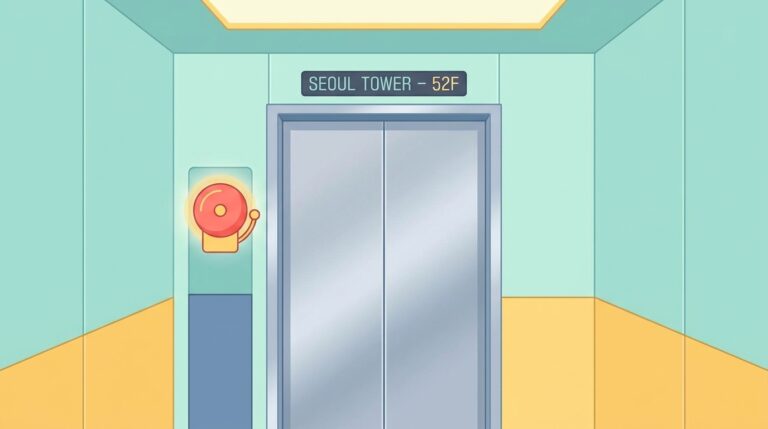
Phase 1: Empathy & Story-Driven Opening
안녕하세요! 매일한글 에디터입니다. (Hello! This is your Daily Hangul editor.)
Imagine this: You are descending from the 45th floor of a gleaming high-rise residential complex in Songdo or Yeouido after an intense business summit or a late-night gathering with friends. Suddenly, a jarring thud rattles the cabin, the floor drops half an inch, and everything halts dead in its tracks. The digital indicator flickers out, leaving only the dim amber glow of the auxiliary backup light. Your smartphone displays “No Service” inside the reinforced steel shaft.
In high-stress emergency situations, standard intermediate survival phrases like “도와주세요!” (Help me!) leave emergency operators in the dark about critical logistical details. When an elevator stalls in South Korea, clear, authoritative, and linguistically precise communication over the crackling intercom (비상통화장치) can slash response times from thirty minutes to under ten. Today, we delve into sophisticated C2-level crisis command protocols, teaching you how to articulate exact technical specifications, calm fellow passengers, and coordinate with Korea’s emergency response teams with unwavering poise.
Phase 2: Core Expressions Deep Dive (C2 Focus)
1. 엘리베이터가 급정거 후 멈춰 섰습니다. 승강기 고유번호를 확인해 드릴게요.
- Pronunciation: El-li-be-i-teo-ga geup-jeong-geo hu meom-chwo seot-seum-ni-da. Seung-gang-gi go-yu-beon-ho-reul hwa-gin-hae deu-ril-ge-yo. (Sounds like: El-lee-bay-tuh-gah goop-jung-guh hoo mum-chwo sut-neem-nee-dah. Seung-gahng-gee go-yoo-bun-ho-rool hwah-geen-hay deu-reel-gay-yo.)
- Meaning: “The elevator came to an abrupt halt and is immobilized. Let me read out the elevator ID number for you.”
- K-Culture Moment: You hear this steady, proactive tone in high-stakes corporate thrillers (Emergency Declaration or Stranger) when a seasoned protagonist takes charge during a municipal blackout.
- Editor’s Insight: Notice the lexical choice 급정거 (abrupt emergency stop) combined with 승강기 고유번호 (Elevator Unique Identification Number). In South Korea, every elevator has a unique 7-digit ID linked directly to the National Elevator Safety Information System. Giving this immediately pinpoints your exact GPS coordinates and building grid.
- Situation Spectrum: Casual 🚫 | Semi-formal ⚠️ | Formal ✅
- 🤔 Think About It: How does shifting from a passive victim stance (“We are trapped!”) to an analytical technical reporter stance change the psychological dynamic inside a confined crisis space?
2. 강제 개방을 시도하지 마시고, 구조대가 도착할 때까지 침착하게 대기해 주십시오.
- Pronunciation: Gang-je gae-bang-eul si-do-ha-ji ma-si-go, gu-jo-dae-ga do-chak-hal ttae-kka-ji chim-chak-ha-ge dae-gi-hae ju-sip-si-o.
- Meaning: “Please do not attempt forced door extraction; wait calmly until the rescue team arrives.”
- K-Culture Moment: The seasoned building manager broadcasting over the intercom or a calm resident soothing a panicking tourist.
- Editor’s Insight: The phrase utilizes high-register formal imperative ~시도하지 마시고 alongside 대기해 주십시오. It conveys authoritative crisis leadership, preventing dangerous civilian attempts to pry open outer shaft doors.
- Situation Spectrum: Casual 🚫 | Semi-formal ⚠️ | Formal ✅
- 🤔 Think About It: In Korean collectivist emergencies, leaders often use inclusive yet firm imperatives to prevent mass panic. How does your native language structure crisis authority?
3. 환풍 시설이 작동 중이며 질식의 위험은 없으니 심호흡을 하시기 바랍니다.
- Pronunciation: Hwan-pung si-seor-i jak-dong jung-i-myeo jil-sig-ui wi-heom-eun eop-seu-ni sim-ho-heub-eul ha-si-gi ba-ram-ni-da.
- Meaning: “The ventilation system is functioning and there is no danger of suffocation, so please practice deep breathing.”
- K-Culture Moment: Classic disaster survival film dialogue where safety personnel systematically debunk common entrapment myths.
- Editor’s Insight: 질식의 위험 (danger of suffocation) is the number one psychological trigger during cabin entrapment. Addressing this specific physiological fear with objective technical assurance restores immediate cabin stability.
- Situation Spectrum: Casual 🚫 | Semi-formal ⚠️ | Formal ✅
- 🤔 Think About It: Notice the causal connective -으며 / -(으)니. High-level Korean packs logistical reassurance and behavioral guidance into a single continuous stream.
Phase 3: Textbook Korean vs. Real Korean
Situation 1: Calling Dispatch on the Intercom
- 📖 교과서 한국어 (Textbook): “여보세요? 살려주세요! 문이 안 열려요!” (Yeo-bo-se-yo? Sal-lyeo-ju-se-yo! Mun-i an yeol-lyeo-yo! – “Hello? Save me! The door won’t open!”)
- 🗣️ 진짜 한국어 (Real Korean – C2): “비상통화 연결됐습니다. 승강기 갇힘 사고이고요, 승강기 번호 1234-567, 18층 부근에서 정지했습니다.” (Bi-sang-tong-hwa yeon-gyeol-dwaet-seum-ni-da. Seung-gang-gi gat-him sa-go-i-go-yo, seung-gang-gi beon-ho 1234-567, sip-pal-cheung bu-geun-e-seo jeong-ji-haet-seum-ni-da.)
- 💡 왜 다를까? (Why the difference?): Screaming emotional pleas wastes precious transmission bandwidth over crackling two-way analog intercoms. Advanced speakers open with a situational status header followed immediately by spatial coordinates.
Situation 2: Calming an Agitated Passenger
- 📖 교과서 한국어 (Textbook): “걱정하지 마세요. 괜찮아요.” (Geok-jeong-ha-ji ma-se-yo. Gwaen-chan-a-yo. – “Don’t worry. It is okay.”)
- 🗣️ 진짜 한국어 (Real Korean – C2): “추락 방지 안전장치가 이중으로 체결되어 있으니 안심하셔도 됩니다.” (Chu-rak bang-ji an-jeon-jang-chi-ga i-jung-eu-ro che-gyeol-doe-eo it-seu-ni an-sim-ha-syeo-do doem-ni-da.)
- 💡 왜 다를까? (Why the difference?): Vague comfort fails against claustrophobia. Specifying the physical failsafe (추락 방지 안전장치 / 이중 체결) grounds panicking individuals in empirical mechanical reality.
Phase 4: K-Culture Deep Dive & Non-Verbal Manners
4-1. Nunchi & Emergency Composure (눈치와 위기 대처)
In South Korea’s densely populated vertical architecture, elevator decorum is rooted in quiet mutual consideration. When an unexpected stall occurs, immediate vocal escalation or dramatic pounding on the door is considered counterproductive and disruptive (민폐).
* Body Language: Avoid crowding the intercom panel. Designate one articulate spokesperson while others step back to preserve spatial breathing room.
* Physical Stance: If the elevator exhibits sudden vibrational shifts, lean against the cabin wall with knees slightly flexed, holding the handrail (손잡이) firmly rather than standing dead-center.
4-2. Cultural Code: The 7-Digit National Elevator Safety Identification Grid
Look right above the control panel or above the cabin door. You will notice a rectangular metallic plate displaying a yellow or silver badge with a 7-digit number (승강기 고유번호). Established under the Korea Elevator Safety Agency (KoELSA), this system immediately dispatches the nearest 119 rescue squad with exact blueprints of the building’s hoistway layout.
Phase 5: Real-Life Roleplay Scenario
Setting: 9:45 PM. Inside an elevator in an office tower in Gangnam. The lift jerks and halts between the 14th and 15th floors. You press the yellow bell button (비상벨).
- 보안실 관제원 (Security Operator): “네, 방재실입니다. 비상벨 누르셨습니까? 비상 상황이신가요?” (Ne, bang-jae-sir-im-ni-da. Bi-sang-bel nu-reu-syeot-seum-ni-da? Bi-sang sang-hwang-i-sin-ga-yo?)
- You (Narrator):
🎭 [손잡이를 짚고 침착하고 명료한 톤으로]“네, 14층과 15층 사이에서 승강기가 덜컹거리며 완전 정지했습니다.” (Ne, sip-sa-cheung-gwa sip-o-cheung sa-i-e-seo seung-gang-gi-ga deol-keong-geo-ri-myeo wan-jeon jeong-ji-haet-seum-ni-da.) - 보안실 관제원: “탑승 인원 및 부상자 유무 확인 부탁드립니다.” (Tap-seung in-won mit bu-sang-ja yu-mu hwa-gin bu-tak-deu-rim-ni-da.)
- You: “성인 4명 탑승 중이며 외상자는 없습니다. 다만 호흡 곤란을 호소하는 분이 한 분 계십니다.” (Seong-in ne-myeong tap-seung jung-i-myeo oe-sang-ja-neun eop-seum-ni-da. Da-man ho-heub gon-ran-eul ho-so-ha-neun bun-i han bun gye-sim-ni-da.)
- 동승자 (Passenger):
🎭 [과호흡을 하며 문을 두드리려 함]“문 좀 열어봐요! 여기서 나가야 해요!” (Mun jom yeor-eo-bwa-yo! Yeo-gi-seo na-ga-ya hae-yo!) - You:
🎭 [동승자의 어깨를 부드럽게 제지하며]“선생님, 강제 개방 시 추락 위험이 있으니 문에서 한 걸음 물러서 계세요. 119 구조대가 즉각 출동 중입니다.” (Seon-saeng-nim, gang-je gae-bang si chu-rak wi-heom-i it-seu-ni mun-e-seo han geor-eum mul-leo-seo gye-se-yo. Il-il-gu gu-jo-dae-ga jeuk-gak chul-dong jung-im-ni-da.) - 보안실 관제원: “패널 상단 승강기 일련번호 7자리 불러주시겠습니까?” (Pae-neol sang-dan seung-gang-gi il-lyeon-beon-ho ilgop-ja-ri bul-leo-ju-si-get-seum-ni-da?)
- You: “네, 승강기 고유번호 0045-891 확인했습니다. 신속한 구조 요청드립니다.” (Ne, seung-gang-gi go-yu-beon-ho gong-gong-sa-o pal-gu-il hwa-gin-haet-seum-ni-da. Sin-so-khan gu-jo yo-cheong-deu-rim-ni-da.)
🔀 Interactive Branching Choice:
The passenger insists on wedging their fingers between the door seals to pry it open. What is your response?
* Option A: “열릴 수도 있으니 같이 힘을 줘서 문을 벌려봅시다.” (Let’s help force it open together.)
* Option B: “비상 정지된 상태에서 도어를 개방하면 승강로 추락 사고로 이어집니다. 손잡이를 잡고 자세를 낮추세요.” (Forcing the door during an emergency stop triggers shaft falls. Hold the handrail and lower your posture.)
* Option C: “그냥 가만히 계세요. 시끄럽습니다.” (Just stay still. You are being too loud.)
Feedback:
* Option A [BAD / FATAL RISK]: Forcing elevator doors in an unaligned floor position (단차 구간) exposes passengers to hoistway shear hazards.
* Option B [BEST]: C2-level crisis command that clearly identifies structural hazards while giving actionable safety posture instructions.
* Option C [POOR NUNCHI]: Heightens interpersonal friction and spikes cabin panic levels during confined emergencies.
Phase 6: 10-Second Emotion Shadowing Drill
Practice these lines using precise micro-pauses (/) and dynamic vocal control:
[🚨 단호하고 명료하게 / Firm and Authoritative]
“현재 승강기 멈춤 사고 발생 / 승강기 번호 8492-103 / 탑승객 3명 전원 무사합니다.”
(Hyeon-jae seung-gang-gi meom-chum sa-go bal-saeng / seung-gang-gi beon-ho pal-sa-gu-i il-gong-sam / tap-seung-gaek se-myeong jeon-won mu-sa-ham-ni-da.)-
[🤝 차분하고 진정시키는 톤 / Soothing and Reassuring]
“승강기 와이어는 다중 안전 설계가 되어 있으니 / 동요하지 마시고 / 벽면에 기대어 대기해 주세요.”
(Seung-gang-gi wa-i-eo-neun da-jung an-jeon seol-gye-ga doe-eo it-seu-ni / dong-yo-ha-ji ma-si-go / byeok-myeon-e gi-dae-eo dae-gi-hae ju-se-yo.)
Phase 7: K-Culture Mini Dictionary
- 승강기안전종합정보망 (Elevator Safety Comprehensive Information Network) | Seung-gang-gi-an-jeon-jong-hap-jeong-bo-mang
- Definition: The national real-time cloud registry linking all 7-digit elevator codes directly to 119 and certified maintenance technicians.
- 비상통화장치 (Emergency Intercom System) | Bi-sang-tong-hwa-jang-chi
- Definition: The two-way intercom that connects directly to the management office, or automatically reroutes to an external monitoring center after 30 seconds if unanswered.
- 과호흡 증후군 (Hyperventilation Syndrome) | Gwa-ho-heub jeung-hu-gun
- Definition: A common rapid-breathing panic symptom in confined spaces; vital for informing dispatchers about trapped passengers’ medical states.
- 수동 개방 (Manual Key Extraction / Release) | Su-dong gae-bang
- Definition: The specialized mechanical process performed exclusively by 119 rescue crews using triangular keys to release door latches safely.
Phase 8: Traveler’s Survival Kit
Top 3 Immediate Survival Phrases
- “승강기 비상벨 눌렀습니다. 통화 버튼 계속 누르고 계세요.”
(Bi-sang-bel nul-leot-seum-ni-da. Tong-hwa beon-teun gye-sok nu-reu-go gye-se-yo.)
Pro Tip: Older intercoms require pressing and holding the yellow button while speaking. - “외부에서 문을 강제로 젖히시면 안 됩니다!”
(Oe-bu-e-seo mun-eul gang-je-ro jeot-hi-si-myeon an doem-ni-da!)
Pro Tip: Shouted to well-meaning outsiders attempting dangerous pry rescues from the hallway. - “휴대폰 전파가 잡히지 않아 비상 인터폰으로만 통신 가능합니다.”
(Hyu-dae-pon jeon-pa-ga jap-hi-ji an-a bi-sang in-teo-pon-eu-ro-man tong-sin ga-neung-ham-ni-da.)
Editor’s Travel & Emergency Note
Make sure to have the official Emergency Ready App (안전디딤돌) downloaded on your device. It works in multi-language modes across all Korean telecom networks to provide offline disaster guides and immediate 119 location pings.
Phase 9: Stepping Stones (Deep Reflection)
In South Korean high-density metro life, safety resilience is deeply communal. When an infrastructure glitch strikes, individual stoicism combined with clear reporting is seen as an act of public care. By mastering accurate procedural vocabulary rather than generic panicky Korean, you actively preserve social composure in high-stakes environments.
💬 Your Turn: Have you ever experienced an elevator failure in your home country or while traveling? What was the first instinctual phrase you uttered, and how would you convey that in C2 Korean now? Share in the comments below!
Phase 10: FAQ & Common Pitfalls
Q: What if no one answers the emergency intercom button inside the elevator?
A: Keep pressing the button. In South Korea, by law, if the building security desk does not answer within 30 to 45 seconds, the system auto-forwards the emergency line directly to an external 24-hour elevator maintenance agency or regional 119 dispatch center.
Q: Can an elevator run out of oxygen if trapped for a few hours?
A: No. Korean elevator safety codes mandate natural upper/lower hoistway ventilation grilles. Announce clearly to other passengers: “환기구가 확보되어 있어 산소가 부족하지 않습니다.” (Ventilation is secured; oxygen will not run out).
Q: What if the elevator is pitch black and I cannot see the 7-digit ID code?
A: Use your smartphone flashlight to illuminate the panel border. If completely unreadable, state the exact building name, road address (도로명 주소), and estimated floor gap.
🚨 Common Mistakes Checklist
- ❌ Mistake 1: Jumping repeatedly to trigger floor sensors. -> Correct Action: Maintain a steady stance against the back wall.
- ❌ Mistake 2: Shouting vague floor approximations like “위층이에요!” (It’s an upper floor!). -> Correct Action: Report estimated floor markers: “12층과 13층 경계 지점입니다.”
- ❌ Mistake 3: Letting go of the intercom button while speaking on older analog models. -> Correct Action: Press and hold until you finish your complete sentence.
Phase 11: Action Missions
- 🥉 Bronze Mission: Locate the 7-digit
승강기 고유번호in the next elevator you enter today and read it out loud in Korean using Sino-Korean numbering. - 🥈 Silver Mission: Record yourself shadow-drilling Phase 6 with the authoritative tone of an emergency crisis leader.
- 🥇 Gold Mission: Write down a mock 119 crisis dispatch report paragraph describing an elevator stall scenario using 5 advanced terms from Phase 7.
- 🎮 K-Culture Challenge: Watch a scene from a disaster K-drama (like Sweet Home or Exit) and spot whether the characters adhere to correct elevator emergency protocol.
Phase 12: Interactive Quiz Challenge
Q1. When reporting an elevator entrapment over the intercom, what is the single most efficient piece of information to provide first?
A) The names and ages of all passengers
B) The 7-digit 승강기 고유번호 (Elevator ID Number)
C) The elevator brand manufacturer
D) What time you entered the building
👉 Click to view Answer & Explanation
Correct Answer: B
Explanation: The 7-digit elevator ID immediately pulls up the building’s precise blueprint, floor layout, and address on the National Elevator Safety Information System, enabling instant 119 and technician dispatch.
Q2. Fill in the blank with the appropriate C2-level term:
“비상 상황 발생 시 문을 억지로 여는 ______ 개방을 절대 시도하지 마십시오.”
(In an emergency, never attempt forced extraction by prying open the doors.)
👉 Click to view Answer & Explanation
Correct Answer: 강제 (Forced / Compulsory -> 강제 개방 = Forced opening/extraction).
Q3. True or False:
If an elevator suddenly stops between floors, you should immediately pound on the ceiling hatch and attempt to climb out onto the roof of the elevator cab.
👉 Click to view Answer & Explanation
Correct Answer: False (F)
Explanation: Modern elevator escape hatches are locked from the exterior for passenger safety. Exiting the cabin roof puts civilians at risk of high-voltage shock and counterweight collision. Always wait inside for professional rescue squads.







