

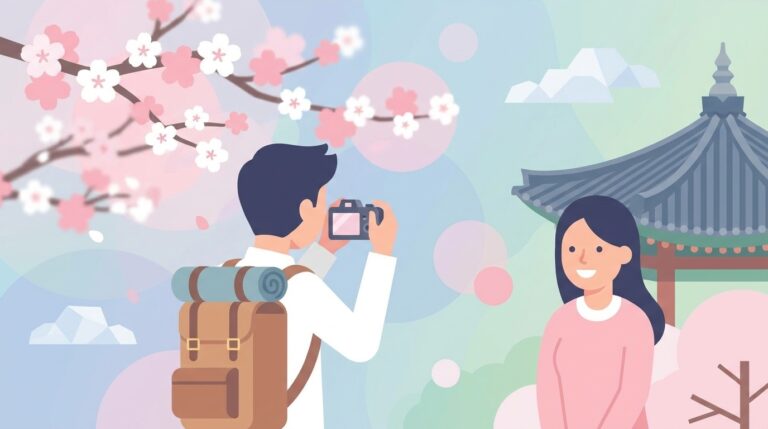
Mastering Korean Portrait Photography: How to Ask for the Perfect Bokeh and ‘Life Shots’
Phase 1: Empathy (Story-Driven Opening)
안녕하세요! 매일한글 에디터입니다. (Hello! This is your Daily Hangul editor.)
Picture this: You are standing under a breathtaking canopy of cherry blossoms at Yeouido Park or against the retro neon alleys of Euljiro (Hipjiro). You’ve dressed in your trendiest K-fashion outfit, the golden hour lighting is heavenly, and you hand your phone or mirrorless camera to a friendly Korean passerby or a friend. You want that dreamy, cinematic look where you pop crisply in the foreground while the bustling crowd and background melt into soft, creamy circles of light—what photographers call bokeh, or what Koreans universally call ‘아웃포커싱’ (out-focusing).
Instead, you get a photo where the focus accidentally locks onto a delivery scooter behind your left ear, or worse, everything is so tack-sharp that you blend entirely into the brick wall behind you! You try saying “Please blur the back!” in textbook Korean, but it sounds like a literal translation from a 1995 manual.
Capturing an 인생샷 (insaeng-shot / the photograph of a lifetime) in Korea isn’t just about good lighting—it’s about knowing the exact, culturally attuned, nuanced Korean terminology to guide the photographer. Based on feedback from hundreds of advanced Korean learners who love photography and aesthetic café hopping, this guide is designed to elevate your Korean expression to a sophisticated C1 level so you can direct and shoot professional-tier portraits effortlessly.
Phase 2: Core 3 Expressions In-Depth
1. 배경을 확 날려주세요 (한글)
- Pronunciation: [Bae-gyeong-eul hwak nal-lyeo-ju-se-yo] (Sounds like: bay-gyung-eul hwak nahl-lyuh-joo-seh-yo — ‘hwak’ sounds like a sudden gust of wind, ‘whack’)
- Meaning: Literal: “Please blow away the background completely.” / Nuance: “Please heavily blur/defocus the background so the subject pops cleanly.”
- K-Culture Moment: Frequently heard during outdoor K-pop idol concept shoots and aesthetic vlog tutorials when YouTubers ask their cameramen to isolate the idol from distracting fans or messy backgrounds.
- Editor’s Insight: The verb ‘날리다’ literally means ‘to fly’ or ‘to blow away’, but in colloquial photography Korean, it vividly describes obliterating background clutter into smooth bokeh.
- Situation Spectrum: Casual (배경 확 날려줘) ✅ | Semi-formal (배경 확 날려주세요) ✅ | Formal (배경 심도를 얕게 처리해 주십시오) ⚠️
- 🤔 Think About It: Notice how Korean uses dynamic action verbs (‘날리다’ – to blow away) rather than static descriptive adjectives (‘흐리게 하다’ – to make blurry) to convey photographic depth. What does this reveal about Korean speakers’ preference for punchy, sensory imagery?
2. 인물 모드로 심도 좀 얕게 잡아봐 (한글)
- Pronunciation: [In-mul mo-deu-ro sim-do jom yat-ge ja-ba-bwa] (Sounds like: in-mool mo-deu-ro sheem-doh johm yaht-gay jah-bah-bwah)
- Meaning: Literal: “Try holding the depth shallow in portrait mode.” / Nuance: “Switch to portrait mode and give it a shallow depth of field.”
- K-Culture Moment: Seen constantly in youth K-dramas when couples take photos for each other at scenic Han River parks or trendy Seongsu-dong pop-up stores.
- Editor’s Insight: ‘심도’ (depth of field) is technical, but pairing it with ‘얕게 잡다’ (to frame/capture shallowly) demonstrates C1-level fluency, striking the sweet spot between professional knowledge and natural colloquial flow.
- Situation Spectrum: Casual (심도 얕게 잡아봐) ✅ | Semi-formal (심도 좀 얕게 잡아주실래요?) ✅ | Formal (심도를 얕게 조절해 주시기 바랍니다) 🚫
- 🤔 Think About It: In your native language, do everyday smartphone users casually discuss optical principles like depth of field, or is it strictly reserved for professional gear?
3. 피사체랑 배경 거리 좀 띄워줘 (한글)
- Pronunciation: [Pi-sa-che-rang bae-gyeong geo-ri jom tti-wo-jwo] (Sounds like: pee-sah-chay-rahng bay-gyung guh-ree johm ddee-woh-jwoh)
- Meaning: Literal: “Please space out the distance between the subject and background a bit.” / Nuance: “Create more physical separation between me and the backdrop to maximize the out-of-focus effect.”
- K-Culture Moment: The standard golden rule uttered by visual directors and Instagram photography influencers across Seoul to maximize natural optical bokeh without digital artifacts.
- Editor’s Insight: ‘피사체’ (photographic subject) elevates your conversation instantly. Asking to ‘거리 띄우다’ (create physical separation) solves the technical root cause of stiff portrait photos.
- Situation Spectrum: Casual (거리 좀 띄워줘) ✅ | Semi-formal (거리 좀 띄워주세요) ✅ | Formal (피사체와 배경 간격을 유지해 주십시오) ⚠️
Phase 3: Textbook Korean vs. Real Korean
Situation 1: Asking someone to focus on you while blurring the scenery
- 📖 교과서 한국어 (Textbook): “초점을 저에게 맞추고 뒷배경을 흐리게 찍어 주시겠습니까?” (Would you take a photo by setting the focus on me and making the background blurry?)
- 🗣️ 진짜 한국어 (Real Native C1): “저한테 초점 딱 맞추고, 배경은 감성 있게 싹 날려주세요!” (Lock the focus right on me, and blur the entire background with an aesthetic vibe!)
- 💡 왜 다를까? (Why the difference?): Koreans rarely say “뒷배경을 흐리게 하다” in casual conversation; adverbs like ‘싹’ (completely/cleanly) combined with ‘날리다’ sound far more intuitive, stylish, and lively.
Situation 2: Adjusting the aperture on a dedicated camera
- 📖 교과서 한국어 (Textbook): “조리개 수치를 낮추어서 촬영하도록 하겠습니다.” (I will proceed with the shoot by lowering the aperture numerical value.)
- 🗣️ 진짜 한국어 (Real Native C1): “조리개 최대로 개방해서 보케 예쁘게 살려볼게요.” (Let me open the aperture wide up to really bring out that pretty bokeh.)
- 💡 왜 다를까? (Why the difference?): In real creative contexts, Korean creatives use camera-native idioms like ‘조리개 개방’ (wide-open aperture) and ‘보케를 살리다’ (accentuate/bring bokeh to life).
Phase 4: K-Culture Deep Dive & Non-Verbal Etiquette
4-1. Nunchi (눈치) & Camera Etiquette in Korea
When taking portraits in public spots in Korea (e.g., Bukchon Hanok Village or trendy cafes in Ikseon-dong):
* The Foot-to-Frame Rule: When handing your phone to someone, politely indicate the bottom edge framing by tapping your lower screen and gesturing toward your feet. Koreans take pride in framing portraits so that the subject’s feet align near the bottom edge, making legs look naturally longer.
* Burst Shots & Silent Consideration: Korean phone cameras make a distinct shutter sound by law to prevent illicit photography. When shooting someone, holding down burst mode in quiet galleries or cozy cafes is frowned upon. Give a subtle head nod, take 3–4 deliberate, well-framed shots, and say “확인해 보실래요?” (Would you like to check?).
4-2. Cultural Code: The ‘Insaeng-shot’ (인생샷) Culture
In South Korea, taking high-quality photos isn’t seen as vanity; it is an act of shared social care and hospitality. If a friend asks you to take a photo, crouching down or finding optimal light angles is standard social courtesy. Understanding how to control depth of field (아웃포커싱) instantly marks you as a considerate, skilled companion.
Phase 5: Interactive Roleplay Scenario
Setting: An aesthetic café terrace in Samcheong-dong filled with autumn foliage.
Characters: Minji (민지) – An Instagram enthusiast friend with a DSLR/latest iPhone; Alex (알렉스) – An advanced Korean learner aiming for a pristine editorial portrait.
- Turn 1 (Minji): “알렉스, 여기 단풍 배경 진짜 예쁘다! 의자에 앉아봐, 내가 한 장 찍어줄게.” (Alex, the autumn foliage here is gorgeous! Sit on the chair, let me take a picture for you.)
🎭 [카메라를 들며 신나게 손짓한다] - Turn 2 (Alex): “고마워 민지야! 저 뒤에 지나가는 사람들 안 나오게 배경 확 날려줄 수 있어?” (Thanks, Minji! Could you blur out the background completely so the passersby behind don’t show up?)
🎭 [미소를 지으며 자연스러운 포즈를 잡는다] - Turn 3 (Minji): “인물 모드로 찍을 거긴 한데, 지금 벽이랑 너무 가까워서 보케가 잘 안 먹혀.” (I’m using portrait mode, but you’re too close to the wall right now, so the bokeh effect isn’t taking well.)
🎭 [화면을 찌푸려 확인하며 고개를 갸웃거린다] - Turn 4 (Alex): “아, 심도 때문이지? 그럼 내가 테이블 앞쪽으로 한 걸음 더 나올게.” (Ah, because of the depth of field, right? Then I’ll step forward toward the front of the table.)
🎭 [의자를 살짝 앞으로 당겨 앉는다] - Turn 5 (Minji): “오, 딱 좋아! 피사체랑 배경 거리 벌어지니까 인물이 훨씬 또렷하게 산다.” (Oh, perfect! Now that there’s distance between the subject and background, you stand out much more sharply.)
🎭 [구도를 잡으며 엄지를 치켜세운다] - Turn 6 (Alex): “상반신 위주로 잡고, 머리 위 여백(헤드룸) 살짝만 남겨줘!” (Focus primarily on my upper body, and leave just a little headroom above!)
🎭 [시선을 45도 각도로 자연스럽게 돌린다] - Turn 7 (Minji): “하나, 둘, 셋! 찰칵. 와… 진짜 잡지 화보처럼 나왔어. 인생샷 건졌다!” (One, two, three! Click. Wow… this looks like a genuine magazine pictorial. We got your photo of a lifetime!)
🎭 [감탄하며 화면을 바로 보여준다] - Turn 8 (Alex): “대박! 아웃포커싱 완벽하다. 민지 사진 실력 인정!” (Awesome! The out-focusing is flawless. I acknowledge your photo skills, Minji!)
🎭 [박수를 치며 감탄한다]
🔀 Interactive Choice Point
How would you ask a passerby to take another photo with shallower depth of field?
* Option A: “저기요, 조리개를 1.4로 낮추고 광각 렌즈 왜곡 없이 찍어주세요.”
* Option B: “죄송하지만 인물 모드로 저한테 초점 맞춰서 한 장만 부탁드려도 될까요?”
* Option C: “사진 흐리게 해주세요, 사람 안 보이게.”
- Feedback:
- Option A (Risk): Overly technical and pedantic. Passersby may feel pressured or confused by specialized jargon.
- Option B (Best ✅): Polite, concise, and clearly communicates the exact technical mode (‘인물 모드’) without overwhelming the stranger.
- Option C (Bad): Grammatically unnatural and ambiguous; sounds like you want the entire photo blurry.
Phase 6: 10-Second Emotion Shadowing Drill
Read aloud with the exact pausing (/) and emotional tone indicators:
[😊 열정적이고 자신감 넘치게]“저한테 초점 딱 맞추고 / 배경은 감성 있게 / 싹 날려주세요!”[💡 꿀팁을 전수하듯 차분하게]“피사체랑 배경 사이를 / 2미터 이상 띄워야 / 보케가 몽환적으로 나와요.”[🤩 완성작을 보고 감탄하며]“와, 심도 얕게 잡으니까 / 인물이 완전 입체적으로 살아나네!”
Phase 7: K-Culture Mini Dictionary
- 인생샷 (In-saeng-shot) | The Best Photo of One’s Life | A snapshot so visually stunning and flattering that it becomes your definitive profile picture for years.
- 아웃포커싱 (Out-po-keo-sing) | Bokeh / Shallow Depth of Field | The Konglish standard term used universally in Korea for optical or simulated background blur.
- 배경 날리기 (Bae-gyeong Nal-li-gi) | Background Defocusing / Separation | The colloquial action of blowing out busy background elements to emphasize the primary subject.
- 누끼 따다 (Nuk-ki Tta-da) | Isolating Subject / Background Removal | Originating from Japanese graphic arts, commonly used in modern Korean studio culture to refer to razor-sharp edge separation of the subject.
Phase 8: Traveler’s Survival Kit
Top 3 Photo Survival Expressions
- “전신 나오게 세로로 찍어주세요.” (Jeon-sin na-o-ge se-ro-ro jji-geo-ju-se-yo) — “Please take a full-body vertical shot.”
- Pro Tip: Koreans prefer vertical framing for smartphone wallpaper and Instagram reels.
- “배경 흐리게 하는 모드 켜져 있나요?” (Bae-gyeong heu-ri-ge ha-neun mo-deu kyeo-jyeo in-na-yo?) — “Is the portrait/background-blur mode turned on?”
- “수평만 살짝 맞춰주시면 감사하겠습니다.” (Su-pyeong-man sal-jjak mat-chwo-ju-si-myeon gam-sa-ha-get-seum-ni-da) — “I’d appreciate it if you could just keep the horizon level.”
Editor’s Travel Note
Before heading out to famous photo landmarks like Namsan Seoul Tower or Gyeongbokgung Palace, download the Naver Map Navigation App to search for nearby ‘포토존’ (Photo Zones) marked by local visitors. Remember, when taking photos in traditional tea houses or metro stations, make sure tripods don’t obstruct public pathways.
Phase 9: A Step Deeper (한 발 더 깊이)
In Korean society, the collective enthusiasm for capturing the insaeng-shot reflects a broader cultural concept: honoring the shared moment (추억 남기기). Taking time to adjust lighting, posture, and depth of field for someone is viewed as an affectionate gesture of validation. Photography in modern Korea is not merely technical recording; it is a shared emotional language.
💬 Your Turn: What is your go-to camera setting when taking portraits for your friends? Have you ever tried asking for a portrait in Korean? Let us know in the comments below!
Phase 10: FAQ & Common Mistakes
Q: Why do Koreans say ‘아웃포커싱’ instead of ‘보케 (Bokeh)’ or ‘심도 (Depth)’?
A: While professional cinematographers use ‘보케’ (bokeh) and ‘피사계 심도’ (depth of field), ‘아웃포커싱’ (out-focusing) entered Korean vernacular early through camera marketing and remains the most intuitive word for everyday smartphone users.
Q: How do I tell someone that the simulated portrait blur looks too artificial?
A: You can say: “블러 처리가 살짝 부자연스러워서, 기본 모드로 다시 찍어볼게요.” (The blur looks a bit unnatural, so let me try shooting in standard mode again.)
Q: Is it rude to ask a stranger to retake a photo?
A: Not if done politely! Smile warmly and say: “죄송한데, 햇빛 때문에 눈을 감아서 한 장만 더 부탁드려도 될까요?” (I’m sorry, but I blinked due to the sunlight—could you take just one more, please?).
🚨 Common Mistakes Alert
- Mistake: Saying “사진을 흐리게 찍어주세요” without specifying the background.
- Risk: The photographer might think your camera lens is smudged or purposely lower the overall shutter sharpness.
- Correct Action: Explicitly mention 배경 (background): “배경만 날려주세요.”
- Mistake: Standing glued against a flat wall expecting natural bokeh.
- Correct Action: Tell your partner: “벽에서 1미터만 앞으로 나와볼게요.” (Let me step 1 meter away from the wall).
- Mistake: Placing the subject’s face at the very top edge with excessive empty ground space.
- Correct Action: Keep headroom balanced: “발끝 맞추고 상단 여백 조금만 남겨주세요.”
Phase 11: Action Mission
- 🥉 Bronze Mission (Solo Practice): Switch your smartphone to portrait mode. Practice saying “배경을 확 날려보자!” out loud 5 times while adjusting the f-stop slider.
- 🥈 Silver Mission (Social Share): Post a portrait photo on your Instagram story with the caption: “오늘의 인생샷, 배경 확 날리기 성공! 📸”
- 🥇 Gold Mission (Real-life Execution): Visit a local cafe or landmark, hand your camera to a Korean speaker, and naturally use the phrase “저한테 초점 맞추고 배경 심도 좀 얕게 부탁드려요!”
- 🎮 K-Culture Mission: Watch any recent Korean travel vlog (e.g., on YouTube) and spot how many times the creator says “인생샷” or “날리다”.
Phase 12: Interactive Quiz Challenge
1. [Situational Judgment] You want to take a portrait in a crowded market without the crowd being distracting. Which phrase is most natural and polite to say to your Korean friend?
* (A) 배경에 사람 많으니까 배경 싹 날려줘!
* (B) 사람들을 삭제해 주세요.
* (C) 초점을 완전히 없애버리세요.
2. [Fill in the Blank] Fill in the missing technical verb particle:
“보케 효과를 극대화하려면 피사체와 배경 거리를 많이 ( _________ ) 합니다.”
3. [True / False] In Korean photography slang, ‘배경을 날리다’ means to accidentally delete the background image file on your computer.
🔍 Click here to reveal Answers & Explanations
- Answer: (A) — “배경 싹 날려줘!” is the idiomatic native way to request strong background blur to mask crowds.
- Answer: 띄워야 / 벌려야 — Both 거리(를) 띄우다 and 거리(를) 벌리다 denote increasing the physical separation between subject and backdrop.
- Answer: False — ‘배경을 날리다’ means intentionally defocusing/blurring the background into smooth bokeh, not deleting files!






