

Mastering the Subtle Art of Priority Seating in Korea: Social Nuance, Nunchi, and Fluency
Phase 1: Empathy & Immersion
안녕하세요! This is your Daily Hangul editor.
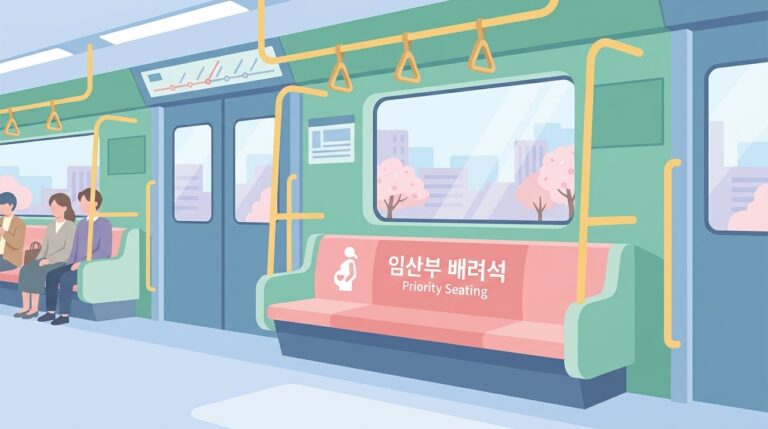
Imagine stepping onto a packed Seoul Metro Line 2 train during peak morning rush hour. Commuters are pressed shoulder-to-shoulder, the carriage is dead silent except for the rhythmic hum of the tracks, and your legs are burning after a 40-minute transfer. Suddenly, you spot it: an empty magenta seat illuminated by the morning sun, adorned with a gentle silhouette badge—the 임산부 배려석 (Pregnant Women Priority Seat). Right at the end of the carriage, another trio of seats sits completely vacant, even though dozens of exhausted salarymen are standing right in front of them.
For advanced learners and long-term expats, public transport in Korea is far more than a transit system; it is a high-stakes arena of unspoken collective ethics, acute situational awareness (nunchi), and generational respect. Have you ever wondered whether sitting down and giving up your seat later is acceptable, or why stepping onto the wrong seat feels like stepping on an invisible societal tripwire?
Today, we dissect the linguistic mastery and deep sociocultural dynamics governing Korea’s priority seating culture (교통약자석 배려 문화). Based on feedback from our C2-level alumni navigating corporate and daily life in Seoul, this guide will equip you to handle these sensitive interactions with utmost cultural tact, authentic honorific fluidity, and native-level grace.
Phase 2: Core Expressions Deep Dive
1. 여기 앉으세요, 제가 곧 내리거든요. (Yeogi anjeuseyo, jega got naerigeodeunyo.)
- Pronunciation: [Yeo-gi an-jeu-se-yo, je-ga got nae-ri-geo-dun-yo] (Sounds like: “Yaw-ghee ahn-jeu-seh-yo, jeh-gah goht neh-ree-gaw-doon-yo”)
- Meaning: Literal: “Sit here, because I get off soon.” | Real Nuance: A polite, face-saving offer to vacate your seat without making the other person feel indebted or noticeably frail.
- K-Culture Moment: Seen frequently in slice-of-life K-dramas (like My Liberation Notes or Hospital Playlist), where an observant protagonist gives up their seat to an elderly person or visibly exhausted commuter while casually walking toward the exit door to minimize awkwardness.
- Editor’s Insight: Koreans often experience 부담 (psychological burden/imposition) when offered special treatment. By white-lying that your stop is imminent, you eliminate their guilt of displacing you.
- Situation Spectrum: Casual: ⚠️ | Semi-formal: ✅ | Formal: ✅
- 🤔 Think About It: How does this polite deception compare to seat-offering customs in your home culture? Is directness valued over saving the recipient’s face?
2. 혹시 몸이 불편하시면 이쪽에 편히 앉으세요. (Hoksi mom-i bulpyeonhasimyeon ijjoge pyeonhi anjeuseyo.)
- Pronunciation: [Hok-si mo-mi bul-pyeon-ha-si-myeon ee-jjo-ge pyeon-hee an-jeu-se-yo] (Sounds like: “Hohk-shee moh-mee bool-pyawn-hah-shee-myawn ee-jjoh-geh pyawn-hee ahn-jeu-seh-yo”)
- Meaning: Literal: “By any chance, if your body feels uncomfortable, sit comfortably over here.” | Real Nuance: An impeccably refined, indirect way to offer a seat to someone who may have an invisible disability, early-stage pregnancy, or sudden illness without bluntly pointing it out.
- K-Culture Moment: The standard high-register interaction in sophisticated office dramas when a junior colleague notices a senior or client feeling under the weather during a company transit trip.
- Editor’s Insight: Notice the subjective conditional marker -시- combined with 혹시 (by chance). This softens the presumption entirely, adhering to Korea’s high-context politeness principles.
- Situation Spectrum: Casual: 🚫 | Semi-formal: ✅ | Formal: ✅
- 🤔 Think About It: What linguistic strategies does your language use to accommodate someone without explicitly labeling their physical vulnerability?
3. 비워두는 게 원칙이자 일종의 사회적 약속이죠. (Biwoduneun ge wonchig-ija iljong-ui sahoejeok yaksog-ijyo.)
- Pronunciation: [Bi-wo-du-neun ge won-chi-gi-ja il-jong-eui sa-hoe-jeok yak-so-gi-jyo] (Sounds like: “Bee-woh-doo-neun geh won-cheeg-ee-jah eel-jong-eh sah-hweh-jawk yahk-soh-gee-jyoh”)
- Meaning: Literal: “Leaving it empty is the principle and a kind of social promise.” | Real Nuance: A philosophically articulate statement explaining why certain priority seats (especially the pink seats) remain untouched even during peak congestion.
- K-Culture Moment: Typical line delivered by public policy commentators, intellectuals, or articulate lead characters in current affairs documentaries and social discourse podcasts.
- Editor’s Insight: Using compound connectors (-이자) and sociological terminology (사회적 약속) demonstrates mastery of advanced public discourse registers in Korean.
- Situation Spectrum: Casual: ⚠️ | Semi-formal: ✅ | Formal: ✅
- 🤔 Think About It: Is public space viewed primarily as utilitarian efficiency (fill every seat) or symbolic mutual respect in your society?
Phase 3: Textbook Korean vs. Real Korean
Situation 1: Offering your seat to an elderly passenger on the subway
- 📖 교과서 한국어: “할아버지, 여기 앉으십시오. 제가 자리를 양보하겠습니다.” (Grandfather, please sit here. I will yield my seat.)
- 🗣️ 진짜 한국어: “어르신, 여기 앉으세요. 저 금방 내려요.” (Honored elder, please have a seat here. I’m getting off right away.)
- 💡 왜 다를까?: Textbook formulas rely on outdated imperatives like 앉으십시오 and clinical vocabulary like 양보하다. Real Korean speakers use the respectful term 어르신 (rather than assuming familial titles like 할아버지 with strangers) and accompany it with a polite white lie (저 금방 내려요) to ease the social friction.
Situation 2: Discussing why pink seats remain empty during rush hour
- 📖 교과서 한국어: “임산부 배려석은 임산부를 위한 자리이므로 앉으면 안 됩니다.” (Because the pregnant women priority seat is for pregnant women, you must not sit.)
- 🗣️ 진짜 한국어: “초기 임산부는 겉으로 티가 잘 안 나잖아요. 눈치 안 보고 편하게 앉으실 수 있게 그냥 비워두는 분위기예요.” (Early-stage pregnant women aren’t visibly noticeable on the outside. The consensus is simply to leave it vacant so they can sit comfortably without feeling self-conscious.)
- 💡 왜 다를까?: Native speakers understand that the core rationale behind keeping pink seats empty is psychological safety (눈치 안 보고), acknowledging the reality of non-visible early pregnancies rather than just quoting transport regulations.
Phase 4: K-Culture Deep Dive & Non-Verbal Manners
4-1. 눈치 (Nunchi) & Non-Verbal Gestures
In Korean transit spaces, the physical action of yielding a seat involves a nuanced choreography of body language:
* The Discreet Stood-Up Step: When offering a seat to an elder standing in front of you, avoid dramatic gestures or loud announcements. Make gentle eye contact, give a slight bow (15 degrees), motion toward the cushion with an open palm facing upward (never point fingers), and immediately step back toward the doors.
* Gaze Direction at the Pink Seat: If you are standing directly in front of the pink seat, keep your smartphone at mid-chest level or avert your eyes toward the overhead digital displays. Staring intently down at someone seated in the priority spot can be perceived as passive-aggressive pressure.
* Badge Awareness (임산부 배려 뱃지): Look out for the pink round keyring attached to bags. If you spot one, stand up quietly without drawing carriage-wide attention.
4-2. Cultural Code Analysis: The Evolution of Public Consideration
In contemporary Korea, priority seating represents a fascinating clash between traditional Confucian filial piety (효/경로사상) and modern individual privacy. While the corner seats (교통약자석) have long been guarded by older generations, the introduction of the pink 임산부 배려석 sparked widespread discourse on public etiquette. Today’s consensus—reflected across modern K-media and public campaigns—is centered on “preemptive consideration” (선제적 배려): creating an environment where vulnerable passengers never have to ask or feel uncomfortable taking their rightful space.
Phase 5: Real-Life Roleplay Scenario
Setting: A bustling Line 4 train heading toward Dongdaemun History & Culture Park station during evening rush hour. You are standing near the priority seats holding the handrail.
Characters:
* You (C2 Korean Learner): Observant and culturally fluent commuter.
* 어르신 (Elderly commuter, 70s): Carrying heavy grocery bags, balancing carefully on the train.
Turn 1 [어르신]: (지하철이 덜컹거리자 손잡이를 꽉 잡으며 가쁜 숨을 몰아쉰다) 에고, 오늘따라 사람이 참 많네...
Turn 1 [Translation]: (Holding the handrail tight as the train rattles, catching breath) Oh dear, there are especially so many people today...

Turn 2 [You]: 🎭 [조심스럽게 눈을 마주치며 한 손으로 빈 좌석을 가리킨다] 어르신, 이쪽으로 오셔서 편히 앉으세요.
Turn 2 [Translation]: [Carefully making eye contact and gesturing toward the vacant seat with an open palm] Sir/Ma'am, please come over here and sit comfortably.

Turn 3 [어르신]: 🎭 [손사래를 치며 미안한 표정을 짓는다] 아이고, 젊은이도 피곤할 텐데 괜찮아. 그냥 서서 가도 돼.
Turn 3 [Translation]: [Waving hands dismissively with an apologetic expression] Oh my, the young person must be tired too, it's alright. I can just stand.

Turn 4 [You]: 🎭 [부드러운 미소를 띠며 문 쪽으로 반 걸음 물러선다] 아닙니다. 저 어차피 다음 정거장에서 갈아타야 해서요. 여기 짐도 내려놓으세요.
Turn 4 [Translation]: [With a gentle smile, taking half a step back toward the door] Not at all. I have to transfer at the next stop anyway. You can set your bags down here too.

Turn 5 [어르신]: 🎭 [환하게 웃으며 자리에 앉는다] 아이구, 고마워요. 말이라도 참 살갑게 잘하네. 한국말을 어쩌면 이렇게 유창하게 해?
Turn 5 [Translation]: [Smiling brightly and sitting down] Oh, thank you. You speak so warmly and kindly. How do you speak Korean so fluently?

Turn 6 [You]: 🎭 [가볍게 목례하며 화답한다] 좋게 봐주셔서 감사합니다. 비 오는 날인데 조심히 들어가세요.
Turn 6 [Translation]: [Bowing head lightly in response] Thank you for your kind words. It's a rainy day, so please get home safely.

Turn 7 [어르신]: 🎭 [가방에서 사탕 하나를 꺼내 건네며] 이거 하나 먹어요. 복 받을 거야, 젊은이.
Turn 7 [Translation]: [Taking out a candy from the bag and handing it over] Have one of these. Blessings will come to you, young one.

Turn 8 [You]: 🎭 [두 손으로 공손히 받으며] 감사히 잘 먹겠습니다, 어르신! 편히 가세요.
Turn 8 [Translation]: [Receiving respectfully with both hands] I will enjoy it gratefully, elder! Have a comfortable ride.
🔀 Interactive Decision Branch
What should you do if an able-bodied young commuter is sitting in the elderly priority corner seat during a crowded ride?
* Choice A: Approach them immediately and say: “여기는 노약자석이니 일어나셔야 합니다.” (Direct confrontation)
* Choice B: Quietly look out for boarding seniors, position yourself nearby, and offer your own regular seat using the polite white lie technique.
* Choice C: Take a photo to post on social media calling out public etiquette breaches.
Feedback:
* Choice A (Risk): High risk of public dispute and social discomfort. Direct public policing from strangers is generally avoided in Korean commuter spaces.
* Choice B (Best): Native-level nunchi. Diffuses tension, assists those in need, and upholds communal harmony without conflict.
* Choice C (Bad): Violates privacy laws in Korea (portrait rights) and escalates negativity.
Phase 6: 10-Second Emotion Shadowing Drill
- Sentence A [😌 배려심 넘치고 정중하게 – Considerate & Courteous]:
어르신, / 제가 곧 내려서 그러는데 / 여기 앉으세요.
(Eo-reu-sin, / je-ga got nae-ryeo-seo geu-reon-de / yeo-gi an-jeu-se-yo.) - Sentence B [😊 겸손하고 사려 깊게 – Humble & Thoughtful]:
짐이 무거워 보이시는데 / 무릎 위에 올려드릴까요?
(Ji-mi mu-geo-wo bo-i-si-neun-de / mu-reup wi-e ol-lyeo-deu-ril-kka-yo?)
Phase 7: K-Culture Mini Dictionary
- 교통약자석 (Gyo-tong-yak-ja-seok) | Priority Seating / Accessible Seating
- Historically referred to as 노약자석, this term now encompasses the elderly, persons with disabilities, pregnant women, and injured commuters under broader social welfare principles.
- 임산부 배려석 (Im-san-bu Bae-ryeo-seok) | Pregnant Women Priority Seat
- The distinctive pink-carpeted subway seats introduced to support low birth rates and protect early-term mothers whose conditions are not outwardly visible.
- 양보의 미덕 (Yang-bo-ui Mi-deok) | The Virtue of Yielding/Deference
- A core cultural tenet valuing the voluntary relinquishing of physical convenience or right-of-way for the harmony of the communal group.
- 눈치싸움 (Nun-chi-ssa-um) | Tactful Observation Battle / Subtle Standoff
- The silent psychological dynamic where passengers gauge who among the surrounding crowd is most eligible or willing to occupy a vacant seat.
Phase 8: Traveler’s Survival Kit
Top 3 Survival Expressions
- “먼저 앉으세요.” (Meonjeo anjeuseyo.) | Please sit first.
- Pro Tip: Use when two people reach an open regular seat simultaneously.
- “이쪽에 자리 났어요!” (Ijjoge jari nasseoyo!) | A seat opened up over here!
- Pro Tip: Great for alerting your travel companion or an elder standing nearby without shouting.
- “실례지만 제가 지나가도 될까요?” (Sillyejiman jega jinagado doelkkayo?) | Excuse me, but may I pass through?
- Pro Tip: The most refined way to navigate past priority seating rows during disembarkation.
Editor’s Travel Note
When navigating Korea’s transit systems, real-time route optimization is essential. Make sure you install the reliable 카카오지하철 실시간 지하철 경로 앱 안내 for real-time carriage occupancy rates and exit door guides. For nationwide bus and train transfers, check out the comprehensive 네이버 지도 대중교통 길찾기 가이드.
Phase 9: “한 발 더 깊이” (One Step Deeper)
Korean public transport serves as a mirror reflecting the delicate transition between collective responsibility (공동체 의식) and individual boundaries in an ultra-dense metropolis. The enduring taboo against occupying priority seats—even when completely empty in a packed train—underscores an unspoken social contract: public spaces maintain their humanity not through rigid enforcement, but through visible, voluntary self-restraint. By respecting these boundaries, you participate in one of Korea’s most profound daily expressions of mutual civic dignity.
💬 Your Turn: Have you ever observed or experienced priority seat dynamics in your home country versus Korea? Share your subway stories in the comments below!
Phase 10: FAQ & Common Mistakes
Q: Can foreigners sit in the pink seat if the train is completely packed and no pregnant woman is around?
A: While there is no legal penalty, social etiquette strongly discourages sitting in the pink seats (임산부 배려석). The rationale is that early-stage pregnant women may feel uncomfortable asking someone to vacate the seat. Keeping it vacant allows them to sit without hesitation or scrutiny.
Q: Is there an age threshold for who is considered an 어르신 for priority corner seats?
A: Generally, priority corner seats (교통약자석) are occupied by individuals aged 65 and above. Even if you are an adult with minor fatigue, occupying these seats during peak hours will frequently draw critical glances or direct remarks from elderly passengers.
Q: What is the most polite phrase if an elderly person aggressively tells me to move?
A: Remain calm, stand up promptly, and say: “죄송합니다, 바로 비켜드리겠습니다.” (I apologize, I will step aside right away.) Escalating transit debates in public is strongly frowned upon.
🚨 Common Mistakes Alert Board
- Mistake 1: Calling an unknown senior “할머니” or “할아버지” in formal situations.
- Correct Action: Address them respectfully as “어르신” or use honorific verbs without directly naming the title.
- Mistake 2: Offering a seat by tapping them on the shoulder abruptly.
- Correct Action: Make gentle eye contact, step slightly aside, and gesture with an open palm.
- Mistake 3: Sitting in the end priority seats (교통약자석) just because your phone battery is dead or you have a heavy backpack.
- Correct Action: Use regular standing space or luggage storage racks overhead.
Phase 11: Action Mission & Engagement
- 🥉 Bronze Level: Practice shadowing Sentence A and B from Phase 6 five times with authentic emotional intonation.
- 🥈 Silver Level: Next time you ride public transit or watch a K-Drama, observe how locals behave around the 임산부 배려석 and journal your observations using 3 keywords from Phase 7.
- 🥇 Gold Level: During your next trip in Korea, successfully yield your seat to an elder or pregnant traveler using the phrase “어르신, 여기 앉으세요. 저 곧 내려요.”
- 🎮 K-Culture Mission: Watch an episode of a Seoul-based drama (e.g., My Mister or Extraordinary Attorney Woo) and pinpoint the exact subway scenes showing transit manners!
Phase 12: Interactive Quiz Challenge
1. Situational Judgment: You are sitting in a regular seat and notice a commuter wearing an 임산부 배려 뱃지 (pregnant badge) standing near you. What is the most culturally adept response?
* A) Wait until they ask you for the seat.
* B) Stand up discreetly, make brief eye contact, and politely offer: “이쪽에 편히 앉으세요.”
* C) Point at the pink seat across the carriage and tell them to go there.
2. Fill in the Blank:
“초기 임산부는 겉으로 티가 안 나기 때문에 자리를 미리 (____) 것이 좋습니다.”
(Because early pregnancy isn’t outwardly visible, it is recommended to leave the seat [____] in advance.)
3. True or False:
In Korean public transit culture, it is considered polite to vocally explain all your physical ailments before accepting a seat from someone younger. (True / False)
🔍 Click here to reveal Answers & Explanations
- Answer: B. Proactive, graceful consideration without drawing unnecessary public attention embodies true 배려 (consideration).
- Answer: 비워두는 (Leaving empty / vacating). The standard cultural principle is 비워두기.
- Answer: False. Accepting a seat is usually accompanied by simple gratitude (“아이구, 고마워요”) and perhaps offering a small candy or warm blessing (“복 받을 거예요”), rather than oversharing personal medical details.







