

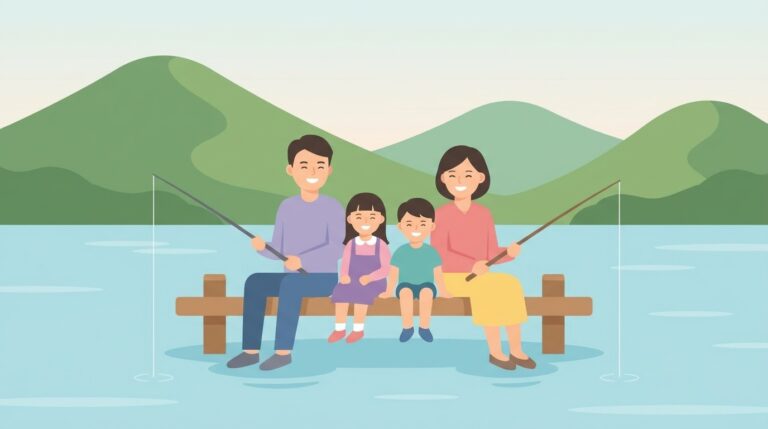
Phase 1: Empathy (Story-Driven Opening)
안녕하세요! 매일한글 에디터입니다. (Hello! This is your Daily Hangul editor.)
Have you ever watched Korean variety shows like The Fishermen and the City (도시어부) or seen cozy K-dramas where extended families spend the weekend at a floating fishing bungalow (좌대) surrounded by mist and sizzling pork belly? You picture a peaceful getaway with Korean friends or family: breathing fresh ocean air, bonding over rod setups, and enjoying ultra-fresh spicy fish stew (매운탕).
However, once you actually arrive at a Korean reservoir or coastal dock, reality hits. People around you are shouting specialized slang like “입질 온다!” or “손맛 대박!”, while the boat captain gives rapid instructions on baiting and safety in Korean honorifics. Standard textbook Korean like “물고기를 잡았습니다” (I caught a fish) suddenly feels stiff and out of place.
Don’t worry! Based on real classroom feedback from intermediate learners preparing for outdoor trips in Korea, this practical B2-level guide will equip you with the exact emotional nuances, fishing terminology, and family etiquette needed to fit right in and create unforgettable memories.
Phase 2: Core 3 Expressions Deep-Dive
1. 손맛이 장난 아니에요! (Son-mas-i jang-nan a-ni-e-yo!)
- Pronunciation: sohn-ma-shi jahng-nahn ah-nee-eh-yo (Think of ‘son’ like a family son + ‘mas’ like the ‘mus’ in mustard)
- Meaning: Literal: “The hand taste is no joke!” | Actual Nuance: “The thrilling tug on the fishing line feels incredible!”
- K-Culture Moment: Used whenever a fisher feels a vigorous pull on the rod and reels it in with huge excitement on variety shows.
- Editor’s Insight: In Korean culture, 손맛 (hand-taste) applies to cooking (a mother’s seasoning touch) as well as fishing (the tactile thrill and resistance of reeling in a catch). Saying 장난 아니다 elevates your speech to authentic intermediate conversational level.
- Situation Spectrum: Casual ✅ | Semi-formal ✅ | Formal ⚠️
- 🤔 Think About It: In English, we focus on the “action” (a great catch), but Korean captures the sensory “tactile connection” (손맛). How does physical sensation reflect hospitality and recreation in your culture?
2. 입질이 오기 시작했어요. (Ip-jir-i o-gi si-jak-hae-sseo-yo.)
- Pronunciation: eep-jee-ree oh-gee she-jahk-hae-ssuh-yo (‘Ip’ sounds like ‘lip’ without the ‘l’, ‘jil’ like ‘jill’)
- Meaning: Literal: “Mouth-actions have started coming.” | Actual Nuance: “The fish are starting to nibble/bite!”
- K-Culture Moment: Whispered excitedly across a quiet pier at sunrise right when the float bobber starts trembling underwater.
- Editor’s Insight: 입질 (nibble/peck) comes from 입 (mouth) + -질 (repetitive action). It is also metaphorically used in modern Korean to describe someone showing romantic interest or consumers responding to a teaser campaign!
- Situation Spectrum: Casual ✅ | Semi-formal ✅ | Formal ✅
- 🤔 Think About It: Notice how Korean creates lively descriptive nouns with the suffix -질 (e.g., 부채질 fanning, 가위질 scissor work). What suffix in your native language turns body actions into lively slang?
3. 잡은 고기로 매운탕 끓여 먹어요. (Jab-eun go-gi-ro mae-un-tang kkeul-yeo meog-eo-yo.)
- Pronunciation: jah-beun go-gee-ro may-oon-tahng kkeul-yuh muhg-uh-yo (‘Kkeul’ rhymes with a tense ‘cool’)
- Meaning: Literal: “Let’s boil and eat spicy stew with the caught fish.” | Actual Nuance: “Let’s celebrate our catch with fresh spicy fish stew together!”
- K-Culture Moment: The iconic climax of any Korean fishing excursion—cooking a steaming pot of stew right by the water or at a local port restaurant.
- Editor’s Insight: In Korea, fishing trips are rarely pure catch-and-release; they are communal culinary experiences. Proposing 매운탕 showcases your understanding of Korean 정 (communal bonding through shared hot meals).
- Situation Spectrum: Casual ✅ | Semi-formal ✅ | Formal ✅
- 🤔 Think About It: Why is sharing a hot communal boiling pot (찌개/탕) at the end of outdoor sports considered the peak of emotional closure (정리) in Korea?
Phase 3: Textbook Korean vs. Real Korean
Situation 1: Spotting a huge fish on the line
- 📖 교과서 한국어 (Textbook): “매우 큰 물고기를 잡았습니다.” (Mae-u keun mul-go-gi-reul jab-at-seum-ni-da. – I caught a very large fish.)
- 🗣️ 진짜 한국어 (Real-Life B2): “와, 이거 완전 대물/월척인데요!” (Wa, i-geo wan-jeon dae-mul/wol-cheog-in-de-yo! – Wow, this is a massive trophy catch!)
- 💡 왜 다를까? (Why the difference?): Native speakers use specific cultural fishing milestones like 월척 (traditionally a carp over 30.3cm) or 대물 (monster catch) instead of generic size adjectives.
Situation 2: The bait is untouched and fish aren’t biting
- 📖 교과서 한국어 (Textbook): “물고기가 미끼를 먹지 않습니다.” (Mul-go-gi-ga mi-kki-reul meok-ji an-seum-ni-da. – The fish do not eat the bait.)
- 🗣️ 진짜 한국어 (Real-Life B2): “오늘은 물때가 안 맞는지 입질이 영 없네요.” (O-neul-eun mul-ttae-ga an man-neun-ji ip-jir-i yeong eop-ne-yo. – Maybe the tide isn’t right today; there’s hardly any nibble.)
- 💡 왜 다를까? (Why the difference?): Intermediate Korean naturally connects fishing conditions to 물때 (tide/timing) with nuanced adverbs like 영 (hardly/scarcely).
Phase 4: K-Culture Deep-Dive & Non-Verbal Manners
4-1. Nunchi & Outdoor Gestures
- Rod & Space Respect: Never cast your line across another person’s trajectory (줄 엉킴). If lines cross accidentally, immediately give a 15-degree head nod and apologize: “죄송합니다, 줄이 엉켰네요.”
- Seating Order on Floating Bungalows (좌대): Korean family trips prioritize comfort for elders (어르신) and children. Offer the inner wind-shielded spots with comfortable folding chairs to older family members before setting up your own tackle box.
- Two-Handed Assistance: When passing a bait box, landing net (뜰채), or scissors to an elder or in-law, use both hands or support your right elbow with your left hand.
4-2. Cultural Code Analysis: 좌대 낚시 & 현장 회 (Boat Sashimi)
Korean family fishing is famous for 좌대 (floating wooden chalets anchored in lakes or sheltered ocean bays). Equipped with heating, TV, and barbecue grills, they allow families to fish right from the living area deck. The true charm is catching flounder (넙치) or sea bass (우럭) and slicing sashimi directly on the boat with vinegared red chili paste (초고추장), culminating in a steaming pot of ramen or 매운탕.
Phase 5: Real-Life Roleplay Scenario
- Setting: A calm morning on a chartered family fishing boat off the coast of Anmyeondo (안면도).
- Characters:
- You (Intermediate Korean Learner)
- Captain Park (Friendly local skipper & boat captain)
- You: 🎭 (Holding the rod with both hands and smiling) 선장님, 오늘 포인트는 어떤 어종이 주로 나오나요?
(Seon-jang-nim, o-neul po-in-teu-neun eo-tteon eo-jong-i ju-ro na-o-na-yo?)
“Captain, what fish species usually come up at today’s spot?” - Captain Park: 🎭 (Adjusting the engine throttle) 요즘 우럭이랑 주꾸미가 제철이라 아주 잘 올라와요!
(Yo-jeum u-reok-i-rang ju-kku-mi-ga je-cheol-i-ra a-ju jal ol-la-wa-yo!)
“Rockfish and webfoot octopus are in season right now, so they bite really well!” - You: 🎭 (Checking the rod tip nervously) 봉돌이 바닥에 닿는 느낌이 드는데 맞나요?
(Bong-dol-i ba-dak-e dan-neun neu-kkim-i deu-neun-de man-na-yo?)
“I feel the sinker weight hitting the seabed; is this right?” - Captain Park: 🎭 (Nodding approvingly) 네, 줄을 팽팽하게 유지하고 톡톡 챔질 타이밍을 봐요.
(Ne, jul-eul paeng-paeng-ha-ge yu-ji-ha-go tok-tok chaem-jil ta-i-ming-eul bwa-yo.)
“Yes, keep the line taut and watch for the moment to hook them with a quick twitch.” - You: 🎭 (Eyes widening as the rod tip bends) 어! 선장님, 초릿대가 휘어요! 입질 온 것 같아요!
(Eo! Seon-jang-nim, cho-rit-dae-ga hwi-eo-yo! Ip-jil on geot gat-a-yo!)
“Oh! Captain, the rod tip is bending! I think I’ve got a bite!” - Captain Park: 🎭 (Grabbing the landing net) 침착하게 감으세요! 천천히 릴링하세요!
(Chim-chak-ha-ge gam-eu-se-yo! Cheon-cheon-hi ril-ling-ha-se-yo!)
“Stay calm and reel it in! Reel steadily!” - You: 🎭 (Lifting a plump rockfish into the boat) 와! 손맛이 진짜 묵직했어요! 대박!
(Wa! Son-mas-i jin-jja muk-jik-haess-eo-yo! Dae-bak!)
“Wow! The pull felt so delightfully heavy! Awesome!” - Captain Park: 🎭 (Giving a thumbs up) 아주 잘하시네요! 이따가 가족들이랑 매운탕 끓여 드시면 최고겠어요.
(A-ju jal-ha-si-ne-yo! I-tta-ga ga-jok-deul-i-rang mae-un-tang kkeul-yeo deu-si-myeon choe-go-gess-eo-yo.)
“You did great! This will taste unbelievable in a spicy stew with your family later.”
🔀 Interactive Choice Point
After landing your catch, the line suddenly gets tangled with an elder family member’s line next to you. What do you say?
- Option A: “죄송합니다! 제가 급하게 감느라 줄이 엉켰어요. 금방 풀어드릴게요!” (Best)
- Feedback: Best! Demonstrates immediate polite ownership, intermediate conversational fluency, and helpful respect for fellow fishers.
- Option B: “왜 제 줄 쪽으로 던지셨어요?” (Bad)
- Feedback: Bad. Highly confrontational tone that destroys the peaceful, family-oriented atmosphere.
- Option C: “선장님, 저분 줄 좀 치워주세요.” (Risk)
- Feedback: Risk. Sounds cold and entitled by referring to a family member or peer as 저분 and delegating trivial courtesy.
Phase 6: 10-Second Emotion Shadowing Drill
[😊 신나고 흥분되게]“우와 / 초릿대 휜 것 좀 보세요! / 진짜 월척 맞죠?”
(U-wa / cho-rit-dae hwin geot jom bo-se-yo! / Jin-jja wol-cheok mat-jyo?)[🥺 아쉽고 애교 섞어서]“아 / 다 건졌는데 / 눈앞에서 놓쳤어요… / 너무 아까워요!”
(A / da geon-jyeot-neun-de / nun-ap-e-seo no-chyeoss-eo-yo… / Neo-mu a-kka-wo-yo!)[😋 군침 돌며 따뜻하게]“오늘 잡은 우럭으로 / 국물 시원한 매운탕 / 얼른 끓여 먹어요!”
(O-neul jab-eun u-reok-eu-ro / gung-mul si-won-han mae-un-tang / eol-leun kkeul-yeo meog-eo-yo!)
Phase 7: K-Culture Mini Dictionary
- 손맛 (Son-mat) | Tactile Thrill of Fishing / Chef’s Secret Touch | Used in fishing for the dynamic resistance of a hooked fish; in daily dining, describes homemade cooking flavor.
- 월척 (Wol-cheok) | Trophy Catch / Jackpot | Historically meaning a freshwater fish exceeding 30.3 cm; frequently used in business and life to mean a huge success.
- 좌대 (Jwa-dae) | Floating Fishing Bungalow | Built-on-water accommodation where family members can relax, cook, and fish right off the deck safely.
- 물때 (Mul-ttae) | Tide Timing / Favorable Moment | Refers to ocean tidal cycles; metaphorically used in Korean business to indicate the ideal market timing (“물때가 좋다”).
Phase 8: Survival Kit for Travelers
Survival Expressions TOP 3
- “구명조끼는 어디에 준비되어 있나요?” (Gu-myeong-jjo-kki-neun eo-di-e jun-bi-doe-eo in-na-yo?)
- Pro Tip: Safety first! Always verify your life jacket location immediately upon boarding.
- “미끼는 지렁이랑 크릴새우 중에 뭐가 잘 먹혀요?” (Mi-kki-neun ji-reong-i-rang keu-ril-sae-u jung-e mwo-ga jal meok-hyeo-yo?)
- Pro Tip: Asking bait recommendations shows experienced etiquette to pier shopkeepers.
- “이 근처에 잡은 생선 손질해 주는 식당이 있나요?” (I geun-cheo-e jab-eun saeng-seon son-jil-hae ju-neun sik-dang-i in-na-yo?)
- Pro Tip: Port restaurants will clean, slice, and cook your fish for a modest 상차림비 (table setting fee).
Editor’s Travel Note
- App Downloads: Before departure, download the 네이버 지도 앱 (Naver Map App) to pinpoint rural fishing piers and use the 바다타임 물때표 앱 (BadaTime Tide App) to check accurate coastal high/low tides.
- Cash Preparation: While card payment is widespread, buying fresh live bait (생물 미끼) from small coastal mom-and-pop bait shacks often requires small cash bills (KRW 1,000 to 10,000) or direct account transfer (계좌이체).
Phase 9: One Step Deeper (Thought Reflection)
In Western recreational angling, sportsmanship often centers around solitary focus, technique mastery, and catch-and-release records. In contrast, traditional Korean fishing culture (한국의 낚시 문화) is rooted in 풍류 (refined outdoor leisure) and collective joy (정). The entire purpose of waiting for hours by the water finds its ultimate meaning when the family gathers at twilight around a communal burner to taste the sea together.
💬 Your Turn: Have you ever participated in a fishing or outdoor trip with Korean peers? What food would you love to cook right at the water’s edge? Share your thoughts in the comments below!
Phase 10: FAQ & Common Mistakes
Q: Can foreigners easily book floating fishing bungalows (좌대) without Korean ID?
A: Yes! Most reservoir and coastal fishing centers allow phone reservations or bookings via Korean travel platforms. If booking directly, sending a polite text like “외국인인데 주말 좌대 1박 예약 가능한가요?” works wonderfully.
Q: What is the etiquette for keeping fish vs releasing them in Korea?
A: In freshwater reservoirs (저수지), catch-and-release of native bass or bass culling rules may apply. In coastal salt-water fishing, keeping legal-size catches to eat as sashimi or stew is standard practice.
Q: Do I need a formal state fishing license in Korea?
A: For general coastal pier, beach casting, and boat fishing, recreational anglers do not require a separate personal license, but life vests on boats are legally mandatory under heavy fines.
🚨 Common Mistakes Warning Board
- Calling all marine creatures 물고기 (Mul-gogi): Use specific marine terms like 우럭 (rockfish), 광어 (flatfish), or 주꾸미 (webfoot octopus). Action: Learn the top 3 coastal target species before your trip.
- Forgetting to check the legal size limit (금지체장): Throw back juvenile fish (방생) immediately to avoid legal penalties and respect local fishery regulations.
- Neglecting life jackets (구명조끼): Never unbuckle life vests while on Korean sea charter boats; coast guards conduct strict spot inspections.
Phase 11: Action Missions
- 🥉 Bronze Mission (Solo Practice): Stand in front of a mirror and practice saying: “선장님, 오늘 입질 대박이에요!” with high energy 5 times.
- 🥈 Silver Mission (Social Media): Post a picture of your favorite seafood dish on Instagram or Threads with the hashtag
#손맛and#매일한글. - 🥇 Gold Mission (Real Life Action): Visit a Korean fish market (수산시장) or dock and ask the merchant: “오늘 매운탕 거리로 어떤 생선이 신선해요?”
- 🎮 K-Culture Mission: Watch an episode of variety show The Fishermen and the City (도시어부) and spot at least two instances of the word 입질 or 손맛 in the subtitles.
Phase 12: Interactive Quiz Challenge
Q1. Situational Judgment: You are fishing with your Korean friend’s parents. The float sinks dramatically and you reel in a big fish. Which exclamation is most natural and polite?
* ① “어이, 나 물고기 잡았어!”
* ② “어머님, 아버님! 저 월척 잡은 것 같아요! 손맛이 대단해요!”
* ③ “이 생선 먹을 수 있습니까?”
Q2. Fill in the blank: “바람이 불어서 파도가 높으니 오늘은 ( )이/가 별로 안 좋네요.”
* Hint: Refers to tidal/sea conditions.
Q3. True or False: In Korea, 손맛 can only be used when catching fish with a fishing rod, not in kitchen cooking.
👉 Click here to check the Answers and Explanations!
- Q1 Answer: ② (Option ① is impolitely casual banmal to elders; Option ③ is stiff and transactional. Option ② shares joy with respectful honorifics!)
- Q2 Answer: 물때 (mul-ttae – tide condition/timing).
- Q3 Answer: False (X) (손맛 is famously used to describe a cook or mother’s intuitive seasoning touch in delicious dishes!).







