

Phase 1: Empathy (Story-Driven Opening)
안녕하세요! 매일한글 에디터입니다. Have you ever stepped onto the vibrant streets of Hongdae after dinner, feeling the irresistible pull of neon signs flashing 노래방 (Noraebang), only to freeze at the doorstep? Picture this: your Korean friends casually ask, “Should we hit a Kono (코노) or grab a big room with service?” You nod politely, but inside, your mind races. Is a coin karaoke room just a tiny booth for solo singers, or can you squeeze three friends in? Why is everyone obsessed with “service minutes” in a traditional Noraebang, and how do you operate that massive remote control without accidentally canceling someone’s favorite K-pop ballad?
Navigating Korean karaoke isn’t just about reading Korean lyrics fast on a screen—it’s an entire social ritual governed by unique unspoken rules, tech shortcuts, and tactical vocabulary. As a B2-level learner, you’re ready to move beyond just singing your favorite chorus; you need the confidence to pick the right spot, split the bill gracefully, negotiate extra time, and master karaoke etiquette like an insider. This guide draws directly from real field feedback from our intermediate learners and Korean nightlife veterans. Let’s unlock the ultimate Noraebang experience!
Phase 2: Core Expressions Deep Dive
1. 코노 갈래, 일반 갈래? (Kono gallae, ilban gallae?)
- Pronunciation: [Ko-no gal-lae, il-ban gal-lae?] (Sounds like: “Coh-no gahl-leh, eel-bahn gahl-leh?”)
- Meaning: Literal: “Do you want to go to Kono or standard?” | Real Nuance: “Are we doing a quick, pay-per-song vibe or renting a spacious party room by the hour?”
- K-Culture Moment: Seen in campus web dramas where university students debate whether to kill 20 minutes before their next lecture (Coin Noraebang) or celebrate the end of midterms (Standard Noraebang).
- Editor’s Insight: 코노 (Kono) is the beloved abbreviation for 코인 노래방 (Coin Noraebang). Asking this shows you understand the social distinction between casual budget singing and a full-scale social gathering.
- Situation Spectrum: Casual: ✅ | Semi-formal: ⚠️ | Formal: 🚫
- 🤔 Think About It: In your culture, do you differentiate between solo/quick-session entertainment versus collective late-night party venues with specific slang?
2. 사장님, 서비스 좀 더 주세요! (Sajangnim, seobiseu jom deo juseyo!)
- Pronunciation: [Sa-jang-nim, seo-bi-seu jom deo ju-se-yo!] (Sounds like: “Sah-jahng-neem, saw-bee-soo johm duh joo-seh-yoh!”)
- Meaning: Literal: “Boss, please give us some service!” | Real Nuance: “Could you hook us up with some bonus free minutes, please?”
- K-Culture Moment: In K-dramas, when the digital timer on the screen drops to 01:00 and suddenly jumps back up to 30:00 because the owner liked the group’s high-energy dancing.
- Editor’s Insight: In Korea, 서비스 (Service) doesn’t mean customer care; it specifically means complimentary freebies (in this case, extra karaoke time).
- Situation Spectrum: Casual: ✅ | Semi-formal: ✅ | Formal: ⚠️
- 🤔 Think About It: How does the cultural expectation of complimentary perks reflect the Korean concept of Jeong (정) and mutual hospitality?
3. 마이크 양보할게, 먼저 불러! (Maikeu yangbohalge, meonjeo bulleo!)
- Pronunciation: [Ma-i-keu yang-bo-hal-ge, meon-jeo bul-leo!] (Sounds like: “Mah-ee-koo yahng-boh-hahl-geh, mun-juh bool-luh!”)
- Meaning: Literal: “I will yield the microphone, sing first!” | Real Nuance: “Take the mic, you go ahead and sing your song!”
- K-Culture Moment: When two friends enter their favorite songs on the remote at the same time, demonstrating polite nunchi before belting out high notes.
- Editor’s Insight: 양보하다 (To yield/give way) is commonly taught for public transport seats, but native speakers use it naturally during shared leisure activities.
- Situation Spectrum: Casual: ✅ | Semi-formal: ✅ | Formal: ⚠️
- 🤔 Think About It: How do group etiquette and turn-taking differ between Western karaoke bars (standing on a public stage) versus Korean private room noraebangs?
Phase 3: Textbook Korean vs. Real Korean
Situation 1: Selecting and prioritizing a song on the remote
- 📖 교과서 한국어: 노래를 우선 예약하겠습니다. (Noraereul useon yeyakhagessseumnida. – I will prioritize-reserve the song.)
- 🗣️ 진짜 한국어: 나 이거 우선예약 누를게! (Na igeo useon-yeyak nureulge! – I’m hitting priority reserve on this one!)
- 💡 왜 다를까? In actual Noraebang settings, commands on remote buttons (like 우선예약, 간주점프) turn directly into dynamic colloquial action verbs among friends.
Situation 2: Skipping a long instrumental intro
- 📖 교과서 한국어: 전주 부분을 건너뛰어 주십시오. (Jeonju bubuneul geonneottwieo jusipsio. – Please skip the intro portion.)
- 🗣️ 진짜 한국어: 야, 간주점프 눌러! (Ya, ganju-jeompeu nulleo! – Hey, hit intro-jump!)
- 💡 왜 다를까? Noraebang machines have a dedicated button labeled 간주점프 (Interlude Jump). Koreans prioritize fast-paced fun over waiting through lengthy instrumental breaks.
Phase 4: K-Culture Deep Dive & Non-Verbal Manners
4-1. 눈치 (Nunchi) & Non-Verbal Manners in Noraebang
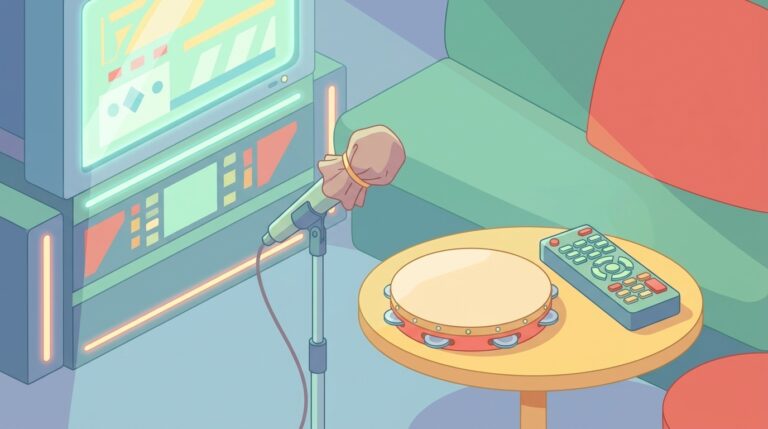
- The Tambourine Duty (탬버린 매너): Even if you aren’t singing, holding a tambourine and shaking it on beat to cheer on your friend is the ultimate sign of social nunchi. Looking down at your phone the entire time kills the mood.
- Duet Consent & Microphone Passing: Never snatch the second microphone to sing harmony unless the main singer invites you or makes direct eye contact during the chorus.
- Sanitary Covers (마이크 커버): In both coin and general Noraebangs, look for the small plastic packet containing two black or colored foam mic covers at the front desk or table. Installing them shows hygiene mindfulness.
4-2. Cultural Code: Coin Noraebang (Kono) vs. General Noraebang
- Coin Noraebang (코인 노래방): Emerged as the ultimate haven for youth autonomy and solo culture (Hon-nol / 혼놀족). You pay per song (typically 1,000 KRW for 2–3 songs) or for 30 minutes via automated kiosk or cash acceptor inside the booth. Perfect for vocal practice or blowing off steam alone without social pressure.
- General Noraebang (일반 노래방): Built for collective celebration (회식, after-parties). You rent the entire room per hour (typically 20,000–30,000 KRW/hr), often featuring snack bars, mood lighting, and the thrilling tradition of receiving bonus 서비스 (Service) minutes near closing.
Phase 5: Real-World Roleplay Scenario
Setting: Minho and Alex are in Hongdae on a Friday night after having Korean barbecue. They stand in front of a building with a Coin Noraebang on the 2nd floor and a luxury General Noraebang on the 3rd floor.
- Minho (NPC): 알렉스, 배도 부른데 2차로 노래방 갈까? (Alex, baedo bureunde icharo noraebang galkka? – Alex, we’re full, should we head to a Noraebang for round two?)
- 🎭 Patting his stomach with a grin and pointing up at the neon signs.
- Alex: 좋아! 근데 코노 갈래, 아니면 일반 노래방 갈래? (Joha! Geunde kono gallae, animyeon ilban noraebang gallae? – Sounds good! But do you want to go to a Kono or a general Noraebang?)
- 🎭 Looking curiously between the two signs on the entrance directory.
- Minho (NPC): 우리 인원도 두 명뿐이고 간단하게 코노 가서 몇 곡만 때리자! (Uri inwondo du myeongppunigo gandanhage kono gaseo myeot gongman ttaerija! – There’s only two of us, let’s just hit Kono and blast a few songs!)
- 🎭 Checking the payment kiosk screen at the 2nd-floor entrance.
- Alex: 그래, 카드 결제 되니까 시간제로 30분 끊을까? (Geurae, kadeu gyeolje doenikka siganjero samsipbun kkeuneulkka? – Sure, card payment works, so should we book 30 minutes on the hourly rate?)
- 🎭 Pulling out his transportation/credit card toward the kiosk.
- Minho (NPC): 굿 초이스! 들어가서 마이크 커버 먼저 씌우자. 첫 곡 뭐 부를래? (Gut choiseu! Deureogaseo maikeu keobeo meonjeo ssiewuja. Cheot gok mwo bureullae? – Good choice! Let’s get inside and put the mic covers on first. What’s your first song?)
- 🎭 Ripping open the sterile mic cover pouch and handing one to Alex.
- Alex: 나 요즘 연습한 데이식스 노래! 간주점프 바로 눌러줘. (Na yojeum yeonseuphan de-isikseu norae! Ganju-jeompeu baro nulleojwo. – That DAY6 song I’ve been practicing lately! Hit interlude jump right away, please.)
- 🎭 Entering the song number with the remote with focused enthusiasm.
- Minho (NPC): 오, 기대되는데? 탬버린 장전 완료! 가보자고! (O, gidaedoeneunde? Taembeorin jangjeon wallyo! Gabojago! – Oh, looking forward to it! Tambourine locked and loaded! Let’s go!)
- 🎭 Grabbing two tambourines and shaking them vigorously to hype the intro.
- Alex: 마이크 볼륨 딱 좋다! 신나게 달려보자! (Maikeu bollyum ttak jota! Sinnage dallyeoboja! – Mic volume is spot on! Let’s rock this!)
- 🎭 Adjusting the echo dial and starting to sing into the mic.
🔀 Interactive Decision Branch
What would you say when Minho’s favorite song comes up next?
* Option A: “민호야, 너 부를 때 내가 코러스 같이 넣어줄게!” (Minho-ya, neo bureul ttae naega koreoseu gachi neoeojulge!)
* Option B: “야, 그 노래 재미없으니까 취소 누른다?” (Ya, geu norae jaemieopseunikka chwiso neureunda?)
* Option C: “사장님한테 가서 서비스 시간 달라고 떼쓰고 올게!” (Sajangnimhante gaseo seobiseu sigan dallago ttesseugo olge!)
Feedback:
* Option A (Best): Fantastic! Offering to sing backup chorus shows peak camaraderie and builds great energy.
* Option B (Bad): Major party foul! Pressing 취소 (Cancel) on someone else’s song without consent ruins the fun immediately.
* Option C (Risk): Awkward! Most automated Coin Noraebangs don’t have staff to negotiate free time with, unlike regular Noraebangs.
Phase 6: 10-Second Emotion Shadowing Drill
[🔥 신나고 열정적으로 / Full of hype & energy]
야, / 전주 너무 길다, / 간주점프 / 빨리 눌러줘!
(Ya, / jeonju neomu gilda, / ganju-jeompeu / ppalli nulleojwo!)-
[🥺 애교 섞이고 능청스럽게 / Playful & hopeful for bonus time]
사장님~ / 저희 진짜 열심히 불렀는데 / 서비스 10분만 / 더 주시면 안 돼요?
(Sajangnim~ / jeohi jinjja yeolsimhi bulleonneunde / seobiseu sipbunman / deo jusimyeon an dwaeyo?) -
[🤝 배려심 넘치고 다정하게 / Warm & considerate turn-taking]
나 방금 불렀으니까, / 이번엔 네가 부르고 싶은 거 / 예약해!
(Na banggeum bulleosseunikka, / ibeonen nega bureugo sipeun geo / yeyakhae!)
Phase 7: K-Culture Mini Dictionary
- 혼코노 (Hon-kono) [Noun]
- Meaning: Going to a Coin Noraebang completely alone (혼자 + 코인 노래방).
- Usage: A mainstream trend among Gen Z and millennials for stress relief without needing an audience.
- 점수제거 (Jeomsu-je-geo) [Feature]
- Meaning: Turning off the automated score screen at the end of each song.
- Usage: Essential setting when you want to avoid embarrassing numerical scores interrupting your emotional ballads.
- 마이크 배틀 (Ma-i-keu Bae-teul) [Slang]
- Meaning: Playful high-note battles between friends on challenging vocal tracks.
- Usage: Common when singing iconic Korean rock ballads or high-energy vocal anthems.
- 막곡 (Mak-gok) [Noun]
- Meaning: The final “grand finale” song sung before your booked time expires.
- Usage: Usually an upbeat crowd-pleaser that everyone sings together at top volume.
Phase 8: Traveler Survival Kit
- Top 1: “카드 결제 돼요, 아니면 현금만 돼요?” (Kadeu gyeolje dwaeyo, animyeon hyeongeumman dwaeyo? – Do you take card payment or cash only?)
- 💡 Pro Tip: Modern Kono machines accept credit cards, T-money, and Samsung Pay, but keeping a few 1,000 KRW bills is wise for older machines.
- Top 2: “마이크 커버 카운터에서 가져가면 되나요?” (Maikeu keobeo kaunteoeseo gajyeogamyeon doenayo? – Can I take the mic covers from the front counter?)
- 💡 Pro Tip: Most self-service coin spots place sanitary packs in a basket right next to the entrance or kiosk.
- Top 3: “방 번호 어디 찍고 들어가요?” (Bang beonho eodi jjikgo deureogayo? – Where do I check in my room number on the screen?)
- 💡 Pro Tip: When using an automated kiosk, select an empty (green) room number on the screen before making payment.
Editor’s Travel Note:
Before wandering looking for empty rooms on busy weekend nights in Gangnam or Hongdae, use the Naver Map app download to search for “코인노래연습장” and check live ratings, room types, and whether coin change machines are available.
Phase 9: Think Deeper
In Western bar karaoke, singing is inherently performative—you step onto a stage in front of strangers to entertain the room. In contrast, the Korean Noraebang is an enclosed, egalitarian safe haven where social hierarchies dissolve inside soundproof walls. Whether you are a CEO or a college freshman, handing over the microphone and enthusiastically banging a tambourine for someone else is an exercise in communal harmony (공동체 의식). The shift from sprawling hourly Noraebangs to solo-friendly Kono also mirrors modern Korea’s balance between deep collective bonding and individual personal space.
💬 Your Turn: What is your go-to karaoke style? Do you prefer belting out songs completely alone in a cozy Hon-kono booth, or partying with a group in a neon-lit standard room? Share your thoughts below!
Phase 10: FAQ & Common Mistakes
Q: Can I bring outside food and drinks into Korean Noraebangs?
A: In general Noraebangs, soft drinks and snacks sold inside are preferred, and alcohol regulations vary strictly by license (some are alcohol-free family zones called 노래연습장). In Coin Noraebangs, outside beverages with lids are usually tolerated, but hot food is strictly prohibited to keep compact booths clean.
Q: What is the difference between TJ Media (태진) and KeumYoung (금영) machines?
A: These are the two dominant karaoke machine brands in Korea. TJ Media is renowned for extensive K-pop catalogs, real-time chart synchronization, and foreign song accuracy, while KeumYoung is beloved for its classic nostalgic interface and pitch adjustment precision.
Q: How do I find English, Japanese, or other international songs on the remote?
A: Press the dedicated 국가선택 (Country Select) or 팝송 (Pop Song) button on the remote control. You can search by English alphabet titles or artist names without needing to translate them into Hangul.
🚨 Common Mistakes Warning Board
- Mistake: Hitting the big red 취소 (Cancel) button when you just wanted to stop the background music.
- Correct Action: Press 간주점프 (Interlude Jump) to skip instrumentals or wait for the song to finish naturally.
- Mistake: Asking the automated kiosk machine for “Service time” (서비스).
- Correct Action: Understand that Coin Noraebangs operate strictly on precise automated digital meters; save your 서비스 requests for attended general Noraebangs.
- Mistake: Forgetting to remove the disposable microphone cover after leaving the room.
- Correct Action: Toss used mic covers into the waste bin near the exit door to show good public etiquette.
Phase 11: Action Missions
- 🥉 Bronze Mission (Solo Practice): Practice saying “간주점프 눌러줘!” and “서비스 좀 더 주세요!” with natural intonation using the Phase 6 emotion tags.
- 🥈 Silver Mission (SNS Challenge): Share your favorite K-pop song number on your social media with the hashtag
#DailyHangulNoraebang. - 🥇 Gold Mission (Real Action): Visit a Coin Noraebang in Korea (or an authentic Korean K-karaoke abroad), successfully select a room using the kiosk, and sing a full song with mic covers installed!
- 🎮 K-Culture Mission: Watch a variety show clip (like Running Man or Knowing Bros) and spot how cast members enthusiastically use tambourines while others sing.
Phase 12: Interactive Quiz Challenge
1. Situation Judgment Quiz: You are at a standard Noraebang with your Korean coworkers and there are 2 minutes left on the clock. What is the most culturally natural sentence to say to the owner?
* (A) 사장님, 환불해 주세요! (Boss, give me a refund!)
* (B) 사장님, 서비스 시간 조금만 더 넣어주세요! (Boss, please add a little bit of service time!)
* (C) 사장님, 노래 취소해 주세요! (Boss, please cancel the song!)
🔍 Click to reveal Answer & Explanation
- Correct Answer: (B)
- Explanation: In traditional Noraebangs, asking for 서비스 (complimentary extra minutes) near the end of your session is an established, playful custom. (A) and (C) are inappropriate for this context.
2. Fill in the Blank Quiz: Fill in the blank with the correct karaoke button term:
“노래 반주가 너무 기니까 ________________ 버튼을 누르자!” (The song’s instrumental break is too long, so let’s press the ________________ button!)
🔍 Click to reveal Answer & Explanation
- Correct Answer: 간주점프 (Ganju-jeompeu / Interlude Jump)
- Explanation: 간주점프 immediately skips long instrumental intros and interludes, taking the singer straight to the lyrics.
3. True or False Culture Quiz: In a Coin Noraebang (코노), you can negotiate with the front desk clerk to get free bonus service minutes just like in a traditional Noraebang. (True / False)
🔍 Click to reveal Answer & Explanation
- Correct Answer: False
- Explanation: Coin Noraebangs run on automated per-song or per-minute electronic meters, so free 서비스 minutes are generally not provided.







