

Soaring High: Mastering the Poetic Nuances of Neolttwigi and Geunettagi in Korean Culture
Phase 1: Empathy (Story-Immersive Opening)
안녕하세요! Welcome back to Daily Hangul. I’m your Korean culture navigator, here to guide you beyond sterile textbook phrases into the living heartbeat of Korean expression.
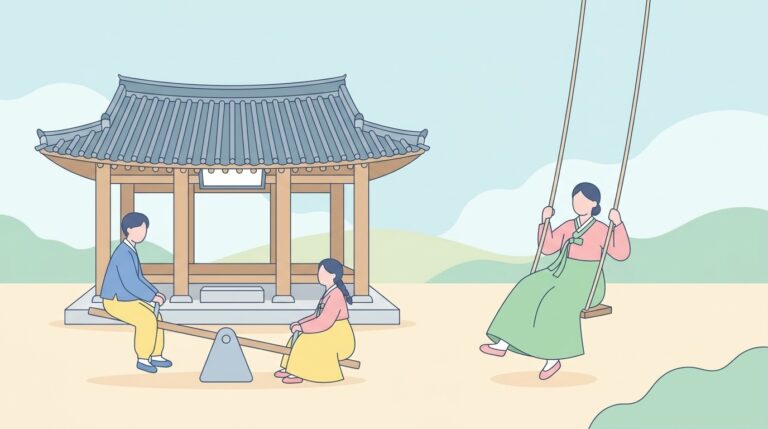
Picture this: You are visiting the Korean Folk Village (Hanguk Minsokchon) during Chuseok or strolling through the historic gardens of Gwanghallu in Namwon on Dano festival day. You watch two people standing on opposite ends of a wooden plank balanced on a straw bolster—Neolttwigi (Korean seesaw)—launching each other high into the crisp air with theatrical precision. Nearby, a giant traditional swing (Geune) suspended from colossal zelkova branches arcs towards the sky. You want to cheer, express wonder, comment on the rhythm and historical gravity of these pastimes, and engage with the locals who are eagerly watching.
Yet, you freeze. Standard beginner phrases like “재미있어요” (It is fun) or “위험해요” (It is dangerous) feel terribly flat and out of place for a C1-level learner who wants to capture the elegance, tension, and communal synergy inherent in these traditional arts. You want to discuss hop (호흡, synchronized breathing/rhythm), momentum, and the historical metaphor of women soaring above the courtyard walls in the Joseon Dynasty.
Based on feedback from hundreds of advanced learners who feel stuck between textbook formality and authentic cultural depth, this guide is crafted specifically for you. By the end of this masterclass, you will speak with the expressive flair, historical awareness, and stylistic nuance of an articulate cultural connoisseur.
Phase 2: Deep Dive into 3 Core Expressions
1. 호흡을 맞추다 (Hoheubeul matchuda)
- Pronunciation: [Ho-heu-beul mat-chu-da] (Think of saying “ho” as in home, “heup” like a quick gasp, and “match-oo-da”)
- Meaning: Literal: “To match breathing” | Actual Nuance: To synchronize pacing, harmonize teamwork, or be in complete rhythm with a partner.
- K-Culture Moment: Used in historical dramas (Sageuk) when two partners execute a coordinated combat or Neolttwigi jump, or in modern variety shows like Running Man when teammates perfectly time a duo mission.
- Editor’s Insight: Neolttwigi cannot function without both individuals calculating each other’s weight and timing. Beyond traditional games, advanced speakers use this expression constantly in corporate strategy meetings, artistic collaborations, and relational milestones.
- Situation Spectrum: Casual: ✅ | Semi-formal: ✅ | Formal: ✅
- 🤔 Think About It: While English focuses on “coordination” or “syncing up” (mechanistic concepts), Korean conceptualizes deep synergy through shared breath (hoheup). What does this reveal about communal intimacy in Korean culture?
2. 치맛자락을 휘날리며 (Chimatjarrageul hwinallimyeo)
- Pronunciation: [Chi-mat-jja-ra-geul hwi-nal-li-myeo] (“Chee-maht-jah-rah-geul hwee-nahl-lee-myeo”)
- Meaning: Literal: “With the skirt train fluttering in the wind” | Actual Nuance: Evoking the poetic, graceful, and liberating motion of traditional hanbok soaring through the air on a swing or seesaw.
- K-Culture Moment: Classic cinematic scenes from Chunhyangjeon or modern period dramas like Mr. Queen and The Red Sleeve, where the female lead swings majestically against a blossoming landscape.
- Editor’s Insight: This is an idiomatic descriptive phrase (묘사적 표현). Using such sensory idioms at the C1 level demonstrates not just vocabulary knowledge, but literary sensibility and atmospheric appreciation.
- Situation Spectrum: Casual: ⚠️ (too poetic for casual banter) | Semi-formal: ✅ | Formal/Literary: ✅
- 🤔 Think About It: Historical Korean literature frequently used vivid attire motion to symbolize a woman’s emotional liberation from societal confines. How do historical gender dynamics shape poetic imagery in your own culture?
3. 반동을 이용하다 (Bandong-eul iyonghada)
- Pronunciation: [Ban-dong-eul ee-yong-ha-da] (“Bahn-dohng-eul ee-yohng-hah-dah”)
- Meaning: Literal: “To utilize the recoil/rebound” | Actual Nuance: To harness physical momentum or leverage situational rebounds/counter-forces effectively.
- K-Culture Moment: Athletes, acrobatics instructors, and traditional performers explaining how to build height on a giant swing without expending brute arm strength.
- Editor’s Insight: In advanced Korean, bandong (rebound/momentum) is both physical and strategic. Mastering both its literal physics use and metaphorical use (turning adversity into leverage) adds profound polish to your speech.
- Situation Spectrum: Casual: ✅ | Semi-formal: ✅ | Formal: ✅
- 🤔 Think About It: Notice how Korean emphasizes yielding to the downward force before ascending, mirroring the philosophical balance of Eum-Yang (Yin-Yang).
Phase 3: Textbook Korean vs. Real Native Korean
Situation 1: Cheering on a Partner on the Traditional Seesaw (Neolttwigi)
- 📖 교과서 한국어 (Textbook): “타이밍을 잘 맞춰서 높이 뛰어보세요.” (Please jump high by matching the timing well.)
- 🗣️ 진짜 한국어 (Real Native): “타이밍 기가 막히네요! 무릎 반동 주면서 솟구쳐 오르는 호흡이 완전 예술이에요!” (Your timing is sensational! The rhythm of bending your knees to spring upward is absolute art!)
- 💡 왜 다를까? (Why the difference?): Native Korean praise thrives on dynamic sensory predicates (솟구치다 – to surge/spring skyward) and high-energy idiomatic exclamations (기가 막히다 – breathtaking/unbelievable) rather than sterile imperative statements.
Situation 2: Describing Someone Riding the Dano High Swing (Geune)
- 📖 교과서 한국어 (Textbook): “그네를 타는 모습이 매우 아름답고 빠릅니다.” (The appearance of riding the swing is very beautiful and fast.)
- 🗣️ 진짜 한국어 (Real Native): “발끝으로 허공을 가르는 모습이 마치 한 폭의 동양화 같지 않나요?” (Doesn’t the way their feet slice through the empty air look just like a traditional Oriental watercolor painting?)
- 💡 왜 다를까? (Why the difference?): At an advanced level, Koreans evoke poetic visual metaphors (한 폭의 동양화 – a spread of oriental canvas) and rhetorical questions (~지 않나요?) to share aesthetic resonance with companions.
Phase 4: K-Culture Deep Dive & Non-Verbal Manners
4-1. Nunchi & Physical Etiquette in Traditional Games
When participating in Neolttwigi, non-verbal communication is paramount. You must lock eyes with your partner before every footfall. Bending your knees slightly to absorb impact while signaling with a nodding breath (고개짓) shows respect and ensures safety. If your partner is struggling with balance, never over-jump; subtly modulate your descent force to match their weight. In Geunettagi, waiting spectators give plenty of clearance around the swinging perimeter and chime in with rhythmic clapping and supportive vocalizations like “얼씨구!” (Eolssigu!) or “좋다!” (Jota!).
4-2. Cultural Code Analysis: The Symbol of Liberation in K-Drama & History
In the Joseon era, women’s spatial mobility was heavily restricted behind residential walls (Damtong). Neolttwigi and Geunettagi—especially celebrated on festive days like Seollal and Dano—were virtually the only socially sanctioned moments where young women could physically elevate themselves high enough to peek over the courtyard walls and glimpse the wider world. When you watch K-dramas such as Sungkyunkwan Scandal or Moonlight Drawn by Clouds, swings and seesaws are never mere toys; they are cinematic devices representing longing (한/Han), fleeting romance, and uninhibited emotional soaring.
Phase 5: Real-World Roleplay Scenario
- Setting: The grand courtyard of Namsangol Hanok Village during the Dano Festival. Red zelkova swings and massive pine seesaws are surrounded by spectators.
- Characters:
- You (Advanced Learner): An appreciative enthusiast of traditional arts.
- Master Park (도편수 박 명인): A veteran traditional craft and game coordinator in his late 60s, donning traditional durumagi.
- Master Park: 🎭 (Placing a straw cushion beneath the center of the wooden plank) “자, 널이 흔들리지 않게 중심을 잘 잡아야 해요. 두 분이 짝을 이뤄서 올라서 보시지요.”
- Ja, neori heundeulliji anke jungsim-eul jal jabaya haeyo. Du buni jjag-eul irwoseo ollaseo bosijiyo.
- “Now, you must secure the center so the board doesn’t wobble. Please pair up and step on.”
- You: 🎭 (Stepping onto the platform lightly, making eye contact with your partner) “선생님, 널뛰기는 단순히 힘으로 뛰는 게 아니라 서로의 호흡을 맞추는 게 핵심이라고 들었습니다.”
- Seonsaengnim, neolttwigineun dansunhi himeuro ttwineun ge anira seoroui hoheubeul matchuneun ge haeksim-irago deureossseumnida.
- “Master, I’ve heard that Neolttwigi isn’t just about raw power, but that synchronizing our breathing is the absolute key.”
- Master Park: 🎭 (Nodding approvingly with a broad smile) “허허, 제대로 알고 계시네! 무릎의 굴신(屈伸) 운동으로 반동을 살려야 힘이 덜 들고 높이 오르는 법이지요.”
- Heoheo, jedaero algo gyesine! Mureup-ui gulsin undong-euro bandong-eul sallyeoya himi deol deulgo nopi oreuneun beobijiyo.
- “Haha, you know your stuff! You must harness the spring of flexing and extending your knees to effortlessly gain height.”
- You: 🎭 (Nodding to partner, establishing rhythm: ‘하나, 둘!’) “좋습니다! 상대방이 내려올 때 무릎을 살짝 굽혀 반동을 실어줄게요.”
- Jotseumnida! Sangdaebang-i naeryeool ttae mureupeul saljjak gupyeo bandong-eul sireojulgeyo.
- “Understood! As you come down, I’ll soften my knees to load the rebound for you.”
- Master Park: 🎭 (Clapping rhythmically) “얼씨구! 바로 그거요! 널판의 탄성을 온전히 타기 시작했구먼!”
- Eolssigu! Baro geugeoyo! Neolpan-ui tanseong-eul onjeonhi tagi sijakhaetgumeon!
- “Splendid! That’s it! You’ve completely tuned into the plank’s elasticity!”
- You: 🎭 (Smiling mid-air, landing gracefully) “하늘로 솟구치는 순간 담장 너머 풍경이 한눈에 들어오는 쾌감이 정말 짜릿하네요!”
- Haneullo sotguchineun sungan damjang neomeo punggyeong-i hannune deureooneun kwaegami jeongmal jjarithaneyo!
- “The thrill of surging toward the sky and catching the entire vista beyond the wall in one glance is truly exhilarating!”
- Master Park: 🎭 (Pointing toward the high swing across the pavilion) “그 기세를 몰아서 저기 단오 그네도 한번 도전해 보시겠소? 발끝이 허공을 가르는 맛이 일품이라오.”
- Geu gisereul moraseo jeogi dano geunedo hanbeon dojeonhae bosigetsso? Balkkeuti heogong-eul gareuneun masi ilpum-irao.
- “Riding on that momentum, would you like to challenge the Dano swing over there? Slicing through the air with your toes is pure magic.”
- You: 🎭 (Politely bowing and stepping down) “안 그래도 옛 문학 속 춘향이처럼 치맛자락을 휘날리며 그네 타는 풍경을 동경했었는데, 꼭 타보고 싶습니다!”
- An geuraedo yet munhak sok Chunhyang-icheoreom chimatjarrageul hwinallimyeo geune taneun punggyeong-eul donggyeonghaesseotneunde, kkok tabogo sipseumnida!
- “In fact, I’ve long admired the classic imagery of Chunhyang swinging with fluttering robes; I would love to try!”
🔀 Interactive Decision Branch
What will you say to Master Park next as you approach the giant swing?
- Option A: “선생님, 그네 줄이 끊어지면 위험하니까 제가 먼저 보험이 되는지 확인해 봐야겠습니다.” (Master, if the rope snaps it’s dangerous, so I need to check if insurance covers this first.)
- Option B: “단오 그네는 단순히 즐기는 놀이를 넘어, 한 해의 액운을 떨치고 생명력을 북돋우는 벽사(僻邪)의 의미도 담겨 있다고 들었습니다.” (I heard Dano swinging goes beyond mere play, carrying the talismanic meaning of warding off evil and invigorating life energy for the year.)
- Option C: “그네는 그냥 서서 타면 되는 거죠? 빨리 태워 주세요.” (I just stand and swing, right? Please let me get on quickly.)
Feedback:
* Choice A (Bad/Awkward): Excessively transactional and dampens the festive spirit. While safety is vital, phrasing it this way creates cultural friction.
* Choice B (Best): Demonstrates profound C1-level cultural literacy. Master Park will be thoroughly impressed by your historical depth and philosophical understanding of Byeoksa (warding off misfortune).
* Choice C (Risk): Misses the opportunity for meaningful connection and ignores the ritualistic care required for giant swings.
Phase 6: 10-Second Emotional Shadowing Drill
Read these dynamic sentences aloud with accurate cadence, honoring the / pauses and emotional cues:
[😊 신나고 활기찬 어조 - Upbeat & Enthusiastic]
“서로 호흡이 딱딱 들어맞으니까 / 발끝으로 하늘을 차고 오르는 느낌이 / 정말 짜릿해요!”
(Seoro hoheubi ttakttak deureomajeunikka / balkkeuteuro haneureul chago oreuneun neukkimi / jeongmal jjarithaeyo!)-
[🌿 감탄하며 그윽한 어조 - Poetic & Reflective]
“치맛자락을 바람에 휘날리며 / 허공을 가르는 모습이 / 마치 한 폭의 그림처럼 / 아늑하고 아름답네요.”
(Chimatjarrageul barame hwinallimyeo / heogong-eul gareuneun masi / machi han pogui geurimcheoreom / aneukhago areumdapneyo.) -
[🤝 든든하고 자신감 넘치는 어조 - Assured & Cooperative]
“제가 착지할 때 반동을 충분히 실어드릴 테니, / 망설이지 말고 / 힘차게 솟구쳐 보세요!”
(Jega chakjihal ttae bandong-eul chungbunhi sireodeuril teni, / mangseoriji malgo / himchage sotguchyeo boseyo!)
Phase 7: K-Culture Mini-Dictionary
-
굴신 운동 (Gul-sin Un-dong) | Flexion and Extension Dynamics
Context: Essential physical terminology in traditional Korean martial arts, dance, and Neolttwigi describing the continuous rhythmic bending and straightening of knees to absorb and generate kinetic power without jarring joints. -
벽사 (Byeok-sa) | Warding off Evil Spirits / Talismanic Expulsion
Context: A cultural concept where high-flying seasonal activities during Dano (the 5th day of the 5th lunar month) were believed to blow away pestilence and negative seasonal energies before the sweltering summer. -
한(恨)과 흥(興) (Han gwa Heung) | Sorrowful Longing and Ecstatic Joy
Context: The twin pillars of Korean emotional philosophy. Neolttwigi and swinging embody the transformation of historical seclusion (Han) into exuberant community celebration (Heung). -
추임새 (Chu-im-sae) | Vocal Encouragement / Responsive Acclamation
Context: Originating in Pansori, these supportive spontaneous interjections (e.g., “얼씨구!”, “지화자!”) are shouted by spectators watching traditional sports and swings to boost the performer’s vigor.
Phase 8: Survival Kit for Travelers & Experiential Explorers
Top 3 On-Site Expressions:
-
“발판 위치를 제 체중에 맞게 조금 조정해 주실 수 있나요?”
(Balpan wichireul je chejunge matge jogeum jojeonghae jusil su innayo?)
👉 Pro Tip: When playing Neolttwigi with a partner of differing weight, asking to adjust the center bolster (Goeim-mok) prevents imbalance and injury. -
“그네 높이가 꽤 상당한데, 안전 요령을 먼저 알려주시겠어요?”
(Geune nopiga kkwae sangdanghande, anjeon yoryeongeul meonjeo allyeojusigesseoyo?)
👉 Pro Tip: Traditional swings at festivals can reach multi-story heights; asking for safety guidelines showcases mature respect. -
“서로 박자를 맞춰서 한 번에 뛰어볼까요?”
(Seoro bakjareul matchwoseo han beone ttwieobolkkayo?)
👉 Pro Tip: Use this friendly icebreaker when teaming up with a local visitor at an experiential folk booth.
Editor’s Travel Note:
When seeking genuine traditional swing and seesaw experiences, head to the Korean Folk Village Experience Reservation Page in Yongin or the Namsangol Hanok Village Event Calendar in Seoul during Seollal (Lunar New Year), Chuseok, or Dano festivals. Navigate easily using the Naver Map Route Finder Application, as historical sites are occasionally tucked inside preservation zones with specific pedestrian entry points.
Phase 9: “Step Deeper” (Philosophical Essay)
In traditional Western playground mechanics, the seesaw is a balanced lever of simultaneous counterweight—one descends as the other ascends in a steady, ground-bound rhythm. Korean Neolttwigi, by contrast, is an aerial dialogue powered by collective timing. Neither player can achieve height alone; one person’s explosive ascent depends entirely upon the other’s selfless, precise landing and intentional downward spring.
This reflects the core ethos of Korean Jeong (정) and Sangsaeng (상생, mutual flourishing)—elevation is achieved not by competing against your counterpart, but by offering your full gravity to launch them into the sky, trusting they will do the same for you in return. When you step onto the wooden board, you are stepping into centuries of synchronized cultural empathy.
💬 Your Turn: Have you ever experienced a traditional activity or sport that required such intimate collective synchronization? Share your thoughts and reflections in the comments below!
Phase 10: FAQ & Common Misconceptions
Q: Can Neolttwigi be played casually alone or without synchronized jumping?
A: No. Unlike modern seesaws where you can sit and gently push off the ground, Neolttwigi requires standing and depends completely on dynamic elasticity. Attempting to jump without partner coordination disrupts balance and can result in joint strain or falling off the board.
Q: Is Geunettagi historically restricted only to women?
A: While historically celebrated as a liberating festive activity for women during Dano in the Joseon period, today both Neolttwigi and Geune are open cultural heritage activities enjoyed by everyone regardless of gender.
Q: Why do Koreans shout words like “얼씨구” (Eolssigu) during these games?
A: These are Chuimsae (traditional expressive vocal cheers). They inject communal rhythm and collective warmth (Heung), breaking the barrier between performer and spectator.
🚨 Common Mistakes Warning Board:
- Mistake: Shouting “더 세게 뛰어!” (Jump harder!) aggressively to a stranger.
Correct Action: Use polite mutual coordination: “서로 호흡을 맞춰서 살살 뛰어봐요.” (Let’s match our breath and jump gently together.) - Mistake: Describing the swing merely as “재미있는 놀이기구” (a fun amusement ride).
Correct Action: Appreciate its heritage: “전통의 정취가 살아있는 세시풍속이네요.” (This is a seasonal custom full of traditional ambiance.) - Mistake: Landing on the board with locked, stiff knees.
Correct Action: Always utilize Gulsin (무릎 굴신): soften your knees to absorb shock and maintain balance.
Phase 11: Action Mission & Challenge
- 🥉 Bronze Mission (Solo Mastery): Practice saying “호흡을 맞춰서 반동을 이용하다” out loud 5 times using the 10-second shadowing tempo.
- 🥈 Silver Mission (Social Connection): Share an image of traditional Korean folk culture or a K-drama clip featuring a swing/seesaw on your Instagram/X and caption it with: “치맛자락을 휘날리며 허공을 가르는 아름다운 한국의 전통 놀이! #DailyHangul #Neolttwigi”
- 🥇 Gold Mission (Real-World Execution): Next time you visit a Hanok village or cultural festival, use at least one phrase learned today when interacting with docents, staff, or fellow travelers.
🎮 K-Culture Media Mission: Watch the classic opening episode of the drama Chunhyangjeon or the festival scenes in Mr. Queen, and spot how the director frames the swing/seesaw as a visual metaphor for emotional freedom.
Phase 12: Interactive Quiz Challenge
1. Situation Judgment (Multiple Choice)
You are at a Dano festival and want to compliment a duo performing synchronized high jumps on the Neolttwigi. Which phrase expresses this with the most elevated cultural nuance?
* A) “너무 위험하니까 빨리 내려오세요.”
* B) “두 분의 호흡이 환상적이라 높이 솟구치는 모습이 정말 장관이네요!”
* C) “그냥 그네나 타러 가는 게 낫겠어요.”
👉 Click to reveal Answer & Explanation
Correct Answer: B
Explanation: Option B incorporates high-level collaborative vocabulary (호흡이 환상적이다 – fantastic synchronized breathing/chemistry) and evocative predicates (솟구치다 – to surge skyward; 장관이다 – a splendid spectacle), perfectly aligned with C1 proficiency.
2. Fill-in-the-Blank
“무릎을 굽혔다 펴는 (________)을/를 잘 활용해야 널판의 탄력을 제대로 받을 수 있습니다.”
👉 Click to reveal Answer & Explanation
Correct Answer: 반동 (Bandong) or 굴신 운동 (Gulsin undong)
Explanation: 반동 (rebound/momentum) and 굴신 운동 (knee flexion-extension dynamics) are the precise terms used to explain the biomechanics of traditional jumping games.
3. Cultural True or False
Historically in Joseon society, Neolttwigi and Geune were simply children’s toys with no social or seasonal significance. (True / False)
👉 Click to reveal Answer & Explanation
Correct Answer: False
Explanation: These pastimes were vital seasonal customs (Sesi Pungsok) celebrated during Seollal and Dano, serving as rare, socially permissible opportunities for women to exercise, enjoy outdoor freedom, and metaphorically view life beyond residential boundary walls.







