

The Ultimate Beginner Guide to Receiving Packages in Korea: What to Say When the Doorbell Rings
Phase 1: 공감 (Empathy & Opening)
안녕하세요! 매일한글 에디터입니다. (Hello! I’m your Daily Hangul editor.)
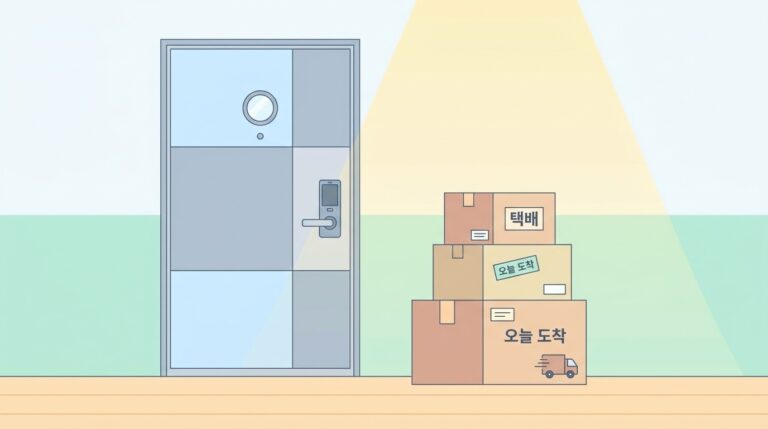
Picture this: You are relaxing in your cozy Airbnb in Seoul after a long day of exploring, waiting for that cute K-beauty haul or late-night snack you ordered online. Suddenly, the loud chime of your video intercom blares: “Ding-dong!” A deep, booming voice shouts through the speaker: “택배요~ (Taekbae-yo!)”
Your heart instantly drops into your stomach. Your mind goes completely blank. What do I say? Do I open the door? Do I need to sign something? Is it rude to stay inside?
If you have ever frozen in terror in front of an apartment intercom in Korea, take a deep breath—you are definitely not alone! In a country famous for its world-renowned lightning-speed delivery culture (Ppalli-Ppalli in full effect), getting packages delivered directly to your doorstep is practically a daily ritual. This practical survival guide is curated directly from real expat hurdles and beginner questions so that you can handle parcel deliveries smoothly, politely, and completely stress-free!
Phase 2: 핵심 표현 3선 심층 분석 (Top 3 Core Expressions)
1. 택배 왔습니다 (Taekbae watseumnida) / 택배요 (Taekbaeyo)
- Pronunciation: [Taek-bae wat-seum-ni-da] / [Taek-bae-yo] (Think: “Tack-bay waht-seum-nee-da” / “Tack-bay-yo”)
- Meaning: Literal: “Delivery has arrived” | Real nuance: “Package delivery here!”
- K-Culture Moment: The iconic delivery shout heard in every modern K-Drama when a character receives an anonymous gift, sudden online order, or fresh kimchi sent by their mom in the countryside.
- Editor’s Insight: You will hear this phrase shouted by the courier through the door or intercom. Couriers usually shorten it to a friendly, brisk “택배요!”.
- Situation Spectrum: Casual: ⚠️ | Semi-formal: ✅ | Formal: ✅
- 🤔 Think About It: In your home country, do delivery drivers announce the specific word “package” out loud, or do they just knock and leave?
2. 문 앞에 두고 가주세요 (Mun ape dugo gajuseyo)
- Pronunciation: [Mun a-pe du-go ga-ju-se-yo] (Think: “Moon ah-peh doo-go gah-joo-say-yo”)
- Meaning: Literal: “Leave it in front of the door and please go” | Real nuance: “Please leave it at the door.”
- K-Culture Moment: Used by homebody K-Drama characters who want contactless delivery without changing out of their loungewear.
- Editor’s Insight: This is your golden superpower phrase! Korea is famous for safe, contactless delivery (비대면 배송). Saying this politely lets the driver know they can just drop it and leave immediately.
- Situation Spectrum: Casual: 🚫 | Semi-formal: ✅ | Formal: ✅
- 🤔 Think About It: Korea has an exceptionally high-trust delivery ecosystem where packages stay untouched in hallways for hours. How does this compare to package theft concerns in your country?
3. 감사합니다, 수고하세요 (Gamsahamnida, sugohaseyo)
- Pronunciation: [Gam-sa-ham-ni-da, su-go-ha-se-yo] (Think: “Gahm-sah-hahm-nee-dah, soo-go-hah-say-yo”)
- Meaning: Literal: “Thank you, please labor hard” | Real nuance: “Thank you so much for your hard work! / Have a good one!”
- K-Culture Moment: The warm, polite phrase shouted through the door by grateful apartment residents to hardworking couriers.
- Editor’s Insight: Saying “수고하세요” acknowledges the physical effort of service workers. It shows immense respect and warmth.
- Situation Spectrum: Casual: 🚫 | Semi-formal: ✅ | Formal: ✅
- 🤔 Think About It: Why does the Korean language have built-in formulas dedicated exclusively to thanking people for their manual effort?
Phase 3: 교과서 한국어 vs 진짜 한국어 (Textbook vs. Real-World Korean)
Situation 1: Asking the courier to leave the box at the door
- 📖 교과서 한국어 (Textbook): “소포를 문 앞에 놓아주십시오.” (So-po-reul mun a-pe noh-a-ju-sip-si-o.)
- 🗣️ 진짜 한국어 (Real-World): “문 앞에 놔주세요!” (Mun a-pe nwa-ju-se-yo!)
- 💡 왜 다를까? (Why the difference?): While “소포” (parcel) and “~놓아주십시오” are grammatically flawless, native speakers prefer the concise verb “놔주세요” (shortened from 놓아주세요) for quick, crisp everyday communication.
Situation 2: The delivery person announcing their arrival
- 📖 교과서 한국어 (Textbook): “택배 배달원이 도착했습니다.” (Taekbae baedal-won-i dochak-haetseumnida.)
- 🗣️ 진짜 한국어 (Real-World): “택배요!” (Taekbae-yo!)
- 💡 왜 다를까? (Why the difference?): Couriers in Korea handle hundreds of boxes daily and operate on tight schedules. A single, energetic word conveys everything instantly.
Phase 4: K-Culture 딥다이브 & 비언어적 매너 (Deep Dive & Non-Verbal Manners)
4-1. 눈치 (Nunchi) & Intercom Etiquette
- Check the Wall Monitor: Most modern Korean apartments and studios (One-rooms) have a video intercom screen (월패드/인터폰). Check the camera before answering.
- Quick & Clear Voice: You don’t need to open the door. Press the talk button (통화), speak clearly, and say “문 앞에 놔주세요! 감사합니다~”.
- Small Head Bow: Even through the door or intercom, Koreans often do a slight nod of the head as an involuntary habit of polite respect.
4-2. Culture Code: The Magic of “Coupang Rocket Delivery” (로켓배송)
Korea’s delivery speed is legendary. You can order groceries or skincare at 11:59 PM and find them outside your door by 7:00 AM the next morning (새벽배송 – Dawn Delivery). Because speed and efficiency are key, couriers rarely wait for you to open the door—they knock, announce, set the box down, snap a confirmation photo for the app, and move to the next floor within seconds!
Phase 5: 실전 롤플레이 시나리오 (Real-Life Roleplay Scenario)
Setting: You are inside your rental studio in Mapo-gu, Seoul. The intercom buzzes.
Characters: Courier Driver Mr. Kim (NPC) & You (Traveler/Learner)
- 🎭 Mr. Kim: (Buzzer rings) 띵동! 택배요~ (Dding-dong! Taekbae-yo! – Delivery here!)
- 🎭 You: (Pressing the intercom button nervously) 네, 누구세요? (Ne, nugu-se-yo? – Yes, who is it?)
- 🎭 Mr. Kim: 302호 맞으시죠? 택배 왔습니다. (Sam-baek-i-ho majeusi-jyo? Taekbae watseumnida. – Room 302, right? Your package is here.)
- 🎭 You: 네, 맞아요! (Ne, majayo! – Yes, that’s right!)
- 🎭 Mr. Kim: 문 열어드릴까요, 아니면 앞에 둘까요? (Mun yeoreo-deuril-kkayo, animyeon ape dulkkayo? – Should I open/hand it, or leave it outside?)
- 🎭 You: 문 앞에 두고 가주세요! (Mun ape dugo gajuseyo! – Please leave it in front of the door!)
- 🎭 Mr. Kim: 네~ 문 앞에 뒀습니다. 수고하세요! (Ne~ mun ape dwoetseumnida. Sugohaseyo! – Okay~ Left it at the door. Have a good one!)
- 🎭 You: 네, 감사합니다! (Ne, gamsahamnida! – Yes, thank you!)
🔀 인터랙티브 분기점 (Interactive Choice Point)
When the delivery person asks if they should leave it or hand it to you, what do you say?
- Option A: “문 앞에 놔주세요, 감사합니다!” (Leave it at the door, thank you!)
- Option B: “안 돼요, 그냥 가세요.” (No, just go away.)
- Option C: “택배 누구야?” (Who is delivery?) without honorifics.
-
Choice Feedback:
- Choice A (Best!): ⭐ Perfection! Clear, polite, and follows modern contactless delivery etiquette.
- Choice B (Bad): 🚫 You might end up having your order canceled or returned to the warehouse!
- Choice C (Risk): ⚠️ Grammatically incorrect and sounds rude (banmal/informal tone) to an elder service worker.
Phase 6: 10초 감정 섀도잉 드릴 (10-Second Emotion Shadowing Drill)
Practice these phrases out loud matching the emotional tones and breath pauses (/):
[😊 Calm & Polite]네~ / 문 앞에 / 놔주세요! (Ne~ / mun a-pe / nwa-ju-se-yo!)[🙌 Energetic & Grateful]네, / 감사합니다! / 수고하세요~ (Ne, / gam-sa-ham-ni-da! / su-go-ha-se-yo~)[👀 Inquiring & Gentle]택배 / 어디에 / 두셨나요? (Taekbae / eo-di-e / du-syeon-na-yo? – Where did you place the delivery?)
Phase 7: K-Culture 미니 사전 (Mini Dictionary)
- 택배 (Taek-bae): Parcel delivery service / package.
- 비대면 배송 (Bi-dae-myeon bae-song): Contactless delivery (dropping the package in front of the unit without direct face-to-face interaction).
- 문 앞 (Mun ap): In front of the door / doorstep.
- 송장번호 (Song-jang beon-ho): Tracking number / Waybill number.
Phase 8: 여행자를 위한 생존 키트 (Traveler’s Survival Kit)
Survival Expressions TOP 3
- 문 앞에 놔주세요. (Mun ape nwa-ju-se-yo) — “Please leave it at the door.” (Pro Tip: Use when you’re busy or not dressed up).
- 경비실에 맡겨주세요. (Gyeong-bi-sil-e mat-gyeo-ju-se-yo) — “Please leave it with the security office.” (Pro Tip: Great for large apartment complexes when you’re away).
- 택배 보관함에 넣어주세요. (Taekbae bo-gwan-ham-e neo-eo-ju-se-yo) — “Please place it in the smart delivery locker.”
Editor’s Travel Note
- If you want to check local shopping spots or find your residential address accurately in Korean, make sure to check out our guide to downloading Naver Map app and finding addresses.
- Always include your Korean phone number and detailed room number (e.g., #301호) when ordering so delivery couriers can text your photo confirmation smoothly.
Phase 9: “한 발 더 깊이” (Deep Cultural Insight)
In many major metropolises worldwide, leaving an expensive smartphone or branded sneakers sitting in an open apartment hallway for 12 hours is an invitation for porch piracy. In South Korea, however, a unique combination of pervasive CCTV networks, building security, and deep communal social trust makes hallway drop-offs the undisputed industry standard. It reflects a society built heavily on mutual respect and shared public responsibility.
💬 Your Turn: What is delivery culture like in your home country? Would you feel safe having packages left right in front of your front door? Share your thoughts below! 👇
Phase 10: FAQ & 오해 방지 (FAQ Schema)
Q: Do I need to sign or give a tip to the Korean delivery driver?
A: No! Tipping is not part of Korean culture, and post-pandemic delivery is 99% digital and contactless. No physical signature is required.
Q: What if I am not home when the delivery arrives?
A: Couriers almost always leave it safely in front of your doorstep (문 앞) and send a text message containing a photo proof of delivery.
Q: How do I tell the driver my front door entrance passcode?
A: In online delivery notes, you write “공동현관 비밀번호: #1234*” (Common entrance passcode) so they can enter the building lobby.
🚨 흔한 실수 (Common Mistakes) Top 3
- Mistake: Opening the door instantly in your pajamas without checking who it is.
- Correct Action: Check the video intercom screen first, then simply answer with “문 앞에 놔주세요!”
- Mistake: Saying “고마워” (informal thank you) to the delivery driver.
- Correct Action: Always use polite honorifics: “감사합니다! (Gamsahamnida)” or “수고하세요! (Sugohaseyo)”.
- Mistake: Forgetting to write the building entry code on your delivery app.
- Correct Action: Always provide the 공동현관 비밀번호 (Lobby passcode) in the delivery memo.
Phase 11: 액션 미션 & 참여 유도 (Action Missions)
- 🥉 Bronze Mission: Stand in front of your mirror and practice saying “문 앞에 놔주세요, 감사합니다!” 3 times smoothly.
- 🥈 Silver Mission: Save the phrase in your phone’s quick memo so you can copy-paste it into delivery requests.
- 🥇 Gold Mission: Next time you hear a knock or buzzer in Korea, calmly reply via intercom without opening the door.
- 🎮 K-Culture Mission: Watch a slice-of-life K-drama episode and spot the moment a character receives a box shouting “택배요!”.
Phase 12: 인터랙티브 퀴즈 챌린지 (Interactive Quiz)
1. Situational Judgment:
The intercom rings and the courier says “택배요!”. You are in the shower and cannot open the door. What is the best phrase to say?
* A) 가세요! (Go away!)
* B) 문 앞에 놔주세요! (Please leave it at the door!)
* C) 안 돼요! (No way!)
🔍 Check Answer & Explanation
Correct Answer: B
Explanation: “문 앞에 놔주세요!” is the standard, polite, and most helpful response for contactless delivery.
2. Fill in the Blank:
“Thank you for your hard work!” in Korean is “감사합니다, ( _______ )!”
🔍 Check Answer & Explanation
Correct Answer: 수고하세요 (sugohaseyo)
Explanation: “수고하세요” acknowledges the physical labor and effort of service workers.
3. True or False:
In Korea, you should tip the delivery driver 10-15% in cash when they bring your package.
🔍 Check Answer & Explanation
Correct Answer: False
Explanation: Korea has zero tipping culture. All delivery fees are paid upfront through the app or website!







