

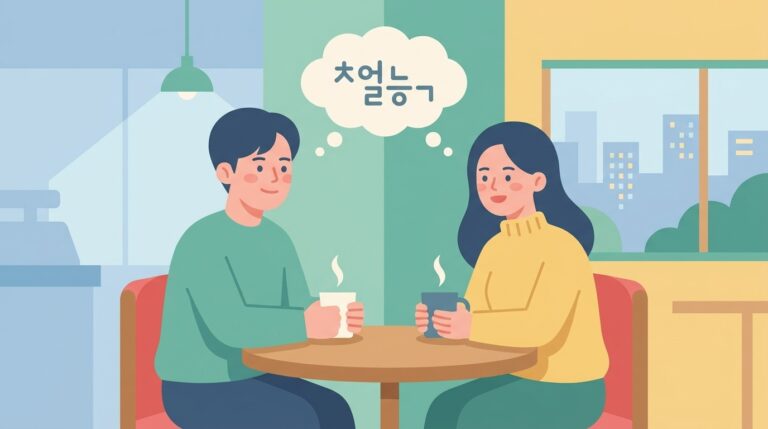
How to Ask ‘How Are You Feeling?’ in Korean Like a Real Friend
Phase 1: Empathy (Story-Immersive Opening)
안녕하세요! (Annyeonghaseyo!) I’m your Daily Hangul editor and cultural navigator. Have you ever watched a K-Drama where the main lead suddenly looks drained after a rough day at work, and their close friend leans in softly asking, “기분 어때?” or “무슨 일 있어?”?
You probably wanted to reach through the screen and check in on your favorite bias or friend just like that! But when you open a standard textbook, you’re usually taught stiff phrases like “기분이 어떠십니까?” (which sounds like an automated survey machine) or “어떻게 지내세요?” (which is way too formal for close mates). In real Korean everyday life, checking someone’s emotional pulse requires a delicate blend of warm intonation, empathy, and intuitive body language called Nunchi. This guide is built directly on real learner questions and native speech habits to give you practical, authentic expressions you can use today.
Phase 2: Top 3 Core Expressions Deep-Dive
1. 기분 어때요? (Gi-bun eo-ttae-yo?)
- Pronunciation: [Gi-bun eo-ttae-yo?] (Sounds like: GEE-boon uh-tteh-yo?)
- Meaning: Direct: “How is your feeling?” | Real Nuance: “How are you feeling right now?”
- K-Culture Moment: Used on casual vlogs and reality shows when idols ask team members after a stage performance or during a cozy coffee break.
- Editor’s Insight: 기분 (Gibun) refers directly to inner mood or emotional state at this exact moment. Adding 요 (yo) keeps it polite yet friendly.
- Situation Spectrum: Casual (기분 어때?): ✅ | Semi-formal (기분 어때요?): ✅ | Strict Formal: ⚠️
- 🤔 Think About It: In English, we often ask “How are you?” as a greeting without expecting deep emotional answers. In Korean, 기분 어때요? genuinely asks about internal feelings.
2. 무슨 일 있어요? (Mu-seun il i-sseo-yo?)
- Pronunciation: [Mu-seun il i-sseo-yo?] (Sounds like: MOO-seun eel ee-ssuh-yo?)
- Meaning: Direct: “Is there some work/matter?” | Real Nuance: “Is something bothering you? / Did something happen?”
- K-Culture Moment: The classic comfort line in K-Dramas when someone notices their friend sighing heavily over convenience store ramen.
- Editor’s Insight: Don’t use this as an upbeat greeting! Only use it when you sense subtle hints of worry, stress, or sadness in the other person.
- Situation Spectrum: Casual (무슨 일 있어?): ✅ | Semi-formal (무슨 일 있어요?): ✅ | Strict Formal (무슨 일 있으십니까?): ✅
- 🤔 Think About It: Koreans tend not to announce their distress immediately. Asking this shows you have keen Nunchi (social awareness).
3. 오늘 하루 어땠어요? (O-neul ha-ru eo-ttaess-eo-yo?)
- Pronunciation: [O-neul ha-ru eo-ttaess-eo-yo?] (Sounds like: OH-neul ha-roo uh-tteh-ssuh-yo?)
- Meaning: Direct: “How was today one day?” | Real Nuance: “How was your day today?”
- K-Culture Moment: Sent over KakaoTalk at night between dating couples or best friends winding down after work.
- Editor’s Insight: 하루 (Haru) means a full whole day. It invites the listener to share both events and feelings from morning to night.
- Situation Spectrum: Casual (오늘 하루 어땠어?): ✅ | Semi-formal: ✅ | Strict Formal: ⚠️
- 🤔 Think About It: Asking about someone’s whole day conveys warm emotional hospitality (Jeong).
Phase 3: Textbook Korean vs. Real Korean
Situation A: Asking a coworker or classmate who looks down
- 📖 Textbook Korean: 기분이 안 좋습니까? (Gi-bun-i an jo-seum-ni-kka? – Are you not in a good mood?)
- 🗣️ Real Korean: 표정이 안 좋아요. 무슨 일 있어요? (Pyo-jeong-i an jo-a-yo. Mu-seun il i-sseo-yo? – Your face looks worried. Did something happen?)
- 💡 Why the Difference? Directly asking “Is your mood bad?” sounds confrontational. Mentioning facial expression (표정) and asking what happened feels deeply caring.
Situation B: Asking a close friend how they feel after good news
- 📖 Textbook Korean: 그것이 당신을 기쁘게 만듭니까? (Geu-geos-i dang-sin-eul gi-ppeu-ge man-deum-ni-kka? – Does that make you happy?)
- 🗣️ Real Korean: 대박! 기분 짱 좋겠다! (Dae-bak! Gi-bun jjang jo-kket-da! – Awesome! You must feel super great!)
- 💡 Why the Difference? Koreans rarely use translated pronouns like 당신 (dang-sin) in spoken conversation; expressive exclamations (대박, 짱) sound lively and natural.
Phase 4: K-Culture Deep-Dive & Non-Verbal Manners
4-1. Nunchi (눈치) & Gentle Body Language
When asking someone about their feelings in Korea, eye contact shouldn’t be aggressive or piercing. Soften your gaze, tilt your head slightly, and lower your voice pitch by a half-step. If you’re close friends, gently offering a warm beverage (like a warm canned coffee or citron tea) before asking “괜찮아요?” (Are you okay?) bridges the emotional gap instantly.
4-2. Comfort Food Culture (위로 푸드)
Notice how K-Drama characters always bring fried chicken, tteokbokki, or warm soup when someone is feeling low? In Korea, asking about emotions is intimately tied to asking whether they have eaten (“밥은 먹었어?”). Food is the premier non-verbal language of emotional care.
Phase 5: Real-Life Roleplay Scenario
Setting: A cozy cafe near Hongdae in Seoul. You meet your Korean exchange friend, Minji, who is staring blankly at her iced Americano.
- Turn 1 (You): 민지 씨, 안녕하세요! 오늘 얼굴이 조금 피곤해 보여요.
(Minji-ssi, annyeonghaseyo! Oneul eolguri jogeum pigonhae boyeoyo.)
“Hi Minji! You look a little tired today.”🎭 (Sit down softly and make gentle eye contact) - Turn 2 (Minji): 아, 진짜요? 요즘 과제가 너무 많아서 잠을 못 잤어요.
(A, jinjjayo? Yojeum gwajega neomu manaseo jameul mot jasseoyo.)
“Ah, really? I haven’t slept well because of so many assignments lately.”🎭 (Sighs and rubs temples) - Turn 3 (You): 아이고, 힘들겠다… 지금 기분은 어때요?
(Aigo, himdeulgetda… Jigeum gibuneun eottaeyo?)
“Oh no, that must be tough… How are you feeling right now?”🎭 (Pours warm water into a cup) - Turn 4 (Minji): 그냥 머리가 좀 무겁고 지쳐요.
(Geunyang meoriga jom mugeopgo jichyeoyo.)
“My head just feels a bit heavy and exhausted.” - Turn 5 (You): 무슨 일 더 있어요? 혹시 제가 도와줄 일 있어요?
(Mu-seun il deo isseoyo? Hoksi jega dowajul il isseoyo?)
“Is there anything else going on? Is there anything I can help with?” - Turn 6 (Minji): 아니에요, 물어봐 줘서 고마워요. 이야기하니까 좀 나아졌어요.
(Anieyo, mureobwa jwoseo gomawoyo. Iyagihanikka jom naajyeosseoyo.)
“No, thank you for asking. Talking about it makes me feel a bit better.”🎭 (Smiles faintly) - Turn 7 (You): 다행이에요! 달콤한 케이크 하나 먹을래요? 제가 살게요!
(Dahaeng-ieyo! Dalkomhan keikeu hana meogeullaeyo? Jega salgeyo!)
“Glad to hear that! Would you like some sweet cake? My treat!”🎭 (Points cheerfully at dessert display) - Turn 8 (Minji): 와, 좋아요! 당 충전해야겠어요!
(Wa, joayo! Dang chungjeonhaeyagetseoyo!)
“Wow, I’d love that! I definitely need a sugar recharge!”
🔀 Interactive Branching Moment: Minji sighs deeply at Turn 2. What do you say?
- Choice A: “기분이 나빠요? 왜 그래요?” (Are you in a bad mood? Why are you doing that?)
- 🚫 Feedback (Bad): Too direct and slightly accusatory! Can make her feel defensive.
- Choice B: “힘들었죠? 기분 어때요? 무슨 일 있어요?” (That must have been hard! How do you feel? Did something happen?)
- ✅ Feedback (Best): Empathetic, acknowledges her fatigue first, and invites her to talk.
- Choice C: “그냥 웃어요! 화이팅!” (Just smile! Fighting!)
- ⚠️ Feedback (Risk): Well-intentioned, but might come across as dismissing her real tiredness.
Phase 6: 10-Second Emotion Shadowing Drill
Repeat these aloud with matching emotional intonation! (/ marks a brief micro-pause):
[🥺 Caring & Gentle]- 많이 지쳤죠? / 오늘 하루 / 어땠어요?
- (Man-i ji-chyeot-jyo? / O-neul ha-ru / eo-ttaess-eo-yo?)
[🤔 Attentive & Soft]- 안색이 안 좋아 보여요… / 무슨 일 / 있어요?
- (An-saeg-i an jo-a bo-yeo-yo… / Mu-seun il / i-sseo-yo?)
[😊 Cheerful & Uplifting]- 표정이 엄청 밝네요! / 오늘 기분 / 완전 좋죠?
- (Pyo-jeong-i eom-cheong bang-ne-yo! / O-neul gi-bun / wan-jeon jo-tjyo?)
Phase 7: K-Culture Mini Dictionary
- 눈치 (Nunchi): The art of sensing others’ moods, feelings, and thoughts through unspoken context.
- 당 충전 (Dang-chung-jeon): Literally “Sugar recharge.” Refers to eating sweet desserts/drinks to recover from emotional exhaustion.
- 힐링 (Healing): Used in Korea to describe anything that rejuvenates your spirit (e.g., walking in a park, quiet cafe chats).
- 토닥토닥 (Todak-todak): An onomatopoeia for gently patting someone on the back to comfort them.
Phase 8: Traveler’s Survival Kit
Survival Phrases TOP 3
- 괜찮으세요? (Gwaen-chan-eu-se-yo?): Are you okay? (Pro Tip: Essential if someone trips or drops something on the street).
- 오늘 기분 최고예요! (O-neul gi-bun choe-go-ye-yo!): I feel the best today! (Pro Tip: Say this to tour guides or store owners).
- 힘내세요! (Him-nae-se-yo!): Cheer up / You’ve got this! (Pro Tip: Warm farewell to busy shop staff or drivers).
Editor’s Travel Note
When navigating Seoul’s subway and quiet neighborhoods, install the Kakao Map mobile navigation app for real-time walking and transit guides. Also, if you need a quick mood booster on the road, grab a hot drink using simple card tap payments available on any Korean convenience store register.
Phase 9: A Step Deeper (한 발 더 깊이)
In Korean culture, emotions are rarely treated as isolated personal property. Due to the deep-rooted concept of Jeong (정)—an affectionate social bond—checking someone’s mood isn’t seen as prying; it’s seen as responsible caring. When you ask “무슨 일 있어요?”, you are extending a subtle safety net that says: “You don’t have to carry this alone.”
💬 Your Turn: How do people in your home country usually check on someone who looks down? Share your thoughts and stories in the comments below!
Phase 10: FAQ & Common Mistakes
Q: Can I use “기분 어때?” to my boss or teacher?
A: No! 기분 어때? is strictly informal (Banmal) for close friends or younger people. For older seniors or superiors, say “오늘 컨디션은 어떠세요?” (How is your condition today?) instead.
Q: What is the difference between 마음 (Maeum) and 기분 (Gibun)?
A: 기분 (Gibun) is your immediate, temporary mood (e.g., happy because of ice cream). 마음 (Maeum) refers to deeper heart, mind, or long-term intentions.
Q: How do I reply if someone asks me “기분 어때요?”?
A: You can say “좋아요!” (I feel good!), “그냥 그래요.” (Just so-so.), or “조금 피곤해요.” (I’m a little tired.).
🚨 Common Mistakes Alert
- ❌ Saying “당신은 어떻게 느껴요?” (Unnatural direct translation of ‘How do you feel?’).
- 👉 Correct Action: Say “기분 어때요?”.
- ❌ Asking “무슨 일 있어요?” with a big broad grin.
- 👉 Correct Action: Match your facial expression to be calm and sympathetic.
- ❌ Overusing textbook “어떻게 지내십니까?” with classmates.
- 👉 Correct Action: Use casual “잘 지냈어?” or “오늘 기분 어때?”.
Phase 11: Action Missions
- 🥉 Bronze Mission (Solo): Stand before a mirror and practice saying “오늘 하루 어땠어요?” with 3 different emotional tones.
- 🥈 Silver Mission (Social): Leave a comment on your favorite K-Pop idol’s social media post asking “오늘 기분 어때요? 푹 쉬어요!”
- 🥇 Gold Mission (Real Life): Ask your Korean language partner or tutor “오늘 기분 어때요?” at the start of your next lesson!
- 🎮 K-Culture Mission: Watch the first 10 minutes of your favorite K-Drama and spot which character uses 눈치 (Nunchi) to check someone’s mood.
Phase 12: Interactive Quiz Challenge
1. Situation Quiz: Your friend passed their TOPIK exam with top scores. Which expression is the most natural to ask/celebrate their mood?
* A) 기분이 안 좋아요?
* B) 기분 완전 짱이죠?
* C) 무슨 일 있으십니까?
👉 Click to reveal Answer & Explanation
Answer: B) 기분 완전 짱이죠?
Explanation: 기분 완전 짱이죠? means “You feel totally on top of the world, right?” which perfectly matches a joyful celebration!
2. Fill-in-the-Blank: Complete the question to ask ‘Did something happen?’:
* “얼굴이 안 좋아 보여요. 무슨 [ ] 있어요?”
👉 Click to reveal Answer & Explanation
Answer: 일 (il)
Explanation: 무슨 일 있어요? (Mu-seun il i-sseo-yo?) is the classic phrase to ask “Did something happen?”.
3. True or False: You can comfortably say “기분 어때?” to your Korean university professor.
👉 Click to reveal Answer & Explanation
Answer: False
Explanation: 기분 어때? is informal Banmal. To a professor, polite honorifics like “교수님, 오늘 컨디션은 어떠세요?” are required.






