

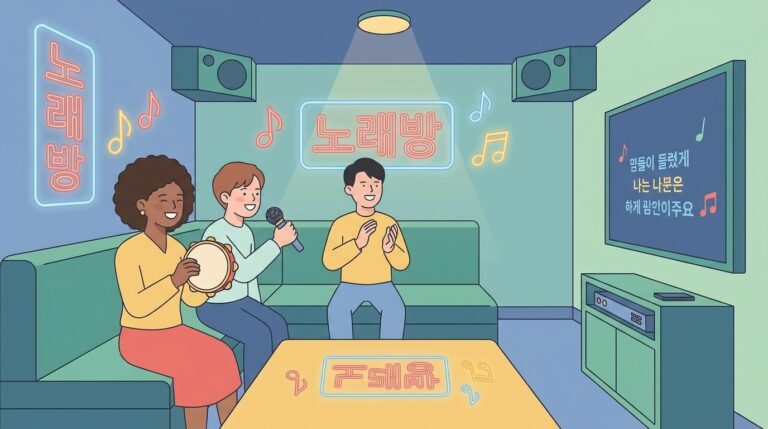
How to Own the Room at a Korean Noraebang: The Ultimate Tambourine & Hype Master Guide
Phase 1: Empathy (Story-Driven Opening)
안녕하세요! 매일한글 (Daily Hangul) Editor here! Have you ever stepped into a neon-lit Korean Noraebang (karaoke room) with Korean friends or co-workers, only to freeze when a metallic jingle gets thrust into your hands? The disco lights flash, a high-tempo K-Pop beat drops, and suddenly everyone expects you to be the life of the party with a tambourine. If you’ve ever sat awkwardly in the corner staring at your phone while everyone else seemed to have mastered a synchronized choreography of shaking, clapping, and chanting—you are definitely not alone. Based on feedback from hundreds of our intermediate learners, conquering the social rhythm of Noraebang is one of the most intimidating yet rewarding milestones in Korea. Mastering just a few hype phrases and rhythm tricks will instantly transform you from a shy spectator into the most beloved hype master in any Korean gathering. Let’s dive in!
Phase 2: Deep Dive into Top 3 Core Expressions
1. 분위기 띄워 볼까요? (Bun-wi-gi ttui-wo bol-kka-yo?)
- Pronunciation: [Bun-wi-gi ttui-wo bol-kka-yo?] (Think: “Boon-we-gee ttee-wah bowl-kkah-yoh?”)
- Meaning: Literal: “Shall we float the atmosphere?” | Real Nuance: “Let’s get this party started / Let’s hype things up!”
- K-Culture Moment: Used right when turning on the disco ball and picking the first upbeat dance track in variety shows like Hangout with Yoo.
- Editor’s Insight: In Korean, the mood isn’t just “warmed up”; it is “floated” (띄우다). You are physically lifting the energy of the room higher.
- Situation Spectrum: Casual ✅ | Semi-formal ✅ | Formal ⚠️
- 🤔 Think About It: Why does Korean describe mood elevation as “floating” or “lifting” rather than just “heating up” like in English?
2. 호응 좀 해주세요! (Ho-eung jom hae-ju-se-yo!)
- Pronunciation: [Ho-eung jom hae-ju-se-yo!] (Sounds like: “Hoh-eung jome hae-joo-seh-yoh!”)
- Meaning: Literal: “Please give some response!” | Real Nuance: “Make some noise! / Let me hear you!”
- K-Culture Moment: Shouted into the mic by the lead singer right before the chorus to rally tambourine shakes and hand claps.
- Editor’s Insight: ‘호응’ (Ho-eung) is mutual resonance. Asking for it playfully breaks the awkward ice and commands collective participation.
- Situation Spectrum: Casual ✅ | Semi-formal ✅ | Formal 🚫
- 🤔 Think About It: How does asking for an audience response reflect the Korean emphasis on collective harmony over solo performance?
3. 탬버린 솜씨 장난 아닌데요? (Taem-beo-rin som-ssi jang-nan a-nin-de-yo?)
- Pronunciation: [Taem-beo-rin som-ssi jang-nan a-nin-de-yo?] (Sounds like: “Taem-buh-reen sohm-shee jahng-nahn ah-neen-deh-yoh?”)
- Meaning: Literal: “Your tambourine skill is no joke!” | Real Nuance: “Whoa, your tambourine game is insane!”
- K-Culture Moment: Said when a friend starts tapping the tambourine against their elbow and hip in lightning-fast rhythm.
- Editor’s Insight: ‘장난 아니다’ (no joke) is the go-to intermediate slang to compliment effortless, mind-blowing skill.
- Situation Spectrum: Casual ✅ | Semi-formal ✅ | Formal ⚠️
- 🤔 Think About It: In your culture, do people compliment rhythm accessories, or is attention strictly reserved for the lead singer?
Phase 3: Textbook Korean vs. Real Korean
Situation 1: Calling for Cheers & Hype
- 📖 Textbook Korean: “모두 함께 박수를 칩시다.” (Let us all clap our hands together.)
- 🗣️ Real Korean: “소리 질러~!” (Make some noise~!)
- 💡 Why the difference? Textbook phrases sound like an official sports day announcement. Real Noraebang culture demands energetic concert-style shoutouts.
Situation 2: Praising a Song Choice
- 📖 Textbook Korean: “이 노래는 매우 훌륭한 선택입니다.” (This song is a very good choice.)
- 🗣️ Real Korean: “선곡 미쳤다!” (This song pick is insane!)
- 💡 Why the difference? ‘미쳤다’ (crazy/insane) expresses instantaneous enthusiasm and cultural bonding over a legendary throwback or hit track.
Phase 4: K-Culture Deep Dive & Non-Verbal Etiquette
4-1. 눈치 (Nunchi) & The Tambourine Posture
- The 4-Hit Rhythm Rule: Never shake continuously like a shaker. Strike on beats 2 and 4, alternating between your palm and your hip or elbow.
- Eye Contact & Chime In: Look at the singer, not the lyrics screen. When they hit high notes, raise the tambourine high overhead with a cheer.
- Mic Distance Courtesy: Never shake the tambourine right next to someone’s active microphone—keep it at chest level slightly away.
4-2. Cultural Code: The Heung (흥) Collective High
- In Korean Noraebang, a “good singer” is appreciated, but the “Hype Maker” (분위기 메이커) is universally loved. Noraebang is not a solo concert; it is a shared stress-release ritual rooted in Heung (the infectious Korean spirit of collective joy).
Phase 5: Real-Life Roleplay Scenario
Setting: A vibrant Noraebang in Hongdae after dinner with coworkers Minho and Jisoo.
- Minho: “자, 다음 곡 누구야? 신나는 걸로 가자!” (Alright, whose song is next? Let’s go with something upbeat!)
🎭 Selects a classic 2000s K-Pop dance hit - You: “제가 분위기 띄워 볼게요!” (I’ll hype the room up!)
🎭 Grabs two tambourines with a confident grin - Jisoo: “오! 준비 완료? 탬버린 장전 완료!” (Oh! Ready? Tambourine fully loaded!)
🎭 Handing you the mic - Minho: “반주 나온다! 소리 질러!” (The beat is starting! Make some noise!)
🎭 Intro music starts blasting with heavy bass - You: “다 같이 호응 좀 해주세요!” (Everyone, let’s hear some noise together!)
🎭 Striking tambourine on elbow to the beat - Jisoo: “와, 탬버린 솜씨 장난 아닌데요?” (Wow, your tambourine skill is no joke!)
🎭 Dancing along while clapping - You: “선곡 미쳤잖아요, 안 흔들 수가 없어요!” (This song pick is crazy good, I couldn’t not shake it!)
🎭 High-fiving Minho while shaking tambourine overhead - Minho: “오늘 밤 주인공은 너다! 달려보자!” (You’re the main character tonight! Let’s ride this wave!)
🎭 Singing the first verse enthusiastically
🔀 Interactive Choice Point
The singer just entered the bridge of a fast dance song. What do you do?
* Option A: Shake the tambourine rapidly over your head and chant: “떼창 가자!” (Let’s sing together!).
* Option B: Put the tambourine on the table and check your smartphone silently.
* Option C: Press the ‘취소’ (Cancel) button on the remote to skip to your own song.
Feedback:
* Option A (Best!): Perfect! You are keeping the energy peak and encouraging everyone to join the chorus.
* Option B (Bad): Sitting quietly on your phone during a high-energy song kills the group chemistry (분위기 깬다).
* Option C (Risk): Critical Noraebang sin! Never cancel another person’s song unless they explicitly ask you to.
Phase 6: 10-Second Emotional Shadowing Drill
[🔥 파이팅 넘치고 신나게]“자, / 오늘 제대로 / 분위기 띄워 볼까요?”[🎤 콘서트 가수처럼 당당하게]“여러분 / 박수 치면서 / 호응 좀 해주세요!”[😲 감탄하며 리듬감 있게]“와, / 리듬감 대박! / 탬버린 솜씨 장난 아닌데요?”
Phase 7: K-Culture Mini Dictionary
- 분위기 메이커 (Bun-wi-gi Me-i-keo): Mood maker / Life of the party who keeps group gatherings engaging.
- 떼창 (Tte-chang): Group sing-along / Crowds chanting and singing lyrics in unison.
- 간주 점프 (Gan-ju Jeom-peu): Interlude skip button on the karaoke remote used to jump directly to the next verse.
- 칼박 (Kal-bak): Knife-sharp rhythm / Perfect timing on the beat.
Phase 8: Traveler’s Survival Kit
- Top 1: “간주 점프 눌러주세요!” (Gan-ju jeom-peu nul-leo-ju-se-yo! – Please press the interlude skip!) 💡 Pro Tip: Speeds up song duration when time is running short.
- Top 2: “보너스 시간 좀 더 주시면 안 돼요?” (Bo-neo-seu si-gan jom deo ju-si-myeon an dwae-yo? – Could you give us a little bonus time?) 💡 Pro Tip: Noraebang owners frequently grant 10-30 minutes of free ‘service time’ if you ask politely.
- Top 3: “마이크 볼륨 좀 올려주세요.” (Ma-i-keu bol-lyum jom ol-lyeo-ju-se-yo. – Please turn up the mic volume.)
Editor’s Travel Note
Always search for nearby coin karaoke (코인노래방) on KakaoMap app download for local navigation for solo practice before going to a big group room. Most places accept Korean transit cards (T-Money) or contactless cards at the kiosk.
Phase 9: A Step Deeper (Reflection)
In Western party culture, karaoke can often feel like an individual audition where vocal accuracy takes center stage. In Korean culture, Noraebang is fundamentally collective emotional therapy (한과 흥). Shaking the tambourine is an intentional act of hospitality: it signals to the singer, “You are safe, you are supported, and we are celebrating together.”
💬 Your Turn: What is the go-to party accessory or gesture in your home country to cheer on friends?
Phase 10: FAQ & Common Mistakes
Q: Can I practice singing and using the tambourine alone in Korea?
A: Absolutely! Look for 코인노래방 (Coin Noraebang). You pay per song (usually 500~1,000 KRW for 2-3 songs) and each private booth includes tambourines and microphones for solo practice.
Q: What should I do if someone is singing a slow sad ballad?
A: Put the tambourine down or shake it very softly on single accents. Wave your lit phone flashlight slowly from side to side instead.
Q: Is it rude to reserve songs while someone else is singing?
A: It is completely fine and encouraged, provided you press ‘예약’ (Reserve) instead of ‘시작’ (Start immediately), which would cut their current track.
🚨 Common Mistakes Warning Board
- Mistake: Pressing ‘시작’ (Start) when picking your track. ➔ Fix: Always press ‘예약’ (Reserve) so it queues without interrupting.
- Mistake: Dominating the microphone for three consecutive tracks. ➔ Fix: Take turns and use tambourine duties between your songs.
- Mistake: Shaking the tambourine constantly with no rhythm. ➔ Fix: Match the snare beat (beats 2 and 4) for a polished, supportive groove.
Phase 11: Action Missions
- 🥉 Bronze Mission: Practice holding the rhythm drill sentence with hand claps in front of your mirror 3 times.
- 🥈 Silver Mission: Post your favorite K-Pop hype song in the comments below using the phrase “선곡 미쳤다!”.
- 🥇 Gold Mission: Next time you visit a Noraebang or coin karaoke booth, hype up the room using “호응 좀 해주세요!” with full tambourine technique.
- 🎮 K-Culture Mission: Watch an episode of a Korean variety show (e.g., Running Man) and spot the cast shaking tambourines during game penalties or song segments.
Phase 12: Interactive Quiz Challenge
1. Situation Check: Your coworker is singing an energetic rock track. What is the most natural Korean phrase to hype them up?
* A) 조용히 해 주세요.
* B) 호응 좀 해주세요!
* C) 집에 가고 싶어요.
2. Fill in the Blank: “와, 탬버린 _____ 장난 아닌데요?” (Wow, your tambourine skill is no joke!)
* A) 선곡
* B) 솜씨
* C) 간주
3. True or False: Pressing ‘간주 점프’ during a long instrumental bridge is considered good etiquette in Noraebang when saving time.
🔍 Click to Reveal Answers & Explanations
- Answer: B (‘호응 좀 해주세요!’ rallies the room to cheer along. Option A means ‘Please be quiet’ and Option C means ‘I want to go home’!).
- Answer: B (솜씨) (‘솜씨’ means skill or craftsmanship; ‘선곡’ is song selection, ‘간주’ is interlude).
- Answer: True (Skipping long instrumental solos keeps the room lively and saves precious paid minutes!).







