

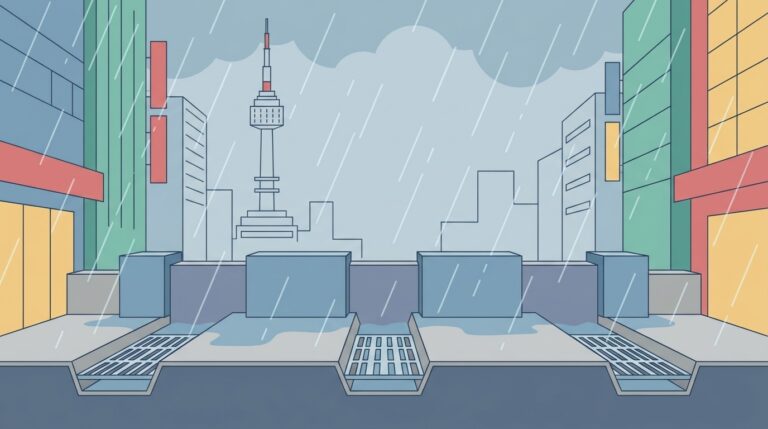
Conquering Korea’s Monsoons: Advanced Urban Flood Safety and Essential Lexicon
Phase 1: Empathy (Story-Immersive Opening)
안녕하세요! It’s your trusted Daily Hangul editor here. Picture this: It is late July in Gangnam. What began as a mild drizzle quickly morphs into an apocalyptic downpour—the kind of torrential rain (gijungho-u) that turns asphalt roads into cascading streams within thirty minutes. Your phone suddenly screeches with a piercing emergency alert sound: [행정안전부] 호우경보 발효, 지하차도 및 저지대 침수 우려.
If you have ever watched the movie Parasite (기생충) or seen breaking news during Korea’s monsoon season (jangma), you know that urban flash flooding is no cinematic exaggeration. Korea’s hyper-dense infrastructure relies heavily on automated floodgates, massive underground water detention basins, and residential bulkhead barriers. However, when sirens wail and subways bypass flooded stations, textbook phrases like “비가 많이 와요” (It’s raining a lot) won’t help you navigate emergency broadcasts, communicate with local building managers (gwalliin), or understand municipal diversion protocols.
At the C2 proficiency tier, master-level fluency requires you to decode rapid administrative alerts, interpret socio-technical flood prevention systems, and articulate urgent concerns with precise diplomatic and civic authority. Drawing from ten years of navigating Seoul’s extreme weather seasons and feedback from advanced international professionals living in Korea, this guide equips you with nuanced disaster-safety Korean that keeps you safe, informed, and completely in control.
Phase 2: Top 3 Core Expressions in Depth
1. 침수 피해를 방지하기 위해 물막이판(차수판)을 전면 가동해 주세요.
- Pronunciation: Chimsu pihaereul bangjihagi wihae mulmagipan(chasupan)eul jeonmyeon gadonghae juseyo. (Sounds like: cheem-soo pee-hae-reul bahng-jee-hah-gee wee-hae mool-mah-gee-pahn jeon-myeon gah-dong-hae joo-seh-yo)
- Meaning: Literal: “To prevent flood damage, please fully operate the water-blocking board (flood barrier).” / Real Nuance: “Please urgently deploy the bulkhead floodgates/retaining barriers to prevent incoming inundation.”
- K-Culture Moment: Seen frequently in urban disaster thrillers and reality disaster docus where underground parking superintendents deploy steel flood barriers (chasupan) before ramp water surges.
- Editor’s Insight: 차수판 (遮水板 – chasupan) is the Sino-Korean technical term, while 물막이판 (mulmagipan) is the native Korean equivalent. Using 전면 가동 (jeonmyeon gadong) conveys operational urgency without sounding panicked.
- Situation Spectrum: Casual 🚫 | Semi-formal ⚠️ | Formal ✅
- 🤔 Think About It: Notice how Korean urban safety vocabulary combines native physical nouns (물막이) with Sino-Korean technical imperatives (방지, 전면 가동). How does your native language balance civic directives vs. everyday speech during a crisis?
2. 배수 시설 역류 우려로 인하여 인근 지하차도 진입이 전면 통제되고 있습니다.
- Pronunciation: Baesu siseol yeokryu uryeoro inhayeo ingeun jihachado jinibi jeonmyeon tongjedeogo itseumnida. (Sounds like: bae-soo shee-seol yeong-nyoo oo-ryeo-ro een-hah-yeo een-geun jee-hah-chah-doh jee-neeb-ee jeon-myeon tong-jeh-dwae-goh eet-seum-nee-dah)
- Meaning: Literal: “Due to concerns over drainage system backflow, entry into the nearby underpass is fully controlled.” / Real Nuance: “The surrounding underpass has been completely closed off due to impending storm drain overflow.”
- K-Culture Moment: The iconic real-time scroll on SBS/KBS special disaster broadcasts warning drivers away from low-lying tunnels (지하차도) during peak flash floods.
- Editor’s Insight: 역류 (yeokryu – backflow/overflow) is critical. When urban drainage fails, water surges backwards from manholes. 전면 통제 (jeonmyeon tongje) indicates zero-tolerance vehicular blockade.
- Situation Spectrum: Casual 🚫 | Semi-formal ⚠️ | Formal ✅
- 🤔 Think About It: Passive/objective framing (~되고 있습니다) is utilized in Korean civic alerts to maintain institutional calm rather than stating personal actions.
3. 저지대 상습 침수 구역 주민들께서는 지체 없이 안전지대로 대피하시기 바랍니다.
- Pronunciation: Jeojidae sangseup chimsu guyeok jumindeulkkeseoneun jiche eopsi anjeonjidaero daepihasigi baramnida. (Sounds like: juh-jee-dae sahng-seup cheem-soo goo-yeok joo-meen-deul-kkeh-seo-neun jee-cheh eop-shee ahn-jeon-jee-dae-roh dae-pee-hah-shee-gee bah-rahm-nee-dah)
- Meaning: Literal: “Residents of low-lying chronic flood zones, please evacuate to safe zones without delay.” / Real Nuance: “High-risk basin residents must evacuate immediately to designated emergency shelters.”
- K-Culture Moment: The village loudspeaker (마을 방송) or mobile Disaster Warning message sent when rivers swell past critical stages.
- Editor’s Insight: 상습 (sangseup) denotes habitual/recurrent vulnerability. Pairing it with 지체 없이 (jiche eopsi – without hesitation/delay) escalates the directive to highest urgency level.
- Situation Spectrum: Casual 🚫 | Semi-formal ⚠️ | Formal ✅
- 🤔 Think About It: Note the respectful honorific suffix ~들께서는 (~deulkkeseoneun) even inside urgent public hazard warnings—reflecting Korean society’s enduring linguistic deference.
Phase 3: Textbook Korean vs. Real Native Korean
Situation A: Advising an acquaintance not to drive near riverbank areas during heavy rain
- 📖 교과서 한국어 (Textbook): 비가 많이 내리니까 강 근처 도로에 운전해서 가지 않는 것이 좋습니다. (Since it rains a lot, it is good not to drive near river roads.)
- 🗣️ 진짜 한국어 (Real C2 Native): 지금 게릴라성 호우로 하천변 하상도로랑 둔치 주차장 다 침수됐거든요. 차 빼서 고지대로 돌리세요! (Currently, due to torrential flash rain, riverside bypasses and basin parking lots are completely submerged. Move your car to higher ground right away!)
- 💡 왜 다를까? (Why the difference?): Real Koreans refer specifically to 게릴라성 호우 (guerilla/flash downpour) and 하상도로 (riverbed roads) which are the exact spots prone to sudden water retention.
Situation B: Warning building residents about rising water near basement units
- 📖 교과서 한국어 (Textbook): 지하에 물이 들어올 수 있으니 조심하십시오. (Water can enter the basement, so be careful.)
- 🗣️ 진짜 한국어 (Real C2 Native): 반지하 가구 쪽으로 빗물 유입 조짐이 보이니까, 모래주머니 쌓고 차수판 바로 올려야겠어요. (There are signs of rainwater seepage toward the semi-basement units; we need to stack sandbags and raise the flood barriers immediately.)
- 💡 왜 다를까? (Why the difference?): Natural advanced Korean pinpoints precise flood-defense gear (모래주머니 sandbags, 차수판 flood barrier) and localized housing risks (반지하 semi-basement).
Phase 4: K-Culture Deep Dive & Non-Verbal Etiquette
4-1. Nunchi & Crisis Body Language
During urban flooding in Korea, 눈치 (Nunchi) manifests as heightened spatial awareness and cooperative non-verbal swiftness. When an emergency siren goes off in a commercial building or subway station:
* Observe Collective Flow: Do not freeze or record social media videos near drain grates or basement stairs; Koreans immediately move towards multi-story vertical exits.
* Physical Restraint: Never step on vibrating metal manhole covers (맨홀 뚜껑), as subterranean water pressure can blow them upwards without warning.
* Supportive Demeanor: When neighbors assemble sandbags (모래주머니) in apartment lobbies, standing by passively is viewed negatively. Pitching in or quietly clearing drainage grates shows impeccable civic etiquette.
4-2. Cultural Code Analysis: The Engineering Behind the K-Disaster Infrastructure
In the wake of historic downpours in Seoul’s Gangnam and Sillim districts, Korea rolled out world-class civil safety measures: multi-layered automated flood barriers, smart drainage sensors connected to the Korea Meteorological Administration (기상청), and the National Disaster Safety Portal (국민재난안전포털). Popular K-Dramas like DP or realistic films like Emergency Declaration often reflect how Koreans view communal resilience: rapid institutional response matched by pragmatic neighborhood mutual aid (품앗이 mindset in modern urban life).
Phase 5: Live Action Roleplay Scenario
Setting: Basement level of an officetel in Gangnam during a record-shaking monsoon storm at 11:30 PM. Rain is gushing into the driveway slope.
Characters:
* You (민우/Minwoo): An alert resident fluent in emergency protocols.
* NPC 관리소장님 (Building Manager Kim, 60s): Scrambling to install flood barriers alone against rising water.
[Scene Start: Rain thunders against the glass doors. Alarm beeps on the control panel.]

1. 민우: 소장님! 지하 주차장 램프 쪽으로 빗물이 급격히 유입되고 있는데, 차수판 설치 완료하셨습니까?
(Sojangnim! Jiha juchajang raempeu jjogeuro bimmuri geupgyeokhi yu-ipdoego inneunde, chasupan seolchi wanryohasyeotseumnikka?)
[Manager Kim! Rainwater is surging rapidly into the parking garage ramp; have you finished setting up the flood barrier?]
🎭 [소매를 걷어붙이며 긴박하게 뛰어온다]

2. 관리소장: 아이고, 민우 씨! 유압식 차수판 스위치가 빗물 때문에 오작동을 일으켜서 수동으로 올려야 해요!
(Aigo, Minwoo ssi! Yuapsik chasupan seuwichiga bimmul ttaemune ojakdongeul ireukyeoseo sudong-euro ollyeoya haeyo!)
[Oh my, Minwoo! The hydraulic flood barrier switch is malfunctioning due to rainwater, so we must raise it manually!]
🎭 [스패너를 들고 빗물 속에서 진땀을 흘린다]

3. 민우: 제가 고정 볼트 조이는 거 거들겠습니다. 모래주머니는 양쪽 틈새에 덧대면 될까요?
(Jega gojeong bolteu joineun geo geodeulgetseumnida. Moraejumeonineun yangjjok teumsaee deotdaemyeon doelkkayo?)
[I will help tighten the fixing bolts. Shall we pad the sandbags along both side crevices?]
🎭 [침착하게 장갑을 착용하며 수동 레버를 지탱한다]

4. 관리소장: 그래주면 정말 고맙지! 양쪽 가이드 레일 틈으로 흙탕물이 스며들면 지하 2층까지 차오를 테니까요.
(Geuraejumyeon jeongmal gomapji! Yangjjok gaideu re-il teumeuro heuktangmuri seomyeodeulmyeon jiha icheungkkaji cha-oreul tenikkayo!)
[That would be a lifesaver! If muddy water seeps through the side guide rails, it will fill up to basement level 2.]
🎭 [민우와 함께 무거운 강철 지지대를 밀어 올린다]

5. 민우: 좋습니다! 수동 차수벽 완벽히 결착되었습니다. 이제 배수펌프는 정상 가동 중인가요?
(Jotseumnida! Sudong chasubyeok wanbyeokhi gyeolchakdoeeotseumnida. Ije baesupeompeuneun jeongsang gadong jung-ingayo?)
[Great! The manual bulkhead is completely locked in. Is the sump pump running normally now?]
🎭 [체크 밸브를 확인하며 확신에 찬 목소리로 묻는다]

6. 관리소장: 다행히 집수정 펌프 3대 다 풀가동 중이에요. 주민들한테도 차량 이동 방송 내보냈습니다.
(Dahaenghi jipsujeong peompeu sedae da pulgadong jung-i-eyo. Jumindeulhantedo charyang idong bangsong naebonaesseumnida.)
[Fortunately, all 3 sump pit pumps are running at full capacity. We already broadcasted for residents to evacuate vehicles.]
🎭 [숨을 헐떡이며 안도의 한숨을 쉰다]

7. 민우: 천만다행이네요. 만약을 대비해 반지하 및 저층 세대 역류 방지 밸브도 한 번 더 점검하시죠.
(Cheonmandahaeng-ineyo. Manya-eul daebihae banjiha mit jeocheung sedae yeokryu bangji baelbeudo han beon deo jeomgeomhasijyo.)
[What a relief. Just in case, let's also double-check the backflow prevention valves for semi-basement and lower units.]
🎭 [방재 매뉴얼을 가리키며 꼼꼼하게 짚는다]

8. 관리소장: 민우 씨 아니었으면 큰일 날 뻔했어. 전문가가 따로 없네! 고마워요!
(Minwoo ssi anieosseumyeon keunil nal ppeonhaesseo. Jeonmungaga ttaro eomne! Gomawoyo!)
[If it weren't for you Minwoo, we would have been in catastrophic trouble. You're a true safety pro! Thank you!]
🎭 [민우의 어깨를 툭툭 치며 고마워한다]
🔀 Interactive Branching Points
If the flood water breaches the threshold, what should Minwoo suggest next?
* Option A: “소장님, 위험하니 전원을 즉시 차단하고 옥상 등 고지대로 주민 대피 유도부터 하시죠!” (Manager, it’s dangerous, let’s cut main breakers immediately and evacuate residents upstairs!)
* Feedback (Best): Flawless C2 crisis management! Mitigates electrocution (감전) risks and prioritizes human evacuation over property.
* Option B: “제가 지하 3층 내려가서 배수관 막힌 거 뚫고 올 테니 기다리세요!” (I will go down to basement level 3 and unclog the drain pipe!)
* Feedback (Bad/High Risk): Never enter an inundating basement. Water rushes into underground stairwells at lethal velocity within seconds.
* Option C: “구청에 민원 넣었으니 공무원 올 때까지 로비에서 지켜봅시다.” (I filed a municipal complaint, let’s just watch from the lobby until officials arrive.)
* Feedback (Ineffective): During citywide flash floods, emergency responders are overloaded; proactive immediate neighborhood response is vital.
Phase 6: 10-Second Emotion Shadowing Drill
Master the cadence of real crisis speech by practicing rhythm stops (/) and dynamic intonations:
- [🚨 긴박하고 단호하게 – Urgent & Decisive]
“현재 / 도로 침수가 급속도로 진행 중이니, / 하천 인근 보행을 / 전면 중단해 주십시오!”
(Hyeonjae / doro chimsuga geupsokdoro jinhaeng jung-ini, / hacheon ingeun bohaeng-eul / jeonmyeon jungdanhae jusipsio!) -
[😨 다급하지만 침착을 유지하며 – Anxious yet Composed]
“맨홀 뚜껑에서 / 물이 솟구치고 있어요! / 감전 및 추락 위험이 있으니 / 멀리 우회하세요!”
(Maenhol ttukkeong-eseo / muri sotguchigo isseoyo! / Gamjeon mit churak wiheomi isseuni / meolli uhoehaseyo!) -
[🤝 안도하며 격려하듯이 – Relieved & Reassuring]
“차수판 결착 / 이상 없습니다. / 이제 실내에서 / 비상 방송에 귀 기울이시면 됩니다.”
(Chasupan gyeolchak / isang eopseumnida. / Ije silnaee-seo / bisang bangsonge gwi giurisyimyeon doemnida.)
Phase 7: K-Culture Mini Dictionary
- 차수판 (遮水板 – Chasupan) | Flood Barrier / Bulkhead Partition
- Installed at garage ramps and storefronts to physically prevent floodwater from entering low-elevation structures.
- 게릴라성 호우 (Guerilla-seong Ho-u) | Localized Flash Torrent / Cloudburst
- Sudden, unpredictable, and intense downpours concentrated on a narrow geographic zone over a short duration.
- 집수정 (集水井 – Jipsujeong) | Sump Pit / Water Collection Sump
- An underground basin designed to collect excess runoff before industrial electric pumps (배수펌프) force it out into main storm drains.
- 우회로 (迂回路 – Uhoero) | Detour Route
- Critical traffic term heard across navigation apps (T-Map, KakaoMap) when riverside thoroughfares undergo flood closure.
Phase 8: Traveler’s Survival Kit
Top 3 Emergency Phrases:
- “여기 지하 침수 위험이 있는데, 비상 대피 장소가 어디입니까?” (Yeogi jiha chimsu wiheomi inneunde, bisang daepi jangyoga eodi-imnikka?)
- Pro Tip: Use this in subway stations or shopping malls if storm water begins entering walkways.
- “차량 침수 우려 지역이라 견인 조치나 이동 주차가 시급합니다.” (Charyang chimsu uryeo jiyeogira gyeonin jochina idong juchaga sigeuphamnida.)
- Pro Tip: Essential when speaking with your rental car agency or residential office during heavy storm advisories.
- “누전 차단기가 내려갔는데 감전 위험 확인 부탁드립니다.” (Nujeon chadangiga naeryeogatneunde gamjeon wiheom hwag-in butakdeurimnida.)
- Pro Tip: When basement/ground floor power cuts during rain, do not touch electrical boxes; announce this to facility management.
Editor’s Travel Note:
- Download the Safety Stepping Stone (안전디딤돌 앱) for real-time multilingual government disaster alerts.
- Always monitor live traffic through 네이버 지도 앱 다운로드 or KakaoMap; flooded tunnels turn dark red with clear “통제” (Controlled/Closed) markers.
Phase 9: A Step Deeper (Reflection)
In Korean linguistic culture, disaster discourse relies on collective social responsibility (공동체 의식). Notice how Korean public safety announcements seldom use aggressive commands like “You must run”; instead, they utilize honorific requests such as “~하시기 바랍니다” (We trust/request you to do so) and collective nouns like “우리 구민/주민 여러분” (Our fellow residents). This reflects a cultural expectation that advanced members of society act harmoniously and protect the shared municipal infrastructure together during climate crises.
💬 Your Turn: In your home country, are public disaster alerts direct and authoritative, or do they lean on community responsibility? Share your thoughts below in Korean!
Phase 10: FAQ & Common Pitfalls
Q: What is the difference between 호우주의보 (Heavy Rain Advisory) and 호우경보 (Heavy Rain Warning)?
A: A 호우주의보 is issued when expected rainfall is over 60mm in 3 hours or 110mm in 12 hours. A 호우경보 is the higher tier emergency warning, triggered when rainfall is projected to exceed 90mm in 3 hours or 180mm in 12 hours. At the 경보 stage, low-lying underpasses and river parks are shut down immediately.
Q: Can I open a car door if flood water reaches the window level?
A: No. Due to exterior water pressure (수압), you cannot push the door open. You must wait until the water fills inside up to your chest level (equalizing the pressure) or shatter the side window corner immediately using a headrest pole.
Q: How do I identify safe emergency shelters (대피소) in Korea during floods?
A: Look for designated 주민센터 (Community Service Centers), designated school gyms, or high-ground public facilities marked with yellow-and-blue civil defense (민방위 대피소) emblems.
🚨 Common Mistakes Alert:
- Mistake 1: Calling all heavy rain “비” instead of distinguishing between 폭우 (heavy downpour), 게릴라성 집중호우 (flash torrential rain), and 장마 (monsoon season).
- Correct Action: Use exact meteorological vocabulary to gauge risk accurately.
- Mistake 2: Ignoring the verb 가동하다 (to operate/activate machinery).
- Correct Action: Pair safety barriers and pumps with 가동하다 / 작동시키다 (e.g., “배수펌프를 가동하다”).
- Mistake 3: Walking through flooded asphalt roads in flip-flops.
- Correct Action: Missing open manhole covers and electrical leakage (누전) make walking in submerged streets hazardous; use elevated structures immediately.
Phase 11: Action Mission
- 🥉 Bronze Level: Shadow Phase 6 drills three times out loud until your rhythm stop (/ ) matches native speed.
- 🥈 Silver Level: Open your Korean navigation app (Naver/Kakao Map) during rainy days and locate 2 traffic blockade alerts (교통 통제).
- 🥇 Gold Level: Write a 3-sentence disaster report in Korean simulating an emergency alert for your local neighborhood.
- 🎮 K-Culture Mission: Watch a clip of news reporting on Seoul’s monsoon season and transcribe 3 technical civil safety terms you identify!
Phase 12: Interactive Quiz Challenge
1. Situational Judgment
Water is rising past the rim of your basement entryway. What is the most immediate technical phrase to say to the building management?
* (A) 비가 참 예쁘게 내리네요.
* (B) 차수판을 설치하고 모래주머니로 유입구를 막아주세요!
* (C) 우산을 챙겨서 마당으로 나가겠습니다.
2. Fill in the Blank
기습적인 폭우로 인해 저지대 하천변 도로가 전면 _________되었습니다. (통제 / 허가)
3. Cultural True or False
In Korea, it is safe to step directly onto vibrating manholes during heavy flash rain because city drains are always self-regulated. (True / False)
🔍 Click here to reveal Answers & Detailed Explanations
- Answer: (B)
- Explanation: Requesting bulkhead installation (차수판 설치) and sandbag reinforcement (모래주머니) is the precise action for preventing water inundation.
- Answer: 통제 (Controlled/Blocked)
- Explanation: 전면 통제 means complete vehicular/pedestrian blockade due to flooding dangers.
- Answer: False
- Explanation: Under heavy hydraulic pressure, water and trapped air can explosively blow manhole covers off; stay far away from manhole covers during torrential rains.
- Explanation: Under heavy hydraulic pressure, water and trapped air can explosively blow manhole covers off; stay far away from manhole covers during torrential rains.







