

Mastering Korean AC Etiquette: How to Politely Adjust the Temperature and Save Energy
Phase 1: Empathy & K-Culture Reality Check
안녕하세요! 매일한글 에디터입니다. (Hello! I’m your Daily Hangul editor.)
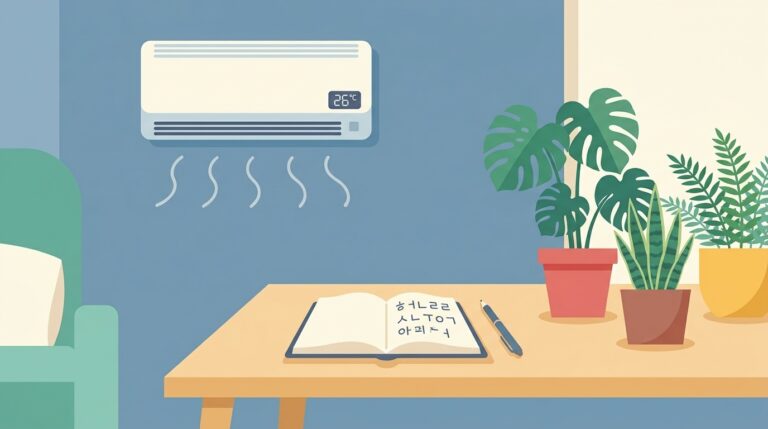
Picture this: It’s peak July in Seoul. The humidity outside feels like a warm sauna, but step inside any shared Korean office, cafe, or shared Airbnb, and you’re instantly met with a blast of Antarctic wind. You find yourself shivering in shorts while your Korean colleagues are calmly wearing light cardigans. You want to touch the remote, but everyone is intensely focused. In Korean shared spaces, touching the air conditioner without checking first is a classic cultural landmine. Why? In Korea, saving electricity (전기 절약) during summer is not just a personal habit; it’s a huge national and communal effort known as keeping the ideal summer indoor temperature at 26°C.
Many of our intermediate learners tell us: “I knew the word for cold (춥다), but I didn’t know how to ask politely without sounding demanding or whiny!” Today, we are bridging that exact gap. Drawing from hundreds of real classroom interactions and workplace feedback, this guide will empower you to navigate AC settings with total naturalness, politeness, and eco-conscious charm.
Phase 2: Core Expression Deep Dive
1. 에어컨 온도 조금만 올려도 될까요? (E-eo-keon on-do jo-geum-man ol-lyeo-do doel-kka-yo?)
- Pronunciation: eh-uh-kohn ohn-doh joh-geum-mahn ohl-lyuh-doh dwel-kkah-yoh (Sounds like ‘air-con on-door’ followed by a soft, polite upward questioning intonation).
- Meaning: “Could we raise the AC temperature just a little bit?” (Literal: “Is it okay even if I raise the air conditioner temperature slightly?”)
- K-Culture Moment: You’ll hear this in office K-Dramas whenever an intern gently holds the remote control in a meeting room with shivering coworkers.
- Editor’s Insight: Using
조금만(just a little) softens your request significantly, making you sound considerate rather than picky.- Situation Spectrum: Casual ✅ | Semi-formal ✅ | Formal ⚠️ (In very formal setups, use
올려도 괜찮으시겠습니까?)- 🤔 Think About It: In your home country, do you adjust room settings unilaterally, or do you always ask group consensus first?
2. 실내 적정 온도가 26도래요. (Sil-nae jeok-jeong on-do-ga i-sip-yuk-do-rae-yo.)
- Pronunciation: sheel-neh juk-jung ohn-doh-gah ee-ship-yook-doh-reh-yoh (Smooth glide on jeok-jeong like ‘check-jung’).
- Meaning: “They say the optimal indoor temperature is 26°C.” (Citing public guidelines as a gentle reminder to save energy).
- K-Culture Moment: Seen in campus sitcoms or green-living variety shows where roommates debate over summer electricity bills (전기세 폭탄).
- Editor’s Insight: The indirect speech ending
-대요is pure magic. It shifts responsibility to standard guidelines, so you sound informative rather than bossy.- Situation Spectrum: Casual ✅ | Semi-formal ✅ | Formal ⚠️
- 🤔 Think About It: How does referencing shared social rules change how people receive your advice?
3. 전기 아끼게 에어컨 잠깐 끌까요? (Jeon-gi a-kki-ge e-eo-keon jam-kkan kkeul-kka-yo?)
- Pronunciation: juhn-gee ah-kkee-geh eh-uh-kohn jahm-kkahn kkeul-kkah-yoh
- Meaning: “Shall we turn off the AC for a bit to save electricity?”
- K-Culture Moment: Often uttered by sensible drama characters when leaving an empty room or when the weather cools in the evening.
- Editor’s Insight:
-게expresses purpose (“in order to save”). It highlights eco-friendliness over personal comfort.- Situation Spectrum: Casual ✅ | Semi-formal ✅ | Formal 🚫
- 🤔 Think About It: What common phrases do people use in your culture to avoid energy waste?
Phase 3: Textbook Korean vs. Real-World Korean
Situation 1: Expressing that you are freezing in an indoor space
- 📖 교과서 한국어 (Textbook): “저는 지금 너무 춥습니다. 에어컨을 끄십시오.” (I am very cold right now. Turn off the air conditioner.)
- 🗣️ 진짜 한국어 (Real-world): “여기 에어컨 바람이 좀 센데, 살짝 줄여도 될까요?” (The AC draft is a bit strong here, would it be okay if we turn it down a bit?)
- 💡 왜 다를까? (Why the difference?): Demanding someone to turn off a machine creates tension. Native speakers blame the draft (바람이 세다) and propose a mild adjustment (살짝 줄이다).
Situation 2: Suggesting energy-saving habits at home
- 📖 교과서 한국어 (Textbook): “에너지를 절약하기 위해 온도를 높여야 합니다.” (We must raise the temperature to conserve energy.)
- 🗣️ 진짜 한국어 (Real-world): “전기세도 아낄 겸 26도로 맞춰 둘까요?” (Shall we set it to 26°C, both for comfort and to save on bills?)
- 💡 왜 다를까? (Why the difference?): Using
-ㄹ 겸(while also doing / for dual benefit) makes your suggestion friendly and pragmatic.
Phase 4: K-Culture Deep Dive & Non-Verbal Manners
4-1. Nunchi (눈치) & Physical Etiquette
When reaching for the air conditioner remote in Korea:
1. The Remote Scan: Pick up the remote, hold it at chest height with both hands, and make gentle eye contact around the room before pressing any button.
2. The Apologetic Tilt: Give a slight 15-degree head tilt and a warm smile while asking 조금만 올려도 될까요?. This signals that you acknowledge others might feel hotter than you.
3. The Wind Deflector Gesture: Point subtly to the ceiling vent rather than grumbling about the cold, showing your issue is direct airflow, not the entire room’s comfort.
4-2. The Culture Code: ‘전기세 폭탄’ (Electricity Bill Bomb) & 26°C Culture
In South Korea, residential electricity uses a progressive pricing system (누진제). If power consumption crosses a specific threshold, rates surge exponentially—a phenomenon feared as the “electricity bill bomb.” Consequently, public campaigns advocate maintaining indoor temperatures between 26°C and 28°C during peak summer. Demonstrating awareness of this makes you look deeply integrated and culturally savvy.
Phase 5: Real-World Roleplay Scenario
- Setting: A bright co-working cafe in Hongdae on a 33°C August afternoon.
- Characters: You (a mindful international professional) and Minho (a friendly Korean startup founder working on his laptop in short sleeves).
-
Dialogue:
- You: 🎭 (Gently rubbing your arms with a slight shiver) 민호 씨, 혹시 지금 안 추우세요? (Min-ho ssi, hok-si ji-geum an chu-u-se-yo? / “Minho, by any chance, are you not cold right now?”)
- Minho: 🎭 (Looking up with a surprised smile) 아, 저는 괜찮은데… 많이 추우세요? (Ah, jeo-neun gwaen-chan-eun-de… man-i chu-u-se-yo? / “Ah, I’m okay… are you feeling very cold?”)
- You: 🎭 (Holding the remote lightly with both hands) 네, 에어컨 바람이 바로 와서요. 희망 온도 조금만 올려도 될까요? (Ne, e-eo-keon ba-ram-i ba-ro wa-seo-yo. Hui-mang on-do jo-geum-man ol-lyeo-do doel-kka-yo? / “Yes, the AC draft is blowing right at me. Could we raise the target temperature just a bit?”)
- Minho: 🎭 (Nodding warmly) 그럼요! 몇 도로 할까요? (Geu-reom-yo! Myeot do-ro hal-kka-yo? / “Of course! What temperature should we set it to?”)
- You: 🎭 (Checking the digital screen) 지금 22도인데, 26도로 맞추면 어떨까요? 실내 적정 온도래요! (Ji-geum i-sip-i-do-in-de, i-sip-yuk-do-ro mat-chu-myeon eo-tteol-kka-yo? Sil-nae jeok-jeong on-do-rae-yo! / “It’s at 22°C now. How about setting it to 26°C? They say that’s the optimal room temperature!”)
- Minho: 🎭 (Giving a thumbs up) 좋아요. 전기 절약도 되고 환경에도 좋겠네요. (Jo-a-yo. Jeon-gi jeol-yak-do doe-go hwan-gyeong-e-do jo-gen-ne-yo. / “Sounds great. It saves power and is good for the environment too.”)
- You: 🎭 (Setting the temperature with a beep) 감사해요. 혹시 더워지면 언제든 다시 말씀해 주세요. (Gam-sa-hae-yo. Hok-si de-wo-ji-myeon eon-je-deun da-si mal-sseum-hae ju-se-yo. / “Thank you. If it gets too warm, please let me know anytime.”)
- Minho: 🎭 (Smiling cheerfully) 네! 배려해 주셔서 감사해요. 열공해 봐요! (Ne! Bae-ryeo-hae ju-syeo-seo gam-sa-hae-yo. Yeol-gong-hae bwa-yo! / “Sure! Thanks for your consideration. Let’s study hard!”)
🔀 Interactive Decision Branch
What would you say if someone enters the room and complains it feels warm after you raised the temperature?
* Choice A: “전기 아끼려면 26도로 유지해야 해요. 참으세요.” (To save power, we must keep it at 26°C. Endure it.) ➡️ Bad: Excessively blunt and dismissive.
* Choice B: “바람 방향을 위로 돌리고 선풍기 틀어드릴까요?” (Shall we aim the AC vents upward and turn on the electric fan for you?) ➡️ Best: Proactive, empathetic, and eco-friendly compromise.
* Choice C: “그냥 에어컨 최저 온도로 내릴게요.” (I will just lower the AC to the lowest.) ➡️ Risk: Wastes energy and swings back to freezing temperatures.
Phase 6: 10-Second Emotion Shadowing Drill
Read aloud along the slashes (/), matching the emotional tags:
[🥺 Gently asking for empathy / Politeness]
저기… / 에어컨 바람이 조금 센데 / 온도 살짝만 올려도 괜찮을까요?
(Jeo-gi… / e-eo-keon ba-ram-i jo-geum sen-de / on-do sal-jjak-man ol-lyeo-do gwaen-chan-eul-kka-yo?)-
[💡 Informative & Friendly / Cooperative]
실내 온도를 26도로 맞추면 / 전기세도 많이 아낄 수 있대요!
(Sil-nae on-do-reul i-sip-yuk-do-ro mat-chu-myeon / jeon-gi-se-do man-i a-kkil su it-dae-yo!) -
[🌱 Cheerful & Responsible / Mindful]
방 나갈 때는 / 에어컨 끄는 거 / 잊지 마세요!
(Bang na-gal ttae-neun / e-eo-keon kkeu-neun geo / it-ji ma-se-yo!)
Phase 7: K-Culture Mini Dictionary
- 전기 절약 (Jeon-gi jeol-yak) | Energy conservation / Saving electricity. Commonly seen on summer office notice boards and subway announcements.
- 실내 적정 온도 (Sil-nae jeok-jeong on-do) | Optimal indoor temperature (Summer: 26°C–28°C / Winter: 18°C–20°C). The cornerstone standard of Korean eco-campaigns.
- 냉방병 (Naeng-bang-byeong) | “Air-conditioning sickness” (headache, fatigue, or mild cold caused by prolonged exposure to cold AC drafts).
- 누진제 (Nu-jin-je) | Progressive electricity billing system where rates jump upon exceeding preset usage brackets.
Phase 8: Traveler’s Survival Kit
Top 3 On-the-Go Phrases
- “에어컨 리모컨 어디에 있어요?” (E-eo-keon ri-mo-keon eo-di-e it-seo-yo?) – Pro Tip: Handy when checking into hotels, guesthouses, or pension stays.
- “바람 세기 좀 줄여주실 수 있나요?” (Ba-ram se-gi jom ju-ryeo-ju-sil su in-na-yo?) – Pro Tip: Perfect for cafes or restaurants when you can’t reach the thermostat.
- “외출할 때 에어컨 꺼둘게요.” (Oe-chul-hal ttae e-eo-keon kkeo-dul-ge-yo.) – Pro Tip: An eco-friendly phrase that will earn instant praise from Airbnb hosts.
Editor’s Travel Note
In summer, subway cars on Seoul Metro Lines 1–9 designate specific cars as 약냉방칸 (Mild AC Car, usually cars 3 and 4 on most lines, except Line 2 which varies). If you catch chills easily, plan your boarding spot beforehand via the KakaoMetro subway map app.
Phase 9: A Step Deeper (한 발 더 깊이)
In Korean culture, the thermostat is never just about individual comfort—it is an arena of communal harmony (공동체 의식). Adjusting the temperature involves negotiating personal physical comfort, collective eco-responsibility, and financial considerations for the group. Rather than treating this as a battle between hot and cold preferences, Koreans use the shared value of environmental conservation to build mutual understanding.
💬 Your Turn: How do people in your country politely resolve thermostat disagreements at home or at the office? Share your experience in the comments below!
Phase 10: FAQ & Common Pitfalls
Q: Can I directly ask a cafe barista to raise the air conditioner temperature?
A: Yes! Approach the counter with a polite tone and say: “죄송한데 에어컨 바람이 조금 세서, 살짝만 조절해 주실 수 있을까요?” Staff will gladly adjust the airflow direction or the temperature setting.
Q: What is the most polite grammar ending for requesting temperature changes?
A: Using -아/어/여도 될까요? (Could it be okay if I…?) paired with adverbs like 조금만 (just a bit) or 살짝 (slightly) creates the most courteous, natural impression.
Q: What does ‘외출 모드’ on a Korean AC remote mean?
A: It stands for ‘Away Mode’. It keeps the room at a moderate baseline with minimal power consumption so the unit doesn’t overwork when you return.
🚨 Common Mistakes & Quick Fixes
- ❌ Mistake 1: Saying “에어컨 꺼!” (Turn off the AC!) to friends in public.
- 👉 Fix: Say “우리 에어컨 조금만 줄일까?” (Shall we turn down the AC a bit?).
- ❌ Mistake 2: Walking away from an Airbnb room with the AC blasting at 18°C.
- 👉 Fix: Turn it off or switch to 26°C/Away mode (외출 모드) before heading out.
- ❌ Mistake 3: Criticizing someone for feeling hot.
- 👉 Fix: Offer a shared fan (선풍기) or suggest redirecting the vent slats (바람 방향 조절).
Phase 11: Action Mission & Community Challenge
- 🥉 Bronze Mission: Stand in front of your home thermostat and practice saying “실내 적정 온도는 26도예요!” out loud 3 times.
- 🥈 Silver Mission: Post a picture of your summer fan or eco-friendly setup on Instagram/X with the hashtag
#전기절약and#DailyHangul. - 🥇 Gold Mission: Next time you are in a Korean cafe, restaurant, or talking with a Korean language partner, use “조금만 올려도 될까요?” in real conversation.
- 🎮 K-Culture Mission: Watch a contemporary slice-of-life K-Drama and spot any scene featuring an electric bill (전기세) debate or remote-control battle!
Phase 12: Interactive Quiz Challenge
1. Situation Quiz: You are at a study cafe in Seoul, feeling chilly right under the AC vent. What is the most natural Korean sentence to use?
– A) 에어컨 지금 당장 끄세요.
– B) 에어컨 바람 방향을 조금 위로 올려도 될까요?
– C) 왜 이렇게 춥게 살아요?
2. Fill-in-the-Blank: 여름철 실내 _____ 온도는 26도에서 28도 사이입니다. (Hint: ‘optimal/appropriate’)
3. True or False: On the Seoul Subway, all cars have the exact same temperature without any mild AC cars (약냉방칸).
🔍 Click here to view Answer Key & Explanations
- Answer: B (Asking to adjust the wind direction politely with
-도 될까요?is respectful and constructive). - Answer: 적정 (실내 적정 온도 means standard optimal indoor temperature).
- Answer: False (Seoul Subway lines offer designated 약냉방칸 (Mild Air Conditioning cars) where the temperature is kept roughly 1°C higher for sensitive passengers).







