

Mastering Korean Project Retrospectives: How to Reflect, Praise, and Give Constructive Feedback Like a Pro
Phase 1: Empathy & Story Opening
안녕하세요! 매일한글 에디터입니다. (Hello! This is your Daily Hangul editor.)
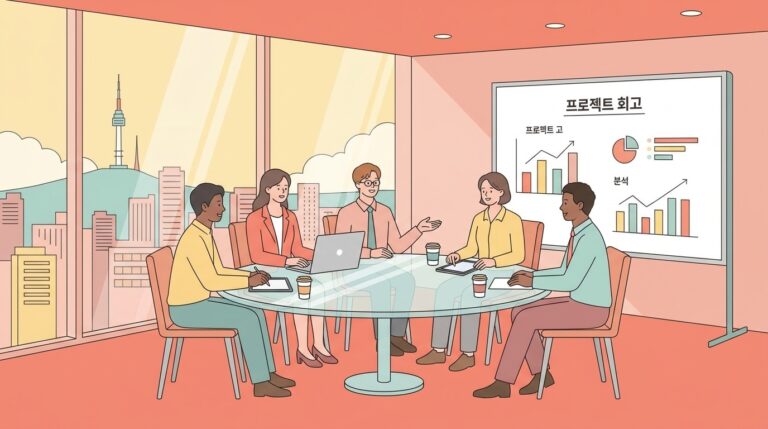
Imagine this scenario straight out of an office K-drama like Misaeng (미생): The grueling three-month project launch is finally over. The client is happy, the software is live, and your entire team is gathered in the conference room for the official post-mortem retrospective meeting (프로젝트 회고 미팅). You want to share your genuine thoughts—pointing out both what went brilliantly and where the team faced bottleneck delays—without sounding overly aggressive, defensive, or dismissive.
In Western business cultures, “radical candor” is often applauded. You might say, “Our communication broke down in week two, and the design handoff was unacceptable.” But in a Korean corporate setting, blunt criticism in a post-project debrief can freeze the room faster than an iced Americano in mid-January. Many intermediate (B2) learners tell us: “I know how to say simple praise like ‘수고하셨습니다’, but I freeze when I need to suggest actionable process improvements without offending my senior teammates!”
Mastering the nuanced art of Korean retrospective language bridges the gap between sounding like a rigid textbook speaker and being a collaborative, culturally savvy teammate. Today’s guide is built on real-world feedback from foreign professionals working in Seoul tech startups and conglomerates. Let’s make your next sprint retro seamless!
Phase 2: 3 Core Retrospective Expressions
1. 이번 프로젝트를 통해 많은 인사이트를 얻을 수 있었습니다.
- Pronunciation: Ibeon peurojekteureul tonghae maneun insaiteureul eodeul su isseotseumnida. (Sounds like: ee-beon pro-jek-teu-reul tong-hae mah-neun in-sa-ee-teu-reul uh-deul soo ees-sut-seum-nee-dah)
- Meaning: Literal: “Through this project, we were able to gain many insights.” | Nuance: “We learned vital lessons from this experience (including our mistakes), which will make our future work stronger.”
- K-Culture Moment: In tech and corporate dramas, the team lead or project manager wraps up a tense retrospective presentation by summarizing team growth using this elegant framing.
- Editor’s Insight: Using “인사이트를 얻다” (gain insights) or “배운 점이 많았습니다” softens past failures by framing them positively as valuable collective learnings.
- Situation Spectrum: Casual: ⚠️ (Use ‘많이 배웠어’ instead) | Semi-formal: ✅ | Formal: ✅
- 🤔 Think About It: In your native language, do you focus more on the concrete errors made, or do you frame missteps as collective organizational learning?
2. 다음 스프린트에서는 이 부분을 보완하면 좋겠습니다.
- Pronunciation: Daeum seupeurinteueseoneun i bubeuneul bowanhamyeon jokkessseumnida. (Sounds like: dah-eum seu-prin-teu-eh-suh-neun ee boo-boo-neul boh-wahn-hah-myeon joh-ket-seum-nee-dah)
- Meaning: Literal: “In the next sprint, it would be good if we supplement/remedy this part.” | Nuance: “Here is a constructive improvement suggestion for next time.”
- K-Culture Moment: An agile development retrospective meeting where team members post sticky notes on the board under the “Keep / Problem / Try” categories.
- Editor’s Insight: Notice the ending “~하면 좋겠습니다” (It would be good if…). It softens what would otherwise be a direct imperative (“이걸 고치세요” – Fix this), making it a polite, collaborative proposal.
- Situation Spectrum: Casual: ⚠️ | Semi-formal: ✅ | Formal: ✅
- 🤔 Think About It: Why does Korean project communication rely heavily on conditional phrases (~(으)면 좋겠다) when delivering critical feedback to peers and superiors?
3. 팀원분들이 적극적으로 협조해 주신 덕분에 무사히 마무리할 수 있었습니다.
- Pronunciation: Tim-won-bun-deuri jeokgeuk-jeog-euro hyeopjo-hae jusin deokbune musahi mamurihal su isseotseumnida. (Sounds like: teem-won-boon-deul-ee jeok-geuk-jeok-eu-roh hyup-joh-hae joo-shin deok-boo-neh moo-sah-hee mah-moo-ree-hal soo ees-sut-seum-nee-dah)
- Meaning: Literal: “Thanks to the team members actively cooperating, we were able to finish safely.” | Nuance: “This success was a true team effort, and I genuinely appreciate everyone’s dedication.”
- K-Culture Moment: The ceremonial wrap-up slide of a client retrospective deck, or during the post-project dinner toast (회식).
- Editor’s Insight: Using “~덕분에” (thanks to) acknowledges collective contribution. In Korean business culture, attributing success to team harmony (협조) rather than individual heroics earns immense respect.
- Situation Spectrum: Casual: ⚠️ | Semi-formal: ✅ | Formal: ✅
- 🤔 Think About It: How does highlighting shared effort in Korean workplaces differ from Western individual recognition spotlights?
Phase 3: Textbook Korean vs. Real Korean
Situation 1: Pointing out a workflow bottleneck
- 📖 교과서 한국어 (Textbook): “마감 일정을 지키지 못해서 전체 일정이 지연되었습니다.” (Because the deadline was not kept, the entire schedule was delayed.)
- 🗣️ 진짜 한국어 (Real Korean): “일정 조율 과정에서 약간의 병목 현상이 있었던 것 같습니다. 다음엔 버퍼(여유 기간)를 조금 더 두면 좋겠습니다.” (It seems there was a slight bottleneck during schedule coordination. Next time, it would be great if we set aside a bit more buffer.)
- 💡 왜 다를까? (Why the difference?): Textbook Korean directly points fingers at the failure to meet deadlines, creating defensive tension. Real native Korean softens the critique using “~것 같습니다” (it seems like) and proactive structural solutions (“병목 현상”, “버퍼”).
Situation 2: Praising outstanding results during retro
- 📖 교과서 한국어 (Textbook): “결과가 매우 좋습니다. 당신은 일을 잘했습니다.” (The result is very good. You did your work well.)
- 🗣️ 진짜 한국어 (Real Korean): “이번 릴리즈 기대 이상으로 반응이 진짜 좋네요! 다들 고생 많으셨습니다.” (The reaction to this release is truly beyond expectations! Everyone worked so hard.)
- 💡 왜 다를까? (Why the difference?): “당신” sounds unnatural and confrontational in Korean workplaces. Real professionals use collective enthusiasm like “기대 이상으로” (beyond expectations) and acknowledge mutual effort with “고생 많으셨습니다”.
Phase 4: K-Culture Deep Dive & Non-Verbal Etiquette
4-1. 눈치 (Nunchi) & Retrospective Body Language
In a Korean retrospective, body language carries equal weight to your spoken words:
* The Two-Handed Pitch: When presenting retrospective slide decks or handing documentation to a colleague, hold the clicker or tablet with both hands or support your right forearm with your left hand.
* Softening Eye Contact: Avoid intense, unblinking eye contact when discussing shortcomings. Look at the shared screen or whiteboard while offering process critique, then make warm eye contact when acknowledging teammate efforts.
* Nodding Cadence (고개 끄덕임): Actively nod and say small listener cues (맞습니다, 그렇죠) while others share their reflections to demonstrate active listening.
4-2. Cultural Code: The Post-Retro “Hoesik” (회식)
In K-dramas like Search: WWW or Start-Up, project retrospectives often happen in two stages: the formal meeting room sprint debrief, followed by an informal team dinner (회식 or a casual coffee chat). The conference room is for objective data and structural process adjustments; the dinner or cafe session is where colleagues patch up any bruised feelings, clink glasses or coffee mugs, and say, “정말 고생 많았어요! 다음에도 잘해봐요!” (Great job, let’s keep rocking on the next one!).
Phase 5: Real-World Roleplay Scenario
Setting: Friday 4 PM, Bright glass conference room at NeoTech Seoul headquarters. The team has just finished the Q3 product launch retrospective.
Characters:
* Min-woo (민우): Pragmatic Senior Project Manager (NPC)
* You (알렉스 – Alex): Intermediate foreign Project Lead
Dialogue:
1. 민우: 🎭 (화이트보드를 가리키며 진지한 표정으로) “자, 이번 Q3 론칭 회고를 진행해 보죠. 알렉스 님, 이번 프로젝트 전반적으로 어떠셨나요?”
(Ja, ibeon Q3 ronching hoegoreul jinhaenghae bojyo. Alex nim, ibeon peurojekteu jeonbanjeog-euro eotteosyeonnayo?)
“Well, let’s proceed with the Q3 launch retro. Alex, how was the project overall from your perspective?”
2. You: 🎭 (자료를 가볍게 넘기며 차분하게) “네, 팀원분들이 적극적으로 협조해 주신 덕분에 목표했던 기능들을 무사히 배포할 수 있었습니다.”
(Ne, timwonbundeuri jeokgeuk-jeog-euro hyeopjohae jusin deokbune mokpyohaetteon gineungdeureul musahi baepohal su isseotseumnida.)
“Yes, thanks to everyone’s active cooperation, we successfully deployed all target features without issue.”
3. 민우: 🎭 (만족스러운 미소를 지으며 고개를 끄덕인다) “맞아요. 개발팀 속도가 정말 빨랐죠. 그래도 분명 아쉬웠던 점도 있었을 텐데요?”
(Majayo. Gaebaltim sokdoga jeongmal ppallatjyo. Geuraedo bunmyeong aswiwotteon jeomdo isseosseul tendeyo?)
“Agreed. The dev team was really fast. Still, surely there were some pain points or regrets?”
4. You: 🎭 (분석 차트를 띄우며 조심스럽게) “QA 단계에서 커뮤니케이션 싱크가 조금 안 맞았던 부분이 아쉬움으로 남습니다.”
(QA dangye-eseo keomyunikeisyeon sing-keuga jogeum an majatteon bubuni aswiumeuro namseumnida.)
“It was a bit regrettable that our communication sync was slightly misaligned during the QA phase.”
5. 민우: 🎭 (턱을 괴며 공감하듯) “아, 티켓 전달 과정에서 누락이 좀 있었죠. 다음 프로젝트 때는 이걸 어떻게 개선하면 좋을까요?”
(Ah, tiket jeondal gwajeong-eseo nuragi jom isseotjyo. Daeum peurojekteu ttaeneun igeol eotteoke gaeseonhamyeon joeulkkayo?)
“Ah, there were indeed a few missed handoffs in ticket delivery. How should we improve this next time?”
6. You: 🎭 (대안을 제시하며 또렷한 목소리로) “다음 스프린트에서는 일일 스탠드업 때 QA 진척도를 5분씩 공유하는 세션을 추가하면 좋겠습니다.”
(Daeum seupeurinteueseoneun iril seutaendeueop ttae QA jincheokdoreul 5-bunsik gong-yuhaneun sesyeoneul chugahamyeon jokkessseumnida.)
“For the next sprint, it would be great to add a 5-minute QA progress sync during daily standups.”
7. 민우: 🎭 (손뼉을 가볍게 치며) “아주 좋은 아이디어네요! 프로세스에 바로 반영하도록 하죠. 다들 이번에 정말 고생 많으셨습니다.”
(Aju joeun aidieoneyo! Peuroseseue baro banyeonghadorok hajyo. Dadeul ibeone jeongmal gosaeng maneusyeotseumnida.)
“That’s a great idea! Let’s reflect it in the workflow right away. Everyone worked tremendously hard.”
8. You: 🎭 (미소 지으며 양손으로 가볍게 목례) “감사합니다, 민우 님. 다음 프로젝트도 잘 부탁드립니다!”
(Gamsahamnida, Min-woo nim. Daeum peurojekteudo jal butakdeurimnida!)
“Thank you, Min-woo. Looking forward to working smoothly together on the next project as well!”
🔀 Interactive Choice Point
At turn 4, if Min-woo asks about the QA delay, how do you respond?
- Option A: “QA팀이 버그 리포트를 너무 늦게 올려서 일정이 다 밀렸습니다. QA팀 잘못입니다.” (The QA team uploaded bug reports too late, pushing back everything. It is the QA team’s fault.)
- 👉 Feedback (Bad): Blaming a specific department in a public retro destroys psychological safety and creates immediate workplace hostility.
- Option B: “QA 과정에서 약간의 지연이 있었지만, 이번 경험을 바탕으로 다음엔 QA 일정을 3일 정도 더 확보하면 좋겠습니다.” (There were slight delays during QA, but based on this experience, it would be great to secure about 3 extra buffer days next time.)
- 👉 Feedback (Best!): Objective, constructive, framing the issue as an actionable scheduling solution rather than individual failure.
- Option C: “아무 문제 없었습니다. 전부 완벽했습니다.” (There were zero problems. Everything was completely perfect.)
- 👉 Feedback (Risk): Ignoring obvious bottlenecks makes you look unobservant and prevents the team from refining its engineering practices.
Phase 6: 10-Second Emotion Shadowing Drill
Practice reading these lines aloud with the indicated pause (/) and emotional tone:
[🤝 겸손하고 진심 어린 어조로 - Humble & sincere]
“팀원분들이 / 적극적으로 협조해 주신 덕분에 / 무사히 마무리할 수 있었습니다.”-
[💡 건설적이고 부드러운 제안 - Constructive & gentle suggestion]
“다음 스프린트에서는 / QA 싱크 일정을 / 조금 더 보완하면 좋겠습니다.” -
[🚀 활기차고 미래지향적인 마무리 - Energetic & forward-looking]
“이번 회고를 통해 얻은 인사이트로 / 다음 프로젝트는 / 더 멋지게 만들어 봐요!”
Phase 7: K-Culture Mini Dictionary
- 회고 (Hoego / Hoe-goh): Retrospective / Post-mortem. In modern Korean workplaces, “스프린트 회고” (sprint retro) is widely used across tech and creative sectors to reflect on workflow efficiency.
- 보완하다 (Bowanhada / Boh-wahn-hah-dah): To supplement, patch up, or remedy shortcomings. The go-to professional replacement for the harsher verb “고치다” (to fix/correct).
- 마무리 (Mamuri / Mah-moo-ree): Wrap-up, finalization, or finishing touch. Frequently paired with “짓다” (마무리를 짓다 – to bring to completion) or “하다” (마무리하다).
- 티키타카 (Tiki-taka / Tee-kee-tah-kah): Flawless back-and-forth chemistry and communication between team members, borrowed from soccer passing terminology.
Phase 8: Traveler & Business Expat Survival Kit
Top 3 Survival Phrases
- 1. 오늘 회의록 정리해서 공유해 드리겠습니다. (Oneul hoe-ui-rok jeong-ni-hae-seo gong-yu-hae deu-ri-get-seum-ni-da.) — “I will organize today’s meeting notes and share them with the team.”
- Pro Tip: Instant way to establish yourself as a dependable team player.
- 2. 혹시 피드백 있으시면 언제든 편하게 말씀해 주세요. (Hoksi pi-deu-baek is-seu-si-myeon eon-je-deun pyeon-ha-ge mal-sseum-hae ju-se-yo.) — “If you have any feedback, please feel free to share anytime.”
- Pro Tip: Shows psychological openness to senior and junior colleagues alike.
- 3. 다음 프로젝트도 잘 부탁드립니다! (Dae-um peu-ro-jek-teu-do jal bu-tak-deu-rim-ni-da!) — “Looking forward to working well together on the next project!”
- Pro Tip: The ultimate respectful closer for wrap-up meetings.
Editor’s Business & Travel Note
When coordinating meetings and retrospectives in Korea, make sure to check room bookings using corporate tools or local map apps. If you need to navigate to co-working spaces or client offices in Gangnam or Pangyo Techno Valley, install the Naver Map app on your mobile device rather than relying on global mapping apps, as it gives real-time subway transfer exit numbers and walking routes inside complex tech hubs.
Phase 9: Stepping Deeper (Cultural Reflection)
In many individualistic work environments, retrospectives focus heavily on individual KPIs and task ownership. In Korea, however, a retrospective is not just an analytical review—it is a communal ritual that reinforces team cohesion (조직력). Critiquing a process without acknowledging the collective emotional exhaustion (고생) can damage rapport. When you master softening endings like “~한 것 같습니다” and praise shared effort with “~덕분에”, you show that you value human harmony just as much as deadline metrics.
💬 Your Turn: In your workplace or study group, how do you handle post-project feedback? Do you prefer candid direct critique or cushioned collaborative suggestions? Leave a comment below in Korean or English!
Phase 10: Structured FAQ & Common Mistakes
Q: Is it rude to directly point out someone’s mistake during a retrospective in a Korean company?
A: Yes, calling out an individual by name (e.g., “민수 씨가 일정을 늦췄습니다”) in a group retrospective is considered inappropriate. Instead, depersonalize the issue by focusing on the workflow or stage (e.g., “기획안 전달 단계에서 지연이 발생했습니다”).
Q: What is the difference between ‘수고하셨습니다’ and ‘고생하셨습니다’?
A: Traditionally, “수고하셨습니다” was used by seniors toward juniors. While widely used among peers today, juniors speaking to senior managers often prefer “고생 많으셨습니다” (You went through a lot of hard work) to express respect.
Q: Can I use English tech terms like ‘Sprint’, ‘Deploy’, or ‘Buffer’ during Korean retrospectives?
A: Absolutely! Korean tech startups and corporate agile teams frequently use loanwords like 스프린트 (sprint), 배포/디플로이 (deploy), 버퍼 (buffer), and 싱크 (sync) naturally in daily conversation.
🚨 3 Common Mistakes
- Mistake: Saying “당신의 발표는 아쉬웠습니다” (Your presentation was lacking).
- Correct Action: Replace “당신” with the person’s name + title, or depersonalize: “발표 자료의 데이터 보완이 조금 더 이루어지면 좋겠습니다.”
- Mistake: Using aggressive command forms like “다음엔 실수하지 마세요” (Don’t make mistakes next time).
- Correct Action: Use collaborative suggestions: “다음에는 사전에 크로스 체크를 한 번 더 진행해 보죠.”
- Mistake: Skipping praise and jumping straight into complaints.
- Correct Action: Always open with positive reinforcement (Keep/Good) before addressing problem areas (Problem/Try).
Phase 11: Action Missions
- 🥉 Bronze Mission (Self-Practice): Shadow the 3 core expressions in Phase 2 three times each while timing your pace.
- 🥈 Silver Mission (Social Share): Write your own retrospective sentence for a recent personal project or language study milestone in the comments below using “~덕분에” and “~보완하면 좋겠습니다”.
- 🥇 Gold Mission (Real-World Use): In your next study sprint or work meeting with Korean speakers, use “이번 프로젝트를 통해 많은 인사이트를 얻었습니다!”
- 🎮 K-Culture Mission: Watch an episode of an office K-drama (like Misaeng or Start-Up) and identify at least one moment where teammates toast or debrief after completing a deliverable.
Phase 12: Interactive Quiz Challenge
Q1. [Context Judgment] You want to suggest in a retrospective meeting that team documentation needs improvement for the next sprint. Which phrase is the most culturally polite and professional?
* A) 문서 정리를 똑바로 하세요.
* B) 다음 스프린트에서는 문서화 작업을 조금 더 보완하면 좋겠습니다.
* C) 당신의 문서가 마음에 들지 않습니다.
Q2. [Fill in the Blank] Complete the sentence acknowledging team help:
“팀원분들이 적극적으로 협조해 주신 ( ) 프로젝트를 잘 끝마쳤습니다.”
* A) 때문에
* B) 탓에
* C) 덕분에
Q3. [True or False] In Korean corporate culture, blaming a specific person directly during a retrospective meeting is considered standard and encouraged practice.
* A) True
* B) False
🔍 Click to reveal Quiz Answers & Explanations!
- Answer: B | Explanation: “~보완하면 좋겠습니다” provides a softened, constructive proposal without sounding demanding or hostile.
- Answer: C (덕분에) | Explanation: “~덕분에” means ‘thanks to’ (positive attribution), whereas “~탓에” implies blaming, and “~때문에” is neutral/casual.
- Answer: B (False) | Explanation: Critique should always focus on the system, process, or workflow rather than publicly blaming individual colleagues.







