

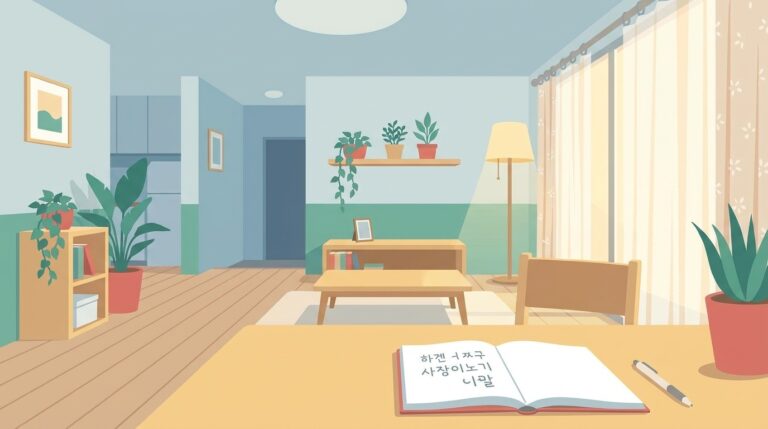
Mastering Minimalist Korean Living: Transform Tiny Spaces into Aesthetic Sanctuaries
Phase 1: 공감 (Empathy & Immersive Opening)
안녕하세요! 매일한글 에디터입니다.
Have you ever watched an episode of I Live Alone (나 혼자 산다) or a cozy K-drama like Because This Is My First Life and marveled at how Koreans transform a seemingly microscopic 6-pyeong (약 20㎡) studio into a breathtaking, Pinterest-worthy sanctuary? Then, you look at your own living space—whether it’s an officetel in Gangnam or an apartment back home—and wonder: Why does my room feel cramped while theirs feels intentionally minimalist and deeply aesthetic?
Many intermediate and advanced learners hit a wall here. You might know basic interior words like 가구 (furniture) or 방 (room), but expressing refined concepts such as “maximizing spatial efficiency,” “eliminating visual clutter,” or “creating visual openness” requires advanced, nuanced Korean. In this guide, backed by insights from native interior stylists and feedback from dozens of C1 learners residing in Seoul, you will master the sophisticated vocabulary and cultural concepts needed to articulate high-level minimalist interior ideas like a true design connoisseur.
Phase 2: 핵심 표현 3선 심층 분석 (Deep Dive into 3 Core Expressions)
1. 공간 활용을 극대화하다 (공간 활용을 극대화하다)
- Pronunciation: [Gong-gan hwal-yong-eul geuk-dae-hwa-ha-da] (Sounds like: gohng-gahn hwal-yong-eul geuk-deh-hwah-hah-dah)
- Meaning: Literally “to maximize space utilization”; colloquially “to optimize every square inch of layout.”
- K-Culture Moment: Frequently used by architects on YouTube channels like Zipview (집뷰) when introducing clever multi-functional loft structures.
- Editor’s Insight: 극대화하다 elevates your speech from simple everyday talk (잘 쓰다) to a professional, analytical level. Use this when discussing multi-functional furniture or smart zoning.
- Situation Spectrum: Casual ⚠️ | Semi-formal ✅ | Formal ✅
- 🤔 Think About It: In Korean urban culture, space isn’t just empty physical area; it’s a dynamic asset to be actively orchestrated. How does this compare to how space is discussed in your home country?
2. 짐을 비워내다 (짐을 비워내다)
- Pronunciation: [Jim-eul bi-wo-nae-da] (Sounds like: jeem-eul bee-wo-neh-dah)
- Meaning: Literally “to empty out baggage/belongings”; nuance: “to mindfully purge clutter for mental and physical clarity.”
- K-Culture Moment: Seen in wellness vlogs and minimalist lifestyle variety shows where hosts clear out accumulated items to embrace Bium (비움 – the art of emptying).
- Editor’s Insight: Notice the auxiliary verb -내다 (to accomplish through effort). It implies that decluttering is a conscious, active endeavor rather than mere throwing away (버리다).
- Situation Spectrum: Casual ✅ | Semi-formal ✅ | Formal ✅
- 🤔 Think About It: 비우다 carries philosophical Taoist/Buddhist undertones in Korean culture—emptying physical space to create room for peace of mind.
3. 개방감을 주다 (개방감을 주다)
- Pronunciation: [Gae-bang-gam-eul ju-da] (Sounds like: geh-bahng-gahm-eul joo-dah)
- Meaning: Literally “to give a sense of openness/airiness”; nuance: “to create an illusion of expansive space.”
- K-Culture Moment: Essential vocabulary when discussing glass partitions, low-profile furniture, or sheer linen curtains in Korean interior design community Today’s House (오늘의집).
- Editor’s Insight: 개방감 is a key interior design keyword. Instead of saying 방이 넓어 보여요 (the room looks big), saying 개방감을 살렸네요 instantly marks you as a C1 speaker.
- Situation Spectrum: Casual ⚠️ | Semi-formal ✅ | Formal ✅
- 🤔 Think About It: Why is sensory terminology (-감, feeling/sense) so prevalent in Korean aesthetics?
Phase 3: 교과서 한국어 vs 진짜 한국어 (Textbook vs. Real Korean)
Situation 1: Explaining why you are throwing away old items in a small studio
- 📖 교과서 한국어: 방이 좁아서 물건을 많이 버려야 해요. (Because the room is narrow, I must throw away many things.)
- 🗣️ 진짜 한국어: 원룸이라 공간이 협소해서, 미니멀 라이프 실천할 겸 과감하게 비워내려고요. (Since it’s a compact studio, I’m planning to boldly declutter to embrace a minimalist lifestyle.)
- 💡 왜 다를까? Advanced native speakers replace basic adjectives like 좁다 with 협소하다 and use idiomatic expressions like 과감하게 비워내다 to express intentional lifestyle choices.
Situation 2: Suggesting storage ideas for hidden corners
- 📖 교과서 한국어: 수납장을 사서 구석에 물건을 정리하세요. (Buy a cabinet and organize things in the corner.)
- 🗣️ 진짜 한국어: 틈새 수납장을 활용해서 데드스페이스를 알차게 살려보세요. (Try utilizing a slim gap-organizer to make the most out of dead space.)
- 💡 왜 다를까? Modern Korean interior enthusiasts borrow terms like 데드스페이스 (Dead space) and combine them with native idioms like 알차게 살리다 (to make fruitful use of).
Phase 4: K-Culture 딥다이브 & 비언어적 매너 (Culture & Etiquette)
4-1. Nunchi & Non-Verbal Manners when Visiting Small Korean Homes (집들이)
When invited to a friend’s compact studio (원룸 집들이), never focus on the compact footprint by saying “It’s smaller than I thought!” Instead, exercise Nunchi (눈치) by complimenting their spatial arrangement (동선, flow of movement) and curation:
* Gesture: Scan the room gently with your eyes rather than staring intently at storage corners or laundry racks.
* Compliment Point: Appreciate their lighting (간접 조명) or tone-and-manner: “화이트 우드 톤이라 아늑하면서도 개방감이 넘치네요!” (The white-and-wood tone makes it feel cozy yet wonderfully open!).
4-2. Cultural Code: The ‘Today’s House’ (오늘의집) Phenomenon
In Korea, interior styling for renters is no longer considered a waste of money. Thanks to the mega-platform Today’s House, single-person households (1인 가구) prioritize self-care through “room styling” (방꾸미기). It represents emotional refuge in a hyper-competitive society, proving that even a rental space deserves personal aesthetic value.
Phase 5: 실전 롤플레이 시나리오 (Interactive Roleplay Scenario)
Setting: Minji (a freelance graphic designer and interior buff) invites you to her newly renovated 7-pyeong studio in Seongsu-dong.
- Minji: 어서 와요! 방이 좀 아담하죠? 짐을 최대한 덜어내느라 고생 좀 했어요.
(Eoseo wayo! Bang-i jom adam-hajyo? Jim-eul choedaehan deor-eonaeneura gosaeng jom haesseoyo. / Welcome! The room is a bit cozy, right? I struggled quite a bit to cut down on clutter.)
🎭 Minji hands you house slippers with a humble smile. - You: 전혀요! 오히려 가구 배치가 절묘해서 공간 활용을 극대화하신 것 같아요.
(Jeonhyeoyo! Ohiryeo gagu baechiga jeolmyo-haeseo gong-gan hwal-yong-eul geuk-dae-hwa-hasin geot gat-ayo. / Not at all! In fact, the furniture layout is so ingenious that you maximized the space utilization.) - Minji: 좋게 봐줘서 고마워요. 원래는 큰 책상을 두려다가 시야를 가려서 과감하게 처분했거든요.
(Joke bwa-jwoseo gomawoyo. Wonrae-neun keun chaeksang-eul duryeodaga siyareul garyeoseo gwagam-hage cheobun-haetgeodeunyo. / Thank you for the kind words. I originally wanted a big desk, but it blocked the line of sight, so I boldly got rid of it.) - You: 탁월한 선택이었네요. 낮은 가구 위주로 배치하니까 시야가 트여서 개방감이 확실히 살아요.
(Tagwol-han seontaeg-ieonneyo. Najeun gagu wiju-ro baechi-hanikka siyaga teuyeoseo gaebang-gam-i hwaksil-hi sarayo. / That was an excellent choice. Placing low-profile furniture opens up the line of sight and definitely enhances the feeling of spaciousness.) - Minji: 맞아요! 그리고 저기 모퉁이에 틈새 수납장 보이죠? 데드스페이스를 없애려고 맞춤 제작했어요.
(Majayo! Geurigo jeogi motung-ie teumsae sunapjang boijyo? Dedeu-seupeiseu-reul eop-saeryeogo matchum jejag-haesseoyo. / Exactly! And see that slim organizer in the corner? I custom-ordered it to eliminate dead space.) - You: 와, 인테리어 감각이 보통이 아니시네요. 톤앤매너도 화이트와 베이지로 통일해서 훨씬 정돈돼 보여요.
(Wa, interi-eo gamgagi botongi anisineyyo. Ton-aen-maeneodo hwaiteu-wa beijiro tong-il-haeseo hwolssin jeongdon-dwae boyeoyo. / Wow, your interior taste is truly exceptional. Unifying the tone and manner with white and beige makes it look far more organized.) - Minji: 후후, 역시 뭘 좀 아시네요! 차 한잔하면서 룸투어 마저 시켜드릴게요.
(Huhu, yeoksi mwol jom asineyyo! Cha hanjan-hamyeonseo rum-tueo majeosikyeo deurilgeyo. / Haha, you really know your stuff! Let’s have some tea while I finish giving you the room tour.) - You: 네, 기대할게요! 공간 분리 팁도 꼭 전수해 주세요.
(Ne, gidae-halgeyo! Gong-gan bunri tipdo kkok jeonsu-hae juseyo. / Yes, looking forward to it! Please pass on your space-zoning tips too.)
🔀 인터랙티브 분기점 (Interactive Decision Point)
Imagine Minji asks you: “침대 프레임을 수납형으로 바꿀까 하는데 어때 보여요?” (I’m thinking of switching to a storage bed frame, what do you think?)
- Option A: “수납력을 챙길 수 있어서 실용적이겠지만, 부피감 때문에 자칫 답답해 보일 수도 있으니 저상형 프레임과 비교해 보세요.”
- Feedback: [Best Choice] Shows advanced analytical nuance balancing storage (수납력) vs. visual openness (개방감).
- Option B: “그냥 방이 좁으니까 아무것도 사지 마세요.”
- Feedback: [Bad Choice] Overly blunt, dismissive, and culturally insensitive to the host’s styling passion.
- Option C: “비싼 가구를 사면 인테리어가 훨씬 고급스러워질 거예요.”
- Feedback: [Risk] Misses the essence of Korean minimalism and space optimization entirely.
Phase 6: 10초 감정 섀도잉 드릴 (10-Second Emotion Shadowing Drill)
Practice these natural rhythm pauses (/) with emotional immersion:
[😊 깊은 감탄과 확신]
“낮은 가구 위주로 / 배치하니까 / 시야가 트여서 / 개방감이 확실히 살아요.”
(Najeun gagu wiju-ro / baechi-hanikka / siyaga teuyeoseo / gaebang-gam-i hwaksil-hi sarayo.)-
[💡 발견의 기쁨을 담아]
“자칫 버려질 뻔한 / 틈새 공간을 활용해서 / 데드스페이스를 / 완벽하게 살려냈네요!”
(Jachit beoryeojil ppeon-han / teumsae gong-gan-eul hwal-yong-haeseo / dedeu-seupeiseu-reul / wanbyeok-hage sallyeonaenneyo!) -
[🤔 진지하고 세련된 제안]
“파티션으로 / 공간 분리를 해주면 / 아늑함과 실용성을 / 동시에 잡을 수 있어요.”
(Patisyeon-euro / gong-gan bunri-reul haeju-myeon / aneuk-ham-gwa sir-yong-seong-eul / dongsi-e jabeul su isseoyo.)
Phase 7: K-Culture 미니 사전 (Mini Dictionary)
- 데드스페이스 (Dedeu-seupeiseu) | Dead Space | Unusable, awkward nooks between walls or furniture that smart minimalists reclaim with tailored shelves.
- 톤앤매너 (Ton-aen-maeneor) | Tone & Manner | The overall color palette, texture balance, and mood unity across an interior space.
- 오늘의집 (O-neul-ui-jip) | Today’s House | South Korea’s leading interior lifestyle platform and e-commerce community that dictates single-household living trends.
- 룸투어 (Rum-tu-eo) | Room Tour | The social phenomenon of filming and presenting every detail of one’s meticulously styled compact room.
Phase 8: 여행자와 거주자를 위한 생존 키트 (Survival Kit)
📌 Pro Interior Survival Phrases
- “가구 실측 사이즈가 어떻게 되나요?”
Pronunciation: [Gagu sil-cheuk sa-i-jeu-ga eo-tteo-ke doe-na-yo?]
Pro Tip: Essential when buying furniture online in Korea to verify exact dimensions against your floor plan. - “공간 분리용 가벽이나 파티션을 찾고 있어요.”
Pronunciation: [Gong-gan bun-ri-yong ga-byeog-i-na pa-ti-syeon-eul chat-go iss-eo-yo.]
Pro Tip: Use at home decor stores like IKEA Korea or Modern House to divide bedroom and study zones. - “조립 및 설치 서비스도 포함인가요?”
Pronunciation: [Jo-rip mit seol-chi seo-bi-seu-do po-ham-in-ga-yo?]
Pro Tip: Avoid surprise fees when ordering multi-functional desks or bed frames.
🧭 Editor’s Practical Note
If you are setting up your studio in Korea, head over to the mobile app store and search for the 오늘의집 라이프스타일 플랫폼 다운로드 to browse user reviews filtered specifically by room size (평수). For budget-friendly space-saving organizers, visit multi-story flagship Daiso branches in Hongdae or Gangnam.
Phase 9: “한 발 더 깊이” (Deep Cultural Reflection)
In traditional Korean architecture (Hanok), the concept of Madang (마당) and Chae (채) emphasized empty space not as void, but as breathing room connecting nature and people. In today’s hyper-dense vertical metropolis of Seoul, this ancestral philosophy manifests as modern interior minimalism. Living in a small studio isn’t seen as a limitation; rather, it has become an art form of curating what truly matters, creating a peaceful barrier between oneself and the bustling city.
💬 Your Turn: How do you balance physical storage and mental peace in your own living space? Share your thoughts in Korean below!
Phase 10: FAQ & 오해 방지 (FAQ & Common Mistakes)
Q: Can ‘비워내다’ be used for mental or emotional states, or only for physical clutter?
A: Both! Native speakers frequently say 마음을 비워내다 (to clear one’s mind of worries/greed) as well as 짐을 비워내다 (to purge physical belongings). It signifies deliberate, mindful decluttering.
Q: What is the exact difference between ‘수납력’ and ‘정리정돈’?
A: 수납력 refers specifically to the capacity/efficiency of furniture or storage solutions to hold items cleanly. 정리정돈 refers to the ongoing human action and discipline of tidying up and keeping things in order.
Q: Is it rude to comment on how small someone’s apartment is in Korea?
A: Yes, directly commenting 방이 정말 작네요 (Your room is really small) can cause loss of face (체면). Instead, praise their curation: “아담하면서도 동선이 정말 깔끔해요!” (It’s cozy and the layout flow is so neat!).
🚨 흔한 실수 (Common Mistakes TOP 3)
- Mistake: Using 버리다 (to throw away) repeatedly when discussing intentional minimalism.
- Correct Action: Use 비워내다 (to mindfully empty) or 정리하다 (to organize/streamline).
- Mistake: Saying 방을 넓게 만들다 instead of 개방감을 살리다.
- Correct Action: Physical walls cannot expand; native speakers say 개방감을 주다/살리다 (giving a sense of openness).
- Mistake: Translating “multi-functional” literally as 많은 기능.
- Correct Action: Use the natural compound 다기능 or 멀티 가구 (e.g., 공간 절약형 다기능 가구).
Phase 11: 액션 미션 & 참여 유도 (Action Missions)
- 🥉 Bronze Mission: Look around your room right now. Point to one corner and say aloud: “이 코너의 데드스페이스를 활용해서 개방감을 살려야겠어요.”
- 🥈 Silver Mission: Post a photo of your favorite aesthetic corner on Instagram with the caption: #미니멀라이프 #공간활용 #오늘의집감성.
- 🥇 Gold Mission: Watch an episode of a Korean room-tour vlog and leave a comment in natural C1 Korean praising their 공간 활용 and 톤앤매너.
- 🎮 K-Culture Mission: Search
#원룸인테리어on Instagram or YouTube and spot the top 3 core expressions we learned today!
Phase 12: 인터랙티브 퀴즈 챌린지 (Interactive Quiz)
1. [상황 판단 퀴즈]
친구의 원룸에 방문했을 때 가장 세련되고 자연스럽게 칭찬하는 표현은?
* ① 방이 좁아서 답답할 뻔했는데 가구가 작아서 다행이네요.
* ② 공간 활용을 극대화해서 아늑하면서도 개방감이 넘치네요!
* ③ 물건을 더 버리면 방이 훨씬 커 보일 것 같아요.
2. [빈칸 채우기]
“모퉁이에 틈새 수납장을 배치해서 버려지던 (____________)를 알차게 살렸어요.”
3. [True / False 문화 퀴즈]
한국 인테리어 커뮤니티에서는 수납 침대나 접이식 식탁처럼 좁은 공간에 최적화된 가구를 ‘공간 절약형 다기능 가구’라고 부른다. (T / F)
🔍 정답 및 상세 해설 확인하기 (Click to view answers)
- 정답: ②
해설: ①과 ③은 직설적으로 좁다는 뉘앙스를 주어 실례가 될 수 있습니다. ②번은 공간 활용과 개방감이라는 고급 어휘를 적절히 활용한 최고의 찬사입니다. - 정답: 데드스페이스 (Dead space)
해설: 가구 사이의 좁은 틈이나 활용하기 어려운 구석진 공간을 일컫는 필수 인테리어 용어입니다. - 정답: True (T)
해설: 1인 가구 비중이 높은 한국에서는 좁은 공간을 스마트하게 활용하는 ‘공간 절약형 다기능 가구’ 시장이 매우 발달해 있습니다.







