

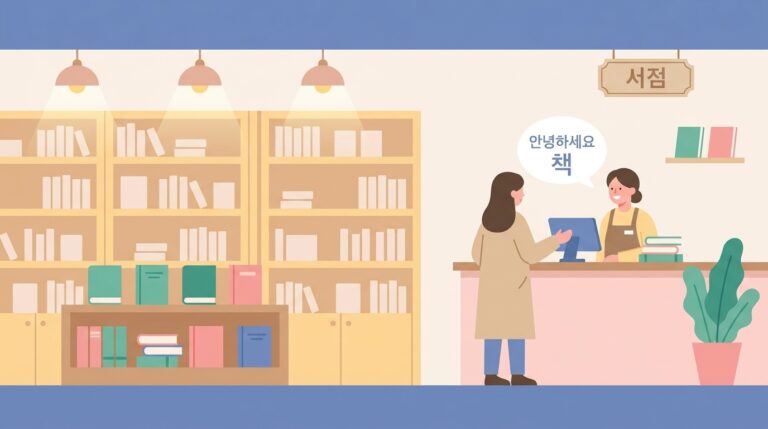
Phase 1: Empathy & Storytelling Opening
안녕하세요! 매일한글 에디터입니다. (Hello! This is your Daily Hangul editor!)
Have you ever walked into the massive Gwanghwamun Kyobo Book Centre in Seoul, hoping to pick up that gorgeous photo essay by your favorite K-pop idol or that trending webtoon paperback you saw in a K-drama, only to freeze in utter bewilderment? The store feels endless—tens of thousands of square meters filled with towering wooden bookshelves, aromatic signature fragrances, stationery corners, and bustling crowds.
You pull out your phone with a screenshot of the book cover, your heart thumping. You spot a bookstore clerk organizing shelves, but suddenly your mind goes blank. How do you say “Where is this book?” or “Do you have this in stock?” without sounding like a robotic translation app?
Don’t worry, my friend! Many of our beginner learners tell us that bookstores are among the most intimidating yet rewarding places in Korea. In this guide tailored specifically for A2 learners, we’ll equip you with natural, native-approved phrases and cultural body language so you can browse, inquire, and walk away with your dream Korean book effortlessly.
Phase 2: Core 3 Expressions
1. 이 책 어디에 있어요? (I chaek eodie isseoyo?)
- Pronunciation: [I-chaek-eo-di-e-i-sseo-yo?] (Think: “E-check uh-dee-eh eat-saw-yo?”)
- Meaning: Literal: “Where is this book at?” / Nuance: “Could you tell me where I can find this book?”
- K-Culture Moment: Seen in countless slice-of-life K-dramas where a student shyly holds up a study guide or novel to a clerk.
- Editor’s Insight: You can simply point to your phone screen showing the book cover or title while saying this. It’s polite, natural, and instantly understood.
- Situation Spectrum: Casual: ⚠️ (Only with friends: 이 책 어디 있어?) | Semi-formal: ✅ (Perfect for clerks: 이 책 어디에 있어요?) | Formal: ✅ (이 책 어디에 있습니까?)
- 🤔 Think About It: In English, we often ask “Do you sell this book?” whereas in Korean, asking for the physical location (
어디에 있어요?) naturally implies you want to purchase it.
2. 이거 재고 있어요? (Igeo jaego isseoyo?)
- Pronunciation: [I-geo-jae-go-i-sseo-yo?] (Think: “Ee-guh jay-go eat-saw-yo?”)
- Meaning: Literal: “Does this have inventory?” / Nuance: “Is this in stock? / Do you have another copy of this?”
- K-Culture Moment: When a popular K-pop artist releases a limited edition essay or photo book, fans swarm the bookstore asking if copies remain in storage.
- Editor’s Insight: If the shelf display copy is slightly damaged or missing, use this phrase.
재고(jaego) specifically means “stock/inventory”. - Situation Spectrum: Casual: ⚠️ | Semi-formal: ✅ | Formal: ✅
- 🤔 Think About It: Korean service interactions favor concise noun + verb patterns over long modal phrases like “Would you be able to check if…”.
3. 검색대 어디 있어요? (Geomsaekdae eodi isseoyo?)
- Pronunciation: [Geom-saek-dae-eo-di-i-sseo-yo?] (Think: “Guhm-seck-day uh-dee eat-saw-yo?”)
- Meaning: Literal: “Search station where is it?” / Nuance: “Where is the book search kiosk?”
- K-Culture Moment: Walking into large bookstores like Kyobo or Bandi & Luni’s, you’ll see people lining up near touchscreens printing out shelf location slips.
- Editor’s Insight: Large Korean bookstores have
도서검색대(computer terminals that print out location slips). Finding the kiosk saves you time! - Situation Spectrum: Casual: ⚠️ | Semi-formal: ✅ | Formal: ✅
- 🤔 Think About It: Notice how polite Korean questions end smoothly in
-어요without needing an elaborate introductory apologetic clause.
Phase 3: Textbook Korean vs. Real Korean
Situation 1: Asking if a book is available
- 📖 교과서 한국어 (Textbook): “이 책을 판매하고 계십니까?” (Are you selling this book? – Too rigid & archaic)
- 🗣️ 진짜 한국어 (Real-Life): “혹시 이 책 있어요?” (Excuse me, do you happen to have this book?)
- 💡 왜 다를까? (Why the difference?): Adding
혹시(by any chance) softens the question naturally without needing stiff honorific verb conjugations.
Situation 2: Asking for a fresh copy without scratches
- 📖 교과서 한국어 (Textbook): “새로운 물건으로 교환해 주십시오.” (Please exchange this for a new item.)
- 🗣️ 진짜 한국어 (Real-Life): “새 책으로 다른 거 있을까요?” (Would there be another fresh copy of this?)
- 💡 왜 다를까? (Why the difference?): Using
-을까요?sounds considerate and friendly rather than demanding.
Phase 4: K-Culture Deep Dive & Non-Verbal Manners
4-1. 눈치 (Nunchi) & Gestures in Korean Bookstores
- Two-Handed Phone Presentation: When showing the clerk a book title on your phone screen, hold the phone with both hands or support your right wrist with your left hand. This non-verbal gesture instantly conveys respect.
- Soft Voice & Step Back: Korean bookstores are treated like semi-libraries where people sit and read. Keep your voice at a warm whisper, and take half a step back after asking your question to respect personal space.
4-2. Cultural Code: The Bookstore Sanctuary
- In Korea, mega bookstores like Kyobo are cultural sanctuaries. Kyobo famously has a management philosophy dating back to founder Shin Yong-ho: “Never give a dirty look to someone reading without buying, and never stop them from writing down notes.”
- Notice the iconic signature scent inside Kyobo Book Centre (The Scent of Page). Books are seen as lifestyle companions, and buying a printed edition of a webtoon or essay is a major way young Koreans show appreciation for creators.
Phase 5: Real-Life Roleplay Scenario
Setting: Gwanghwamun Kyobo Book Centre. Soft instrumental music plays in the background. You are looking for an illustrated Korean essay book, holding your phone with a screenshot.
NPC Clerk: Min-jun (민준), friendly staff member holding a scanning device.
- You: 저기요, 실례지만 혹시 이 책 어디에 있어요?
(Jeogiyo, sillyejiman hoksi i chaek eodie isseoyo?)
🎭 Politely showing your phone screen with both hands. - Min-jun: 아, 네! 잠시만 화면 보여주시겠어요?
(Ah, ne! Jamsiman hwamyeon boyeojusigesseoyo?)
🎭 Tilts head slightly to read the screen. - You: 네, 여기요. 제목이 ‘마음의 온도’예요.
(Ne, yeogiyo. Jemogi ‘Maeum-ui Ondo’yeyo.)
🎭 Points to the Korean title on the screen. - Min-jun: 아, 에세이 코너 C구역 4번에 있어요.
(Ah, esei koneo C-guyeok sabeone isseoyo.)
🎭 Points toward the wooden pillars in section C. - You: C구역 4번이요? 감사합니다. 그런데 혹시 새 책 재고도 있어요?
(C-guyeok sabeon-iyo? Gamsahamnida. Geurende hoksi sae chaek jaegodo isseoyo?)
🎭 Asks with a warm, curious expression. - Min-jun: 네, 매대에 3권 정도 남아있을 거예요.
(Ne, maedae-e segwon jeongdo namaisseul geoyeyo.)
🎭 Smiles reassuringly. - You: 아, 다행이네요! 정말 감사합니다.
(Ah, dahaeng-ineyyo! Jeongmal gamsahamnida.)
🎭 Gives a light 15-degree bow. - Min-jun: 좋은 하루 보내세요!
(Joeun haru bonaeseyo!)
🎭 Bows back kindly.
🔀 Interactive Choice Point
You walk to Section C, Shelf 4, but the spot is completely empty!
* Option A: “야! 책 없는데?” (Hey! There’s no book here?)
* Option B: “저기요, C-4 매대가 비어있는데 재고 더 있나요?” (Excuse me, shelf C-4 is empty, is there more stock in the back?)
* Option C: Say nothing and leave the bookstore disappointed.
Feedback:
* Choice A (Bad): 🚫 Very rude! 야 is informal slang for friends and will shock the clerk.
* Choice B (Best): ✅ Perfect! Clear, polite, and directly explains the situation.
* Choice C (Risk): ⚠️ Many Korean bookstores keep extra copies in their back storage drawer right under the display table. Always ask!
Phase 6: 10-Second Emotion Shadowing Drill
Repeat these lines out loud matching the pauses (/) and emotions:
[😊 Politeness & Curiosity]
저기요, / 혹시 이 책 / 어디에 있어요?
(Jeogiyo, / hoksi i chaek / eodie isseoyo?)-
[🤔 Clarifying & Seeking Confirmation]
이 책 / 진열된 거 말고 / 새 거 있을까요?
(I chaek / jinyeoldoen geo malgo / sae geo isseulkkayo?) -
[🙏 Warm Relief & Gratitude]
찾아주셔서 / 정말 감사합니다! / 좋은 하루 되세요.
(Chajajusyeoseo / jeongmal gamsahamnida! / Joeun haru doeseyo.)
Phase 7: K-Culture Mini Dictionary
- 베스트셀러 (Beseuteuselleo) | Bestseller section | Located right near the main entrance; the easiest place to spot Korea’s latest cultural trends.
- 도서 검색대 (Doseo Geomsaekdae) | Book Search Kiosk | Automated terminals where you enter titles/authors and print a small location receipt map.
- 재고 (Jaego) | Inventory / Stock | Essential word when checking if an item is available in storage even if the shelf is empty.
- 단행본 (Danhaengbon) | Standalone/Tankobon book | Commonly used when purchasing collected physical volumes of popular webtoons or comic series.
Phase 8: Survival Kit for Travelers
Survival Phrases TOP 3
- 이거 찾아주실 수 있어요? (Igeo chajajusil su isseoyo?) – “Could you help me find this?”
- Pro Tip: Use this when you have a print slip from the search kiosk.
- 도서 검색 위치 출력증 어디서 뽑아요? (Doseo geomsaek wichi chulryeokjeung eodiseo ppobayo?) – “Where can I print the location slip?”
- 선물 포장 되나요? (Seonmul pojang doenayo?) – “Can I get gift wrapping?”
- Pro Tip: Most big bookstores offer charming gift wrapping services for a small fee!
Editor’s Travel Note
- Before walking miles inside Kyobo, download the official 교보문고 앱 다운로드. It features real-time inventory checking for each store branch (Gwanghwamun, Gangnam, Jamsil).
- You can also use 네이버 지도 앱 다운로드 to check opening hours and locate cozy independent bookstores (독립서점) in trendy neighborhoods like Yeonnam-dong and Euljiro.
Phase 9: Think Deeper (한 발 더 깊이)
In modern Korea, bookstores have evolved from mere commercial retail spots into emotional retreats. In bustling metropolitan hubs where living spaces can be compact, bookstores offer expansive wooden tables, natural sunlight, and quiet reading spaces where anyone can rest freely without pressure. Asking a clerk for a book is rarely viewed as an interruption; rather, it is welcomed as an interaction between fellow book lovers.
💬 Your Turn: What kind of Korean book would you love to find on your next trip to Seoul—a webtoon paperback, a poetry collection, or a language study guide? Share with us in the comments below!
Phase 10: FAQ & Common Mistakes
Q: Can I take photos of book covers inside Korean bookstores?
A: Yes, taking a quick photo of a cover or title is totally fine. However, taking photos of internal pages or filming people reading quietly without their consent is considered bad bookstore etiquette.
Q: What if I don’t know the Korean title of the book?
A: You can look up the author’s English name or international ISBN on the search kiosk (도서 검색대), or show the clerk an image of the cover. Clerks are very tech-savvy and quick to assist!
Q: Can I read books on the reading tables without buying them first?
A: Yes! At major bookstores like Kyobo and Arc N Book, books without plastic wrap can be read at designated public reading tables. Just make sure to handle them gently.
🚨 흔한 실수 (Common Mistakes) 경고판
- Calling staff “아줌마” (Ajumma) or “아저씨” (Ajeossi):
- Correct Action: Say “저기요” (Jeogiyo) or “직원분” (Jig-won-bun).
- Ripping open plastic-wrapped books (비닐 포장):
- Correct Action: Sealed books cannot be opened before purchase. Ask the staff: “이거 샘플 볼 수 있어요?” (Can I see a sample copy of this?)
- Speaking in complex English sentences without context:
- Correct Action: Show the screen first and use simple keywords: “이 책 있어요?”.
Phase 11: Action Missions
- 🥉 Bronze Mission (Solo Practice): Practice saying “저기요, 이 책 어디에 있어요?” in front of a mirror 5 times holding your phone.
- 🥈 Silver Mission (SNS Challenge): Look up your favorite K-drama novel or K-pop essay on Kyobo’s website and screenshot its Korean title.
- 🥇 Gold Mission (Real Action): Visit a Korean bookstore in person (or online Korean bookstore community) and ask for a book recommendation using “추천해 주실 책 있어요?”.
- 🎮 K-Culture Discovery: Watch an episode of a slice-of-life K-drama (like Romance is a Bonus Book) and spot how characters browse shelves!
Phase 12: Interactive Quiz Challenge
1. You are looking for an essay book at Kyobo. Which phrase is the most natural to ask a staff member?
* A) 야, 이 책 줘. (Ya, i chaek jwo.)
* B) 저기요, 혹시 이 책 어디에 있어요? (Jeogiyo, hoksi i chaek eodie isseoyo?)
* C) 이 책을 빨리 파십시오. (I chaek-eul ppalli pasipsio.)
2. Fill in the blank:
* “매대에 있는 거 말고 새 책 ______ 있어요?” (Do you have fresh stock instead of the display copy?)
* Hint: Meaning ‘inventory/stock’.
3. [True / False] Korean bookstores will kick you out if you read unsealed books at reading tables without buying them.
🔍 Click here to reveal Answers & Explanations!
- Answer: B | Explanation: “저기요, 혹시 이 책 어디에 있어요?” is polite, standard, and natural. Option A is rude slang, and Option C is an aggressive command.
- Answer: 재고 (Jaego) | Explanation:
재고refers to inventory or stock in back storage. - Answer: False | Explanation: Reading at designated tables is encouraged in major bookstores, provided the books are not plastic-sealed and you handle them with care!






