

Don’t Sit There! The Ultimate Survival Guide to Korean Bus Priority Seats
Phase 1: Empathy & Storytelling
안녕하세요! I’m your Daily Hangul editor. Imagine this: You just had the most incredible day exploring Seoul. You hiked up Namsan, ate delicious tteokbokki at Gwangjang Market, and your feet are screaming for mercy. You hop onto a vibrant blue Seoul city bus. It’s packed, but wait—there is a single empty seat near the front! You happily sit down, breathe a sigh of relief, and check your phone. Suddenly, you feel a chilling wave of heavy stares. An older lady (Halmeoni) is standing right in front of you, looking unimpressed, while other passengers glance at you with intense Nunchi (social awareness). You just accidentally sat in the 노약자석 (Priority Seat). Don’t panic! We have all been there. Public transit etiquette in Korea is deeply rooted in respect and community care. In this beginner-friendly guide, I will give you the exact phrases, manners, and confidence you need so you can ride Korean buses like a true local without breaking a single unspoken rule.
Phase 2: 3 Key Expressions Deep Dive
1. 여기 앉으세요 (Yeogi anjeuseyo)
- Pronunciation: [Yeo-gi an-jeu-se-yo] (Sounds like: Yaw-gee ahn-jeu-say-yo)
- Meaning: Literal: “Sit here.” | Actual Nuance: “Please, take this seat (I am offering it to you politely).”
- K-Culture Moment: In warm slice-of-life K-Dramas like Reply 1988 or Our Blues, young characters immediately jump up and gesture to an elderly person with this sweet phrase.
- Editor’s Insight: Adding
-세요 (-seyo)makes any verb polite and respectful. It shows immediate warmth and good manners.- Situation Spectrum: Casual ⚠️ | Semi-formal ✅ | Formal ✅
- 🤔 Think About It: In your hometown, do people verbally offer their seats, or do they just quietly stand up and move away?
2. 먼저 앉으세요 (Meonjeo anjeuseyo)
- Pronunciation: [Meon-jeo an-jeu-se-yo] (Sounds like: Mun-juh ahn-jeu-say-yo)
- Meaning: Literal: “Sit first.” | Actual Nuance: “Please, go ahead and sit first!”
- K-Culture Moment: When two people reach an empty bus seat at the exact same second, the polite Korean person always steps back and smiles, offering it with this phrase.
- Editor’s Insight: Meonjeo means “first” or “ahead.” It is a magic etiquette word in Korea for letting others go before you in lines, elevators, and transit.
- Situation Spectrum: Casual ⚠️ | Semi-formal ✅ | Formal ✅
- 🤔 Think About It: Why is yielding to others considered a top virtue in densely populated cities like Seoul?
3. 죄송합니다 (Joesonghamnida)
- Pronunciation: [Joe-song-ham-ni-da] (Sounds like: Jway-song-hahm-nee-dah)
- Meaning: Literal: “I am sorry.” | Actual Nuance: “Excuse me / I apologize deeply for my mistake.”
- K-Culture Moment: In almost every K-drama, whenever a character bumps into someone on a crowded subway or realizes they made a social blunder, this is their instant reflex word.
- Editor’s Insight: Joesonghamnida is much more respectful and sincere than Mianhaeyo (미안해요). If you accidentally sit in a priority seat, say this with a gentle nod.
- Situation Spectrum: Casual ⚠️ | Semi-formal ✅ | Formal ✅
- 🤔 Think About It: Notice how polite apologies in Korea often come with a small bow instead of just eye contact.
Phase 3: Textbook Korean vs. Real Korean
Situation 1: Offering your seat to an elder
- 📖 Textbook Korean: 어르신, 이 자리에 앉으십시오. (Eoreusin, i jarie anjeusipsio. – “Elderly person, please sit in this seat.”)
- 🗣️ Real Korean: 여기 앉으세요! (Yeogi anjeuseyo! – “Please take this seat!”)
- 💡 Why is it different? Textbook phrases can sound overly dramatic and archaic like a historical Joseon period drama. A cheerful, gentle Yeogi anjeuseyo with a warm hand gesture is what real locals use every single day.
Situation 2: When someone thanks you for giving up your seat
- 📖 Textbook Korean: 천만에요. (Cheonman-eyo. – “You are welcome.”)
- 🗣️ Real Korean: 아니에요, 괜찮아요! (Anieyo, gwaenchanayo! – “Oh no, it’s totally fine!”)
- 💡 Why is it different? Koreans rarely say Cheonman-eyo in real spoken life. Saying “No no, it’s really nothing!” (Anieyo) shows genuine humility.
Phase 4: K-Culture Deep Dive & Non-Verbal Manners
4-1. Nunchi (눈치) & Body Language
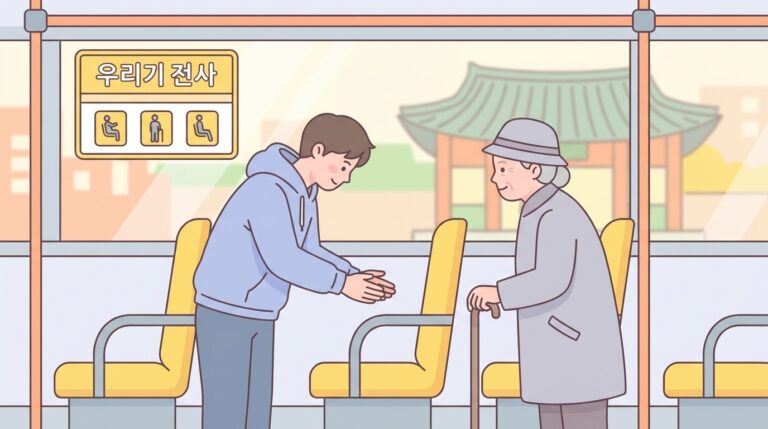
On Korean city buses, the seats labeled 노약자석 (No-yak-ja-seok) near the front doors or colored distinctively (often yellow or pink for pregnant passengers) are reserved for the elderly, injured, pregnant women, and young children. Even when the bus is completely empty, many Koreans leave these seats vacant out of habit and respect. If you are sitting in a regular seat and see an older person board, simply make gentle eye contact, stand up slightly, and gesture toward the seat with both palms facing upward. Never point with one finger!
4-2. Cultural Code: The ‘Ppalli-Ppalli’ Bus Rush vs. Deep Respect
Korean bus drivers are famous for their fast driving (Ppalli-Ppalli culture). Because buses start and stop quickly, elderly riders need to sit down immediately to prevent falls. Offering a seat isn’t just politeness—it is viewed as an essential act of safety and community care in Korean daily life.
Phase 5: Real-Life Roleplay Scenario
Setting: A bumpy blue bus line 143 passing through Gangnam during evening rush hour. An energetic Halmeoni (grandmother) with heavy grocery bags boards the bus.
- You: (🎭 Noticing the grandmother struggling to hold the handrail) 저기요, 여기 앉으세요! (Jeogiyo, yeogi anjeuseyo! / Excuse me, please sit here!)
- Grandmother: (🎭 Surprised and touching your arm gently) 아이고, 외국인 학생이 착하네. 고마워요! (Aigo, oegugin haksaengi chakane. Gomawoyo! / Oh my, what a kind foreign student. Thank you!)
- You: (🎭 Smiling and bowing your head 15 degrees) 아니에요, 할머니. 편하게 가세요. (Anieyo, halmeoni. Pyeonhage gaseyo. / No problem at all, grandmother. Have a comfortable ride.)
- Grandmother: (🎭 Sitting down and patting your hand) 학생도 힘들 텐데, 정말 고마워. (Haksaengdo himdeul tende, jeongmal gomawo. / You must be tired too, thank you so much.)
- You: (🎭 Holding the ceiling strap with both hands safely) 괜찮습니다! (Gwaenchanseumnida! / I am completely fine!)
- Grandmother: (🎭 Pulling a small wrapped candy from her pocket) 이거 하나 먹어 봐요. (Igeo hana meogeo bwayo. / Try eating this candy.)
- You: (🎭 Receiving the candy with two hands) 와, 감사합니다! (Wa, gamsahamnida! / Wow, thank you!)
- Grandmother: (🎭 Beaming warmly) 조심히 가요! (Josimhi gayo! / Safe travels!)
🔀 Interactive Choice Point
You are sitting in a pink Pregnancy Priority seat on a crowded bus. A pregnant woman wearing a pink badge boards. What do you do?
* Option A: Pretend to look intensely at your smartphone and do not move.
* Option B: Stand up immediately, make gentle eye contact, gesture with two hands, and say “여기 앉으세요!”
* Option C: Stay seated, shout “Excuse me!” in English, and point at another passenger to give up their seat.
- Feedback:
- Option A (Bad 🚫): You will trigger intense negative Nunchi from surrounding passengers and cause discomfort to the pregnant rider.
- Option B (Best ✨): Perfect 100-point Korean etiquette! Clear, warm, and respectful.
- Option C (Risk ⚠️): Calling out other passengers creates public embarrassment (Bukkureoum) and creates unnecessary tension.
Phase 6: 10-Second Emotion Shadowing Drill
Practice matching the rhythm and emotional pauses marked by /:
[😊 Warm and polite]여기 / 앉으세요! (Yeo-gi / an-jeu-se-yo!)[🤗 Humble and reassuring]아니에요, / 괜찮아요! (A-ni-e-yo, / gwaen-chan-a-yo!)[🙇 Sincere and apologetic]죄송합니다, / 먼저 / 앉으세요. (Joe-song-ham-ni-da, / meon-jeo / an-jeu-se-yo.)
Phase 7: K-Culture Mini Dictionary
- 노약자석 (No-yak-ja-seok) | Priority Seating: Designated seats for the elderly, disabled, and children.
- 임산부 배려석 (Im-san-bu bae-ryeo-seok) | Pregnancy Consideration Seat: Pink-cushioned seats specifically reserved for expectant mothers.
- 눈치 (Nunchi) | Social intuition / situational awareness: The subtle art of reading the room and sensing others’ needs before words are spoken.
- 손잡이 (Son-jab-i) | Handrail / Safety strap: The hanging rings on buses and subways you must hold firmly while standing.
Phase 8: Traveler’s Survival Kit
Top 3 Survival Phrases
- 내릴게요! (Naerilgeyo! – “I am getting off!”) -> Pro Tip: Shout this clearly if the bus exit is blocked by passengers!
- 감사합니다! (Gamsahamnida! – “Thank you!”) -> Pro Tip: Say this to the bus driver as you tap your card and step out the back door.
- 잠시만요! (Jamsimanyo! – “Just a moment / Excuse me!”) -> Pro Tip: Use this to politely move through a crowded aisle.
Editor’s Travel Note
Always tap your T-money card when boarding and again when getting off to ensure transit transfer discounts. To navigate public routes with real-time bus arrival countdowns, be sure to install the Naver Map navigation application.
Phase 9: A Step Deeper (Reflection)
In many Western cultures, asking an active senior if they want a seat might accidentally imply that they look frail or weak. However, in Korea’s Confucian-rooted tradition of Hyodo (filial respect), offering your seat is the purest gesture of community honor and safety. It says: “You worked hard to build our society; please rest your feet.”
💬 Your Turn: In your home country, is public transit seating strictly reserved or first-come, first-served? Tell me in the comments below!
Phase 10: FAQ & Common Mistakes
Q: Can I sit in the 노약자석 (Priority Seat) if the bus is completely empty?
A: While there is no legal fine, most locals prefer leaving it empty even on quiet buses. If you sit there, make sure you stay vigilant and stand up instantly whenever someone enters.
Q: What is the pink seat with the teddy bear icon on buses and subways?
A: That is the 임산부 배려석 (Pregnancy Seat). It is strongly recommended to keep this seat empty at all times so that early-stage pregnant women (who might not look visibly pregnant) feel comfortable sitting down without having to ask.
Q: What should I say when getting off a crowded Korean bus?
A: Say “내릴게요, 잠시만요!” (I’m getting off, excuse me a moment!) with a clear voice so people step aside for you.
🚨 Common Mistakes Alert
- Mistake: Wearing a large backpack while standing in the aisle.
- Correct Action: Take off your backpack and hold it down by your knees or put it in front of your chest to avoid bumping into seated passengers.
- Mistake: Talking loudly on speakerphone or watching videos without earphones.
- Correct Action: Keep your phone on vibrate mode and keep phone calls brief and quiet.
- Mistake: Bringing open cups of take-out coffee onto the bus.
- Correct Action: Korean bus drivers are legally allowed to deny boarding if you carry disposable open beverage cups. Finish drinks or use spill-proof sealed bottles.
Phase 11: Action Missions
- 🥉 Bronze Mission: Practice saying “여기 앉으세요!” 5 times in front of your mirror with a warm, welcoming hand gesture.
- 🥈 Silver Mission: Watch an episode of a Seoul-based K-Drama (like Extraordinary Attorney Woo) and spot the priority seating signs on public transit.
- 🥇 Gold Mission: On your next trip to Korea, willingly offer your seat to an elder or child and proudly say “여기 앉으세요!”
Phase 12: Interactive Quiz Challenge
Q1. What is the most polite, natural phrase to offer your seat on a bus?
* A) 저리 가세요 (Jeori gaseyo)
* B) 여기 앉으세요 (Yeogi anjeuseyo)
* C) 앉지 마세요 (Anji maseyo)
Q2. True or False: You should use only one finger to point to an empty seat when offering it to a Korean grandmother.
Q3. Fill in the blank: When someone thanks you for giving them your seat, you can humbly reply: “________, 괜찮아요!” (Hint: It means ‘No, it is fine!’)
👉 Click to view Answers & Explanations
- Q1 Answer: B) 여기 앉으세요 (Yeogi anjeuseyo). (Option A means “Go away,” and Option C means “Do not sit down!”)
- Q2 Answer: False! Pointing with a single finger is considered rude in Korea. Always gesture open-handed with both palms facing upward.
- Q3 Answer: 아니에요 (Anieyo). Saying “아니에요, 괜찮아요!” is the most authentic, humble Korean response!







