

Phase 1: Empathy (Story-Driven Opening)
안녕하세요! 매일한글 에디터입니다. (Hello! I’m your Daily Hangul editor.)
Picture this classic K-Drama scene: You’ve been looking forward to an authentic Korean BBQ night in Hongdae with your Korean friends for over a week. But two hours before meeting, sudden overtime work lands on your desk, or an intense wave of travel fatigue hits you. Your heart sinks. You stare at your phone screen, wondering: “How do I say sorry in Korean without sounding cold, rude, or overly dramatic?”
Many beginner learners either freeze up and use a robotic textbook phrase like “죄송합니다 (I am sorry)” with zero context, or worse, sound too casual by blurting out “미안! (Sorry!)” to an older colleague. Canceling plans is always stressful, but in Korea, where relational harmony (jeong) and prompt politeness are prized, how you deliver an apology makes all the difference.
In this guide, crafted from years of coaching international learners through real social hurdles in Seoul, you’ll discover how to cancel or change appointments sincerely, keep your friendships stronger than ever, and master the art of the polite Korean apology at an easy A2 level!
Phase 2: Core 3 Expressions Deep Dive
1. 정말 죄송해요. 오늘 급한 일이 생겼어요. (Jeongmal joesonghaeyo. Oneul geupan iri saenggyeosseoyo.)
- Pronunciation: [Jeong-mahl jweh-song-hae-yo. Oh-neul geup-hahn ee-ree saeng-gyeoss-eo-yo.] (Like saying “jung-mal” and “song-hey-yo”)
- Meaning: Literal: “Truly sorry. Today urgent work arose.” / Actual Nuance: “I am so sorry, an urgent matter came up suddenly today.”
- K-Culture Moment: The quintessential line heard in Korean dramas when the protagonist gets called into an unexpected team project or family emergency right before a romantic date.
- Editor’s Insight: “급한 일 (urgent matter)” is Korea’s most polite and universally accepted blanket reason when canceling plans short-notice without oversharing personal details.
- Situation Spectrum: Casual: ⚠️ | Semi-formal: ✅ | Formal: ✅
- 🤔 Think About It: In your culture, do you usually explain specific medical/personal details when canceling, or is a polite general reason preferred?
2. 어쩌죠? 오늘 약속을 취소해야 할 것 같아요. (Eojjeojyo? Oneul yaksogeul chwisohaeya hal geot gat-ayo.)
- Pronunciation: [Ut-jjo-jyo? Oh-neul yahk-so-geul chwee-so-hae-yah hal geot gah-tah-yo.] (The start sounds like a gentle “Uh-jjo-jyo”)
- Meaning: Literal: “What shall I do? It seems I must cancel today’s appointment.” / Actual Nuance: “Oh no, what should I do? I think I might have to cancel our plans today.”
- K-Culture Moment: Used by warm, caring friends over KakaoTalk voice notes or messages when expressing genuine remorse and distress over an unavoidable schedule clash.
- Editor’s Insight: “~할 것 같아요 (it seems like…)” softens the statement, turning a blunt cancellation into a gentle, apologetic realization.
- Situation Spectrum: Casual: ✅ | Semi-formal: ✅ | Formal: ⚠️
- 🤔 Think About It: Why does indirect phrasing often sound kinder than direct statements in high-context communication cultures?
3. 다음에 제가 꼭 맛있는 거 살게요! (Daeume jega kkok masinneun geo salgeyo!)
- Pronunciation: [Dah-eum-eh jeh-gah kkok mah-shin-neun guh sahl-geh-yo!]
- Meaning: Literal: “Next time I will definitely buy delicious thing!” / Actual Nuance: “Next time, lunch/dinner is 100% on me to make it up to you!”
- K-Culture Moment: The gold-standard Korean recovery phrase after canceling plans. You’ll see close coworkers or university seniors say this right before sending a Starbucks gift coupon.
- Editor’s Insight: In Korea, canceling an appointment is almost always cushioned by proposing a future meal that you promise to pay for.
- Situation Spectrum: Casual: ✅ | Semi-formal: ✅ | Formal: ⚠️
- 🤔 Think About It: How does offering to buy food show care and restore social balance in Korean relationships?
Phase 3: Textbook Korean vs. Real Korean
Situation 1: Saying “I am really sorry” to a friend/peer
- 📖 교과서 한국어 (Textbook): 대단히 미안합니다. (Daedanhi mianhamnida. – Extremely formal and archaic)
- 🗣️ 진짜 한국어 (Real-life): 정말 미안해요! (Jeongmal mianhaeyo! / Casual: 진짜 미안해!)
- 💡 왜 다를까? “대단히” sounds like a public press conference announcement. Real Koreans use “정말 (truly)” or “진짜 (really)” for authentic, heartfelt daily remorse.
Situation 2: Changing the meeting time on the same day
- 📖 교과서 한국어 (Textbook): 시간을 변경해 주십시오. (Sihaneul byeongyeonghae jusipsio. – Rigid demand)
- 🗣️ 진짜 한국어 (Real-life): 혹시 시간 조금만 미룰 수 있을까요? (Hoksi sigan jogeumman mirul su isseulkkayo?)
- 💡 왜 다를까? Adding “혹시 (by any chance)” and “미룰 수 있을까요 (could we push it back?)” turns a command into a humble, considerate inquiry.
Phase 4: K-Culture Deep Dive & Non-Verbal Manners
4-1. 눈치 (Nunchi) & Body Language
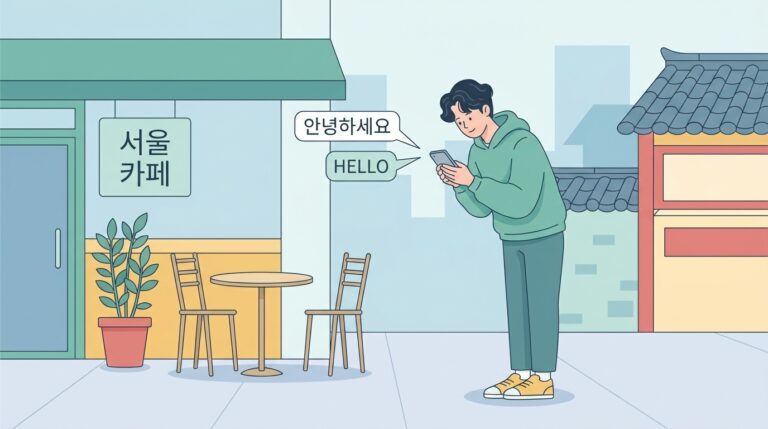
- The Two-Hand Phone Grip: When texting an apology on KakaoTalk or calling someone to cancel, hold your phone with both hands or bow your head slightly while speaking on the phone. Koreans physically bow even during voice calls—it naturally softens your tone!
- Immediate Reply (칼답 – Kkaldap): Don’t wait until the last minute. Informing the other person at least 2 to 3 hours prior reflects good nunchi (tactful awareness) and shows respect for their time.
4-2. Cultural Code: The Power of “밥 살게요” (I’ll buy you a meal)
In Korean culture, sharing meals builds deep interpersonal bonding. When you cancel, you create a slight emotional debt. Saying “다음에 맛있는 거 살게요 (Next time, delicious food is on me)” immediately clears that awkward tension and reaffirms that you genuinely cherish the relationship.
Phase 5: Real-Life Roleplay Scenario
Setting: You were scheduled to meet your Korean language exchange partner, Minjun (민준), at a cafe in Gangnam at 3:00 PM, but you caught a sudden flu.
- Turn 1 (You): 🎭 Typing a worried KakaoTalk message at 12:30 PM
민준 씨, 혹시 메시지 볼 수 있어요?
(Minjun ssi, hoksi mesiji bol su isseoyo?)
“Minjun, can you check your messages by any chance?” -
Turn 2 (Minjun): 🎭 Replying immediately
네! 저 지금 출발 준비 중이에요. 무슨 일 있어요?
(Ne! Jeo jigeum chulbal junbi jung-ieyo. Museun il isseoyo?)
“Yes! I’m getting ready to head out now. Did something happen?” -
Turn 3 (You): 🎭 Sending a sincere sad emoji
정말 죄송해요. 갑자기 몸살이 나서 오늘 못 나갈 것 같아요.
(Jeongmal joesonghaeyo. Gapjagi momsar-i naseo oneul mot nagal geot gat-ayo.)
“I am truly sorry. I suddenly got body aches/flu, so I don’t think I can make it today.” -
Turn 4 (Minjun): 🎭 Expressing concern
헐, 정말요? 병원은 다녀왔어요? 약은 먹었고요?
(Heol, jeongmalyo? Byeong-woneun danyeowasseoyo? Yageun meogeotgoyo?)
“Oh no, really? Have you been to the clinic? Did you take medicine?” -
Turn 5 (You): 🎭 Showing gratitude
네, 약 먹고 쉬고 있어요. 미리 연락 못 드려서 미안해요.
(Ne, yak meokgo swigo isseoyo. Miri yeollak mot deuryeoseo mianhaeyo.)
“Yes, I took medicine and am resting. I’m sorry for not contacting you earlier.” -
Turn 6 (Minjun): 🎭 Reassuring with kindness
아니에요! 약속은 전혀 신경 쓰지 말고 푹 쉬세요.
(Anieyo! Yaksogeun jeonhyeo singyeong sseuji malgo puk swiseyo.)
“Not at all! Don’t worry about our plan at all and get plenty of rest.” -
Turn 7 (You): 🎭 Proposing a warm make-up plan
감사해요 ㅠㅠ 몸 나으면 다음 주에 제가 맛있는 밥 꼭 살게요!
(Gamsahaeyo ㅠㅠ Mom naeumyeon daeum jue jega masinneun bap kkok salgeyo!)
“Thank you ㅠㅠ Once I recover, I will definitely treat you to a delicious meal next week!” -
Turn 8 (Minjun): 🎭 Smiling response
좋아요! 얼른 나으세요! 화이팅!
(Joayo! Eolleun na-euseyo! Hwaiting!)
“Sounds great! Get well soon! Fighting!”
🔀 Interactive Branching Moment
What should you do right after canceling your appointment due to an unexpected delay?
- Choice A: Send a one-word text saying “취소 (Cancel)” without explanation.
- Feedback (Bad ❌): Extremely rude and damages trust instantly.
- Choice B: Apologize with “정말 죄송해요 (I’m so sorry)”, state the reason, and offer to reschedule with a meal treatment.
- Feedback (Best ✅): Perfect! Demonstrates respect, sincerity, and Korean conversational manners.
- Choice C: Don’t send a message until 2 hours after the meeting time has passed.
- Feedback (Risk ⚠️): Ghosting (잠수) will break your friendship permanently in Korea.
Phase 6: 10-Second Emotion Shadowing Drill
Read these sentences out loud following the slash pauses / and emotional cues:
[🥺 Worried & Sincere]
정말 죄송해요, / 오늘 갑자기 / 급한 일이 생겼어요. /
(Jeongmal joesonghaeyo, / oneul gapjagi / geupan iri saenggyeosseoyo.)-
[😔 Apologetic & Gentle]
어쩌죠? / 오늘 약속을 / 다음으로 미뤄야 할 것 같아요. /
(Eojjeojyo? / oneul yaksogeul / daeumeuro mirwoya hal geot gat-ayo.) -
[😊 Bright & Determined]
제가 다음에 / 꼭 / 맛있는 커피 살게요! /
(Jega daeume / kkok / masinneun keopi salgeyo!)
Phase 7: K-Culture Mini Dictionary
- 약속 (Yaksok) | Promise / Appointment / Social Plan
- Used for both personal hangouts and formal meetings. In Korea, breaking a yaksok without notice is a serious social taboo.
- 미루다 (Miruda) | To postpone / To push back
- Perfect for when you don’t want to cancel entirely, but just need to delay the time by an hour or a few days.
- 취소하다 (Chwisohada) | To cancel
- Standard verb for canceling restaurant bookings, train tickets, or social dates.
- 밥 사다 (Bap sada) | To buy a meal (treat someone)
- The ultimate social currency in Korea used to show gratitude, build rapport, or apologize warmly.
Phase 8: Survival Kit for Travelers
Top 3 Survival Phrases
- 1. 예약 취소할 수 있을까요? (Yeyak chwisohal su isseulkkayo?)
- Pro Tip: Use this when calling a restaurant, salon, or K-beauty clinic to cancel your reservation.
- 2. 30분 정도 늦을 것 같아요. (Samsipbun jeongdo neujeul geot gat-ayo.)
- Pro Tip: Send this whenever Seoul subway transfers or traffic delays make you late.
- 3. 다음 주로 변경 가능할까요? (Daeum juro byeongyeong ganeunghalkkayo?)
- Pro Tip: Ideal when asking to reschedule a tour or activity ticket to next week.
Editor’s Travel Note
When navigating transit delays across Seoul or bus bookings, check real-time routing directly via the 네이버 지도 앱 다운로드 to provide your Korean friends with an accurate estimated arrival time rather than vague guesses!
Phase 9: One Step Deeper
In Korean society, an apology is not merely an admission of an error; it is an active emotional bridge (jeong repair). When you say “죄송해요” accompanied by an offer to meet later, you are validating that the other person’s time and feelings are important to you. It shows collective awareness—a core pillar of Korean interpersonal etiquette.
💬 Your Turn: Have you ever had to cancel plans in another language? What is the most polite apology custom in your home country? Drop your thoughts in the comments below!
Phase 10: FAQ & Common Mistakes
Q: What is the difference between 죄송합니다 and 미안합니다?
A: “죄송합니다 (Joesonghamnida)” carries deeper humility and is suitable for elders, bosses, acquaintances, and polite formal settings. “미안합니다 (Mianhamnida)” is polite but generally used toward peers or those younger than you. When in doubt, always default to 죄송합니다/죄송해요!
Q: Can I just send “미안 (Mian)” over KakaoTalk?
A: Only to very close friends of the same age or younger! Using “미안” with someone older or an acquaintance will sound disrespectful.
Q: How do I offer to pay next time without sounding boastful?
A: Use the phrase “제가 다음에 꼭 맛있는 거 살게요 (I will definitely buy something tasty next time)”. It sounds humble, warm, and natural.
🚨 Common Mistakes Alert Board
- Mistake: Saying “실례합니다 (Excuse me)” when canceling a plan.
- Correct Action: Use “죄송합니다 (I am sorry)”. “실례합니다” is for passing by people or interrupting someone.
- Mistake: Ghosting and apologizing hours later.
- Correct Action: Contact them immediately the moment you know your schedule has changed.
- Mistake: Over-promising an exact time you cannot make.
- Correct Action: Soften your message with “~할 것 같아요 (I think / It seems like)”.
Phase 11: Action Missions
- 🥉 Bronze Mission (Solo Practice): Shadow Expression 1 and Expression 3 out loud three times while looking in the mirror.
- 🥈 Silver Mission (Social Check): Send a mock cancellation message using “급한 일이 생겼어요” in your Korean study group or language exchange chat.
- 🥇 Gold Mission (Real Life): Next time you run late or change a date, use “다음에 커피 살게요!” to make someone smile.
- 🎮 K-Culture Mission: Watch an episode of a modern K-Drama and spot how many times characters say “급한 일” or “밥 살게요” when leaving abruptly!
Phase 12: Interactive Quiz Challenge
Q1. Fill in the blank:
“오늘 갑자기 _____ 일이 생겨서 못 갈 것 같아요. 정말 죄송해요!”
(Hint: Urgent matter)
👉 Click to view Answer & Explanation
Answer: 급한 (Geupan)
Explanation: “급한 일 (urgent matter)” is the standard natural way to explain an unexpected schedule conflict politely.
Q2. True or False:
Saying “다음에 제가 꼭 맛있는 거 살게요” is considered an arrogant and rude phrase in Korean culture.
👉 Click to view Answer & Explanation
Answer: False ❌
Explanation: It is the warmest and most courteous way to smooth over a canceled plan and show that you value the friendship!







