

Phase 1: 공감 (Story-Driven Opening)
안녕하세요! 매일한글 에디터입니다.
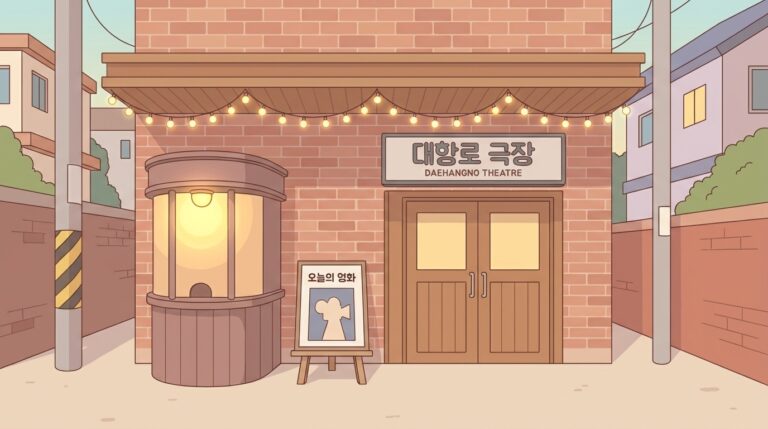
Picture this: You step out of Hyehwa Station Exit 2 on a crisp Saturday evening. Neon signs flicker down narrow brick alleys, bustling street performers draw crowds around Marronnier Park, and the scent of sweet hotteok fills the air. You’ve finally made it to Daehangno (대학로), Seoul’s Broadway and the undisputed heartbeat of Korean indie performing arts with over 150 small theaters (sogeukjang).
You walk down the steep concrete staircase into a cozy basement theater, clutching your reservation confirmation. But suddenly, reality hits. The box office staff rapid-fires questions at you: “현장 수령이세요?”, “인터파크 예매자 성함이랑 전화번호 뒷자리 알려주시겠어요?” Inside, the seating arrangement seems completely puzzling, the multi-role actors (Meol-ti-maen) talk directly to audience members in the front row, and people around you are laughing at theater slang you never saw in standard textbooks.
Navigating Korea’s intimate theater scene can be intimidating, even for advanced learners. But watching an indie play up-close is arguably one of the most rewarding cultural experiences in Seoul. This guide draws directly from real feedback from our intermediate learners who went from feeling lost in the ticket queue to chatting effortlessly with indie actors during curtain calls. Let’s equip you with authentic B2-level phrasing and the unwritten etiquette of Daehangno!
Phase 2: 핵심 표현 3선 심층 분석 (Top 3 Essential Expressions)
1. 예매 내역 확인해 주시겠어요? (한글)
- Pronunciation: Yemae naeyeok hwag-inhae jusigess-eoyo? (Sounds like: Ye-meh neh-yeok hwa-geen-hae joo-she-gess-o-yo)
- Meaning: Literal: “Could you check my reservation details?” / Natural: “Hi, I’m picking up tickets under my reservation.”
- K-Culture Moment: Used at small ticket booths (Maepyo-so) before shows when picking up online tickets booked via Interpark or YES24.
- Editor’s Insight: Rather than just saying “Ticket please” (표 주세요), using 예매 내역 (booking history/details) and the polite tentative ending -주시겠어요? shows sophisticated conversational courtesy at a B2 level.
- Situation Spectrum: Casual: 🚫 | Semi-formal: ✅ | Formal: ✅
- 🤔 Think About It: Notice how Korean customer interactions often focus on the “action/process of checking records” rather than simply demanding the physical object (the ticket).
2. 앞자리로 배정 가능할까요? (한글)
- Pronunciation: Apjari-ro baejeong ganeunghalkkayo? (Sounds like: Ahp-jah-ree-ro beh-jeong gah-neung-hal-kka-yo?)
- Meaning: Literal: “Is assignment to front seats possible?” / Natural: “Could I get seats closer to the stage if available?”
- K-Culture Moment: Many small indie theaters in Daehangno assign seats on a first-come, first-served basis (Seonchaksun) when you pick up tickets 1 hour before curtain call.
- Editor’s Insight: 배정 (assignment/allotment) is a polished Sino-Korean word. Pairing it with -가능할까요? softens the request, making it sound respectful rather than entitled.
- Situation Spectrum: Casual: 🚫 | Semi-formal: ✅ | Formal: ✅
- 🤔 Think About It: In Korean small theaters, front row seats are intense—actors might interact with you directly! Are you brave enough for the front row?
3. 커튼콜 때 사진 촬영 되나요? (한글)
- Pronunciation: Keoteun-kol ttae sajin chwaryeong doenayo? (Sounds like: Kuh-teun-kohl tteh sah-jeen chwa-ryung dweh-nah-yo?)
- Meaning: Literal: “Is photo shooting allowed during the curtain call?” / Natural: “Are we allowed to take photos during the curtain call?”
- K-Culture Moment: Korean theater etiquette strictly forbids any photography or filming during the performance (Gwan-geuk), but many Daehangno plays have dedicated “Photo Times” during the curtain call.
- Editor’s Insight: Using 촬영 (filming/photography) instead of just 사진 찍기 sounds natural and refined when checking venue policies with house ushers.
- Situation Spectrum: Casual: ⚠️ | Semi-formal: ✅ | Formal: ✅
- 🤔 Think About It: Why do you think live performance spaces in Korea maintain such strict rules about silence and recording compared to some Western musical venues?
Phase 3: 교과서 한국어 vs 진짜 한국어 (Textbook vs. Real Korean)
Situation 1: Picking up your tickets at the box office
- 📖 교과서 한국어: “인터넷으로 산 표를 받으러 왔습니다.” (I came to receive the ticket I bought on the internet.)
- 🗣️ 진짜 한국어: “인터파크 예매 건인데, 전화번호 뒷자리로 확인될까요?” (It’s an Interpark booking; can you check it with the last 4 digits of my phone number?)
- 💡 왜 다를까?: Korean small theaters rarely ask for physical printed vouchers; they almost exclusively verify identity using your booking platform name, your name, and the last 4 digits of your phone number.
Situation 2: Asking if audience participation is required
- 📖 교과서 한국어: “배우가 관객에게 말을 겁니까?” (Does the actor speak to the audience?)
- 🗣️ 진짜 진짜 한국어: “혹시 무대 참여나 관객 소통 많은 편인가요?” (Is there a lot of stage participation or audience interaction?)
- 💡 왜 다를까?: 소통 (interaction/communication) and 관객 참여 (audience participation) are standard theater-goer terminology in Korea that accurately convey the dynamic of small theater comedies.
Phase 4: K-Culture 딥다이브 & 비언어적 매너 (Deep Dive & Etiquette)
4-1. 눈치 (Nunchi) & Non-Verbal Manners in Small Theaters
- 시체관극 (Siche-gwan-geuk) Culture: In Korea, theatergoers take immersion very seriously. The slang term Siche-gwan-geuk literally means “watching a play like a corpse”—meaning no whispering, no rustling candy wrappers, no leaning forward (yeon-jwa blocking the view of the person behind you), and resting your back firmly against the seat backrest.
- Small Theater Posture: Because indie theaters have compact bench-style seating with tight legroom, keep your bag on your lap or beneath your feet. Refrain from crossing your legs as it often kicks the seat in front of you in tight spaces.
4-2. Cultural Code: The Iconic ‘멀티맨’ (Multi-Man)
- In almost every popular Daehangno comedy or romance play (like 옥탑방 고양이 or 한뼘사이), you will encounter the 멀티맨 (Multi-Man) or 멀티걸 (Multi-Woman). This single actor plays 10 to 15 different comic relief characters throughout the 90 minutes, changing costumes backstage in seconds. Knowing how to react enthusiastically to their spontaneous jokes and improv (A-deu-lip) is the secret to enjoying Korean theater!
Phase 5: 실전 롤플레이 시나리오 (Interactive Roleplay)
Setting: Basement ticket booth of a cozy 80-seat theater in Daehangno, 30 minutes before showtime.
Characters: You (Alex) and the friendly Box Office Staff (Staff).
- Staff: 🎭 (Smiling, holding a seating chart) 안녕하세요! 연극 <달빛 로맨스> 예매하셨나요?
(Annyeonghaseyo! Yeongeukyemaehasyeonnayo? / Hello! Did you book tickets for the play ?) - Alex: 🎭 (Showing phone screen) 네, 인터파크로 미리 예매하고 왔어요. 현장 수령 맞죠?
(Ne, Inteopakeu-ro miri yemaehago wasseoyo. Hyeonjang suryeong matjyo? / Yes, I booked in advance via Interpark. This is where I pick them up on-site, right?) - Staff: 🎭 (Clicking mouse) 네, 맞습니다. 예매자분 성함이랑 연락처 뒷자리 네 자리 말씀해 주세요.
(Ne, matseumnida. Yemaejabun seongham-irang yeollakcheo dwitjari ne jari malsseumhae juseyo. / Yes, correct. Please give me your name and the last four digits of your phone number.) - Alex: 🎭 (Speaking clearly) 알렉스이고요, 전화번호는 5678이에요.
(Alex-igoyo, jeonhwabeonho-neun o-yuk-chil-pal-ieyo. / I’m Alex, and the phone number is 5678.) - Staff: 🎭 (Checking monitor) 네, 알렉스 님 2매 확인되셨습니다. 지금 앞쪽 2열 중앙 좌석이랑 뒤쪽 통로 좌석 남아있는데, 어디로 드릴까요?
(Ne, Alex-nim du-mae hwagindoesyeosseumnida. Jigeum apjjok i-yeol jung-ang jwaseog-irang dwitjjok tongno jwaseok nama-inneunde, eodiro deurilkkayo? / Confirmed 2 tickets for Alex. We currently have 2nd row center and back row aisle available; which would you prefer?) - Alex: 🎭 (Curious about audience participation) 혹시 앞자리에 앉으면 배우분들이 말 많이 시키나요?
(Hoksi apjarie anjeumyeon baeubundeuri mal mani sikinayo? / If we sit in the front row, do the actors talk to the audience a lot?) - Staff: 🎭 (Chuckling) 2열은 살짝 호응 유도 정도만 있어요! 부담스럽지 않으실 거예요.
(I-yeor-eun saljjak hoeung yudo jeongdoman isseoyo! Budamseureopji aneusil geoyeyo. / In the second row, there is just light cheer induction! It won’t be burdensome at all.) - Alex: 🎭 (Nodding enthusiastically) 좋아요! 그럼 앞자리 쪽으로 배정해 주세요. 감사합니다!
(Joayo! Geureom apjari jjogeuro baejeonghae juseyo. Gamsahamnida! / Great! Then please assign us to the front seats. Thank you!)
🔀 인터랙티브 분기점 (Branching Decision Point)
Imagine the staff suddenly asks: “공연 시작 10분 전부터 입장 가능한데, 공연 중 화장실 이용 어려우신 점 괜찮으실까요?” (Doors open 10 minutes prior; please note you cannot use the restroom once the show starts. Is that okay?)
- Choice A: “네, 미리 다녀올게요! 티켓 감사합니다.” (Sure, I’ll visit the restroom in advance! Thanks for the tickets.)
- 🌟 Feedback (Best): Perfect! Small theaters often don’t have interior restrooms and prohibit re-entry during performances. Acknowledging this clearly avoids mid-show emergencies.
- Choice B: “중간에 잠깐 나갔다 오면 안 돼요?” (Can’t I just step out briefly during the show?)
- ⚠️ Feedback (Risk): While grammatically correct, leaving mid-performance disrupts the intimate room and re-entry is almost universally banned in Korean small theaters.
- Choice C: “화장실 어디 있어요? 당장 가요.” (Where is the bathroom? I’m going right now.)
- 🚫 Feedback (Bad): Too blunt (당장 가요) and lacks polite conversational cohesion. Better: “혹시 화장실이 건물 어디에 있나요?”
Phase 6: 10초 감정 섀도잉 드릴 (Emotional Shadowing Drill)
Read aloud along with the pitch breaks (/) and adopt the indicated emotional mood:
[😊 설레고 정중하게 - Excited & Polite]
“저희 인터파크로 예매했는데요, / 혹시 앞자리로 / 배정 가능할까요?”
(Jeohui Inteopakeu-ro yemaehaenneundeyo, / hoksi apjari-ro / baejeong ganeunghalkkayo?)-
[🤔 조심스럽고 궁금하게 - Inquiring & Careful]
“공연 중에 / 사진 촬영은 안 되지만, / 커튼콜 때는 / 찍어도 되죠?”
(Gong-yeon jung-e / sajin chwaryeong-eun an doejiman, / keoteunkol ttae-neun / jjigeodo doejo?) -
[👏 감탄하며 열정적으로 - Impressed & Energetic]
“멀티맨 배우님 연기가 / 진짜 대박이었어요! / 너무 몰입해서 봤네요.”
(Meol-ti-maen bae-u-nim yeon-gi-ga / jinjja daebag-ieosseoyo! / Neomu moriphaeseo bwan-neyo.)
Phase 7: K-Culture 미니 사전 (Mini Dictionary)
- 소극장 (So-geuk-jang) – Small Theater / Black Box Theater
- Intimate performance spaces seating under 100–300 people where actors’ breathing and micro-expressions are visible from every seat.
- 총막 / 막공 (Chong-mak / Mak-gong) – Final Performance
- Short for 마지막 공연. The emotional finale of a theater run where actors give special stage speeches (Mudae-insa) and extra fan service.
- 오픈런 (Open-run) – Open-ended Run
- Shows that run continuously without a fixed closing date due to steady popularity (e.g., famous Daehangno comedy shows).
- 티켓팅 / 피켓팅 (Tiketting / Pi-ketting) – Ticket Booking / Bloodbath Ticketing
- A portmanteau of 피 (blood) and 티켓팅 (ticketing), describing how intensely competitive booking popular Korean shows can be.
Phase 8: 여행자를 위한 생존 키트 (Traveler’s Survival Kit)
Top 3 Survival Phrases for Daehangno
- 1. “리플릿(팸플릿) 하나 가져가도 될까요?” (Ripleut hana gajyeogado doelkkayo?)
- Pro Tip: Grab the colorful mini-brochure at the ticket booth—it often contains character maps and actor cast schedules (Cast Board).
- 2. “입장은 몇 분 전부터 가능한가요?” (Ipjang-eun myeot bun jeonbuteo ganeunghangayo?)
- Pro Tip: Most small venues open doors exactly 10 to 15 minutes before the show.
- 3. “재관람 할인 증빙은 어떻게 보여드려요?” (Jaegwanram harin jeungbing-eun eotteoke boyeodeuryeoyo?)
- Pro Tip: If you booked a “Re-watching Discount” (재관람 할인), you must show your previous physical ticket stub at the desk!
🗺️ Editor’s Travel Note
- Getting There & Navigating: Take Seoul Subway Line 4 to Hyehwa Station (혜화역). Small theaters are tucked in narrow hills and basements—make sure you rely on the 네이버 지도 앱 다운로드 (Naver Map App Download) rather than Google Maps for accurate alley routing.
- Restroom Alert: 80% of small theaters do NOT have restrooms inside the theater room. Always use the public restrooms inside Hyehwa Station or nearby cafes before checking in.
Phase 9: “한 발 더 깊이” (Cultural Essay)
In Korean performance culture, going to a play is not merely passive consumption; it is an unspoken covenant of shared emotional energy (Jeong and Heung). Because small theaters bring actors and audiences within arm’s reach, the audience’s silence during tense scenes and synchronized laughter during comedic beats become part of the play itself. Respecting quiet theater etiquette (Gwan-geuk manner) is regarded not as a restriction, but as the highest form of respect for the actors pouring their sweat on stage.
💬 Your Turn: Have you ever attended an intimate live theater performance in Korea or your home country? What was the biggest cultural difference you noticed in audience reactions? Share your story in the comments below!
Phase 10: FAQ & 오해 방지 (FAQ Schema & Common Mistakes)
Q: Can I buy tickets directly at the theater box office on the day of the show?
A: Yes! Most Daehangno theaters operate on-site ticket booths (현장 매표소) opening 1 hour before curtain call. However, for popular weekend shows, booking online in advance via Interpark or YES24 is strongly recommended to guarantee a seat.
Q: Is food or beverage allowed inside small theaters in Korea?
A: Generally, absolutely no food or drinks are allowed, with the occasional exception of bottled water with a secure cap. Coffee in take-out cups will be turned away at the door.
Q: What should I do if an actor suddenly asks me a question from the stage?
A: Don’t panic! It is part of the small theater charm. Smile, answer briefly in simple Korean or English, and ride along with the humor. The actor will guide the laughter kindly!
🚨 흔한 실수 (Common Mistakes) Warning Board
- Mistake: Leaning forward in your chair to see better.
- Correct Action: Keep your back against the chair. Leaning forward (연좌) completely blocks the view of the person behind you.
- Mistake: Arriving 2 minutes past showtime expecting to slip in quietly.
- Correct Action: Late admission is strictly forbidden in most Daehangno theaters. If you are late, you will forfeit your ticket without refund.
- Mistake: Taking photos during the play because the theater is small and cozy.
- Correct Action: Keep phones turned completely off or on silent (not vibrate). Only take photos when actors announce the 포토타임 (Photo Time) during curtain call.
Phase 11: 액션 미션 & 참여 유도 (Action Missions)
- 🥉 Bronze Mission (Solo Practice): Practice saying “인터파크 예매자 성함 알렉스입니다” smoothly 5 times out loud in front of a mirror.
- 🥈 Silver Mission (Social Share): Look up a current Daehangno theater poster on Instagram using
#대학로연극and leave a comment predicting what genre it is! - 🥇 Gold Mission (Real Life): Visit Hyehwa Station Exit 2, walk to a small theater box office, and successfully pick up a ticket using today’s phrases!
- 🎮 K-Culture Mission: Watch an episode of a Korean drama featuring Daehangno actors (such as Hospital Playlist or Start-Up) and spot actors who built their careers on the Daehangno stage!
Phase 12: 인터랙티브 퀴즈 챌린지 (Interactive Quiz)
Q1. (Situational Judgment) You reserved tickets online and arrived at the Daehangno box office. Which sentence is the most natural way to claim your seats?
* ① 표 내놓으세요.
* ② 예매 내역 확인 부탁드립니다. 제 이름은 김민수입니다.
* ③ 인터넷에서 샀으니까 그냥 들어가겠습니다.
🔍 정답 및 해설 보기 (Click to reveal answer)
정답: ②
* 해설: Asking politely to verify your reservation (예매 내역 확인 부탁드립니다) followed by your name is the natural, polite B2 standard.
Q2. (Fill-in-the-blank) Complete the phrase asking about photo policies during the finale:
“혹시 ________ 때 사진 촬영 가능한가요?” (Curtain call)
🔍 정답 및 해설 보기 (Click to reveal answer)
정답: 커튼콜 (Keoteunkol)
* 해설: 커튼콜 (Curtain call) is the moment actors return to the stage to bow after the performance concludes.
Q3. (True / False Cultural Check) In Korean small theaters, it is acceptable to keep your phone on vibrate mode inside your pocket during the show. [ True / False ]
🔍 정답 및 해설 보기 (Click to reveal answer)
정답: False
* 해설: Vibrations resonate loudly against small theater floorboards and walls. Phones must be turned off or switched to “Do Not Disturb / Theater Mode”.







