

Phase 1: 공감 (Story-driven Opening)
안녕하세요! 매일한글 에디터입니다.
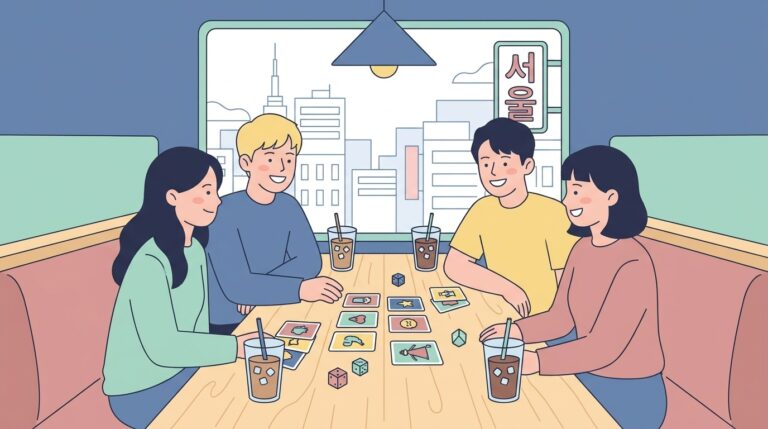
Picture this: You find yourself in the neon-lit alleyways of Hongdae on a Friday night, surrounded by friends who are itching for something more interactive than just another round of chimaek (chicken and beer). Someone shouts, “Let’s hit a board game cafe!” Walking through the door of a premier Korean board game cafe (보드게임 카페), you’re greeted by walls lined with hundreds of color-coded boxes, private curtained booths, and tablet menus buzzing with customized drink orders. But the moment the game of Splendor or The Resistance: Avalon kicks off, your standard textbook Korean falls completely flat.
Suddenly, the table erupts into lightning-fast banter: whispers of psychological warfare, bluffing accusations, and complex negotiations that sound nothing like “저는 보드게임을 좋아합니다.” You want to negotiate a truce, call someone’s bluff, or tactfully suggest a different difficulty level without sounding robotic or clumsy.
Mastering advanced, strategic Korean in this micro-society isn’t just about winning the board; it’s about reading between the lines, gauging the room’s nunchi (눈치), and asserting your presence with effortless wit. In this guide, backed by years of field observation and real feedback from advanced learners, we’ll dive deep into C1-level gaming vernacular and unspoken cafe etiquette so you can navigate any Korean board game cafe like a seasoned local strategist.
Phase 2: 핵심 표현 3선 심층 분석 (Top 3 Key Expressions)
1. 밑밥을 깔다 (Mit-babeul kkal-da)
- Pronunciation: Mit-babeul kkal-da (Sounds like “meet-bahb-ool kkal-dah” — imagine ‘laying down bait like groundbait before fishing’)
- Meaning: Literal: To lay down groundbait (chumming the water) | Nuance: To strategically set the stage or make subtle excuses/preparations in advance before dropping a major move or truth.
- K-Culture Moment: Frequently used in Korean variety game shows like The Genius or Running Man when a player pretends to have terrible cards early on, only to reveal an unbeatable hand at the decisive turn.
- Editor’s Insight: At a C1 level, you don’t just say “거짓말하다” (to lie). You use 밑밥을 깔다 to describe calculated psychological positioning. It implies proactive strategic finesse.
- Situation Spectrum: Casual ✅ | Semi-formal ⚠️ | Formal 🚫
- 🤔 Think About It: How does the fishing metaphor reflect Korean collective culture’s focus on long-term situational context over direct upfront confrontation?
2. 판을 뒤집다 (Paneul dwijip-da)
- Pronunciation: Pan-eul dwi-jip-da (Sounds like “pahn-ool dwee-jeep-dah” — think of ‘flipping the entire game board over’)
- Meaning: Literal: To flip the table/board | Nuance: To orchestrate a dramatic game-changing reversal; to turn the tables completely.
- K-Culture Moment: Heard during high-stakes mafia or territory-control games like Catan or Bang! when an underdog executes a masterstroke that ruins the frontrunner’s dominance in one turn.
- Editor’s Insight: Be careful with context: 판을 뒤엎다 (with 엎다) can mean literally ruining the mood or flipping the table in anger, whereas 판을 뒤집다 highlights a brilliant strategic comeback.
- Situation Spectrum: Casual ✅ | Semi-formal ✅ | Formal ⚠️ (often used in political/business journalism)
- 🤔 Think About It: Why is dramatic underdog reversal (역전극) so deeply celebrated in Korean competitive narratives?
3. 눈치 싸움이 치열하다 (Nunchi ssaumi chiyeol-hada)
- Pronunciation: Nun-chi ssa-um-i chi-yeol-ha-da (Sounds like “noon-chee ssah-oom-ee chee-yuhl-hah-dah”)
- Meaning: Literal: The fight of wits/situational sensing is fierce | Nuance: A subtle, unspoken battle of reading intentions, timing, and psychological pressure.
- K-Culture Moment: Essential during blind-bid or hidden-role games like Citadels or Coup, where victory depends on guessing which card your opponent chose without verbal clues.
- Editor’s Insight: This phrase elevates your Korean from descriptive (“재미있다”) to analytical, demonstrating that you understand the psychological tension under the surface.
- Situation Spectrum: Casual ✅ | Semi-formal ✅ | Formal ✅
- 🤔 Think About It: How does nunchi transform from a social survival mechanism into a voluntary, thrilling game mechanic in modern Korean entertainment?
Phase 3: 교과서 한국어 vs 진짜 한국어 (Textbook vs. Real-Life Korean)
Situation 1: Calling out someone’s bluff or suspicious move
- 📖 교과서 한국어: “당신이 거짓말을 하고 있는 것 같습니다.” (I think that you are telling a lie.)
- 🗣️ 진짜 한국어: “지금 블러핑에 밑밥 까시는 거 다 보이거든요? 속을 줄 알고요?” (I can see right through your bluff and prep work. You think I’d fall for that?)
- 💡 왜 다를까? Textbook phrases sound like an interrogation in a police station. Native speakers frame strategic skepticism as playful, banter-heavy challenges using gaming loanwords (블러핑) combined with vivid idiomatic verbs.
Situation 2: Asking the cafe staff for a game recommendation suited for the group
- 📖 교과서 한국어: “네 명을 위한 재미있는 보드게임을 추천해 주십시오.” (Please recommend an interesting board game for four people.)
- 🗣️ 진짜 한국어: “저희 4인팟인데, 룰 설명 10분 컷에 텐션 확 올라가는 심리전 위주로 추천해 주실 수 있나요?” (We’re a party of 4; could you recommend a high-energy mind game with rules explained in under 10 minutes?)
- 💡 왜 다를까? Advanced speakers use specialized community jargon like ~인팟 (party of N players), ~컷 (completable within a timeframe), and 텐션 (group energy/vibe) to get spot-on recommendations quickly.
Phase 4: K-Culture 딥다이브 & 비언어적 매너 (Deep Dive & Non-Verbal Manners)
4-1. 눈치(Nunchi) & Gaming Etiquette
- The Bell & Tablet Etiquette: In modern Korean board game cafes (like Red Button or Asmodee lounges), tables feature digital call bells or tablets for tutorial videos. Never shout across the room for staff; press the tablet button quietly.
- Card Sleeves & Tile Handling: Koreans take board game preservation seriously. Cards are almost always sleeved (프로텍터). Avoid bending cards in your hands while strategizing or slamming wooden meeples aggressively on the table.
- One Drink Per Person Rule (1인 1음료): Cafe entry is usually calculated per hour plus a mandatory beverage order per head. Make your drink selection right away upon check-in.
4-2. The “Tension” Culture in K-Board Game Venues
Board game cafes in Korea function as a central social hub bridging the gap between digital gaming and face-to-face social friction. The vibe is heavily dictated by 텐션 (group energy). If a game becomes too analytical, someone will say “뇌절 온다” (brain overload) or deliberately introduce chaotic moves to keep the group laughing. Winning without maintaining good camaraderie is seen as poor social nunchi.
Phase 5: 실전 롤플레이 시나리오 (Interactive Roleplay Scenario)
Setting: Gangnam ‘Red Button’ Board Game Cafe, Friday, 8:30 PM. You and your Korean acquaintance Min-jun (민준) are mid-game playing Avalon with two others.
- Turn 1 (Min-jun): 이번 원정대는 저랑 수진 씨가 가는 게 맞다니까요? 저 진짜 선량한 시민이에요! (I’m telling you, Sujin and I should go on this quest! I’m genuinely a loyal servant!)
- Turn 2 (You): 🎭 [Smirking, tapping your fingers on the table] 민준 씨, 눈빛 흔들리는 거 다 티 나요. 아까부터 밑밥 깔아두신 거 아니에요? (Min-jun, your eyes are shaking visibly. Haven’t you been setting this trap since earlier?)
- Turn 3 (Min-jun): 🎭 [Defensively raising both hands] 억울합니다! 제가 배신자면 제 손에 장을 지질게요. 지켜보세요! (That’s unjust! If I’m a traitor, I’ll fry my hand in soy sauce. Just watch!)
- Turn 4 (You): 🎭 [Turning to Sujin with an analytical tone] 수진 씨, 민준 씨 말에 넘어가면 이번 판 바로 터져요. 신중하게 가시죠. (Sujin, if we fall for his words, this round will blow up immediately. Let’s be prudent.)
- Turn 5 (Min-jun): 어라? 오히려 저를 몰아가면서 판을 뒤집으려는 큰 그림 아니에요? (Wait? Aren’t you framing me to orchestrate a complete table reversal yourself?)
- Turn 6 (You): 🎭 [Leaning back with composed confidence] 제 패는 투명합니다. 수진 씨가 선택하세요. 누구 블러핑이 더 조잡한지! (My hand is crystal clear. Sujin, choose. Whose bluff is clumsier!)
- Turn 7 (Min-jun): 캬, 멘트 살벌하네. 이번 판 눈치 싸움 제대로네요. 투표 갑시다! (Wow, sharp words! This round is pure psychological warfare. Let’s take the vote!)
- Turn 8 (You): 🎭 [Placing the voting token face down] 후회 없는 선택 하시길 바랍니다. 투표 공개하시죠! (I hope you make a choice you won’t regret. Let’s reveal the vote!)
🔀 Interactive Choice Point
Sujin is hesitating on the decisive vote. How do you solidify your alliance?
- Choice A: “수진 씨, 제 직감을 믿으세요. 저 배신자 아니에요.” (Sujin, trust my gut. I’m not the traitor.)
- Choice B: “수진 씨, 민준 씨가 표정 관리 실패한 거 보셨죠? 여기서 승부수 던져야 판을 잡습니다.” (Sujin, you saw Min-jun fail to keep a straight face, right? We have to drop the decisive move here to control the board.)
- Choice C: “그냥 아무나 뽑고 다음 게임으로 넘어가요. 머리 아파요.” (Let’s just pick anyone and move to the next game. My head hurts.)
Feedback on Choices:
* Choice A (Risk): Too vague and emotional for a C1 tactical debate. It lowers the dramatic tension.
* Choice B (Best!): Spot-on! Employs nuanced phrases (표정 관리, 승부수를 던지다, 판을 잡다) while maintaining high group engagement.
* Choice C (Bad): Kills the mood (갑분싸). Defeats the collective social contract of the board game cafe.
Phase 6: 10초 감정 섀도잉 드릴 (Emotion Shadowing Drill)
- Drill 1:
[🔥 강한 의심과 카리스마]아까부터 / 은근슬쩍 밑밥 까시는데, / 제 눈은 / 못 속입니다.
(Ah-kka-bu-teo / eun-geun-seul-jjeok mit-bap kka-si-neun-de, / je nun-eun / mot sok-im-ni-da.) - Drill 2:
[😏 여유 넘치는 도발]여기서 승부수 안 던지면 / 판 완전히 넘어가요. / 쫄리면 / 빠지시든가요!
(Yeo-gi-seo seung-bu-su an deon-ji-myeon / pan wan-jeon-hi neom-eo-ga-yo. / Jjol-li-myeon / ppa-ji-si-deun-ga-yo!) - Drill 3:
[🤝 차분하지만 단호한 설득]저희 둘이 연합해서 / 1등 견제 안 하면 / 다음 턴에 / 게임 끝납니다.
(Jeo-hui dul-i yeon-hap-hae-seo / il-deung gyeon-je an ha-myeon / da-eum teon-e / ge-im kkeut-nam-ni-da.)
Phase 7: K-Culture 미니 사전 (Mini Dictionary)
- 견제하다 (Gyeon-je-ha-da) | To check / neutralize a leading player | Used when coordinating with other players to target the current leader (e.g., “우리 지금 1등 견제 들어가야 돼요”).
- 승부수를 던지다 (Seung-bu-su-reul deon-ji-da) | To make a decisive, high-stakes move | Borrowed from Baduk (Go); used when playing an all-in aggressive strategy that dictates win or loss.
- 표정 관리 (Pyo-jeong gwan-ri) | Poker face (literally ‘expression management’) | Used when accusing someone of failing to hide joy or guilt during hidden-role games.
- 빌드업 (Build-up) | Strategic setup / Long-term engine building | Refers to spending early turns laying foundations for an exponential scoring combo later.
Phase 8: 여행자를 위한 생존 키트 (Survival Kit for Travelers)
Top 3 Survival Phrases
- “혹시 이 게임 룰 설명 영상 태블릿으로 볼 수 있나요?” (Hok-si i ge-im rul seol-myeong yeong-sang tae-beul-lit-eu-ro bol su in-na-yo?) — Pro Tip: Most modern Korean cafes offer interactive guided video tutorials right on the table screen.
- “테이블 이용 시간 연장 가능한가요?” (Te-i-beul i-yong si-gan yeon-jang ga-neung-han-ga-yo?) — Pro Tip: Peak weekend hours may have fixed limits, while weekdays often allow seamless automatic hourly extensions.
- “반납대에 보드게임 반납하고 새로 가져오면 되죠?” (Ban-nap-dae-e bo-deu-ge-im ban-nap-ha-go sae-ro ga-jyeo-o-myeon doe-jyo?) — Pro Tip: Return games piece-by-piece to the designated counter so staff can verify components before taking your next pick.
Editor’s Travel Note
When seeking top-tier venues in Seoul, open your map app and search with the keyword [네이버 지도 앱에서 보드게임 카페 찾기] in areas like Sinchon, Hongdae, or Gangnam Station. Major franchises like Red Button (레드버튼), Holic (보드스쿨), or Devil Dice (데빌다이스) provide private booths with phone charging ports, ambient lighting control, and gourmet snacks like churros and tteokbokki delivered straight to your table.
Phase 9: “한 발 더 깊이” (Cultural Essay)
In Korean social dynamics, leisure spaces are rarely purely individualistic; they are stages for collective resonance (정 and 흥). A Korean board game cafe is a micro-theatre of social hierarchy and tension dissolution. Within these curtained booths, strict age-based honorific barriers naturally soften as playful banter and joint problem-solving take precedence. Engaging in strategic counter-play isn’t viewed as hostile; rather, playing sharply and invoking cultural banter is the ultimate form of respect for your peers’ intelligence.
💬 Your Turn: Have you ever experienced a gaming session where language barriers vanished through competitive banter? Share your favorite board game moment or your favorite tactical Korean idiom in the comments below!
Phase 10: FAQ & 오해 방지 (FAQ Schema)
Q: How are pricing and payments structured at Korean board game cafes?
A: Most operate on an hourly rate per person (typically 3,000 to 4,000 KRW/hour) plus a mandatory 1-drink-per-person order paid at the end or upon entry. You settle the remaining hourly balance when checking out at the front desk.
Q: Can I visit a board game cafe alone as a solo traveler?
A: While most venues cater to groups (2 to 8 people), some cafes host open weekly meetup tables (소모임 or 오픈채팅 tables). However, walking in solo without joining a designated community table is uncommon.
Q: Do games come with English rulebooks?
A: Premier chain locations occasionally stock bilingual editions of popular international games, but domestic titles are predominantly in Korean. Using the table tablet’s visual tutorial or requesting staff help (직원 호출) is the quickest way to grasp rules.
🚨 흔한 실수 (Common Mistakes) 경고판
- Mistake: Taking multiple games to your private booth at once.
Correct Action: Always take one game at a time, return it to the return desk (반납대), and select your next title. - Mistake: Forgetting to return food trays separately from game boxes.
Correct Action: Dishes and cups go to the kitchen return area (퇴식구), while game boxes go to the designated game counter. - Mistake: Using aggressive honorific-stripping (반말) abruptly during a game without prior social agreement.
Correct Action: Keep sentence endings in polite formal/informal forms (e.g., ~하셨죠?, ~인가요?) even during intense tactical banter.
Phase 11: 액션 미션 & 참여 유도 (Action Missions)
- 🥉 Bronze Mission (Solo): Read the Phase 6 Shadowing Drills aloud 3 times, focusing on natural pauses at slashes (
/). - 🥈 Silver Mission (Social): Leave a comment constructing your own strategic challenge sentence using the idiom “판을 뒤집다” or “밑밥을 깔다”.
- 🥇 Gold Mission (Field): Visit a Korean board game cafe in Korea or with Korean friends and execute a game recommendation request using the phrase “~인팟인데 심리전 게임 추천해주세요”.
- 🎮 K-Culture Mission: Watch an episode of a Korean brain-game show (e.g., The Devil’s Plan or The Genius) and count how many times players use the terms 견제, 연합, or 블러핑.
Phase 12: 인터랙티브 퀴즈 챌린지 (Interactive Quiz)
1. Situation Judgment Quiz
Your friend in Coup is pretending to be the Duke for three consecutive turns, but you suspect deception. Which C1-level response is the most natural and witty?
* A) 거짓말을 멈추어 주십시오.
* B) 지금 몇 턴째 밑밥 까시는 것 같은데, 저 의심 들어갑니다?
* C) 저는 당신의 직업 카드가 마음에 들지 않습니다.
🔍 정답 및 해설 확인하기
정답: B
해설: Option B showcases natural mastery of idioms (밑밥 까시다) and authentic gaming rhythm (의심 들어갑니다), whereas A and C are stiff and grammatically unnatural in a casual cafe context.
2. Fill-in-the-Blank Quiz
Complete the sentence with the appropriate idiom:
“상대방이 1등을 굳히지 못하도록, 이번 턴에 확실하게 [ ______ ]를 던져서 역전을 노려야 해.”
🔍 정답 및 해설 확인하기
정답: 승부수 (또는 판을 뒤집는 한 수)
해설: 승부수를 던지다 means to risk a critical, game-deciding move to aim for a comeback (역전).
3. True or False Culture Quiz
In Korean board game cafes, taking 3-4 board games to your table all at once so you don’t have to get up repeatedly is considered good manners. (T/F)
🔍 정답 및 해설 확인하기
정답: False
해설: It is proper etiquette to borrow and return one game box at a time so other guests have fair access to the game library.






