

Phase 1: Empathy (스토리 몰입형 오프닝)
안녕하세요! 매일한글 에디터입니다.
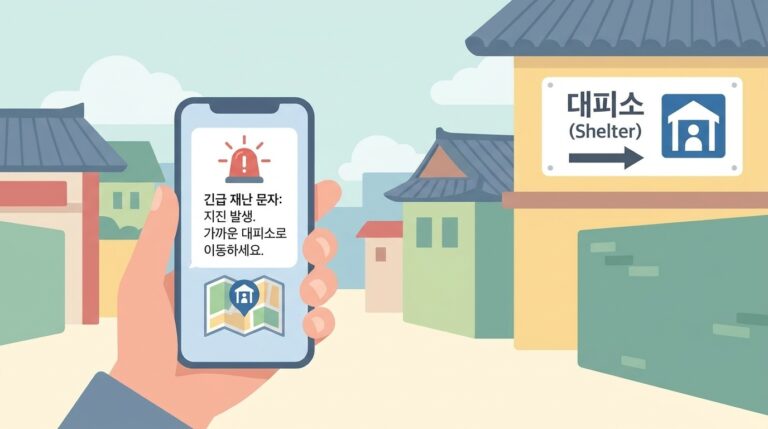
Imagine sitting peacefully at a cozy cafe in Seongsu-dong, enjoying a hot hand-drip coffee, when suddenly every smartphone in the room emits a loud, high-pitched alert tone simultaneously: 삐—! Everyone reflexively checks their screens to read a severe warning message: [행정안전부] 00시 00분 지역 규모 4.5 지진 발생. 낙하물에 유의하시고 안전한 곳으로 대피하십시오.
For advanced learners, reading emergency broadcast texts (재난문자) and responding swiftly in Korean isn’t just an academic exercise—it is an essential survival skill. While Korea was historically considered relatively safe from major seismic activities, recent earthquakes in Gyeongju and Pohang have prompted the nationwide implementation of rigorous safety protocols and automated disaster notification systems. When the ground shakes, panic sets in if you cannot understand crucial instructions like securing evacuation routes or turning off gas valves.
In this comprehensive guide tailored for C1 advanced learners, we will move beyond basic emergency terms. You will master high-level disaster management vocabulary, structural nuances used in government safety broadcasts, and the subtle cultural etiquette required during public emergencies in South Korea. Backed by real feedback from international residents who navigated seismic events in Korea, this lesson equips you with both technical clarity and native-level fluency when seconds count.
Phase 2: 핵심 표현 3선 심층 분석
1. 낙하물에 대비하여 머리를 보호하십시오
- Pronunciation: [Nak-ha-mul-e dae-bi-ha-yeo meo-ri-reul bo-ho-ha-sip-si-o] (Sounds like: Nak-ha-mool-eh dae-bee-ha-yuh muh-ree-reul boh-ho-hah-ship-see-oh)
- Meaning: Literal: “Against falling objects, prepare and protect your head.” / Nuance: Standard formal emergency instruction advising people to shelter their heads immediately under sturdy furniture or bags.
- K-Culture Moment: Frequently broadcasted over subway PA systems or apartment complex speakers immediately following an epicenter warning.
- Editor’s Insight: The word 낙하물 (Falling objects) combines ‘낙’ (drop), ‘하’ (down), and ‘물’ (object). In C1 Korean, recognizing Sino-Korean roots helps you decipher formal warnings instantly.
- Situation Spectrum: Casual 🚫 | Semi-formal ⚠️ | Formal ✅
- 🤔 Think About It: How does the formal imperative ending
-하십시오alter public compliance compared to conversational commands in your native language?2. 진동이 멈춘 후 대피로를 확보하세요
- Pronunciation: [Jin-dong-i meom-chun hu dae-pi-ro-reul hak-bo-ha-se-yo] (Sounds like: Jeen-dong-ee meom-choon hoo dae-pee-roh-reul hahk-boh-hah-seh-yoh)
- Meaning: Literal: “After vibrations cease, secure an evacuation route.” / Nuance: Instructions to open doors or windows before the building frame warps, preventing exit blockage.
- K-Culture Moment: Seen in administrative safety posters inside high-rise apartment elevators and public facilities across Seoul.
- Editor’s Insight: 확보하다 (To secure/guarantee) is a pivotal C1 business and administrative verb used when taking clear physical action to ensure safety or availability.
- Situation Spectrum: Casual ⚠️ | Semi-formal ✅ | Formal ✅
- 🤔 Think About It: Why is opening doors early emphasized in modern high-rise urban planning in East Asia?
3. 2차 피해를 막기 위해 가스와 전기를 차단해야 합니다
- Pronunciation: [I-cha pi-hae-reul mak-gi wi-hae ga-seu-wa jeon-gi-reul cha-dan-hae-ya ham-ni-da] (Sounds like: Ee-cha pee-hae-reul mahk-gee wee-hae gah-seuh-wah jeohn-gee-reul chah-dahn-hae-yah hahm-nee-dah)
- Meaning: Literal: “To block secondary damage, gas and electricity must be shut off.” / Nuance: Preventing post-earthquake fires or electrical short-circuits by shutting off main valves.
- K-Culture Moment: Instructed by floor wardens during nationwide Civil Defense Drills (민방위 훈련).
- Editor’s Insight: 2차 피해 (Secondary damage) refers to fires or gas leaks following an initial shock—a critical concept in Korean disaster mitigation literature.
- Situation Spectrum: Casual ⚠️ | Semi-formal ✅ | Formal ✅
- 🤔 Think About It: How does the concept of collective safety influence personal actions in densely populated residential spaces?
Phase 3: 교과서 한국어 vs 진짜 한국어
Situation 1: Giving clear instructions inside a shaken indoor space
- 📖 교과서 한국어: 지진이 발생하였으니 침착하게 신속히 대피하십시오. (An earthquake has occurred; please evacuate calmly and quickly.)
- 🗣️ 진짜 한국어: 일단 가방으로 머리부터 가리고, 진동 가라앉으면 바로 계단으로 나가자! (First cover your head with your bag, and once the shaking calms down, let’s head out using the stairs right away!)
- 💡 왜 다를까? In real urgent crises, Koreans drop heavy official terminology (
대피하십시오) and use highly direct, action-oriented spoken phrasing (머리부터 가리고,계단으로 나가자) emphasizing specific body parts and immediate physical actions.
Situation 2: Checking gas valves and safety with neighbors
- 📖 교과서 한국어: 가스 밸브를 차단하여 추가 사고를 예방하십시오. (Shut off the gas valve to prevent further accidents.)
- 🗣️ 진짜 한국어: 가스 불부터 빨리 끄고 밸브 확실히 잠겼나 확인해 봐! (Turn off the gas stove first and check if the valve is tightly closed!)
- 💡 왜 다를까? Conversational emergency communication relies heavily on emphatic adverbs (
확실히,빨리) and clear sensory instructions rather than abstract nouns (추가 사고 예방).
Phase 4: K-Culture 딥다이브 & 비언어적 매너
4-1. 눈치 (Nunchi) & Non-verbal Etiquette During Earthquakes
In Korean crisis management, exercising rapid 눈치 (situational tact) is critical. When an emergency strikes in a public area (subway, cinema, library):
* Do not push or scream: Maintaining public composure is considered a collective duty to prevent mass stampedes.
* Body posture: Immediately drop to a low crouching position, using whatever items are available (a thick coat, backpack, or notebook) to cover the back of your head and neck.
* Elevator awareness: Never run straight into an elevator. If you are inside one during a quake, press all floor buttons immediately and exit at the first available floor.
4-2. Cultural Code Analysis: Disaster Systems & KakaoTalk
South Korea relies on advanced civic infrastructure during emergencies:
* 재난문자 (Public Safety Alerts): Sent automatically based on cell tower locations. They are categorized into Safety Info (안전안내), Emergency Alert (긴급재난), and Extreme Emergency Alert (위급재난).
* 카카오톡 안전 확인 (KakaoTalk Safety Check): During major natural disasters, KakaoTalk often activates an in-app safety check feature, allowing users to report their status to family and friends with one tap.
Phase 5: 실전 롤플레이 시나리오
Setting: 15th floor of a apartment building in Seoul during an unexpected tremor.
NPC: Building Manager (아파트 관리소장님) over the intercom.
- 관리소장님: [🚨 긴급] 주민 여러분, 방금 규모 4.2의 지진이 발생했습니다. 모두 침착하시기 바랍니다!
(Residents, a magnitude 4.2 earthquake just occurred. Please remain calm everyone!) - User: [😰 당황하며] 소장님, 건물이 좀 흔들렸는데 지금 당장 밖으로 나가야 하나요?
(Manager, the building shook quite a bit, should I head outside right away?) - 관리소장님: [📢 단호하게] 아직 잔여 진동이 있을 수 있습니다. 우선 튼튼한 탁자 밑으로 들어가 머리를 보호하세요.
(There might still be aftershocks. First, get under a sturdy table and protect your head.) - User: [💡 침착하게] 네, 알겠습니다. 가스 밸브랑 전기 두꺼비집도 바로 확인하겠습니다.
(Yes, understood. I will also check the gas valve and circuit breaker right away.) - 관리소장님: [👍 안심시키며] 아주 잘하셨습니다. 진동이 멈추면 엘리베이터 대신 반드시 계단을 이용하세요.
(Very well done. When the shaking stops, make sure to use the stairs instead of the elevator.) - User: [🏃♂️ 준비하며] 비상용 가방 챙겨서 대피로 확보해 두겠습니다.
(I’ll grab my emergency bag and secure the evacuation route.) - 관리소장님: [📻 안내하며] 현재 1층 공터와 근처 학교 운동장이 지진옥외대피장소로 지정되어 있습니다.
(Currently, the 1st floor open area and nearby school playground are designated as outdoor shelters.) - User: [✅ 확인하며] 네, 안내 방송 계속 들으면서 질서 있게 이동하겠습니다.
(Understood, I will listen to further broadcasts and move orderly.)
🔀 인터랙티브 분기점 (Interactive Choice)
When the shaking stops, what should you do immediately?
- Choice A: Run quickly to the elevator so you can get down from the 15th floor before aftershocks start.
- Choice B: Open the main front door to secure an exit, turn off the gas valve, grab your emergency pack, and use the stairs.
- Choice C: Stay in bed with the blanket over your head and wait for a rescue team to text you.
[Feedback Analysis]
* Choice A (Risk 🚨): Never use elevators during or after a quake! Power cuts can trap you inside.
* Choice B (Best ✅): Excellent decision! Securing the exit door prevents jammed frames, turning off gas stops fires, and taking stairs ensures safe egress.
* Choice C (Bad ❌): Inaction increases risk from secondary fires or severe structural damage.
Phase 6: 10초 감정 섀도잉 드릴
Practice these high-priority sentences with realistic emotional tone and strategic pauses (/):
[🚨 긴급하고 단호하게]
“낙하물에 대비해서 / 머리부터 보호하고 / 테이블 밑으로 들어가세요!”
(Protect your head against falling objects and get under the table!)-
[😰 침착하게 상황 파악]
“진동이 가라앉았으니까 / 가스 밸브 차단하고 / 계단으로 대피합시다.”
(Since the shaking has calmed down, let’s turn off the gas valve and evacuate via the stairs.) -
[📢 주변 사람 도우며]
“엘리베이터는 위험해요! / 비상계단 쪽 대피로를 / 확보해 주세요!”
(Elevators are dangerous! Please secure the evacuation route toward the emergency stairs!)
Phase 7: K-Culture 미니 사전 (핵심 키워드 4개)
- 재난문자 (Jae-nan-mun-ja) | Disaster Alert SMS
- Automated government broadcast text messages delivered directly to mobile phones detailing regional emergencies, localized weather warnings, or earthquake hypocenters.
- 지진옥외대피장소 (Ji-jin-ong-wae-dae-pi-jang-so) | Outdoor Earthquake Evacuation Site
- Designated open spaces such as park plazas or school sports fields marked with yellow-and-black emergency signs.
- 대피로 (Dae-pi-ro) | Evacuation Route
- Marked pathways, corridors, and stairs free of obstacles leading to designated safe zones.
- 2차 피해 (I-cha-pi-hae) | Secondary Damage
- Collateral disasters triggered by the initial event, specifically urban gas explosions, electrical fires, or water pipe ruptures.
Phase 8: 여행자를 위한 생존 키트
Survival Expressions TOP 3
- “가장 가까운 지진 대피소가 어디예요?” (Gajang gkkaun jijin daepiso-ga eodi-ye-yo?)
- Pro Tip: Use this with police or emergency wardens if you are disoriented outdoors.
- “엘리베이터 타지 말고 계단으로 가야 돼요!” (Ellibeito taji malgo gyaedan-euro gaya dwae-yo!)
- Pro Tip: Crucial sentence to remind confused tourists or companions in high-rise buildings.
- “가스 밸브랑 전원 차단하셨나요?” (Gaseu baelbeu-rang jeonwon chadan-hasyeonna-yo?)
- Pro Tip: Sophisticated phrase to verify residential safety before leaving an apartment.
Editor’s Travel Note
Always download the official government disaster safety app when living or traveling long-term in Korea. You can get real-time bilingual notifications by searching for the Safety Stepping Stone App (안전디딤돌 앱 Download) in the app store. Set the language preferences to English to receive instantaneous translation of critical regional safety advisories!
Phase 9: “한 발 더 깊이” (생각 질문)
South Korea’s high population density in metropolitan areas like Seoul requires a unique mindset during crisis management: 공동체 안전의식 (Community Safety Consciousness). The swiftness with which Korean citizens follow broadcast instructions, share disaster texts across group chats, and check on elderly neighbors reflects a deeply ingrained social solidarity. Rather than individualistic panic, orderly public behavior is expected and valued as a civic virtue.
💬 Your Turn: Have you ever experienced a natural disaster broadcast or earthquake alert while traveling abroad? How does your home country’s emergency communication system compare to Korea’s automated 재난문자 alerts? Share your experiences in the comments below!
Phase 10: FAQ & 오해 방지 (FAQ Schema)
Q: What should I do if I receive a loud emergency alert (재난문자) in Korean and cannot translate it immediately?
A: Look at the primary icon or high-frequency keywords: 지진 (Earthquake), 대피 (Evacuation), 화재 (Fire), or 호우 (Heavy Rain). If you see 지진, drop, cover, and hold on immediately before translating the remaining details.
Q: Can I use public transportation like subways right after an earthquake in Korea?
A: Subways typically stop or run at reduced speeds automatically during moderate to severe quakes to inspect rail tracks. Listen closely to platform announcements (안내 방송) for service updates.
Q: Where is the safest place to go if I am inside a residential building?
A: Stay away from windows and heavy glass. Take shelter under a sturdy desk or dining table. Do not run outside while active shaking is occurring due to falling exterior tiles or glass.
🚨 흔한 실수 (Common Mistakes) TOP 3
- ❌ Mistake 1: Running straight to the elevator during active tremors.
- ✅ Correct Action: Shelter under a table first, wait for shaking to stop, then use the emergency stairs.
- ❌ Mistake 2: Leaving gas stoves on while panicking to exit.
- ✅ Correct Action: Quickly shut off the gas valve (
가스 밸브 잠그기) to prevent secondary fires.
- ✅ Correct Action: Quickly shut off the gas valve (
- ❌ Mistake 3: Ignoring the initial disaster broadcast alert because you cannot read all the Hangul.
- ✅ Correct Action: Memorize core C1 keywords (
낙하물,진동,대피로) to instantly gauge urgency.
- ✅ Correct Action: Memorize core C1 keywords (
Phase 11: 액션 미션 & 참여 유도
3-Step Action Mission
- 🥉 Bronze: Read the three Phase 2 core expressions out loud twice using proper pause markers from Phase 6.
- 🥈 Silver: Check your current location on Kakao Maps or Naver Maps and search for the phrase
지진옥외대피장소to locate your nearest evacuation site. - 🥇 Gold: Explain the 3 step safety action (Drop, Cover, Hold On) in fluent Korean to a friend or study partner.
🎮 K-Culture Mission
Watch a clip from a modern Korean urban disaster movie (such as Exit or Concrete Utopia) and spot how characters react to emergency broadcasts and navigate exit routes!
Phase 12: 인터랙티브 퀴즈 챌린지
Q1. Real-life Situation Test
지진 진동이 멈춘 직후, 건물 밖으로 대피할 때 가장 먼저 해야 할 올바른 행동은 무엇인가요?
1. 엘리베이터를 타고 신속히 내려간다.
2. 가스 밸브를 잠그고 출입문을 열어 대피로를 확보한다.
3. 창문 바로 옆에 서서 밖의 상황을 구경한다.
See Answer & Explanation
정답: 2번 (가스 밸브를 잠그고 출입문을 열어 대피로를 확보한다.)
해설: 진동으로 문틀이 비틀어지면 문이 열리지 않을 수 있으므로, 문을 조금 열어 대피로를 확보하고 가스 밸브를 잠가 2차 피해(화재)를 막아야 합니다.
Q2. Blank-Filling Quiz
지진 발생 시 건물 외벽의 유리창이나 간판 등 (_________)에 대비하여 가방이나 방석으로 머리를 보호해야 합니다.
* HINT: Phase 2, Keyword #1 (Objects dropping from above)
See Answer & Explanation
정답: 낙하물 (Nak-ha-mul)
해설: ‘낙하물’은 위에서 떨어지는 물건을 의미하며, 지진 시 가장 흔한 부상 원인이 됩니다.
Q3. True/False Culture Quiz
한국의 ‘지진옥외대피장소’는 주로 지하철 내부나 지하 상가처럼 땅속 깊은 곳으로 지정되어 있다. (True / False)
See Answer & Explanation
정답: False
해설: ‘옥외(Outdoor)’ 대피장소는 건물 붕괴 위험이 없는 넓은 공터, 학교 운동장, 공원 등으로 지정됩니다. 지하 공간은 ‘지하 대피 시설’로 별도 구분됩니다.







