

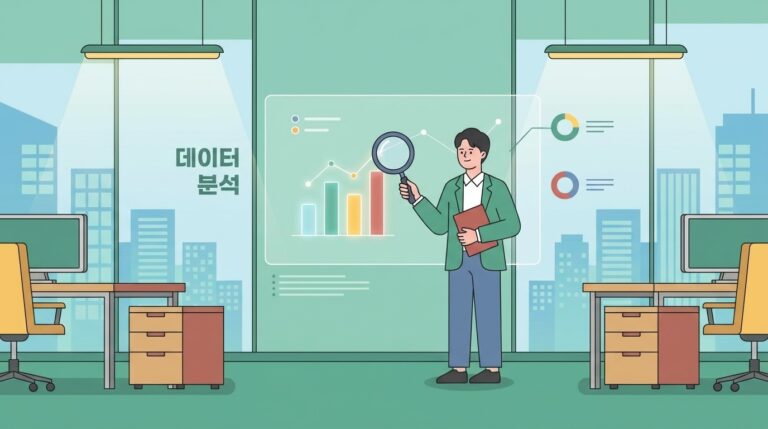
Phase 1: Empathy & Storytelling
안녕하세요! Welcome back to Daily Hangul! I’m your lead editor and cultural navigator. Have you ever watched a high-stakes K-Drama boardroom scene or a heated news debate on JTBC where an executive smugly slides a sleek bar chart across the table, claiming, “Our customer satisfaction rate reached 98%!”—only for the sharp-witted protagonist to smirk and dismantle the entire argument in seconds?
Navigating C2-level Korean requires much more than understanding basic vocabulary; it demands the mental agility to analyze subtle logical fallacies and spot statistical manipulation during high-level discussions, corporate meetings, or academic debates. When native Korean speakers manipulate data to frame a narrative—whether through cherry-picked sampling (표본 편향) or misleading averages (평균의 오류)—knowing how to critically call out these blind spots politely yet incisively transforms you from a fluent listener into a formidable communicator.
Today, we are going to master the art of intellectual defense in Korean. Grounded in real-world corporate feedback and advanced rhetoric, this guide will equip you with the linguistic precision to spot lies disguised as numbers and express critique with effortless sophistication.
Phase 2: Core Expressions Deep Dive
1. 통계의 착시 현상을 이용하다
- Pronunciation: [Tong-gye-ui chak-si hyeon-sang-eul i-yong-ha-da] (Sounds like “Tong-gyeh-ui chack-see hyeon-sahng-eul ee-yong-hah-dah”)
- Meaning: Literally “To utilize the optical illusion of statistics,” meaning to exploit statistical blind spots or misleading visualizations to deceive others.
- K-Culture Moment: Seen frequently in thrillers and corporate dramas like Agency or Stranger, where corrupt executives present skewed graphs to obscure declining quarterly profits.
- Editor’s Insight: The word ‘착시’ (optical illusion) metaphorically highlights how numbers can create a false reality. Pairing it with ‘이용하다’ implies deliberate, tactical intent.
- Situation Spectrum: Casual 🚫 | Semi-formal ⚠️ | Formal ✅
- 🤔 Think About It: Does your native language separate unintended mathematical errors from intentional visual manipulation in data presentation?
2. 아전인수 격으로 데이터를 해석하다
- Pronunciation: [A-jeon-in-su gyeok-eu-ro dae-i-teo-reul hae-seok-ha-da] (Sounds like “Ah-jeon-in-soo gyeok-eu-roh dae-ee-ter-reul hae-seock-hah-dah”)
- Meaning: To interpret data in a self-serving manner, stretching facts to fit one’s own bias (drawn from the Four-Character Idiom 我田引水, meaning “drawing water to one’s own rice paddy”).
- K-Culture Moment: Used by seasoned commentators in investigative journalism shows like Unanswered Questions (그것이 알고 싶다) when critiquing biased polling methods.
- Editor’s Insight: C2 speakers elevate their register by inserting four-character idioms (사자성어) like ‘아전인수’ into formal critiques to add persuasive weight and cultural depth.
- Situation Spectrum: Casual 🚫 | Semi-formal ⚠️ | Formal ✅
- 🤔 Think About It: How does utilizing historical idioms strengthen academic or professional arguments in your culture?
3. 표본의 대표성을 상실하다
- Pronunciation: [Pyo-bon-ui dae-pyo-seong-eul sang-sil-ha-da] (Sounds like “Pyo-bon-ui daeh-pyo-sung-eul sahng-seel-hah-dah”)
- Meaning: To lose sample representativeness; indicating a sampling bias that invalidates a survey or study.
- K-Culture Moment: Common in tech panel debates or marketing strategy review meetings in Pangyo IT hub startups.
- Editor’s Insight: Using terms like ‘대표성’ (representativeness) and ‘상실하다’ (to lose) demonstrates an advanced scientific mindset without sounding overly aggressive.
- Situation Spectrum: Casual 🚫 | Semi-formal ⚠️ | Formal ✅
- 🤔 Think About It: How do you politely challenge authority figures in your home country when their statistical base is clearly flawed?
Phase 3: Textbook Korean vs. Real Native Korean
Scenario 1: Pointing out that a survey only questioned a small, biased group
- 📖 Textbook Korean: 이 조사는 작은 집단만 조사해서 정확하지 않습니다. (This survey researched only a small group, so it is not accurate.)
- 🗣️ Real Native Korean: 특정 계층에 편중된 조사라 표본 편향이 심각해 보이네요. (This survey is skewed toward a specific demographic, so the sampling bias appears quite severe.)
- 💡 Why the Difference? C2 native speakers replace generic adjectives like ‘정확하지 않다’ with precise analytical terminology such as ‘편중되다’ (to be biased/skewed) and ‘표본 편향’ (sampling bias).
Scenario 2: Highlighting that high average figures hide severe inequality
- 📖 Textbook Korean: 평균 수치만 보면 실제 상황을 알 수 없습니다. (If you only look at the average number, you cannot know the real situation.)
- 🗣️ Real Native Korean: 평균의 착시 때문에 착시 효과 뒤에 숨은 중간값의 차이를 놓치고 있습니다. (Due to the illusion of averages, we are missing the variance in median values hidden behind the optical illusion.)
- 💡 Why the Difference? Advanced Korean workplace communication contrasts parameters like ‘평균’ (mean) and ‘중간값’ (median) to expose logical flaws analytically.
Phase 4: K-Culture Deep Dive & Non-Verbal Manners
4-1. Nunchi & Skeptical Non-Verbal Cues
When challenging data in a Korean corporate setting, maintaining proper Nunchi (눈치) is critical to remain persuasive without appearing confrontational:
* Slight Chin Tilt & Soft Gaze: Tilt your head slightly by 5 degrees, resting your elbows lightly on the table with hands loosely clasped. Avoid aggressive pointing.
* Pensive Hum (음…): Begin your counter-argument with a thoughtful lower-pitched “음… 수치상으로는 그렇습니다만…” (Hmm… while that is true numerically…). This softens the blow before delivering logical critique.
4-2. Cultural Code: The Pangyo Tech & Editorial Rhetoric
In South Korea’s bustling tech ecosystem (Pangyo) and media hubs (Yeouido), statistical data is frequently leveraged to justify funding or product shifts. However, Korean professional culture deeply values thoroughness (꼼꼼함). Calling out flaws using high-level Sino-Korean terms demonstrates respect for truth rather than personal antagonism.
Phase 5: Real-World Roleplay Scenario
Setting: A strategy review room in a Yeouido venture capital firm. Senior Analyst Park is presenting a glowing graph regarding a new app’s retention rate.
Characters:
* Senior Analyst Park (박 선임): Overconfident, pushing for rapid project approval using cherry-picked statistics.
* You (Guest Director): A sharp, analytical leader evaluating investment risks.
Dialogue:
- 박 선임: (그래프를 자신 있게 가리키며) 이번 분기 사용자 만족도가 95%에 달했습니다. 사업 확장이 시급합니다!
- You: (손가락으로 데이터 하단을 짚으며) / 박 선임님, 이 수치는 전체 가입자 대상인가요, 아니면 유료 회원 대상인가요?
- 박 선임: (당황하며 목소리가 떨림) / 어… 헤비 유저 100명을 대상으로 한 설문 결과입니다.
- You: (고개를 느리게 젓고 안경을 고쳐 쓰며) / 역시 그렇군요. 표본의 대표성이 결여된 통계의 착시입니다.
- 박 선임: (식은땀을 흘리며) / 하지만 만족도 자체는 높게 나온 것이 사실입니다!
- You: (차분하고 정돈된 목소리로) / 아전인수 격 해석입니다. 이탈 고객 데이터를 제외한 수치는 착시 효과일 뿐이죠.
- 박 선임: (서류를 정리하며) / 그럼 설문 구성을 다시 재검토하겠습니다…
- You: (단호하지만 신사적인 미소로) / 네, 객관적인 전체 데이터로 재보고 부탁드립니다.
🔀 Interactive Choice Point
How would you challenge Analyst Park’s flawed report?
- Option A: “이 그래프 다 거짓말이네요. 다시 만드세요.” (This graph is all lies. Remake it.)
- Option B: “표본 추출 과정에서 편향성이 개입된 것으로 보이니, 객관적 검증이 필요합니다.” (It appears bias was introduced during sampling, so objective verification is required.)
- Option C: “숫자가 이상해요. 저는 안 믿겠습니다.” (The numbers are weird. I won’t believe them.)
Feedback:
- Option A (Bad / Risk): 🚫 Excessively rude and emotionally charged. Ruins professional rapport instantly.
- Option B (Best): ✅ Perfect C2 rhetoric! Articulates the analytical problem clearly using appropriate Sino-Korean terminology.
- Option C (Bad / Amateurs): ⚠️ Sounds childish and lacks logical grounding for an advanced executive.
Phase 6: 10-Second Emotion Shadowing Drill
- [🤔 진지하고 신중하게]
수치 자체는 오류가 없지만 / 데이터를 해석하는 방식에 / 편향이 개입되어 있습니다.
(Su-chi ja-che-neun o-ryu-ga eop-si-man / dae-i-teo-reul hae-seok-ha-neun bang-sig-e / pyeon-hyang-i gae-ib-doe-eo it-seum-ni-da.) -
[🔍 차갑고 날카롭게]
평균값 뒤에 숨겨진 / 양극화 현상을 / 간과해서는 안 됩니다.
(Pyeong-gyun-gkap dwi-e sum-gyeo-jin / yang-geuk-hwa hyeon-sang-eul / gan-gwa-hae-seo-neun an doeb-ni-da.)
Phase 7: K-Culture Mini Dictionary
- 표본 편향 (Pyo-bon Pyeon-hyang) | Sampling Bias
- Usage: Used when critique centers on unrepresentative survey groups in market reports.
- 아전인수 (A-jeon-in-su) | Self-serving Bias / Drawing water to own field
- Usage: Applied when someone twists facts or statistics solely to support their opinion.
- 교묘하다 (Gyo-myo-ha-da) | Crafty / Cleverly misleading
- Usage: Describes subtle, deceptive manipulation of graphics or numerical scales.
- 착시 효과 (Chak-si Hyo-gwa) | Optical Illusion Effect
- Usage: Frequently metaphorically used to describe charts with scaled Y-axes designed to exaggerate growth.
Phase 8: Resident & Business Survival Kit
Top 3 Analytical Survival Expressions
- “통계적 착시가 있어 보입니다.”
- Meaning: There seems to be a statistical illusion here.
- Pro Tip: Use this in boardroom reviews to signal skepticism without insulting the presenter.
- “모집단의 규모가 너무 작지 않나요?”
- Meaning: Isn’t the population size too small?
- Pro Tip: Essential query when evaluating claims made by health/beauty commercials in Korea.
- “분산 수치도 함께 확인해야 합니다.”
- Meaning: We must check the variance figures as well.
- Pro Tip: Excellent counter-statement when presented only with simple averages.
Editor’s Travel & Business Note
When conducting academic research or business analysis in Korea, reliable official raw statistics can be queried directly via the Korean Statistical Information Service (KOSIS) Data Portal. Verifying raw data before meetings is the ultimate way to stay ahead!
Phase 9: One Step Deeper (Humanities Essay)
In Korean culture, numbers are often perceived as neutral, objective evidence. However, modern Korean media and corporate environments increasingly emphasize critical thinking (비판적 사고). Advanced fluency in Korean requires seeing beyond respectful surface agreement (존댓말) to challenge systemic fallacies. Recognizing that logical counter-arguments expressed with dignified Sino-Korean vocabulary display higher respect for collective success than passive nods is the ultimate hallmark of a C2 speaker.
💬 Your Turn: Have you ever noticed deceptive statistics in ads or news reports? Share a scenario in the comments below using the expression ‘통계의 착시’!
Phase 10: FAQ & Common Mistakes
Q: Can I use idioms like ‘아전인수’ in everyday casual conversations?
A: It sounds overly grandiose in informal settings. Save four-character idioms for professional presentations, written reports, or debate settings.
Q: What is the difference between ‘오류’ and ‘편향’?
A: ‘오류’ (Error) refers to factual or calculation mistakes, whereas ‘편향’ (Bias) refers to systemic skewing or subjective preference in data collection.
Q: Is calling out statistical flaws considered rude in Korean workplace culture?
A: Not if framed constructively! Using passive voice and precise terminology like “~로 해석될 여지가 있습니다” (There is room for this to be interpreted as…) maintains harmony.
🚨 Common Mistakes Checklist
- ❌ Mistake: Saying “데이터가 거짓말이에요” (Data is a lie) during a meeting.
- ✅ Correct Action: Use “데이터 시각화 과정에서 착시가 발생했습니다” (An optical illusion occurred during data visualization).
- ❌ Mistake: Confusing ‘평균’ (Average) with ‘중간값’ (Median).
- ✅ Correct Action: Always specify statistical terms clearly when critiquing income or metric distributions.
- ❌ Mistake: Accusing the presenter personally instead of critiquing the methodology.
- ✅ Correct Action: Focus critique strictly on ‘표본’ (sample) or ‘조사 방식’ (survey methodology).
Phase 11: Action Mission
- Bronze Level: Practice reading out loud the 10-Second Shadowing Drills with accurate pause points (
/). - Silver Level: Write a 2-sentence comment analyzing a flawed statistic using the phrase “표본의 대표성”.
- Gold Level: Watch a Korean documentary or debate program and spot 1 instance where a speaker critiques statistical data.
🎮 K-Culture Mission: Watch an episode of a Korean legal or corporate drama (e.g., Extraordinary Attorney Woo or Agency) and write down 2 advanced analytical vocabulary terms used during court or board meetings!
Phase 12: Interactive Quiz Challenge
Question 1: Situation Judgment
Which expression is most suitable when a marketing report only surveyed 10 loyal brand fans to claim a 100% satisfaction rate?
🔍 Click to view Answer & Explanation
Answer: “표본의 대표성이 결여되었습니다.” (It lacks sample representativeness.)
Explanation: Surveying only loyal brand fans creates severe sampling bias (표본 편향), making the sample non-representative of the entire population.
Question 2: Fill in the Blank
“이 그래프는 Y축 범위를 조절하여 성과를 부풀린 통계의 ________ 현상을 이용하고 있습니다.”
🔍 Click to view Answer & Explanation
Answer: 착시
Explanation: ‘착시’ (optical illusion) correctly completes the phrase ‘통계의 착시 현상’ (optical illusion phenomenon of statistics).
Question 3: True / False Culture Quiz
In formal Korean corporate debates, using four-character idioms like ‘아전인수’ is considered unprofessional and inappropriate. (True / False)
🔍 Click to view Answer & Explanation
Answer: False
Explanation: Utilizing well-placed four-character idioms (사자성어) in formal arguments demonstrates high educational attainment, cultural depth, and rhetorical skill at the C2 level.







