

Master Hwacheon Ice Fishing Like a Local: Essential B2 Korean for Winter Festivals
Phase 1: Empathy (스토리 몰입형 오프닝)
안녕하세요! 매일한글 에디터입니다. 👋
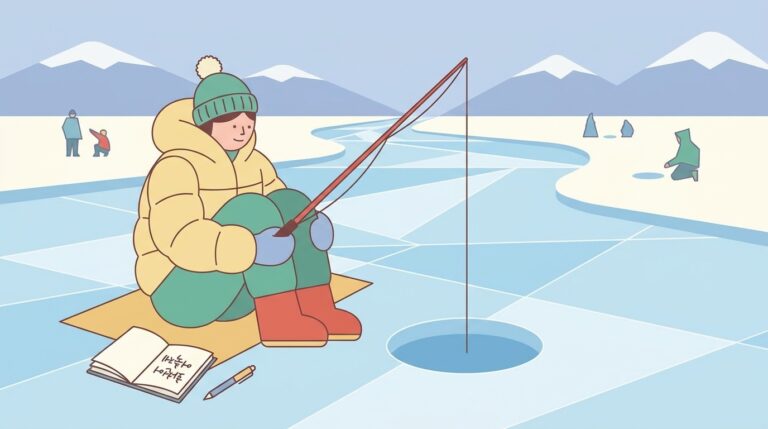
Picture this: You are standing on a foot-thick sheet of clear ice over the frozen Hwacheon stream in Gangwon-do. Millions of tiny snowflakes dance in the crisp sub-zero air, and beneath your boots, brilliant silver Sancheoneo (mountain trout) flash through circular ice holes. You hold a tiny fishing rod, your hands wrapped in thick padded gloves, freezing yet filled with excitement. Everyone around you seems to be pulling up glistening fish, cheering warmly, and heading towards the smoky aroma of grilled trout tents.
Then comes the moment of truth: your line tugs! You want to ask the helpful festival assistant next to you if you should set the hook, or ask a local angler how to drop the lure deeper. But your mind goes blank. Standard textbook sentences like “이곳은 화천 산천어 축제입니다” won’t help you banter with seasoned anglers or navigate the bustling grilling zone (구이터) like a pro.
That is precisely why we created this guide. Based on real feedback from intermediate learners attending Korean winter festivals, mastering these B2-level idioms and cultural nuances won’t just save you from awkward lingering—it will transform you from a confused tourist into an active participant embraced by Korean festival warmth (정, Jeong). Let’s dive into the ice and unlock authentic festival Korean together!
Phase 2: 핵심 표현 3선 심층 분석
1. 입질이 오다 (Iptjiri oda)
- Pronunciation: [Ip-jji-ri o-da] (Sounds like “eep-jee-ree oh-da”, rhythmic and snappy)
- Meaning: Direct Translation: “A bite/nibble comes” vs. Real Nuance: “The fish are nibbling/biting!” (Used metaphorically in everyday Korean when an opportunity or hint is popping up).
- K-Culture Moment: Seen frequently in Korean variety shows like City Fisherman (도시어부) when a member feels a subtle vibration on their line and yells in excitement.
- Editor’s Insight: At intermediate B2 level, moving beyond “물고기가 물었어요” (A fish bit) to “입질이 와요!” shows deep familiarity with authentic spoken idioms.
- Situation Spectrum: Casual ✅ | Semi-formal ✅ | Formal 🚫
- 🤔 Think About It: How does your native language describe the sensory feeling of a fish touching the bait? Is it purely technical, or vivid like Korean?
2. 손맛을 보다 (Sonmaseul boda)
- Pronunciation: [Son-ma-seul bo-da] (Sounds like “son-mah-seul boh-dah”)
- Meaning: Direct Translation: “To taste the hand” vs. Real Nuance: “To feel the thrill of a catch” (The tactile sensation of pulling a tugging fish).
- K-Culture Moment: Korean anglers heavily emphasize Sonmat (손맛). When someone asks “오늘 손맛 좀 보셨어요?”, they are asking if you caught anything satisfying today!
- Editor’s Insight: 맛 (taste) in Korean extends far beyond food—it describes rich, tactile sensory experiences like 손맛 (thrill of holding/catching) or 손맛이 있다 (cooking skill/hands-on skill).
- Situation Spectrum: Casual ✅ | Semi-formal ✅ | Formal ⚠️
- 🤔 Think About It: Why do you think Korean culture uses the sensory word ‘taste’ (맛) to describe physical thrills?
3. 따끈따끈하게 구워주세요 (Ttagkkeun-ttagkkeun-hage guwojuseyo)
- Pronunciation: [Tta-kkeun-tta-kkeun-ha-ge gu-wo-ju-se-yo] (Emphasis on the double consonant ‘따’ like ‘tta’)
- Meaning: Direct Translation: “Please grill it warmly” vs. Real Nuance: “Please grill it piping hot!”
- K-Culture Moment: At the festival roasting tent (구이터), handing over your freshly caught trout wrapped in aluminum foil to the staff while using mimetic words adds instant warmth.
- Editor’s Insight: Doubled sensory adverbs like 따끈따끈 (piping warm) or 뜨끈뜨끈 (steaming hot) make your requests sound deeply natural and friendly.
- Situation Spectrum: Casual ✅ | Semi-formal ✅ | Formal ✅
- 🤔 Think About It: Expressing desired food temperature through doubled words is common in Korean. Does your language use repetition for emphasis?
Phase 3: 교과서 한국어 vs 진짜 한국어
Scenario 1: Asking a nearby local if fish are biting near your ice hole
- 📖 교과서 한국어: 이 얼음 구멍에서 물고기가 잘 잡힙니까?
- 🗣️ 진짜 한국어: 여기 입질 좀 있어요?
- 💡 왜 다를까? Textbook Korean uses heavy full sentences. Native speakers on the ice drop unnecessary subjects and use short, energetic nouns like 입질 to quickly break the cold silence.
Scenario 2: Asking festival staff where to grill your fresh catch
- 📖 교과서 한국어: 제가 잡은 산천어를 어디에서 구울 수 있습니까?
- 🗣️ 진짜 한국어: 이거 구이터로 가져가면 되나요?
- 💡 왜 다를까? Pointing at your catch and using destination-focused verbs (가져가면 되나요? – “Is it okay if I take this to…?”) reflects natural B2 conversational efficiency.
Phase 4: K-Culture 딥다이브 & 비언어적 매너
4-1. 눈치 (Nunchi) & Ice Hole Etiquette
- Visual Cue & Space: Don’t drill or drop lures immediately right next to an occupied ice hole without acknowledging the person. A quick light nod with a friendly smile demonstrates good Nunchi.
- Hand Warming Gesture: Rubbing your gloved hands together (손을 싹싹 비비며) while making polite eye contact signals that you’re friendly, cold, and open to local advice!
4-2. Culture Code: The Magic of Gu-i-teo (구이터)
In Korean festival culture, catching the fish is only half the thrill; sharing food is the peak experience. Massive line-roasting facilities (구이터) process thousands of trout daily. Numbers are assigned, wrapped fish go onto coal grills, and strangers share tables inside warm tents, swapping hot barley tea and stories. Participating in this communal feast unlocks the heart of winter warmth (정).
Phase 5: 실전 롤플레이 시나리오
Setting: Hwacheon Ice Fishing Zone. Frozen river surface.
Characters: You (Intermediate Learner) & Fishing Uncle (낚시 아저씨, Seasoned local volunteer).
- You: 안녕하세요! 혹시 여기 입질 좀 있어요? (Hello! Having any bites over here?)
- 🎭 Action: Rubbing gloved hands and looking curiously into the ice hole.
- Fishing Uncle: 아, 방금 하나 낚았어! 미끼를 좀 더 바닥 쪽으로 내려봐요. (Ah, just caught one! Try lowering your lure closer to the bottom.)
- 🎭 Action: Pointing downwards with a friendly grin.
- You: 아, 바닥까지요? 요렇게 흔들면 되나요? (Ah, down to the bottom? Like this gentle twitching?)
- 🎭 Action: Gently twitching the small rod up and down.
- Fishing Uncle: 그렇지! 나이스! 어, 올라온다! 살살 쳐올려요! (That’s it! Nice! Oh, it’s coming up! Gently flick your wrist!)
- 🎭 Action: Leaning over eagerly to check your hole.
- You: 와! 잡았어요! 손맛 대박이네요! (Wow! I caught it! What an amazing tug!)
- 🎭 Action: Lifting a shimmering trout into the cold air with high energy.
- Fishing Uncle: 축하해요! 어우, 씨알이 작지 않네. 바로 구워 먹으면 꿀맛이에요. (Congratulations! Wow, nice size! It’s gonna taste delicious grilled right now.)
- 🎭 Action: Helping unhook the trout smoothly.
- You: 정말 감사합니다! 혹시 구이터가 어느 쪽이에요? (Thank you so much! By the way, which way is the grilling zone?)
- 🎭 Action: Holding the trout container and pointing around.
- Fishing Uncle: 저기 빨간 천막 보이죠? 그리로 직진해요! (See that red tent over there? Head straight that way!)
- 🎭 Action: Pointing towards the steaming red festival marquee.
🔀 인터랙티브 분기점 (Interactive Choice)
When the fish tugs on your line, what do you do?
* Choice A: Yell loudly “도와주세요!” (Help me!) and drop the rod.
* Choice B: Gently lift the rod while saying “어? 입질 왔다!” (Oh? Got a bite!).
* Choice C: Stand frozen without moving, waiting for someone to notice.
- Feedback:
- 🏆 Best (Choice B): Perfect! Using concise situational phrases like 입질 왔다! signals excitement and lets surrounding anglers naturally step in to congratulate or assist.
- ⚠️ Risk (Choice A): Shouting “Help me!” sounds like an emergency on the ice. Locals might think you slipped!
- 🚫 Bad (Choice C): Hesitating means the fast Sancheoneo trout will spit out the artificial lure in seconds.
Phase 6: 10초 감정 섀도잉 드릴
Practicing speed and emotional delivery boosts B2 fluency. Pay attention to / pauses:
[😊 Excitement]와! / 진짜 / 입질이 오네요! (Wa! / Jinjja / iptjiri oneyo!)[🤩 Amazed]손맛이 / 아주 / 대박이에요! (Sonmaseul / aju / daebagieyo!)[😋 Hungry]따끈따끈하게 / 바싹 / 구워주세요! (Ttagkkeun-ttagkkeun-hage / bassak / guwojuseyo!)
Phase 7: K-Culture 미니 사전 (핵심 키워드 4개)
- 산천어 (Sancheoneo) | Mountain Trout | The prized cold-water fish known for high purity and delicacy, central to Hwacheon festival.
- 얼음구멍 (Eoreum-gumeong) | Ice Fishing Hole | Drilled circular holes into 30cm-thick ice where anglers drop lures.
- 구이터 (Gu-i-teo) | Festival Roasting Area | Dedicated indoor tent where freshly caught fish are salt-crusted and grilled in foil over hot charcoal.
- 초장 (Cho-jang) | Sweet & Sour Chili Paste | Vinegar-infused gochujang sauce served with raw trout sashimi (산천어 회).
Phase 8: 여행자를 위한 생존 키트
Survival Expressions TOP 3
- 얼음낚시 채비 주세요. (Eoreum-nakshi chaebi juseyo.)
- Meaning: Please give me an ice fishing tackle set.
- Pro Tip: Use this at the festival equipment shop to get your mini rod and lure fast.
- 여기 구워주는 데 맞나요? (Yeogi guwojuneun de mannayo?)
- Meaning: Is this the place that grills fish?
- Pro Tip: Great for confirming you are in the right queue inside crowded tents.
- 핫팩 하나 더 주실 수 있나요? (Hat-paek hana deo jusil su innayo?)
- Meaning: Could I get one more hand warmer?
Editor’s Travel Note
- Getting There: Check real-time intercity bus and train reservations using the official KORAIL Train Ticket Booking Service app. Trains from Seoul to Namchuncheon or ITX lines connect smoothly with shuttle buses during festival season.
- Warmth Tip: Standing on ice saps body heat quickly. Wear thick insulated boots, bring multi-layered clothing, and purchase heat pads at local stalls.
Phase 9: “한 발 더 깊이” (생각 질문)
Korean local festivals are vibrant expressions of community resilience. In winter, quiet rural towns like Hwacheon open up ice rivers to welcome millions of visitors. Shared warmth, or Jeong (정), manifests when strangers hand you hot tea, share fishing tips, or help you unhook a struggling fish. Language at these festivals isn’t about rigid grammar—it is about shared human joy in freezing temperatures.
💬 Your Turn: Have you ever attended an outdoor winter festival in your country? How do people break the ice and talk to strangers there? Leave a comment below!
Phase 10: FAQ & 오해 방지 (FAQ Schema)
Q: Can I bring my own fishing equipment to the Hwacheon Festival?
A: Yes, but traditional long fishing rods are prohibited for safety. Lightweight ice fishing rods and specific lures provided or sold at the venue are recommended.
Q: What if I don’t catch any trout during my session?
A: Don’t worry! Festival zones often host special catch-guarantee events or bare-hand fishing catching challenges (맨손 잡기), and nearby food stalls sell prepared trout dishes!
Q: Is B2 level Korean really necessary for local festivals?
A: While basic English signs exist, B2 conversational expressions allow you to interact directly with local elders, understand safety announcements, and enjoy authentic humor.
🚨 Common Mistakes TOP 3
- Mistake: Using “잡아주세요” (Please catch it for me) instead of asking for tips.
- Correct Action: Ask “어떻게 흔들어야 해요?” (How should I twitch the line?).
- Mistake: Confusing 구이터 (grilling place) with 회센터 (sashimi center).
- Correct Action: Decide if you want grilled fish (구이) or raw sashimi (회) before queuing.
- Mistake: Overusing overly formal declarative endings like “-습니다” while chatting casually with friendly local volunteers.
- Correct Action: Keep tone friendly with polite polite endings like “-요” (e.g., “입질 왔어요!”).
Phase 11: 액션 미션 & 참여 유도
- 🥉 Bronze Mission: Practice saying “손맛 대박이에요!” out loud three times with excited expressions.
- 🥈 Silver Mission: Write a 2-sentence dummy comment below describing your dream Korean winter snack.
- 🥇 Gold Mission: Visit a local Korean market or festival, use the phrase “따끈따끈하게 해주세요”, and share your real experience!
- 🎮 K-Culture Mission: Watch a clip of Korean variety show 2 Days & 1 Night (1박 2일) winter festival episodes and spot when someone says “손맛”!
Phase 12: 인터랙티브 퀴즈 챌린지
Quiz 1. Situation Judgment
When you feel the fish pulling gently on your lure, which phrase is most natural to shout out excitedly?
1. 입질이 와요!
2. 손을 비벼요!
3. 식사가 시작됩니다!
🔍 Show Answer & Explanation
Answer: 1. 입질이 와요!
Explanation: “입질이 와요!” means fish are nibbling/biting! Option 2 means rubbing hands, and Option 3 means a formal meal starts.
Quiz 2. Fill-in-the-blank
Handing your foil-wrapped trout to the grilling station worker, you say: “생선 __________ 구워주세요!”
1. 차갑게
2. 따끈따끈하게
3. 딱딱하게
🔍 Show Answer & Explanation
Answer: 2. 따끈따끈하게
Explanation: 따끈따끈하게 means piping hot/warmly, which is the perfect sensory adverb for roasted food!
Quiz 3. True or False
손맛 strictly refers to how delicious food tastes when eaten with your fingers.
🔍 Show Answer & Explanation
Answer: False!
Explanation: While 손맛 can describe a cook’s culinary skill, in festival and fishing contexts, it refers to the exciting tactile thrill of catching a fish on your line!







