

Phase 1: Empathy & Storytelling
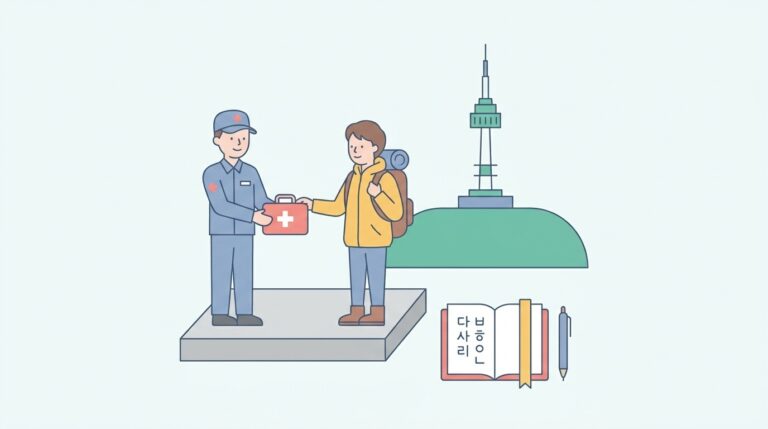
안녕하세요! I’m your Daily Hangul editor, your trusted native cultural navigator! Imagine this scenario: you’re enjoying a weekend hike up Namsan Mountain or walking through a bustling street in Hongdae when your friend suddenly trips, scrapes their knee badly, or twists an ankle. You rush to a nearby pharmacy or call for help, but panic sets in because you don’t know the right Korean terms to describe the injury or ask for immediate first aid.
In Korean dramas like Hospital Playlist or Descendants of the Sun, emergency situations move at lightning speed. While we hope you never face a dire crisis in Korea, knowing how to communicate basic first aid steps—like stopping bleeding, applying disinfectant, or locating an AED—can transform a terrifying situation into a manageable one. Based on feedback from hundreds of intermediate learners, mastering first aid vocabulary builds immense real-world confidence. Let’s learn these life-saving expressions together so you’re always prepared!
Phase 2: Core Expressions Deep Dive
1. 제발 구급차 좀 불러 주세요! (Jebal gugupcha jom bulleo juseyo!)
- Pronunciation: [Jebal goo-goop-cha jom bool-leo joo-se-yo] (Imagine shouting ‘go-go-car’ for gugupcha!)
- Meaning: Direct: “Please call an ambulance!” / Nuance: Urgent request for medical emergency dispatch.
- K-Culture Moment: Frequently heard in K-drama thrillers when a bystander rushes to help an injured character on the street.
- Editor’s Insight: Jebal (Please) adds extreme urgency, while jom softens the request to sound polite yet desperately needy.
- Situation Spectrum: Casual ⚠️ / Semi-formal ✅ / Formal ✅
- 🤔 Think About It: In Korea, calling 119 is free and extremely fast. How does your home country handle emergency dispatches?
2. 지혈해야 해요. (Jihyeol-haeya haeyo.)
- Pronunciation: [Jee-hyeol-hae-ya hae-yo]
- Meaning: Direct: “We must stop the bleeding.” / Nuance: Indicating that pressure or a bandage is needed immediately to control blood loss.
- K-Culture Moment: Seen during action scenes or disaster dramas when a character applies pressure to a wound.
- Editor’s Insight: Jihyeol comes from Hanja (止血), meaning ‘stop blood’. Using -haeya haeyo shows strong necessity.
- Situation Spectrum: Casual ⚠️ / Semi-formal ✅ / Formal ✅
- 🤔 Think About It: Korean Medical Korean relies heavily on concise Hanja-based nouns. Does your language use Latin or Greek roots for medical terms?
3. 상처 소독약 좀 주세요. (Sangcheo sodogyak jom juseyo.)
- Pronunciation: [Sahng-cheo so-dog-yak jom joo-se-yo]
- Meaning: Direct: “Please give me wound disinfectant.” / Nuance: Asking a pharmacist or first responder for antiseptic or rubbing alcohol.
- K-Culture Moment: A staple line when buying supplies at a local 24-hour pharmacy (yakguk).
- Editor’s Insight: Sangcheo means wound/cut, and sodogyak literally means disinfectant medicine (sodok = sterilize + yak = medicine).
- Situation Spectrum: Casual 🚫 / Semi-formal ✅ / Formal ✅
- 🤔 Think About It: Convenience stores in Korea sell basic emergency items (sangbi-yak). How accessible are medical supplies in your city?
Phase 3: Textbook Korean vs Real Native Korean
Situation 1: Explaining where you got hurt
- 📖 Textbook Korean: 어디가 아프십니까? (Eodiga apeusimnikka?) – “Where does it hurt?”
- 🗣️ Real Native Korean: 어디 다치셨어요? (Eodi dachisyeosseoyo?) – “Where did you get injured/hurt?”
- 💡 Why is it different? Natives prefer dachida (to get hurt/injured) over the generic apuda (to be sick/hurt) when dealing with physical trauma or accidents.
Situation 2: Asking for a quick bandage or ice pack
- 📖 Textbook Korean: 붕대와 얼음주머니를 주십시오. (Bungdaewa eoreumjumoneireul jusipsio.) – “Give me a bandage and an ice bag.”
- 🗣️ Real Native Korean: 대밴드랑 얼음팩 좀 얻을 수 있을까요? (Daebaendeurang eoreumpaek jom eodeul su isseulkayo?) – “Could I get a band-aid and an ice pack?”
- 💡 Why is it different? Native Koreans naturally use loanwords like baendeu (band-aid) or eoreum-paek (ice pack) and conversational indirect requests (jom eodeul su isseulkayo?).
Phase 4: K-Culture Deep Dive & Non-Verbal Manners
4-1. Nunchi & Emergency Gestures
In an emergency in Korea, rapid eye contact and clear body gestures are vital. If someone is bleeding, press directly on the wound while gesturing for help. Raise one arm high with an open palm toward bystanders to signal an emergency call. Maintain calm eye contact with 119 operators or paramedics to convey reliability.
4-2. Cultural Code: The 119 & Pharmacy Safety Net
Korea’s 119 emergency dispatch system is known worldwide for speed and efficiency. Additionally, Korean neighborhood pharmacies (yakguk) serve as the first line of defense for minor injuries. You can easily spot them by the glowing red or blue ‘약’ (Yak) sign. During late hours, designated Hyumanity Pharmacies (휴일지킴이약국) or safety-designated convenience stores provide essential first aid kits.
Phase 5: Real-World Interactive Roleplay
Setting: You are on a walking tour near Han River Park. Another pedestrian trips on the curb and scrapes their knee severely. A helpful Korean passerby (Min-soo) rushes over.
- Turn 1 (Min-soo): 괜찮으세요? 어디 많이 다치셨어요? (Gwaenchaneuseyo? Eodi mani dachisyeosseoyo?) 🎭 Looking concerned and crouching down
- Turn 2 (You): 무릎을 넘어져서 피가 많이 나요. (Mureubeul neomeojyeoseo piga mani nayo.) 🎭 Pointing to your bleeding knee
- Turn 3 (Min-soo): 아, 피가 계속 나네요. 지혈부터 해야겠어요! (A, piga gyesok naneyo. Jihyeolbuteo haeyagessoyo!) 🎭 Taking out clean tissues
- Turn 4 (You): 깨끗한 휴지로 상처를 눌러 주세요. (Kkaekkeut-han hyujiro sangcheoreul nulleo juseyo.) 🎭 Applying pressure to the wound
- Turn 5 (Min-soo): 근처 편의점에 가서 빨간약이랑 반창고 사 올게요! (Geuncheo pyeon-uijeome gaseo ppalganyak-irang banchanggo sa olgeyo!) 🎭 Standing up quickly
- Turn 6 (You): 정말 감사합니다! 소독약도 같이 부탁해요. (Jeongmal gamsahamnida! Sodogyakdo gachi 부탁haeyo.) 🎭 Holding the tissue firmly
- Turn 7 (Min-soo): 여기 사 왔어요. 소독하고 밴드 붙여 드릴게요. (Yeogi sa wasseoyo. Sodokhago baendeu butyeeo deurilgeyo.) 🎭 Handing over antiseptic wipes and band-aid
- Turn 8 (You): 덕분에 살았어요. 정말 감사합니다! (Deokbune sarasseoyo. Jeongmal gamsahamnida!) 🎭 Bowing head politely in relief
🔀 Interactive Choice Point
The person’s wound continues to bleed heavily despite pressing on it. What do you do?
- Option A: Keep waiting silently hoping it stops on its own.
- Option B: Shout clearly to bystanders: “119에 전화해 주세요!” (Please call 119!)
- Option C: Stand up and walk around to find a hospital yourself.
Feedback:
* Option A (Risk): Bleeding might worsen. In Korea, asking for immediate bystander help is expected.
* Option B (Best): Perfect! Designating someone or asking clearly for 119 brings professional paramedics immediately.
* Option C (Bad): Walking on an injured leg or moving during heavy bleeding can cause further complications.
Phase 6: 10-Second Emotional Shadowing Drill
[🚨 Urgently & loudly]
제발 / 구급차 좀 / 불러 주세요!
(Jebal / gugupcha jom / bulleo juseyo!)-
[😟 Worried & decisive]
피가 나니까 / 빠르게 / 지혈해야 해요!
(Piga nanikka / ppareuge / jihyeol-haeya haeyo!) -
[🙏 Polite & relieved]
도와주셔서 / 정말 / 감사드립니다.
(Dowajusyeoseo / jeongmal / gamsadeureimnida.)
Phase 7: K-Culture Mini Dictionary
- 구급함 (Gugubham) | First Aid Kit | Essential box containing bandages, antiseptic, and gauze found in public places, subway stations, and offices.
- 파스 (Paseu) | Medicated Pain Relief Patch | Extremely popular in Korea for muscle aches, sprains, and joint pain.
- 연고 (Yeongo) | Ointment / Antibiotic Cream | Applied on cuts and burns (e.g., Madecassol or Fucidin in Korea).
- 제세동기 (Jesedonggi / AED) | Automated External Defibrillator | Located near elevator halls and subway customer centers across Korea for cardiac emergencies.
Phase 8: Traveler’s Survival Kit
Top 3 Emergency First Aid Expressions
- 응급처치 상자 어디 있어요? (Eunggeupcheochi sangja eodi isseoyo?) – Where is the first aid kit?
- 약국이 어디에 있나요? (Yakgugi eodie innayo?) – Where is the pharmacy?
- 119에 신고해 주세요! (Il-il-gu-e singohae juseyo!) – Please report this to 119!
Editor’s Travel Note
Always download the Emergency Medical Information App by Korean Government or check real-time location via Naver Map App Download to locate 24-hour pharmacies and nearby emergency medical centers anywhere in Korea.
Phase 9: One Step Deeper (Thinking Question)
In Korean culture, helping an injured person on the street stems from the traditional concept of Jeong (정) and collective safety awareness. People will often go out of their way to guide you to a pharmacy or wait with you until 119 arrives. Showing sincere gratitude with respectful honorifics (gamsahamnida) reinforces this warm community bond.
💬 Your Turn: Have you ever needed medical help or first aid while traveling abroad? How did you communicate with locals? Share your experience in the comments below!
Phase 10: FAQ & Common Mistakes
Q: Can I dial 119 if I don’t speak fluent Korean?
A: Yes! Korea’s 119 service offers instant translation services in English, Chinese, Japanese, and several other languages once connected.
Q: What is ‘빨간약’ (Ppal-gan-yak) that Koreans often mention?
A: It literally translates to ‘red medicine’ and refers to iodine/povidone antiseptic used for disinfecting minor scrapes and cuts.
Q: Are basic medical supplies available at convenience stores?
A: Yes, 24-hour convenience stores carry basic emergency medicines (safety-designated OTC drugs) like pain relievers, fever medicine, and basic bandage strips.
🚨 Common Mistakes Top 3
- Mistake: Calling 112 for medical emergency.
Correct Action: Call 119 for medical help and fire; call 112 strictly for police/crime. - Mistake: Using informal language (Banmal) during emergency assistance.
Correct Action: Use polite honorifics like ~요 (~yo) or ~습니다 (~seumnida) to maintain respect. - Mistake: Saying “병원 주세요” (Give me a hospital).
Correct Action: Say “병점에 가야 해요” (I need to go to a hospital) or “구급차를 불러 주세요” (Please call an ambulance).
Phase 11: Action Mission & Engagement
- Bronze Mission: Speak out loud: “119에 전화해 주세요!” 3 times with urgent emotion.
- Silver Mission: Create a contact card on your phone with Korean emergency phrases and save nearby pharmacy locations on your map app.
- Gold Mission: Practice roleplay with a study partner where one acts as an injured tourist and the other as a Korean first responder!
🎮 K-Culture Mission: Watch an episode of a Korean medical drama (like Hospital Playlist) and spot 2 first-aid terms learned today!
Phase 12: Interactive Quiz Challenge
- Scenario Quiz: Someone near you is bleeding from a cut. Which Korean phrase should you use to say “We must stop the bleeding”?
- A) 약 사야 해요.
- B) 지혈해야 해요.
- C) 배고파요.
Click to view Answer & Explanation
Answer: B) 지혈해야 해요.
Explanation: ‘지혈’ (Jihyeol) refers to stopping blood flow/hemostasis.
- Fill-in-the-Blank: 상처 _________ 좀 주세요. (Please give me wound disinfectant.)
- A) 소독약 (Sodogyak)
- B) 사탕 (Satang)
- C) 안경 (Angyeong)
Click to view Answer & Explanation
Answer: A) 소독약 (Sodogyak)
Explanation: ‘소독약’ means disinfectant/antiseptic solution.
- True / False Culture Quiz: In Korea, calling emergency services (119) requires paying a service fee upfront.
- True / False
Click to view Answer & Explanation
Answer: False
Explanation: Emergency dispatch via 119 in Korea is completely free of charge!







