

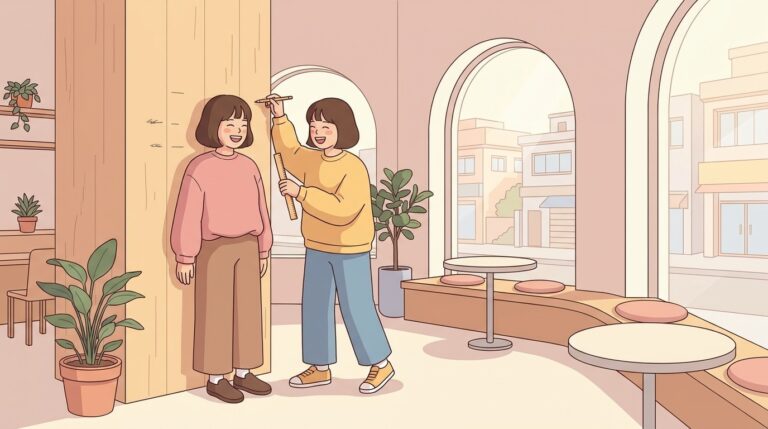
How to Talk About Height in Korean: Say “I’m Short” Naturally and Politely!
Phase 1: Empathy & Storytelling
안녕하세요! 매일한글 에디터입니다. (Hello! This is your Daily Hangul Editor.) Have you ever been standing in line at a bustling K-Pop concert venue in Seoul, or trying to grab a cute item off the top shelf in a stylish K-Beauty store, only to realize you can’t reach? You want to turn to your Korean friend and say, “Ah, I’m a bit short!” but you hesitate. Is saying “키가 작아요” rude? Will it sound awkward?
Describing height is one of the most common everyday topics in Korea—whether discussing your favorite idol’s charming proportions or talking about yourself. Navigating physical descriptions can feel tricky because you don’t want to sound unintentionally harsh or overly formal. Today, we’re going to break down how to describe short stature naturally, warmly, and politely so you can chat with confidence! Based on real feedback from language learners in Korea, this guide gives you real-life phrases that real Koreans actually use.
Phase 2: Key Expressions Analysis
1. 키가 작아요 (Ki-ga jag-a-yo)
- Pronunciation: [Ki-ga jag-a-yo] (Sounds like: Kee-gah jahg-ah-yo)
- Meaning: “I am short” / “He/She is short” (Literal: Height is small)
- K-Culture Moment: Seen in K-Dramas when characters tease each other lightheartedly about reaching tall shelves.
- Editor’s Insight: This is the standard, everyday phrase for saying someone is short. Adding “조금” (a little) before it—”키가 조금 작아요”—makes it sound much softer and more natural.
- Situation Spectrum: Casual ✅ | Semi-formal ✅ | Formal ⚠️
- 🤔 Think About It: In English, we say “I am short,” but Korean uses the noun “키” (height) followed by the adjective “작다” (to be small). How does framing height as a property change the feeling?
2. 키가 안 크다 / 키가 작은 편이에요 (Ki-ga an keu-da / Ki-ga ja-geun pyeon-i-e-yo)
- Pronunciation: [Ki-ga ja-geun pyeon-i-e-yo] (Sounds like: Kee-gah jah-geun pyuhn-ee-eh-yo)
- Meaning: “I’m on the shorter side” / “I’m not very tall”
- K-Culture Moment: Frequently used by Korean celebrities on variety shows when modestly describing their own appearance.
- Editor’s Insight: Direct descriptions can sometimes sound blunt. Using “~는 편이다” (on the side of) softens your speech, making you sound considerate and fluent.
- Situation Spectrum: Casual ✅ | Semi-formal ✅ | Formal ✅
- 🤔 Think About It: Why do many cultures prefer indirect expressions when describing physical traits?
3. 아담하다 (A-dam-ha-da)
- Pronunciation: [A-dam-ha-da] (Sounds like: Ah-dam-hah-dah)
- Meaning: Petite / Compact and charming
- K-Culture Moment: Often used in webtoons and fashion blogs to describe cute, stylish, petite outfits or cozy figures.
- Editor’s Insight: This word carries a very positive, warm vibe! It means petite, cozy, and well-proportioned.
- Situation Spectrum: Casual ✅ | Semi-formal ✅ | Formal 🚫
- 🤔 Think About It: Is there a word in your language that turns “short” into a compliment?
Phase 3: Textbook Korean vs. Real Korean
Scenario 1: Describing your height to a friend
- 📖 Textbook Korean: 저는 키가 작습니다. (Jeo-neun ki-ga jak-seum-ni-da.)
- 🗣️ Real Korean: 저 키가 좀 작은 편이에요. (Jeo ki-ga jom ja-geun pyeon-i-e-yo.)
- 💡 Why the difference? Koreans rarely use super formal endings like “~습니다” in social settings. Adding “좀” (a bit) and “~은 편이에요” makes you sound natural and humble.
Scenario 2: Asking for help reaching an item on a high shelf
- 📖 Textbook Korean: 키가 작아서 손이 안 닿습니다. (Ki-ga ja-ga-seo son-i an dak-seum-ni-da.)
- 🗣️ Real Korean: 저 키가 작아서 안 닿아요! (Jeo ki-ga ja-ga-seo an da-ha-yo!)
- 💡 Why the difference? In real life, soft conversational tones build immediate rapport when asking strangers for a quick favor.
Phase 4: K-Culture Deep Dive & Non-Verbal Manners
4-1. Nunchi & Gestures
When talking about height in Korea, body language matters! If you are describing yourself as short, a playful gesture—like putting your hand flat horizontally near your waist or chest with a smiling face—shows self-deprecating humor. When talking about someone else, avoid gesturing downwards sharply, as it can seem patronizing.
4-2. Culture Code: “Petit Charm” in K-Media
In Korean media, being short or petite (“아담하다”) is often celebrated as adorable! From romantic comedy height differences (“키 차이”) to idol group members affectionately called “fairy” (요정) for their small height, height is often embraced with affectionate nicknames.
Phase 5: Real Life Roleplay Scenario
Setting: You are at a trendy lifestyle shop in Seongsu-dong with your Korean friend, Min-ji. You see a cute mug on the top shelf.
- Min-ji: 이 컵 진짜 예쁘다! 한번 들어볼래? (This cup is so pretty! Want to hold it?)
- 🎭 (Actions: Min-ji points up to the top shelf.)
- You: 어… 저 키가 좀 작아서 안 닿아요! (Uh… I’m a bit short so I can’t reach!)
- 🎭 (Actions: Reaching up on tip-toes and laughing self-consciously.)
- Min-ji: 아, 진짜네! 내가 꺼내 줄게! (Ah, true! Let me grab it for you!)
- 🎭 (Actions: Min-ji easily grabs the mug and hands it over.)
- You: 고마워요! 키가 커서 부러워요. (Thank you! I envy you for being tall.)
- Min-ji: 에이, 아니야~ 너는 키가 아담해서 옷 잘 어울려! (Ayy, no way~ You are petite so clothes look great on you!)
- You: 정말요? 그렇게 말해줘서 고마워요! (Really? Thank you for saying so!)
- Min-ji: 다음에도 높이 있는 건 나한테 말해! (Tell me next time too if something is up high!)
- You: 네, 부탁해요! (Yes, please!)
🔀 Interactive Choice Point
Min-ji asks if you want to see another item higher up. What do you say?
* Choice A: 저 키가 작으니까 내려주세요! (Best! Friendly and direct)
* Choice B: 저는 키가 작습니다. 꺼내십시오. (Bad! Way too formal/robotic)
* Choice C: 키가 왜 이렇게 높아? (Risk! Sounds like complaining loudly)
Phase 6: 10-Second Emotion Shadowing Drill
Practice reading these out loud with rhythm and feeling!
- [😊 Cheerful & Light] 저 / 키가 / 좀 작은 편이에요! (Jeo / ki-ga / jom ja-geun pyeon-i-e-yo!)
- [🥺 Playful Cute Request] 키가 안 닿아요 / 도와주세요! (Ki-ga an da-ha-yo / do-wa-ju-se-yo!)
- [💖 Complimenting Friend] 키가 아담해서 / 정말 귀여워요! (Ki-ga a-dam-hae-seo / jeong-mal gwi-yeo-wo-yo!)
Phase 7: K-Culture Mini Dictionary
- 키 (Ki) | Height | Used in all height measurements.
- 비율 (Bi-yul) | Body proportions | Highly valued in Korean aesthetics beyond just raw height.
- 아담하다 (A-dam-ha-da) | Petite/Charming | A positive adjective for cute, smaller proportions.
- 도토리 (Do-to-ri) | Acorn | Playful slang used among friends to describe someone tiny and cute.
Phase 8: Traveler’s Survival Kit
Top 3 Survival Phrases
- 저 키가 작아서 안 보여요. (Jeo ki-ga ja-ga-seo an bo-yeo-yo.) -> I’m short, so I can’t see.
- 조금만 내려주시겠어요? (Jo-geum-man nae-ryeo-ju-si-ges-seo-yo?) -> Could you lower it a bit for me?
- 키가 몇이에요? (Ki-ga myeot-i-e-yo?) -> How tall are you? (Casual inquiry among friends)
Editor’s Travel Note
When navigating crowded sights or concert venues, check mobile street guides like the Naver Map App Download to find good viewing spots or accessible spaces nearby!
Phase 9: One Step Deeper
In Korean culture, talking about physical features like height is often more open than in Western cultures. However, politeness rules still apply! Adding softening markers like “편이다” (on the side of) or using complimentary framing like “아담하다” (petite) reflects the core social value of maintaining harmony (jeong and nunchi).
💬 Your Turn: How do people gracefully talk about height in your home culture? Leave a comment below and share!
Phase 10: FAQ & Common Mistakes
Q: Is it rude to say “키가 작다” to someone in Korea?
A: Saying it directly to an older person or superior can sound blunt. Use “키가 작은 편이에요” or avoid directly commenting on elders’ physical traits.
Q: What is the difference between 작다 and 쪼그맣다?
A: “작다” is the standard word for small/short. “쪼그맣다” is casual/cute slang meaning “tiny.”
Q: How do I say “I’m average height”?
A: You can say “키가 보통이에요” (Ki-ga bo-tong-i-e-yo).
🚨 Common Mistakes TOP 3
- Mistake: Saying “저는 키가 적어요.” (X)
- Correct Action: Use







