

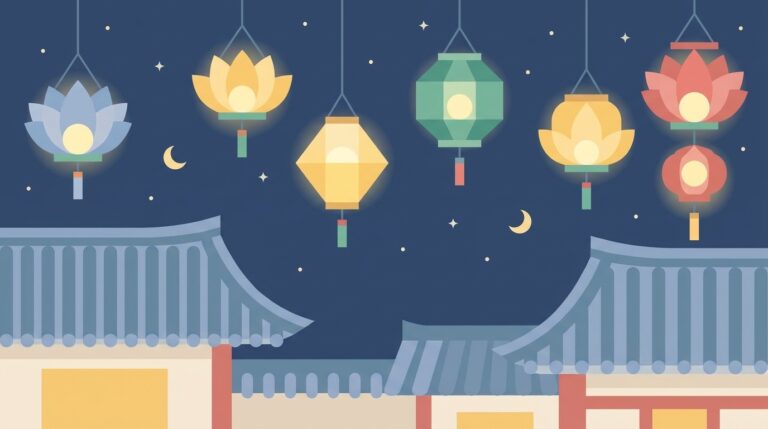
안녕하세요! 매일한글 에디터입니다. Have you ever spent a major holiday in Korea? If you arrive in Seoul around May, you will see streets lined with thousands of colorful lotus lanterns suspended under the spring sky. If you visit in December, bright LED trees, romantic pop songs, and glowing holiday decorations take over busy districts like Myeongdong and Hongdae. Yet, foreign visitors often face a confusing surprise: Christmas in Korea is primarily a holiday for couples and friends rather than big family reunions, while Buddha’s Birthday (부처님 오신 날) feels like a vibrant community cultural festival open to everyone! Many intermediate Korean learners struggle with the right vocabulary to discuss religious holidays, cultural etiquette at Buddhist temples, or modern festive atmosphere without sounding like a formal textbook. Today, based on feedback from over 500 of our global learners, we are unlocking the exact phrases and cultural nuances you need to navigate both sacred traditions and festive celebrations in Korea like a seasoned local.
1. 연등을 달다 (yeondeungeul dalda)
- Pronunciation: [yeon-deung-eul dal-da] (Sounds like yawn-deung + eul + dahl-dah)
- Meaning: Literal: “To hang a lotus lantern.” / Nuance: To participate in Buddha’s Birthday celebrations by writing a personal wish on a paper ribbon attached to a hanging lantern at a temple.
- K-Culture Moment: Seen frequently in historical and modern K-dramas where characters visit ancient temples at dusk during spring festivals to make solemn wishes for love or health.
- Editor’s Insight: Hanging a lantern isn’t just decorative; it’s a spiritual gesture of spreading wisdom and light over world darkness. When locals say “연등 달러 가자” (Let’s go hang lotus lanterns), it implies a peaceful, reflective outing.
- Situation Spectrum:
- Casual: ✅ (연등 달러 가자!)
- Semi-formal: ✅ (저희 연등 달러 절에 갈 거예요.)
- Formal: ✅ (부처님 오신 날을 맞아 연등을 답니다.)
- 🤔 Think About It: In your home country, do holiday decorations carry individual written prayers or wishes like Korean temple lanterns?
2. 분위기를 내다 (bunwigireul naeda)
- Pronunciation: [boon-wee-gi-reul nae-da] (Sounds like boon-wee-gee + ree-ool + nae-dah)
- Meaning: Literal: “To produce an atmosphere.” / Nuance: To set the mood or get into the festive spirit (e.g., decorating a Christmas tree, playing holiday tunes, eating seasonal cake).
- K-Culture Moment: Used constantly in Korean reality shows around late December when cast members decorate living rooms with tiny LED trees and put on Santa hats to celebrate Christmas Eve.
- Editor’s Insight: Koreans love creating special seasonal aesthetics. Using “분위기 내다” shows you understand the emotional vibe of celebrating seasonal moments together.
- Situation Spectrum:
- Casual: ✅ (크리스마스니까 분위기 좀 내볼까?)
- Semi-formal: ✅ (연말이라 카페에서 크리스마스 분위기를 냈네요.)
- Formal: ⚠️ (행사장 분위기를 조성했습니다 – 조성하다 is preferred in business contexts.)
- 🤔 Think About It: Why do you think atmospheric elements like lighting and seasonal music play such a big role in modern social gatherings?
3. 소원을 빌다 (sowoneul bilda)
- Pronunciation: [so-won-eul bil-da] (Sounds like so-won + eul + beel-dah)
- Meaning: Literal: “To beg for a wish.” / Nuance: To pray or make a heartfelt wish upon a lantern, ring a temple bell, or blow out Christmas candles.
- K-Culture Moment: A staple scene in romantic Korean dramas where the lead characters stand before a glowing temple tower or a birthday cake, close their eyes, and secretly make a wish.
- Editor’s Insight: In Korea, wishing is an active, ritualistic part of both Buddhist holidays and modern celebrations like Christmas and New Year’s Eve.
- Situation Spectrum:
- Casual: ✅ (무슨 소원 빌었어?)
- Semi-formal: ✅ (새해에는 무슨 소원을 비셨어요?)
- Formal: ✅ (모두의 평화를 위해 소원을 빕니다.)
- 🤔 Think About It: Do people in your culture share their holiday wishes aloud, or keep them quiet so they come true?
Situation 1: Expressing Christmas holiday plans
- 📖 교과서 한국어: 저는 크리스마스에 가족들과 함께 종교적 집회를 갑니다. (I go to a religious gathering with my family on Christmas.)
- 🗣️ 진짜 한국어: 이번 크리스마스에는 친구들이랑 홈파티하면서 분위기 좀 내려고요! (I’m planning to throw a home party with friends this Christmas to get into the holiday spirit!)
- 💡 왜 다를까? In Korea, Christmas is predominantly recognized as a romantic or social holiday for couples and young friends to party, eat special cakes, and view holiday lights, while churchgoers attend services.
Situation 2: Visiting a temple during Buddha’s Birthday
- 📖 교과서 한국어: 석가탄신일에 사찰을 방문하여 연등을 관람합니다. (I visit temples on Buddha’s Birthday to view lotus lanterns.)
- 🗣️ 진짜 한국어: 부처님 오신 날에 조계사 가서 연등 달고 소원 빌고 왔어요. (I went to JogYESa Temple on Buddha’s Birthday, hung a lantern, and made a wish.)
- 💡 왜 다를까? Native speakers use the warm, colloquial name “부처님 오신 날” over the formal Hanja term “석가탄신일”, and mention specific actions like hanging lanterns (연등 달기).
4-1. Nunchi & Etiquette Guidelines
- Temple Manners (부처님 오신 날): When entering a main temple hall (대웅전), step over the wooden threshold—never step directly on it! Keep your voice down, remove your shoes before entering worship spaces, and bow lightly (반배) with palms joined at chest height when meeting monks.
- Christmas Date Manners: Christmas Eve is one of the busiest date nights of the year. If you plan to dine out, reserve restaurants weeks in advance. Bringing a boutique Christmas cake to a dinner gathering is considered standard festive etiquette.
4-2. Cultural Code Analysis: Temple Food vs. Festive Cakes
During Buddha’s Birthday, temples often serve free seasonal vegetarian meal bowls like Sachal Bibimbap (사찰 비빔밥) to all visitors as an act of selfless sharing. In contrast, Korean Christmas revolves around trendy bakery cakes—bakeries launch extravagant limited-edition cake lines every December that locals pre-order weeks early!
Setting: Ji-hoon (a local Korean friend) and Alex (an intermediate foreign visitor) are walking near Jogyesa Temple in downtown Seoul during Buddha’s Birthday night festival.
- Ji-hoon: 알렉스, 연등 행사 보니까 어때? 진짜 화려하지? (Alex, how do you like the lantern festival? Isn’t it really colorful?)
- Alex: 🎭 [눈이 와이드해지며 감탄스러운 표정으로] 와, 진짜 예뻐요! 거리가 온통 연등으로 가득 차서 분위기가 대박이에요. (Wow, it’s so beautiful! The whole street is filled with lanterns, so the vibe is amazing.)
- Ji-hoon: 그치? 우리도 소원지 작성해서 연등 하나 달고 갈까? (Right? Should we write a wish paper and hang a lantern too?)
- Alex: 🎭 [미소를 지으며 고개를 끄덕인다] 좋아요! 연등을 달면 소원이 정말 이루어질까요? (Sounds great! If we hang a lantern, will our wish really come true?)
- Ji-hoon: 정성스럽게 비는 게 중요하지! 너는 어떤 소원 빌고 싶어? (The sincere heartfelt wish is what matters! What wish do you want to make?)
- Alex: 🎭 [손을 모으고 진지한 어조로] 한국어 실력이 더 늘어서 한국 친구들이랑 더 깊은 대화를 나누게 해달라고 빌 거예요. (I’m going to pray that my Korean skills improve so I can have deeper conversations with Korean friends.)
- Ji-hoon: 멋진 소원이네! 내 소원도 알렉스 한국어 공부 도와주는 걸로 해야겠다. (That’s a cool wish! I should make my wish about helping you study Korean then.)
- Alex: 🎭 [장난스럽게 웃으며] 고마워요! 다 달고 나서 근처에서 비빔밥 먹으러 가요. (Thanks! After hanging it up, let me go eat bibimbap nearby.)
🔀 Interactive Choice Point: How should Alex ask Ji-hoon about how to properly bow before the Buddha altar inside the hall?
- Option A: “지훈 씨, 절할 때 어떻게 해야 돼요? 방법 좀 가르쳐 주세요!” (Best Choice: Polite, natural, clear request for assistance.)
- Option B: “어이 지훈, 나 대신 절해라!” (Bad Choice: Rude imperative tone inappropriate for culture and friendships.)
- Option C: “불교 신자가 아니면 절을 절대로 하면 안 되나요?” (Risk Choice: Asking a defensive religious boundary question rather than participating warmly.)
Feedback:
* Option A (Best): Perfect! It uses natural semi-formal speech (해요체) and politely asks for guidance on cultural etiquette.
* Option B (Bad): Uses overly aggressive informal grammar. Avoid commanding friends in spiritual places!
* Option C (Risk): While valid, it might create an awkward, overly formal theological debate instead of enjoying the communal festival moment.
Practice reading these out loud with natural intonation! The slash (/) indicates a light pause.
[😊 기쁘고 감탄하며]연등 빛이 / 너무 아름다워서 / 눈을 뗄 수 없어요! (The lantern light is so beautiful that I can’t take my eyes off it!)[🥺 아쉽지만 기대하며]크리스마스 예약은 놓쳤지만 / 홈파티로 / 분위기 내보려고요! (We missed the Christmas reservation, but we’ll try to set the mood with a home party!)[🙏 진지하고 정성스럽게]가족들의 건강과 평화를 위해 / 간절하게 / 소원을 빌었습니다. (I earnestly made a wish for the health and peace of my family.)
- 연등회 (Yeondeunghoe) | Lotus Lantern Festival | An annual UNESCO Intangible Cultural Heritage festival celebrated around Buddha’s Birthday featuring massive street parades in Seoul.
- 점등식 (Jeomdeungsik) | Lighting Ceremony | Official events held in public plazas where giant public Christmas trees or grand temple lanterns are lit for the season.
- 성탄절 (Seongtanjeol) | Christmas Day | The official Korean term for Christmas used on news, calendars, and formal holiday announcements.
- 시주/보시 (Siju / Bosi) | Buddhist Offering/Alms | Making a small voluntary donation at a temple when hanging lanterns or receiving temple food.
- Top 1: “연등 달려면 어디로 가야 돼요?” (Yeondeung dallyeomyeon eodiro gaya dwaeyo?) – Where should I go to hang a lantern?
- Pro Tip: Use this at major urban temples like Jogyesa or Bongeunsa to find registration booths.
- Top 2: “크리스마스 케이크 예약 미리 받나요?” (Keuriseumaseu keikeu yeyak miri bannayo?) – Do you take advance pre-orders for Christmas cakes?
- Pro Tip: Ask bakery staff this in late November or early December to secure limited holiday editions.
- Top 3: “종교 상관없이 들어갈 수 있나요?” (Jonggyo sanggwaneopsi deureogal su innayo?) – Can I enter regardless of my religious background?
- Pro Tip: Useful when visiting historical sacred sites or cathedral concerts.
Editor’s Travel Note:
Planning to explore Seoul’s seasonal light displays? Make sure you check real-time transit and venue hours! You can quickly search for official temple lantern parade routes or Myeongdong illuminations using the 네이버 지도 앱 다운로드 guide for seamless subway transfers during late-night holiday festivities.
Korea presents a unique religious harmony: Buddhism and Christianity coexist prominently as major public holidays. Rather than intense ideological conflicts, Korean society often integrates holiday seasons into collective social joy—whether lighting lanterns in May or sharing Christmas pastries in December. This reflects a deep-seated community value (Jeong, 정) where people gather to wish each other well regardless of individual faith backgrounds.
💬 Your Turn: Have you ever celebrated a religious festival outside your home country? Which Korean tradition would you like to experience more—hanging lotus lanterns at night or exploring Christmas bakeries in Seoul? Drop a comment below!
Q: Can non-Buddhists write a wish ribbon on a temple lantern during Buddha’s Birthday?
A: Absolutely! Korean Buddhist temples welcome people of all faiths, backgrounds, and nationalities to write wishes for health, happiness, and peace on lotus lanterns.
Q: Is Christmas an official public national holiday in South Korea?
A: Yes, South Korea is one of the few East Asian countries where Christmas Day (December 25th) is an official national public holiday with schools and offices closed.
Q: Do Korean temples charge admission fees during festival days?
A: Entrance to temple grounds is free during Buddha’s Birthday celebrations, though hanging individual named lanterns usually involves a small voluntary fee or donation.
🚨 Common Mistakes TOP 3
- Mistake: Wearing shoes inside temple prayer halls.
- Correct Action: Always take off your shoes and leave them on shoe racks outside before entering the interior prayer halls (Daeungjeon).
- Mistake: Assuming Christmas is purely spent at home with extended family.
- Correct Action: Keep in mind that Korean friends may have couple dates or group gatherings planned on Christmas Eve.
- Mistake: Pointing your index finger directly at sacred statues or monks.
- Correct Action: Gesture gently with an open palm facing upward when indicating something in a temple.
- Bronze Mission: Read the 3 key expressions out loud 3 times using the Emotion Shadowing Guide.
- Silver Mission: Write a comment below sharing your personal holiday wish in Korean using the phrase
~하게 해달라고 소원을 빌 거예요. - Gold Mission: Find a video clip of Seoul’s Yeondeunghoe (Lotus Lantern Festival) or Christmas illuminations on YouTube, listen for seasonal vocabulary, and write down two phrases you recognized!
🎮 K-Culture Mission: Watch an episode of a modern romantic K-drama (like Crash Landing on You or Goblin) and spot how holiday dates or temple visits are visually depicted!
1. Situation Judgment Quiz (Click to open)
Q: You are visiting a temple during Buddha’s Birthday and want to ask where to hang your wish paper. Which expression is the most natural for a B2 speaker?
A) 어이, 내 연등 어디 있어?
B) 혹시 연등 달 수 있는 곳이 어디인가요?
C) 나는 불교가 아닙니다.
Answer: B
Explanation: B is polite, natural, and accurately asks for the location to hang a lotus lantern in a semi-formal tone.
2. Fill-in-the-blank Quiz (Click to open)
Q: Fill in the blank:







