How to Pick Up Food Delivery in Korea Like a Pro
Phase 1: Empathy & Storytelling Opening
안녕하세요! I’m your lead editor from Daily Hangul! Have you ever ordered delicious fried chicken or spicy tteokbokki on a delivery app in Korea, only to freeze when the doorbell rings?
“Ding dong! (띵동!)”
Your heart races. You hear footsteps outside. You wonder: Do I need to open the door? What if the delivery rider speaks fast Korean to me? What am I supposed to say?
If you’ve felt this exact anxiety, you are not alone! Many of our A2 learners share that picking up food delivery is one of the most nerve-wracking real-life Korean challenges. But here’s the great news: with just three simple phrases and a quick understanding of Korean delivery etiquette, you can turn this moment into a smooth, confident interaction. Based on real feedback from international residents in Seoul, this guide will make receiving your favorite food completely stress-free!
Phase 2: Core Expressions Deep Dive
1. 문 앞에 두고 가주세요 (Mun ap-e dugo gajuseyo)
- Pronunciation: [Mun-ap-e doo-go gah-joo-seh-yo] (Sounds like: Moon-up-eh do-go go-to-say-oh)
- Meaning: Direct translation: “Please leave it in front of the door and go.” / Nuance: “Please leave it at my door!”
- K-Culture Moment: You hear this constantly in modern K-Dramas when characters prefer non-contact delivery while binge-watching late at night.
- Editor’s Insight: This is the ultimate magic sentence for non-contact delivery (문앞 배송). You can type this in your app request or say it through the intercom!
- Situation Spectrum: Casual ⚠️ | Semi-formal ✅ | Formal ✅
- 🤔 Think About It: In your home country, do delivery drivers leave food outside your door, or do you always meet face-to-face?
2. 맛있게 잘 먹겠습니다 (Mas-issge jal meog-gess-seub-nida)
- Pronunciation: [Mah-shing-geh jal muhk-geh-ssumnida]
- Meaning: Direct translation: “I will eat deliciously well.” / Nuance: “Thank you for the meal! / I look forward to eating this!”
- K-Culture Moment: Seen at dinner tables in almost every Korean reality show before digging into food.
- Editor’s Insight: Saying this shows immediate appreciation and polite Korean table manners, even if you are just receiving the food bag at the door.
- Situation Spectrum: Casual 🚫 | Semi-formal ✅ | Formal ✅
- 🤔 Think About It: Expressing gratitude before eating is a core cultural value in Korea that builds instant warmth.
3. 감사합니다, 수고하세요! (Gam-sa-ham-ni-da, su-go-ha-se-yo!)
- Pronunciation: [Gahm-sah-hahm-nee-dah, soo-go-hah-seh-yo!]
- Meaning: Direct translation: “Thank you, please work hard!” / Nuance: “Thank you, have a great day / keep up the good work!”
- K-Culture Moment: The iconic parting greeting used in convenience stores, taxis, and delivery encounters across Korea.
- Editor’s Insight: “수고하세요” is the ultimate friendly farewell to anyone working hard. It warms the delivery rider’s heart every time!
- Situation Spectrum: Casual 🚫 | Semi-formal ✅ | Formal ✅
- 🤔 Think About It: Why does Korean culture place such strong emphasis on verbally acknowledging service workers’ effort?
Phase 3: Textbook Korean vs. Real Native Korean
Situation 1: Asking to leave food at the door
- 📖 Textbook: 음식을 여기에 놓아주십시오. (Eomsigeul yeogie noajuseopsio. – Too formal and robotic)
- 🗣️ Real Native: 문 앞에 두고 가주세요~ (Mun ap-e dugo gajuseyo~ – Natural, soft, and friendly)
- 💡 Why? Koreans prefer soft, request-ending forms like
-아/어 주세요for daily requests rather than rigid commands.
Situation 2: Saying goodbye to the delivery rider
- 📖 Textbook: 안녕히 가십시오. (Annyeonghi gasipsio. – Sounds like an announcement at an airport)
- 🗣️ Real Native: 감사합니다, 수고하세요! (Gamsa-hamnida, su-go-ha-se-yo! – Warm and polite)
- 💡 Why? “수고하세요” specifically acknowledges the rider’s travel effort in delivering your warm food.
Phase 4: K-Culture Deep Dive & Non-Verbal Etiquette
4-1. Nunchi (눈치) & Key Gestures
When opening the door to take your food, a slight 15-degree head bow combined with using both hands to take the bag shows top-tier Korean etiquette. If you are paying in person by card, hand your credit card over using both hands as well!
4-2. The Speed Culture (빠르기 문화) & Non-Contact Delivery
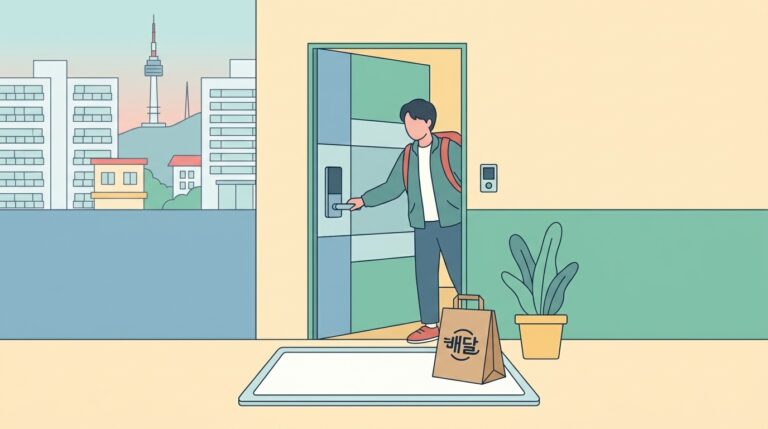
Korea’s food delivery system is world-renowned for lightning speed. Because riders are on tight schedules, non-contact delivery (문앞 배송) has become standard. Don’t feel guilty for asking them to leave the food outside—it actually helps riders stay efficient and safe!
Phase 5: Interactive Roleplay Scenario
Setting: Your apartment front door in Hongdae. Your tteokbokki has arrived!
Characters: Delivery Rider (배달원) & You (학습자)
- 배달원: (Knocks) 배달 왔습니다! (Delivery is here!)
- 🎭 Action: Standing outside with a warm plastic bag.
- You: 네, 감사합니다! (Yes, thank you!)
- 🎭 Action: Speaking clearly through the door or intercom.
- 배달원: 문 앞에 놓아드릴까요? (Shall I leave it in front of the door?)
- 🎭 Action: Holding the bag down toward the doormat.
- You: 네, 문 앞에 두고 가주세요! (Yes, please leave it in front of the door!)
- 🎭 Action: Smiling comfortably behind the door.
- 배달원: 네, 맛있게 드세요! (Okay, enjoy your meal!)
- 🎭 Action: Setting the bag down gently.
- You: 감사합니다, 수고하세요! (Thank you, keep up the good work!)
- 🎭 Action: Unlocking the door slowly after hearing footsteps leave.
- 배달원: 네~ 좋은 하루 되세요! (Yes~ Have a nice day!)
- 🎭 Action: Walking toward the elevator.
- You: (To yourself) 맛있게 잘 먹겠습니다! (I will enjoy this meal!)
- 🎭 Action: Bringing the bag inside eagerly.
🔀 Interactive Choice Point
What do you say right when you hear the doorbell ring?
* Choice A: 누굴까? (Nugulgga? – Who could it be?)
* Choice B: 네, 문 앞에 두고 가주세요! (Ne, mun ap-e dugo gajuseyo!)
* Choice C: 누구세요? 들어오세요! (Nuguseyo? Deureo-oseyo! – Who is it? Come inside!)
Feedback:
* Best Choice: B! Clear, direct, and perfectly polite for delivery!
* Bad Choice: A (Talking to yourself in casual language isn’t helpful for the rider outside).
* Risk Choice: C (Inviting a stranger inside can be uncomfortable and unsafe!).
Phase 6: 10-Second Emotion Shadowing Drill
Practice these lines out loud with exact rhythm (/ marks pauses):
[😊 Cheerful & Clear]네, / 문 앞에 / 두고 가주세요!
(Ne, / mun ap-e / dugo gajuseyo!)[🙏 Grateful & Polite]감사합니다, / 수고하세요!
(Gamsa-hamnida, / su-go-ha-se-yo!)[😋 Excited & Hungry]맛있게 / 잘 먹겠습니다!
(Mas-issge / jal meog-gess-seub-nida!)
Phase 7: K-Culture Mini Dictionary
- 문앞 배송 (Mun-ap baesong) | Leave at door delivery | Used in app requests when you don’t want direct contact.
- 벨누르고 건디디기 (Bel-nureugo geondidigi) | Ring doorbell & leave | Requesting the rider to ring the bell and leave immediately.
- 배달팁 (Baedal-tip) | Delivery Fee | The explicit delivery surcharge calculated in delivery apps.
- 리뷰 이벤트 (Ribyu ibenteu) | Review Event | A popular Korean delivery perk where restaurants give free sides/drinks in exchange for a 5-star review!
Phase 8: Traveler’s Survival Kit
Top 3 Survival Phrases
- 음식 왔어요! (Eomsik wasseoyo!) – The food is here!
- 문 앞에 주세요. (Mun ap-e juseyo.) – Please leave it at the door.
- 감사합니다! (Gamsa-hamnida!) – Thank you!
Editor’s Travel Note
Before ordering food in Korea, make sure you download the Naver Map App Download to copy-paste your exact Korean address into delivery apps like Baemin or Yogiyo smoothly!
Phase 9: One Step Deeper (Thinking Corner)
In Korea, delivery culture reflects a high-trust society where packages and hot meals sit safely outside front doors without worry. The phrase 수고하세요 embodies mutual respect between customer and service provider, reinforcing community connection in fast-paced city life.
💬 Your Turn: Have you ever used a food delivery app in Korea? What is your favorite Korean street food to order at night? Tell us in the comments below!
Phase 10: FAQ & Common Mistakes
Q: What if I didn’t pay yet on the delivery app?
A: If you chose pay-in-person (현장 결제), you must open the door and hand your payment card to the rider. Say “카드 결제할게요” (Card gyeoljehalke-yo – I’ll pay by card).
Q: Should I tip the delivery rider in cash?
A: No! Tipping culture does not exist in Korea. The delivery fee (배달팁) is already included in your order total.
Q: What should I do with food trash after eating?
A: Separate recyclable containers from food waste (음식물 쓰레기). Rinse plastic containers clean before disposal!
🚨 Common Mistakes TOP 3
- Mistake: Saying “안녕” (Annyeong) to the rider. -> Correct Action: Always use formal honorifics like “감사합니다” (Gamsa-hamnida).
- Mistake: Tipping cash at the door. -> Correct Action: Just say a warm “수고하세요!”.
- Mistake: Taking food with one hand while looking at your phone. -> Correct Action: Hold the bag with both hands and make eye contact brief nodding.
Phase 11: Action Mission
- 🥉 Bronze Mission: Practice saying “문 앞에 두고 가주세요” out loud 3 times in front of your mirror.
- 🥈 Silver Mission: Record your voice saying “감사합니다, 수고하세요!” and share it on Instagram tagging @DailyHangul!
- 🥇 Gold Mission: Order delivery food in Korea and successfully receive it using non-contact delivery phrases!
- 🎮 K-Culture Mission: Watch a K-Drama scene with food delivery and spot if the actor says “수고하세요”!
Phase 12: Interactive Quiz Challenge
Question 1: What is the most polite and natural phrase to tell the rider to leave food at your door?
Click to reveal answer
Answer: 문 앞에 두고 가주세요! (Mun ap-e dugo gajuseyo!)
Explanation: This phrase is natural, soft, and respectful for everyday delivery situations.
Question 2: True or False: You should always give a cash tip to Korean delivery riders.
Click to reveal answer
Answer: False!
Explanation: Korea does not have a cash tipping culture. Saying “수고하세요!” is the best gift!