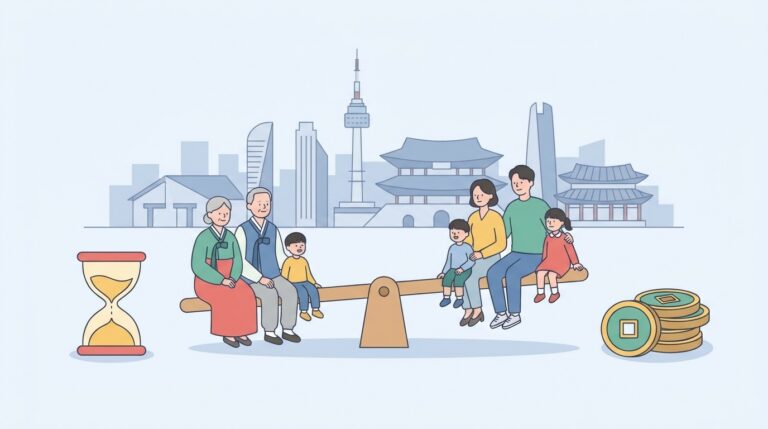
Phase 1: Why Even Advanced Learners Freeze at Korean Cafe Politics
안녕하세요! 매일한글 에디터입니다. (Annyeonghaseyo! Hello, this is your Daily Hangul editor.) Imagine sitting in a bustling Yeouido cafe during lunch. Around you, suited office workers—just like the stressed protagonists in the hit K-drama Misaeng—sigh into their iced Americanos over news about Korea’s demographic cliff and pension reform. Even TOPIK 5 learners freeze when terms like 모수 개혁 (mosu gaehyeok / parametric reform) or 소득대체율 (sodeukdaecheyul / income replacement ratio) drop. Based on real feedback from advanced expats in Seoul, I crafted this insider guide so you can decode Korean news, grasp generational debates, and join high-level chats with total confidence!
Phase 2: Deep Dive into 3 Core Expressions
1. 모수 개혁을 추진하다 (mosu gaehyeogeul chujinhada)
- Pronunciation: [mo-su gae-hyeo-geul chu-jin-ha-da] (“mo-soo” like “more soup” without the r/p, “gae” like “get” without t, “hyeo” like “hyuh”, “chu-jin” like “chew-jeans”)
- Meaning: Literally “to push forward parameter reform.” In practice, it means tweaking the core math of the National Pension system—specifically contribution rates and payout ratios—rather than overhauling its entire architecture.
- K-Culture Moment: You will hear this nonstop on serious current affairs programs like MBC’s 100-Minute Debate or JTBC Newsroom whenever lawmakers and economists clash over how to keep the pension fund from running dry.
- Editor’s Insight: Between us, even native Koreans sometimes mix up 모수 개혁 (mosu gaehyeok / parametric reform) and 구조 개혁 (gujo gaehyeok / structural reform). Pairing it with 추진하다 (chujinhada / to drive forward) instead of a basic verb instantly elevates your Korean to boardroom and broadcast level.
- Situation Spectrum: Casual ⚠️ | Semi-formal ✅ | Formal ✅
- 🤔 Think About It: In English, “parametric” sounds like something trapped in a graduate statistics textbook, yet Korean media puts 모수 개혁 (mosu gaehyeok) right in morning headlines. Does your native language lean on technical policy terms in daily news, or does it translate them into simpler metaphors?
2. 저부담-고급여 구조 (jeobudam-gogeubyeo gujo)
- Pronunciation: [jeo-bu-dam go-geu-byeo gu-jo] (“jeo” like “juh”, “bu-dam” like “boo-dahm”, “go-geu-byeo” like “go-guh-byuh”, “gu-jo” like “goo-joh”)
- Meaning: Literally “low-burden, high-benefit structure.” It refers to an older system design where workers pay relatively little in taxes or premiums now while expecting generous payouts upon retirement—widely seen today as mathematically unsustainable.
- K-Culture Moment: Frequently dissected on investigative shows like PD Notebook or massive Korean finance YouTube channels like Shuka World when explaining why rapid aging broke the original pension math.
- Editor’s Insight: Korean political discourse loves crisp four-syllable contrasts like 저부담-고급여 (jeobudam-gogeubyeo / low contribution, high benefit) versus 더 내고 덜 받는 (deo naego deol batneun / paying more, receiving less). Dropping this compound noun shows you understand the historical root of Korea’s pension dilemma.
- Situation Spectrum: Casual ⚠️ | Semi-formal ✅ | Formal ✅
- 🤔 Think About It: South Korea built its modern safety nets during an era of explosive population growth. How does public debate in your home country frame the tension between today’s young workers and promises made to retirees?
3. 세대 간 형평성을 모색하다 (sedae gan hyeongpyeongseongeul mosaekada)
- Pronunciation: [se-dae gan hyeong-pyeong-seong-eul mo-sae-ka-da] (“se-dae” like “seh-day”, “hyeong-pyeong” like “hyung-pyung”, “mo-sae-ka-da” like “mo-say-kah-dah”)
- Meaning: Literally “to grope for or seek fairness between generations.” In nuance, it captures the delicate struggle to find a compromise where younger workers do not feel overburdened while elderly citizens remain protected from poverty.
- K-Culture Moment: This theme mirrors the emotional heart of acclaimed dramas like My Mister or Navillera, where younger and older generations wrestle with heavy burdens yet strive for mutual empathy—just applied to national policy.
- Editor’s Insight: Pay close attention to 모색하다 (mosaekada / to seek a way through complexity). Unlike 찾다 (chatda / to find), 모색하다 implies there is no obvious answer yet. Also catch the pronunciation rule: ㄱ and ㅎ fuse into a crisp [ㅋ] sound, giving you [모새카다].
- Situation Spectrum: Casual 🚫 | Semi-formal ✅ | Formal ✅
- 🤔 Think About It: Why does Korean public debate place such enormous weight on 형평성 (hyeongpyeongseong / equity and fairness) rather than purely individual opt-out choices? Consider how deeply communal harmony shapes Korean society.
Phase 3: Textbook Korean vs. Real Korean
Situation 1: Translating parametric reform into everyday reality
- 📖 Textbook Korean: 보험료율을 인상하고 소득대체율을 조정하는 모수 개혁을 추진합니다. (Boheomnyoyureul insanghago sodeukdaecheyureul jojeonghaneun mosu gaehyeogeul chujinhamnida. — “Parametric reform is being pushed to raise contribution rates and adjust income replacement ratios.”)
- 🗣️ Real Korean: 결국 월급에서 더 떼어가고 나중에 받는 건 줄이자는 거네. (Gyeolguk wolgeubeseo deo tteeogago najunge batneun geon jurijaneun geone. — “So basically, they want to take more out of our paychecks and give us less later.”)
- 💡 Why the difference? News anchors rely on dense Sino-Korean nouns for objectivity, but over beer and fried chicken, Koreans translate policy straight into kitchen-table reality using 떼어가다 (tteeogada / to deduct or chip away).
Situation 2: Worrying about the pension fund running dry
- 📖 Textbook Korean: 인구절벽으로 인해 청년 세대의 부담이 가중될 우려가 있습니다. (Ingujeolbyeogeuro inhae cheongnyeon sedaeui budami gajungdoel uryeoga itseumnida. — “Due to the demographic cliff, there is concern that the younger generation’s burden will intensify.”)
- 🗣️ Real Korean: 우리 세대는 내기만 하고 정작 받을 때쯤엔 기금 고갈되는 거 아니야? (Uri sedaeneun naegiman hago jeongjak badeul ttaejjeumen gigeum gogaldoeneun geo aniya? — “Aren’t we just paying in, only for the fund to run dry by the time it’s our turn?”)
- 💡 Why the difference? At Level 5, mastering both registers is your secret weapon. Save 가중되다 (gajungdoeda / to intensify) for essays and meetings, and use 기금 고갈 (gigeum gogal / fund depletion) when commiserating with friends.
Phase 4: K-Culture Deep Dive & Non-Verbal Manners
4-1. Nunchi (눈치) & Gestures
Discussing money, taxes, and generational fairness across age groups in Korea requires top-tier 눈치 (nunchi / social radar). Never point or wag a finger while debating contribution rates—keep your hands relaxed on the table and nod softly (고개를 끄덕이다 / gogaereul kkeudeogida) to signal respect before adding your view. Keep your eye contact warm rather than piercing; staring down an older colleague while bringing up 세대 간 형평성 (sedae gan hyeongpyeongseong / intergenerational equity) can easily come across as combative.
4-2. Cultural Code Analysis
If you have ever cried watching Dear My Friends or teared up during interviews on You Quiz on the Block, you already hold a key to Korea’s pension debate. Korea leaped from post-war poverty to a tech powerhouse within a single lifetime. Many seniors sacrificed everything without robust retirement safety nets, while today’s 20s and 30s face sky-high housing costs and fierce competition. That is why pension reform in Korea is never just cold math—it is an emotional negotiation between gratitude for the past and survival for the future.
Phase 5: Real-Life Roleplay Scenario
Setting & Characters: Rain taps against the glass of a minimalist specialty coffee shop in Yeouido after work. On a muted corner TV, breaking news flashes graphics about the National Assembly’s pension talks. You are catching up with Min-jun (민준), a sharp 32-year-old Korean policy analyst who jokes about his shrinking paycheck while secretly reading every economic column.
- Min-jun:
🎭 한숨을 쉬며 뉴스 화면을 가리킨다 (hansumeul swimyeo nyuseu hwamyeoneul garikinda / sighing and pointing at the news screen)뉴스 봤어? 결국 보험료율을 올리는 모수 개혁이 본격적으로 추진된대. (Nyuseu bwasseo? Gyeolguk boheomnyoyureul ollineun mosu gaehyeogi bongyeokjeogeuro chujindoendae. — “Did you see the news? Looks like parametric reform to raise contribution rates is finally moving forward.”) - You:
🎭 아메리카노를 내려놓으며 진지하게 고개를 끄덕인다 (Amerikanoreul naeryeonoeumyeo jinjihage gogaereul kkeudeoginda / setting down your Americano and nodding seriously)응, 봤어. 기존의 저부담-고급여 구조가 한계에 다다랐다는 의견이 많잖아. (Eung, bwasseo. Gijonui jeobudam-gogeubyeo gujoga hangyee dadaratdaneun uigyeoni manjana. — “Yeah, I saw. Lots of people say the old low-burden, high-benefit structure has hit its limit.”) - Min-jun:
🎭 씁쓸하게 웃으며 컵을 만지작거린다 (sseupsseulhage useumyeo keobeul manjijakgeorinda / smiling bitterly while fidgeting with his cup)맞긴 한데, 우리 같은 직장인 입장에서는 소득대체율까지 어떻게 조정될지 막막하지. (Matgin hande, uri gateun jikjangin ipjangeseoneun sodeukdaecheyulkkaji eotteoke jojeongdoelji mangmakhaji. — “True, but for office workers like us, it’s overwhelming not knowing how the income replacement ratio will be adjusted too.”) - You:
🎭 공감하는 눈빛으로 앞쪽으로 살짝 몸을 기울인다 (gonggamhaneun nunbicheuro apjjogeuro saljjak momeul giurinda / leaning forward slightly with an empathetic gaze)충분히 이해돼. 기성세대와 청년층 사이의 세대 간 형평성을 모색하는 게 제일 까다로운 숙제 같아. (Chungbunhi ihaedwae. Giseongsedaewa cheongnyeoncheung saiui sedae gan hyeongpyeongseongeul mosaekaneun ge jeil kkadaroun sukje gata. — “I totally get it. Seeking intergenerational equity between older and younger generations feels like the trickiest puzzle.”) - Min-jun:
🎭 눈이 반짝이며 동의의 의미로 손바닥을 편다 (nuni banjjagimyeo donguiui uimiro sonbadageul pyeonda / eyes lighting up, opening his palm in agreement)딱 그거야! 한국이 이미 초고령사회 문턱인데다 인구절벽까지 겹쳤으니 답이 쉽게 안 나오지. (Ttak geugeoya! Hangugi imi chogoryeongsahoe munteogindeda ingujeolbyeokkkaji gyeopchyeosseuni dabi swipge an naoji. — “Exactly! With Korea already at the threshold of a super-aged society plus the demographic cliff, there’s no easy answer.”) - You:
🎭 차분한 목소리로 질문을 던진다 (chabunhan moksoriro jilmuneul deonjinda / asking in a calm voice)그럼 단순히 숫자만 고치는 게 아니라 근본적인 구조 개혁도 병행해야 한다고 봐? (Geureom dansunhi sutjaman gochineun ge anira geunbonjeogin gujo gaehyeokdo byeonghaenghaeya handago bwa? — “So do you think fundamental structural reform needs to run alongside just tweaking the numbers?”) - Min-jun:
🎭 잠시 생각에 잠겼다가 힘주어 말한다 (jamsi saenggage jamgyeotdaga himjueo malhanda / pausing in thought before speaking firmly)응, 당장은 모수 개혁으로 불을 끄더라도 장기적으로는 자동안정장치 같은 대안이 필수지. (Eung, dangjangeun mosu gaehyeogeuro bureul kkeodeorado janggijeogeuro-neun jadonganjeongjangchi gateun daeani pilsuji. — “Yeah, even if parametric reform puts out the immediate fire, long-term alternatives like automatic stabilizers are essential.”) - You:
🎭 미소 지으며 잔을 들어 건배하듯 살짝 든다 (miso jieumyeo janeul deureo geonbaehadeut saljjak deunda / smiling and slightly raising your cup as if toasting)오늘 정말 많이 배웠어. 우리 노후를 위해서라도 계속 관심 갖고 지켜보자! (Oneul jeongmal manhi baewosseo. Uri nohureul wihaeseorado gyesok gwansim gatgo jikyeoboja! — “I learned a lot today. Let’s keep paying attention—for our own retirement’s sake too!”)
🔀 Interactive Branching Point
Min-jun looks over and asks: 솔직히 너희 나라랑 비교하면 한국의 연금 개혁 논의가 좀 답답해 보이지 않아? (Soljiki neohui nararang bigyohamyeon hangugui yeongeum gaehyeok nonuiga jom dapdapae boiji ana? — "Honestly, compared to your country, doesn't Korea's pension reform debate seem a bit frustrating?") How do you reply?
- Option A:
어느 나라나 이해관계가 얽혀 있어서 사회적 합의를 도출하는 건 늘 어려운 과정인 것 같아. (Eoneu narana ihaegwangyega eolkyeo isseoseo sahoejeok habuireul dochulhaneun geon neul eoryeoun gwajeongin geot gata. — "Since stakeholders' interests are tangled in every country, reaching social consensus always seems tough.")-> 🏆 Best! Empathetic, balanced, and packed with gold-standard TOPIK 5 phrasing like 사회적 합의 도출 (reaching social consensus). - Option B:
맞아, 한국 정치인들은 눈치만 보느라 결단을 못 내리는 것 같아서 너무 답답해. (Maja, hanguk jeongchiindeureun nunchiman boneura gyeoldaneul mot naerineun geot gataseo neomu dapdapae. — "Right, Korean politicians just watch public opinion and can't make decisions, so it's super frustrating.")-> ⚠️ Risk! Even if Min-jun shares your frustration, blunt outside criticism of domestic politics can trigger quiet defensiveness. - Option C:
글쎄, 난 외국인이라 한국 연금 문제는 내 일이 아니라서 별로 관심 없어. (Geulsse, nan oeguginira hanguk yeongeum munjeneun nae iri aniraseo byeollo gwansim eopseo. — "Well, I'm a foreigner, so Korea's pension issue isn't my problem and I'm not really interested.")-> 🚫 Bad! Besides killing the vibe, most foreign workers in Korea actually pay into the National Pension too!
Phase 6: 10-Second Emotional Shadowing Drill
Follow the / markers for natural breath pauses and match each emotional cue!
[🧐 진지하고 분석적으로 / Serious & analytical]기존의 저부담-고급여 구조를 개혁하고자 / 모수 개혁이 추진되고 있습니다. (Gijonui jeobudam-gogeubyeo gujoreul gaehyeokagoja / mosu gaehyeogi chujindoego itseumnida. — “To reform the existing low-burden, high-benefit structure / parametric reform is being pursued.”)[😟 걱정스럽고 공감하며 / Concerned & empathetic]청년 세대의 부담이 커질수록 / 세대 간 형평성을 모색하는 노력이 / 더욱 절실해져요. (Cheongnyeon sedaeui budami keojilsurok / sedae gan hyeongpyeongseongeul mosaekaneun noryeogi / deouk jeolsilhaejyeoyo. — “As the burden on younger generations grows / efforts to seek intergenerational equity / become all the more urgent.”)[😌 차분하고 희망차게 / Calm & hopeful]보험료율과 소득대체율을 합리적으로 조정해서 / 모두가 안심할 수 있는 대안이 나왔으면 좋겠네요. (Boheomnyoyulgwa sodeukdaecheyureul hamnijeogeuro jojeonghaeseo / moduga ansimhal su inneun daeani nawasseumyeon jokenneyo. — “By reasonably adjusting contribution rates and income replacement ratios / I hope an alternative emerges that reassures everyone.”)
Phase 7: K-Culture Mini Dictionary
- 인구절벽 (Ingujeolbyeok) | Demographic Cliff | Seen daily in Korean newspapers and financial podcasts to describe a sharp drop in the working-age population—often paired with 초고령사회 (chogoryeongsahoe / super-aged society).
- 보험료율 (Boheomnyoyul) | Contribution Rate | The percentage of monthly income paid into the National Pension. Watch the nasalization: 보험료 + 율 glides smoothly into [보엄뇨율].
- 소득대체율 (Sodeukdaecheyul) | Income Replacement Ratio | The percentage of pre-retirement average income replaced by pension benefits—the main tug-of-war number in Korean policy talks.
- 국민연금 (Gungminyeongeum) | National Pension | Korea’s mandatory public pension system. If you teach, freelance, or work corporate in Korea, you will spot this line item on every pay stub!
Phase 8: Traveler’s Survival Kit
Top 3 Survival Phrases (For Long-Term Travelers & News Watchers)
- 이 뉴스 정확히 무슨 뜻이에요? (I nyuseu jeonghwaki museun tteusieyo?) — “What does this news mean exactly?” Pro Tip: A fantastic icebreaker with chatty cafe owners or taxi drivers when pension debates play on TV.
- 국민연금 가입 대상인지 확인하고 싶어요. (Gungminyeongeum gaip daesanginji hwaginhago sipeoyo.) — “I’d like to check if I’m eligible for the National Pension.” Pro Tip: Essential if you are shifting from traveler to working resident at HR or a district office.
- 더 쉽게 풀어서 설명해 주실 수 있나요? (Deo swipge pureoseo seolmyeonghae jusil su innayo?) — “Could you break that down more simply?” Pro Tip: Do not feel shy—even native Koreans ask this when bureaucrats speak in heavy Hanja jargon!
Editor’s Travel Note
Exploring Seoul’s financial district in Yeouido or visiting a local service branch? Make sure you get the Naver Map app download for accurate Seoul transit since Google Maps walking routes lag in Korea. If you plan to work in Korea, bookmark the National Pension Service English portal to check your home country’s social security treaty and lump-sum refund rules. For breezy everyday rides and cafe runs, grab a T-money card at any CU or GS25 and top it up with cash.
Phase 9: One Step Deeper
For centuries, Korean eldercare rested on the Confucian pillar of 효 (hyo / filial piety), where adult children supported aging parents under one roof. Yet rapid urbanization, shrinking families, and the steepest demographic cliff in the OECD have shifted that deeply personal duty into a collective national test. Today’s debate over parametric reform asks whether strangers across generations still share enough solidarity to carry one another’s tomorrow. Language mirrors society, and every time Koreans say 모색하다 (to seek together), you hear a culture searching for balance between survival and care.
💬 Your Turn: How does your home country talk about aging populations and pensions? Drop a comment below and tell us which Korean expression surprised you most today!
Phase 10: FAQ & Common Mistakes
Q: What is the real difference between 모수 개혁 (mosu gaehyeok) and 구조 개혁 (gujo gaehyeok)?
A: 모수 개혁 (parametric reform) adjusts the existing numbers—like raising the 보험료율 (contribution rate) or tweaking the 소득대체율 (income replacement ratio)—while keeping the system’s basic frame intact. 구조 개혁 (structural reform) goes deeper by redesigning how the National Pension connects with basic pensions, retirement allowances, and private savings.
Q: Why does 보험료율 sound so tricky when spoken fast?
A: Because of Korean sound assimilation! When ㅁ in 험 meets ㄹ in 료, ㄹ turns into ㄴ, creating [보엄뇨율 / boheomnyoyul]. Practice saying 보험 and 뇨율 together slowly, and it will roll right off your tongue.
Q: Do foreign workers in Korea actually contribute to 국민연금 (National Pension)?
A: Yes! Most foreign residents aged 18 to 59 working in Korea are enrolled automatically unless exempt by a bilateral agreement, and many nationalities can claim a lump-sum refund upon leaving Korea permanently.
🚨 Common Mistakes TOP 3 & Correct Action
- Pronouncing 모색하다 with an awkward stop between ㄱ and ㅎ -> Correct Action: Aspirate them together seamlessly as
[모새카다 / mosaekada]. - Swapping 소득대체율 (payout ratio) and 보험료율 (contribution rate) -> Correct Action: Tie 보험료 (boheomnyo) to the monthly fee leaving your pocket, and 소득대체 (sodeukdaeche) to the income replaced after retirement.
- Dropping formal 추진하다 (chujinhada) into casual late-night chats -> Correct Action: Relax your register with friends using
바꾸려고 한대요 (bakkuryeogo handaeyo / they're trying to change it).
Phase 11: Action Mission & Engagement
- 🥉 Bronze Mission: Record yourself reading the 3 sentences in Phase 6 using the
/breath pauses, and listen back to check your pronunciation of모색하다and보험료율. - 🥈 Silver Mission: Post your favorite new term (like
저부담-고급여) on Instagram, X, or Threads with a one-sentence English summary and tag#DailyHangul. - 🥇 Gold Mission: Over coffee with a Korean colleague or language partner, ask their thoughts on
세대 간 형평성 (intergenerational equity)using one dialogue line from Phase 5!
🎮 K-Culture Mission: Search YouTube for a recent clip from JTBC News or Shuka World about 국민연금 개혁, turn on Korean subtitles, and tally how many times you spot 모수 개혁 or 고갈 in three minutes!
Phase 12: Interactive Quiz Challenge
Quiz 1 (Situational Judgment): Your Korean teammate sighs at lunch: “우리 세대는 돈만 내고 정작 받을 때 돈이 없으면 어떡해?” Which phrase best summarizes the policy goal needed to reassure them?
A) 저부담-고급여 구조 유지
B) 세대 간 형평성 모색
C) 인구절벽 가속화
Click to reveal answer & explanation
Answer: B) 세대 간 형평성 모색 (sedae gan hyeongpyeongseong mosaek)
Your teammate is worried about younger workers bearing unfair burdens while losing future payouts—the exact dilemma behind seeking intergenerational equity! Option A describes the outdated structure causing the strain, and Option C means accelerating the demographic cliff.
Quiz 2 (Fill in the Blank): Fill in the right policy noun: “기존의 ‘저부담-고급여’ 구조를 개혁하고자 보험료율과 소득대체율을 조정하는 ( ____ )이 추진돼요.”
Click to reveal answer & explanation
Answer: 모수 개혁 (mosu gaehyeok / parametric reform)
Adjusting numerical parameters like contribution rates and income replacement ratios without tearing down the entire system’s architecture is the exact definition of 모수 개혁!
Quiz 3 (True / False Cultural Check): True or False — In Korea, bringing up 저부담-고급여 구조 while staring intensely and pointing your finger at an older colleague shows sharp, confident leadership.
Click to reveal answer & explanation
Answer: False!
In Korean communication, pointing fingers and piercing eye contact—especially when debating sensitive economic fairness with elders—violates 눈치 (nunchi) and feels confrontational. Keep your posture relaxed and nod respectfully while sharing your view.
🎬 Watch Our Daily Videos! (Daily Hangul Official Instagram)
Review the expressions you learned in this article with our fun daily short videos! Check out native pronunciation and real-life nuances in action.
- Instagram @dailyhangul_en