

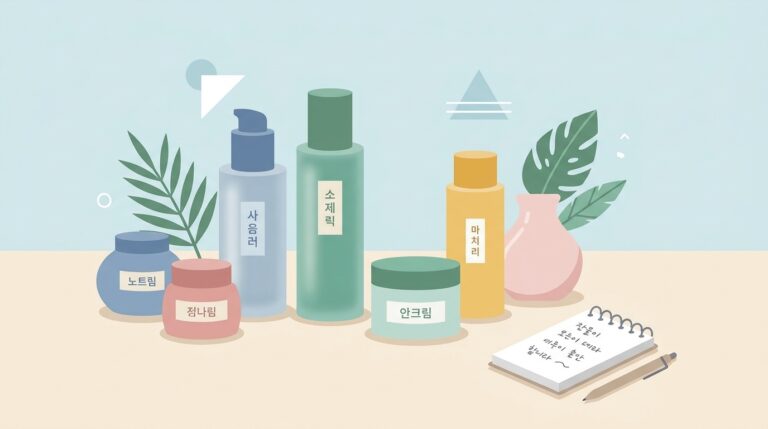
안녕하세요! 매일한글 에디터입니다.
Picture this: You enter a bustling, modern Olive Young store in Seongsu-dong, Seoul. Bright lights reflect off sleek glass bottles labeled in Korean script. You’re searching for a soothing serum made with 100% plant-based ingredients because your skin breaks out easily after traveling. But as you pick up a trendy green bottle, you’re faced with terms like ‘천연 유래 성분’ and ‘비건 인증’. You want to ask the beauty advisor whether this product contains synthetic fragrance or animal-derived ingredients, but you hesitate, worried about using rigid dictionary phrasing.
If you’ve ever felt overwhelmed by complex Korean beauty labels or felt anxious when chatting with cosmetics staff in Seoul, you are not alone! Many B2 intermediate learners know standard grammar but struggle with authentic skincare vocabulary. This guide is crafted from real student feedback and insider K-beauty shopping insights. By the end of this lesson, you’ll comfortably navigate Korean clean beauty aisles, decipher naturally derived ingredients, and shop with total confidence!
Phase 2: Core Expressions Deep Dive
1. 천연 유래 성분 (Cheon-yeon Yu-rae Seong-bun)
- Pronunciation: [cheon-yeon yu-rae seong-bun] (Sounds like: chahn-yuhn yoo-ryeh sung-boon)
- Meaning: ‘Naturally derived ingredients’. Direct translation vs actual nuance: While ‘천연’ means pure natural, ‘유래’ means derived from. It signifies ingredients processed from natural botanical sources rather than harsh synthetic chemicals.
- K-Culture Moment: Featured prominently in Korean clean beauty commercials and product packaging on beauty shows like Get It Beauty.
- Editor’s Insight: In Korea, ‘천연 유래’ sounds much more trustworthy than just ‘천연’ because educated consumers know processed natural extracts are safer and more stable for skin!
- Situation Spectrum: Casual ✅ | Semi-formal ✅ | Formal ✅
- 🤔 Think About It: Why do Korean skincare consumers place so much value on natural origin rather than fast synthetic results? How does this reflect the traditional Korean holistic approach to skin health?
2. 비건 인증을 받다 (Bi-geon In-jeong-eul Bat-da)
- Pronunciation: [bi-geon in-jeong-eul bat-da] (Sounds like: bee-gun in-jung-eul baht-dah)
- Meaning: ‘To receive vegan certification’. It implies the product has undergone strict verification with zero animal testing or animal-derived ingredients.
- K-Culture Moment: Often seen displayed as an official green seal on Olive Young bestsellers and eco-friendly cosmetics brands in Korea.
- Editor’s Insight: Vegan beauty is rapidly expanding in Korea. Using the passive form ‘받다’ (received) adds credibility because it references official regulatory approval.
- Situation Spectrum: Casual ✅ | Semi-formal ✅ | Formal ✅
- 🤔 Think About It: In your country, is vegan skincare considered a niche trend or standard practice? How does certification build trust between brands and consumers?
3. 순해서 자극이 없다 (Sun-hae-seo Ja-geuk-i Eop-da)
- Pronunciation: [sun-hae-seo ja-geuk-i eop-da] (Sounds like: soon-hae-suh jah-geuk-ee up-dah)
- Meaning: ‘It’s gentle, so there’s zero irritation.’ This phrase combines mildness (‘순하다’) with non-irritating properties (‘자극이 없다’).
- K-Culture Moment: Frequently used by Korean beauty influencers doing unboxing videos when recommending products for sensitive skin types.
- Editor’s Insight: Korean beauty consumers prioritize barrier repair and minimal irritation over harsh active peels. Saying ‘순해요’ instantly signals comfort.
- Situation Spectrum: Casual ✅ | Semi-formal ✅ | Formal ✅
- 🤔 Think About It: In Western skincare, ‘active’ and ‘strong’ ingredients are often highlighted, whereas K-beauty emphasizes ‘gentleness’ and ‘hydration’. What does this tell you about Korean beauty philosophy?
Phase 3: Textbook Korean vs. Real Native Korean
Situation 1: Asking if a product is safe for sensitive skin
- 📖 Textbook Korean: 이 제품은 민감한 피부에 적합합니까?
- 🗣️ Real Native Korean: 이거 민감성에 써도 자극 없어요?
- 💡 왜 다를까? Real Korean shoppers use shorter, active phrasing like ‘민감성’ (sensitive skin type) and ask directly about ‘자극’ (irritation).
Situation 2: Checking for vegan ingredients
- 📖 Textbook Korean: 이 화장품에는 동물성 성분이 포함되어 있지 않습니까?
- 🗣️ Real Native Korean: 이거 100% 비건 성분으로 나온 거예요?
- 💡 왜 다를까? Native speakers prefer phrase patterns ending in ‘~로 나온 거예요?’ (Was it released/made as…?) when inquiring about product formulations.
Phase 4: K-Culture Deep Dive & Non-verbal Manners
4-1. Nunchi & Gestures in K-Beauty Shops
When testing skincare products at Olive Young or flagship brand stores in Myeongdong or Seongsu, politeness with store clerks is subtle. When staff offer you a shopping basket or testing spatulas, accept with both hands or lightly touch your right arm with your left hand. Avoid dipping fingers directly into sample jars; always use the provided pump tester or spatula.
4-2. Culture Code: The Clean & Vegan Beauty Wave in Seoul
Korea’s skincare culture has shifted towards ‘Clean Girl Aesthetic’ and ‘EWG Green Grade’ standards. Shoppers inspect ingredients on mobile apps before purchasing. Showing interest in naturally derived ingredients (‘천연 유래 성분’) instantly brands you as a knowledgeable skincare enthusiast in Seoul!
Phase 5: Interactive Roleplay Scenario
Setting: A trendy clean beauty store in Seongsu.
Characters: You (Customer) & Minji (Skincare Advisor NPC)
- Minji: 안녕하세요! 찾으시는 성분이나 피부 고민 있으세요?
(An-nyeong-ha-se-yo! Chat-eu-si-neun seong-bun-i-na pi-bu go-min is-seu-se-yo?)
Hello! Are you looking for specific ingredients or skin concerns?
🎭 Warm smile, holding a shopping basket -
You: 네, 제가 민감성이라서 순한 천연 유래 성분 제품을 찾고 있어요.
(Ne, je-ga min-gam-seong-i-ra-seo sun-han cheon-yeon yu-rae seong-bun je-pum-eul chat-go is-seo-yo.)
Yes, I have sensitive skin, so I’m looking for gentle naturally derived products.
🎭 Pointing gently to face -
Minji: 아, 그렇군요! 이 토너라인은 어떠세요? 100% 식물성 성분이에요.
(A, geu-reoh-gun-yo! I to-neo-ra-in-eun eo-tteo-se-yo? Baek-pro sik-mul-seong seong-bun-i-e-yo.)
Ah, I see! How about this toner line? It’s 100% plant-based ingredients.
🎭 Gesturing toward a clear glass toner bottle -
You: 혹시 이 제품 비건 인증도 받은 건가요?
(Hok-si i je-pum bi-geon in-jeong-do bat-eun geon-ga-yo?)
By any chance, is this product vegan certified too?
🎭 Tilting head with curiosity -
Minji: 네! 정식 비건 인증을 받아서 동물성 성분이 전혀 안 들어갔어요.
(Ne! Jeong-sik bi-geon in-jeong-eul bat-ah-seo dong-mul-seong seong-bun-i jeon-hyeo an deu-reo-gat-seo-yo.)
Yes! It received official vegan certification, so zero animal ingredients are used.
🎭 Pointing to the green vegan seal on the bottle -
You: 트러블 피부에도 자극 없이 쓸 수 있나요?
(Teu-reo-beul pi-bu-e-do ja-geuk eop-si sseul su in-na-yo?)
Can I use it on breakout-prone skin without irritation?
🎭 Looking closely at the ingredient list -
Minji: 네, 진정 효과가 뛰어나서 트러블 피부에 아주 순하게 잘 맞아요.
(Ne, jin-jeong hyo-gwa-ga ttyeu-eo-na-seo teu-reo-beul pi-bu-e a-ju sun-ha-ge jal mat-a-yo.)
Yes, it has great soothing effects, so it fits breakout-prone skin very gently.
🎭 Handing over a cotton pad with sample toner -
You: 완벽하네요! 이걸로 하나 주세용~
(Wan-byeok-ha-ne-yo! I-geol-ro ha-na ju-se-yong~)
Perfect! I’ll take one of these please!
🎭 Nodding happily with a friendly tone
🔀 Branching Decision Point:
What do you say after Minji recommends a complementary serum?
* Option A: “화학 성분 들어간 건 빼주세요.” (Bad: Too aggressive and grammatically unnatural)
* Option B: “혹시 인공 향료나 주의 성분은 안 들어갔죠?” (Best: Natural B2 phrasing checking for artificial fragrances)
* Option C: “이거 진짜 자연산이에요?” (Risk: ‘자연산’ is used for wild-caught seafood, not skincare! Very funny misstep)
Feedback:
– Best choice (B): Perfectly checks ingredients using natural B2 cosmetic terminology.
– Bad choice (A): Sounds demanding and inaccurate since all skincare involves chemistry.
– Risk choice (C): Calling skincare ‘자연산’ will make the clerk laugh because that means wild seafood!
Phase 6: 10-Second Emotion Shadowing Drill
Practice speaking these aloud with rhythm (/) and feeling!
[😊 Excitement & Curiosity]
이거 / 천연 유래 성분이라서 / 진짜 순할 것 같아요!
(I-geo / cheon-yeon yu-rae seong-bun-i-ra-seo / jin-jja sun-hal geot gat-a-yo!)
“Since this is naturally derived, it feels like it’s going to be super gentle!”-
[🤔 Careful Consideration]
민감성 피부에도 / 자극이 없을까요? / 성분표 좀 볼게요!
(Min-gam-seong pi-bu-e-do / ja-geuk-i eop-seul-kka-yo? / Seong-bun-pyo jom bol-ge-yo!)
“Will there be zero irritation even on sensitive skin? Let me check the ingredient list!”
Phase 7: K-Culture Mini Skincare Dictionary
- 진정 성분 (Jin-jeong Seong-bun) | Soothing Ingredients | Used when discussing ingredients like Cica (Centella Asiatica) or Tea Tree that calm redness.
- 식물성 추출물 (Sik-mul-seong Chu-chul-mul) | Botanical Extracts | Commonly listed on green/vegan skincare boxes in Korea.
- 저자극 테스트 완료 (Jeo-ja-geuk Te-seu-teu Wan-ryo) | Hypoallergenic Tested | Written on packaging to guarantee minimal irritation.
- 약산성 (Yak-san-seong) | Slightly Acidic / Low pH | Essential term for skin barrier maintenance products in K-beauty.
Phase 8: Traveler’s Survival Kit
Survival Expressions TOP 3
- 비건 인증 제품 어디에 있나요? (Bi-geon in-jeong je-pum eo-di-e in-na-yo?) – Where are the vegan certified products?
Pro Tip: Use this when entering large skincare sections to save shopping time. - 천연 성분 함량이 어떻게 돼요? (Cheon-yeon seong-bun ham-ryang-i eo-tteo-ke dwae-yo?) – What is the percentage of natural ingredients?
- 샘플 써봐도 돼요? (Saem-peul sseo-bwa-do dwae-yo?) – Can I try a sample?
Editor’s Travel Note
When shopping in Korea, don’t rely solely on store labels! Download Korea’s top skincare review tool using this 화해 앱 다운로드 가이드 to check ingredient safety ratings (EWG grades) and real user reviews in real time.
Phase 9: One Step Deeper
In Korean culture, caring for skin isn’t just about beauty—it’s viewed as self-respect and wellness. The explosion of vegan and naturally derived skincare reflects a broader societal movement toward clean living, ethical consumption, and harmony with nature. By asking about ‘천연 유래 성분’ in Korean, you show respect not only for your skin, but also for this mindful lifestyle movement.
💬 Your Turn: What skincare ingredient does your skin love the most? Have you tried Korean Cica or Mugwort products before? Share your thoughts in the comments below!
Phase 10: FAQ & Common Mistakes
Q: What is the difference between ‘천연’ and ‘유기농’ in Korean skincare?
A: ‘천연’ refers to naturally derived ingredients, while ‘유기농’ specifically means organic ingredients grown without synthetic pesticides.
Q: Does ‘비건’ (Vegan) in Korea guarantee that a product is hypoallergenic?
A: Not necessarily! ‘비건’ means no animal products or animal testing, but natural plant extracts can still trigger allergies. Always check if it says ‘저자극’ (low irritation).
Q: How do I ask if a product contains artificial fragrances?
A: You can comfortably ask: “인공 향료 들어갔나요?” (Does it contain artificial fragrance?)
🚨 Common Mistakes TOP 3
- Mistake: Calling cosmetics ‘자연산’ (Jayeonsan).
Correct Action: Use ‘천연 유래’ (Naturally derived) or ‘식물성’ (Plant-based). ‘자연산’ is only for wild fish! - Mistake: Assuming ‘순하다’ means weak or ineffective.
Correct Action: ‘순하다’ in Korean cosmetics means soothing, gentle, and barrier-safe. - Mistake: Using formal dictionary verbs like ‘합니까?’ when shopping.
Correct Action: Use conversational B2 endings like ‘~예요?’ or ‘~나요?’ for a friendly, natural tone.
Phase 11: Action Mission & Engagement
- Bronze Level: Say “천연 유래 성분” and “비건 인증” out loud 5 times using proper pause points.
- Silver Level: Find a K-Beauty product at home or online, check its ingredient list, and post a sentence in Korean using today’s vocabulary.
- Gold Level: Visit an online Korean cosmetics store (like Olive Young Global) and filter products using the Korean term ‘비건’!
🎮 K-Culture Mission: Watch a video by a Korean beauty YouTuber and listen for how many times they say ‘순하다’ or ‘진정’!
Phase 12: Interactive Quiz Challenge
1. Which phrase correctly asks if a skincare item is gentle on sensitive skin?
– A) 이거 자연산으로 만든 생선이에요?
– B) 이거 민감성 피부에 자극 없나요?
– C) 이 성분 동물한테 테스트했습니까?
🔍 Click to reveal the answer!
Answer: B
Explanation: ‘민감성 피부에 자극 없나요?’ is the most natural B2 expression for asking if a product is safe and gentle for sensitive skin. Option A refers to wild fish!
2. Fill in the blank:
이 제품은 100% 식물성 성분으로 공식 _____ 인증을 받았습니다. (This product received official vegan certification with 100% plant-based ingredients.)
– Word choices: [ 비건 / 자연산 / 화학 ]
🔍 Click to reveal the answer!
Answer: 비건 (Vegan)
Explanation: ‘비건 인증’ means vegan certification.
3. True or False: In Korea, ‘순하다’ means a cosmetic product is poor quality or ineffective.
🔍 Click to reveal the answer!
Answer: False
Explanation: ‘순하다’ means gentle and non-irritating, which is a highly sought-after quality in K-beauty!







