

Phase 1: 공감 (Story-Driven Opening)
안녕하세요! 매일한글 에디터입니다.
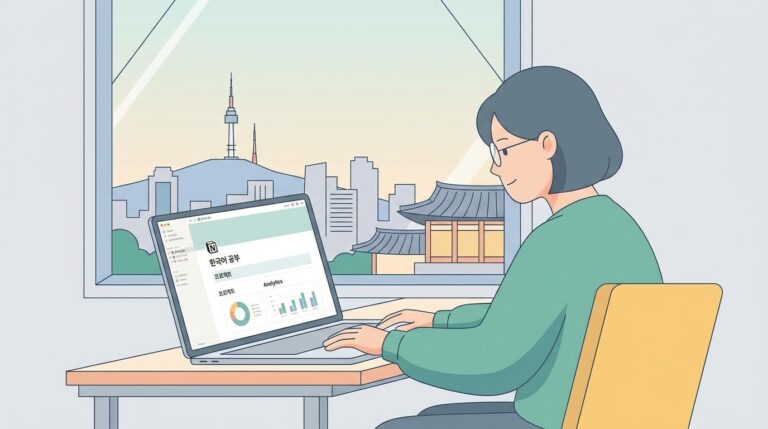
Picture this: You are working remotely for a fast-paced K-Tech powerhouse in Pangyo, Korea’s Silicon Valley. It’s 10:00 AM, and your team’s Slack or KakaoWork channels are buzzing with updates. You want to suggest a new asynchronous project management system to boost productivity without sounding overly demanding or dismissive of existing hierarchies. In Korean business culture, transition to remote work (재택근무) isn’t just about changing physical locations; it requires mastering the art of high-context, courteous, and highly efficient digital communication.
Navigating C1-level business discussions around remote work efficiency (재택 근무의 효율성 제고) can feel daunting when you need to balance speed with traditional etiquette. Many advanced Korean learners report feeling stuck between overly formal textbook phrases and the sleek, rapid terminology used by native professionals today. Based on real-world feedback from expatriate managers and foreign talent working in Korean enterprises, this guide delivers the exact strategic nuances, cultural etiquette, and authentic phrases you need to lead WFH initiatives confidently. Let’s elevate your professional Korean repertoire together!
Phase 2: 핵심 표현 3선 심층 분석 (3 Core Expressions Deep Dive)
1. 업무 효율성을 제고하다
- Pronunciation: [Eopmu hyoyulseong-eul jego-hada] (Think: Eop-moo hyo-yool-sung-ool je-go-hah-dah)
- Meaning: Literal: To raise/enhance work efficiency | Nuance: Formal, executive-level expression used in official proposals, strategic meetings, and corporate policy discussions.
- K-Culture Moment: Seen in corporate K-Dramas like Misaeng or Agency when project managers present operational restructuring to senior executives.
- Editor’s Insight: While basic Korean uses ‘높이다’ (to raise), C1 speakers use ‘제고하다’ (to enhance/elevate) in professional documentation and pitch decks.
- Situation Spectrum: Casual 🚫 | Semi-formal ⚠️ | Formal ✅
- 🤔 Think About It: How does switching from a simple verb (높이다) to an Sino-Korean academic verb (제고하다) alter your professional authority in a remote setting?
2. 비동기 협업 체계를 구축하다
- Pronunciation: [Bidonggi hyeob-eop chegye-reul guchuk-hada] (Think: Bee-dong-gee hyeob-eop cheh-gyeh-rool goo-chook-hah-dah)
- Meaning: Literal: To establish an asynchronous collaboration framework | Nuance: A key buzzword in modern Korean tech companies advocating for WFH flexibility over constant real-time Zoom meetings.
- K-Culture Moment: Frequently featured in tech blogs from IT giants like Naver, Kakao, or Toss explaining their flexible remote work culture.
- Editor’s Insight: ‘비동기’ (asynchronous) paired with ‘체계’ (framework) shows you understand modern digital transformation terminology beyond standard translation.
- Situation Spectrum: Casual 🚫 | Semi-formal ✅ | Formal ✅
- 🤔 Think About It: Why is clarity in asynchronous communication even more critical in Korean hierarchical work cultures?
3. 실시간으로 피드백을 수용하다
- Pronunciation: [Silsigan-euro pideubaek-eul suyong-hada] (Think: Seel-shee-gan-eu-ro fee-deu-baek-ool soo-yong-hah-dah)
- Meaning: Literal: To adopt feedback in real time | Nuance: Demonstrates agility, responsiveness, and openness to team input during remote sprints.
- K-Culture Moment: Used during real-time collaborative editing sessions on tools like Notion or Figma in agile startups.
- Editor’s Insight: Combining the English loanword ‘피드백’ with the high-level Sino-Korean verb ‘수용하다’ (to accept/embrace) strikes the perfect balance between modern startup agility and professional Korean propriety.
- Situation Spectrum: Casual ⚠️ | Semi-formal ✅ | Formal ✅
- 🤔 Think About It: In your culture, does real-time feedback imply urgency or collaboration? How does that compare to the Korean tech landscape?
Phase 3: 교과서 한국어 vs 진짜 한국어 (Textbook vs. Authentic Korean)
Situation 1: Suggesting WFH improvements on a team channel
- 📖 교과서 한국어: 재택근무는 업무 생산성을 높이는 데 도움을 줍니다. (Working from home helps increase work productivity.)
- 🗣️ 진짜 한국어: 재택을 병행하면 몰입도도 올라가고 전반적인 업무 효율이 훨씬 제고될 것 같아요. (Combining WFH boosts deep focus and really elevates overall work efficiency.)
- 💡 왜 다를까? Natives rarely use plain textbook verbs like ‘도움을 줍니다’ in strategy chats. Terms like ‘몰입도’ (level of immersion/focus) and ‘제고되다’ reflect authentic IT/corporate phrasing.
Situation 2: Asking colleagues for updates on async documents
- 📖 교과서 한국어: 문서를 확인하시고 의견을 주십시오. (Please check the document and give opinions.)
- 🗣️ 진짜 한국어: 노션 페이지에 현황 업데이트해 뒀으니 편하신 시간에 핑 주시거나 댓글 남겨주세요! (I updated the status on Notion, so please ping me or leave a comment whenever comfortable!)
- 💡 왜 다를까? Modern remote Korean teams blend English digital terms like ‘핑’ (ping) with respectful endings to keep communication crisp yet friendly.
Phase 4: K-Culture 딥다이브 & 비언어적 매너 (Culture Deep Dive & Non-Verbal Etiquette)
4-1. Nunchi (눈치) & Digital Etiquette in WFH
In a physical office, Nunchi involves reading the room’s energy. In remote settings, digital Nunchi translates to status updates and responsiveness. Setting your status icon on KakaoWork/Slack (e.g., ‘🎯 몰입 근무 중’ – Deep Work Mode) lets colleagues know your availability without awkward interruptions. When turning off cameras during large webinars, leaving active text reactions (e.g., ‘1’, ‘👍’, ‘감사합니다!’) in the chat box proves your active presence.
4-2. Modern K-Work Culture: The Agile ‘Ppalli-Ppalli’ Evolution
Korean work culture is historically famous for rapid execution (Ppalli-Ppalli). However, remote work has refined this into ‘Smart Efficiency’. Instead of long, formal meetings, leading companies prioritize asynchronous documentation on Notion and quick syncs via Slack. Understanding this shift allows foreign professionals to bridge traditional respect with high-speed digital workflows.
Phase 5: 실전 롤플레이 시나리오 (Interactive Roleplay Scenario)
Setting: A Slack huddle call between you (C1 Remote Consultant) and Manager Min (민 팀장님).
- 민 팀장: [🧐 자리에 앉아 펜을 굴리며] 이번 분기 재택근무 효율성에 대해 우려하는 목소리가 좀 있어요. 어떻게 개선하면 좋을까요?
(Manager Min: There are some concerns regarding remote work efficiency this quarter. How should we improve it?) - 나: [💻 화면 공유를 켜며] 팀장님, 비동기 협업 체계를 구축하여 공유 공백을 줄이는 방안을 제안드리고 싶습니다.
(Me: Manager Min, I’d like to propose establishing an asynchronous collaboration framework to reduce communication gaps.) - 민 팀장: [💡 관심 어린 표정으로 고개를 끄덕이며] 비동기 협업이요? concrete 한 실행 방안이 있나요?
(Manager Min: Asynchronous collaboration? Do you have concrete action plans?) - 나: [📊 노션 화면을 가리키며] 코어 타임을 지정하고 실시간 업무 현황을 대시보드화하면 미팅 시간을 30% 절감할 수 있습니다.
(Me: By designating core hours and dashboarding live progress, we can cut meeting times by 30%.) - 민 팀장: [😊 긍정적으로 미소 지으며] 좋은 아이디어네요. 그럼 피드백 반영은 어떻게 진행되나요?
(Manager Min: Good idea. How will feedback incorporation be handled?) - 나: [📝 메모 작성 포즈를 취하며] 팀원들이 실시간으로 피드백을 수용하도록 주간 스탠드업에 비동기 리뷰 프로세스를 도입하겠습니다.
(Me: We will introduce an async review process into weekly stand-ups so members adopt feedback in real time.) - 민 팀장: [👏 손뼉을 가볍게 치며] 아주 체계적이군요! 그럼 관련안을 정리해서 오늘 테크 세션에 공유해 주시겠어요?
(Manager Min: Very systematic! Could you organize the proposal and share it at today’s tech session?) - 나: [네, 승낙의 목례를 하며] 네, 즉시 문서화하여 슬랙 채널에 공지하겠습니다.
(Me: Yes, I will document it immediately and post an announcement on the Slack channel.)
🔀 인터랙티브 분기점 (Interactive Choice)
Manager Min asks: “오늘 퇴근 전까지 가이드라인 초안을 만들어 줄 수 있나요?” (Can you draft the guideline draft before clocking out today?)
- Choice A: 네, 당연히 가능합니다. 지금 바로 작성하겠습니다! (Yes, of course. I’ll write it right away!)
- Choice B: 일정상 약간 타이트할 수 있지만, 핵심 내용 위주로 먼저 정리해서 5시까지 전달드리겠습니다.
- Choice C: 오늘은 재택이라 무리입니다. 내일 드리겠습니다.
Feedback:
* Choice A (Risk): Shows enthusiasm, but overpromising might compromise quality in a remote work framework.
* Choice B (Best): Demonstrates senior-level expectation management, proactive time framing, and professional respect!
* Choice C (Bad): Overly abrupt and uses ‘WFH’ as an excuse, damaging professional trust.
Phase 6: 10초 감정 섀도잉 드릴 (10-Sec Emotion Shadowing Drill)
- [😊 확신에 찬 목소리로]
“재택근무의 / 효율성을 제고하기 위해 / 비동기 협업을 / 강화하겠습니다.”
(To enhance remote work efficiency, we will reinforce asynchronous collaboration.) -
[🤔 신중하고 전문적으로]
“코어 타임 설정을 통해 / 업무 몰입도를 높이고 / 피드백을 / 실시간으로 수용하겠습니다.”
(Through establishing core time, we will boost work immersion and adopt feedback in real time.)
Phase 7: K-Culture 미니 사전 (Mini Dictionary)
- 재택근무 (Jaetaek-geunmu): Work From Home (WFH). Modern tech offices often shorten this casually to ‘재택’.
- 코어 타임 (Core Time): Mandatory hours when all WFH employees must be reachable online (e.g., 1 PM – 4 PM).
- 핑 보내다 (Ping bonaeda): To send a quick direct message or reminder on Slack/KakaoWork.
- 스탠드업 미팅 (Stand-up Meeting): Short, focused team syncs designed to keep everyone aligned without wasting time.
Phase 8: 디지털 노마드 & 프로 작업러를 위한 생존 키트
Survival Phrases TOP 3
- “화면 공유 잘 보이시나요?” (Hwamen gong-yu jal boisinayo?) — Is my screen share visible?
- “마이크가 음소거되어 있었습니다.” (Maikeuga eum-sogeo-doe-eo isseoss-seubnida.) — My microphone was on mute.
- “자세한 내용은 노션 링크로 더해 두겠습니다.” (Jasehan naeyong-eun Noseon lingkeu-ro deohae dugess-seubnida.) — I’ll append detailed info via Notion link.
Editor’s Travel & Remote Work Note
When working remotely from trendy laptop-friendly cafes or co-working spaces in Seoul (e.g., Seongsu, Pangyo), utilize 네이버 지도 앱 다운로드 to search for ‘작업하기 좋은 카페’ (cafes good for working) with high-speed Wi-Fi and ample outlets.
Phase 9: 한 발 더 깊이 (Deep Culture Insight)
Digital communication in Korean workplaces reflects a fascinating evolution of hierarchical harmony. While written text in apps like Slack reduces visual hierarchical friction, respect remains paramount through speech markers (~님, -겠습니 다). Foreign professionals who master this blend—combining modern productivity frameworks with polite linguistic structures—stand out as highly effective, culturally agile leaders in the global Korean market.
💬 Your Turn: How does remote work in your country handle the balance between flexibility and hierarchy? Share your experience in the comments below!
Phase 10: FAQ & 오해 방지 (FAQ & Common Mistakes)
Q: Is using English acronyms like WFH or async acceptable in Korean Slack channels?
A: Modern tech companies welcome English loanwords like ‘비동기’ or ‘스탠드업’, but writing full English acronyms like ‘WFH’ might be unclear to non-tech traditional teams. It is safer to use ‘재택근무’ or ‘재택’ in text.
Q: How do I politely decline an impromptu online meeting during my deep focus hours?
A: You can say: “팀장님, 현재 집중 업무 진행 중이라 해당 건 3시에 확인 후 핑 드려도 괜찮을까요?” (Manager, I’m currently in deep focus work; may I check this and ping you at 3 PM?).
Q: What is the best tone for updating project boards asynchronously?
A: Use concise bullet points ending in standard business polite form (~했습니다, ~예정입니다).
🚨 Common Mistakes TOP 3
- Mistake 1: Using overly informal internet slang like ‘ㅇㅇ’ or ‘ㄴㄴ’ with superiors online. ➔ Correct Action: Use ‘네, 알겠습니다’ or official emoji reactions (👍).
- Mistake 2: Leaving status unupdated while away from desk for over 30 mins. ➔ Correct Action: Set status to ‘자리 비움’ (Away from desk) to show digital courtesy.
- Mistake 3: Dropping honorific suffixes in group chats. ➔ Correct Action: Always attach ‘-님’ to colleagues’ names (e.g., 민수 님).
Phase 11: 액션 미션 & 참여 유도 (Action Missions)
- 🥉 Bronze Mission: Practice saying “비동기 협업 체계를 구축하겠습니다” out loud three times using the shadowing drill.
- 🥈 Silver Mission: Write a mock status update message in Korean using ‘재택’ and ‘코어 타임’.
- 🥇 Gold Mission: Use one of our C1 core expressions during your next remote meeting or written chat with Korean colleagues!
🎮 K-Culture Mission: Watch a recent episode of an office-based K-Drama or startup tech interview on YouTube and spot 2 digital work terms!
Phase 12: 인터랙티브 퀴즈 챌린지 (Interactive Quiz)
- Which term best means ‘to enhance work efficiency’ in a formal pitch deck?
- A) 업무를 빠르게 하다
- B) 업무 효율성을 제고하다
- C) 일자리를 만들다
- Blank Fill: “공유 공백을 줄이기 위해 _____ 협업 체계를 구축합시다.” (asynchronous)
-
True or False: In Korean remote work culture, leaving active chat reactions during video calls is considered disruptive and rude.
🔍 정답 및 해설 보기 (Click to see Answers)
- Answer: B (제고하다 is the standard C1 business expression for enhancing/elevating efficiency).
- Answer: 비동기 (Asynchronous).
- Answer: False (Active text/emoji reactions demonstrate engagement during remote meetings!).







