

Phase 1: Empathy (Storytelling Opening)
안녕하세요! I am your Daily Hangul editor, your 10-year native culture navigator.
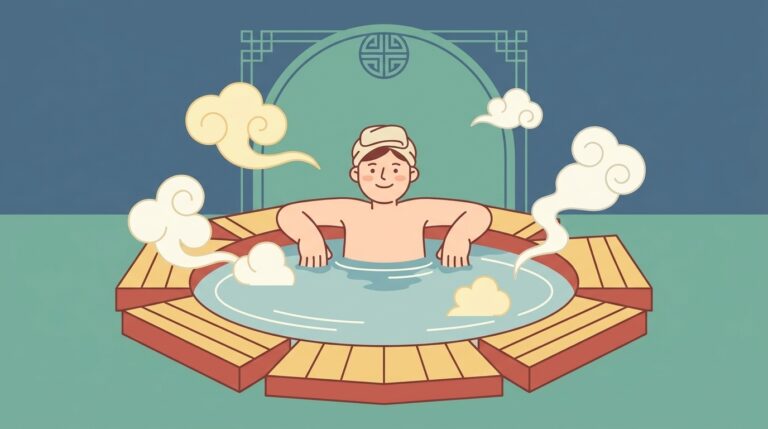
Imagine this: You walk into a stunning Korean Jjimjilbang (찜질방) after a long day of sightseeing. You’ve passed the locker rooms and stepped into the steaming bath area (탕 – tang). Warm vapor fills the air, and you see several hot tubs filled with clear water, green tea water, or herbal infusions. You walk over to the warm tub, but suddenly you freeze. Is the water too hot? Can I step in right now? What should I say to the person already relaxing in the corner?
If you’ve ever felt nervous about bath etiquette or frozen in place at a Korean spa, you are definitely not alone! Entering the bath (탕에 들어가기) is one of the most culturally unique experiences in Korea. Knowing just two or three simple, polite expressions will completely transform your experience from awkward to deeply relaxing.
This guide is packed with real feedback from our A2 beginner students who went from ‘ bathhouse panic’ to blissfully soaking in hot mineral tubs with total confidence. Let’s dive in together!
Phase 2: Core 3 Expressions
1. 뜨거워요? (Tteugeowayo?)
- Pronunciation: [tteu-geo-wa-yo] (Crisp ‘tt’ sound like the ‘st’ in ‘stop’, followed by ‘gah-wah-yoh’)
- Meaning: Direct: “Is it hot?” / Nuance: “Is the bath water quite hot right now?”
- K-Culture Moment: You’ll often see characters in K-dramas dipping a toe into a steamy hot bath and asking bathers nearby this exact question.
- Editor’s Insight: This short phrase is your best conversation starter. It shows respect to fellow bathers and helps you gauge the temperature before jumping in!
- Situation Spectrum: Casual ⚠️ | Semi-formal ✅ | Formal ✅
- 🤔 Think About It: Asking about shared comfort creates a quick bond between strangers in Korean bath culture. Do people talk to strangers in public baths in your home country?
2. 들어가도 돼요? (Deureogado dwaeyo?)
- Pronunciation: [deu-reo-ga-do dwae-yo] (Softly run ‘dew-ruh-gah-doh dway-yoh’)
- Meaning: Direct: “Can I enter?” / Nuance: “May I join you in this bath?”
- K-Culture Moment: Used in public spas when stepping into a smaller specialized tub (like an herbal or ice tub) where someone else is sitting.
- Editor’s Insight: Combining the verb 들어갈다 (to enter) with -도 돼요 (may I / is it okay) makes this an extremely versatile pattern for A2 learners.
- Situation Spectrum: Casual ⚠️ | Semi-formal ✅ | Formal ✅
- 🤔 Think About It: Why does requesting permission to share water space reflect the Korean values of community (정 – Jeong) and consideration (배려 – Baeryeo)?
3. 시원하다! (Siwonhada!)
- Pronunciation: [shi-won-ha-da] (Breathable ‘shee-won-hah-dah’)
- Meaning: Direct: “It’s cool/refreshing!” / Real Nuance: “Ah, this hot bath feels amazingly relaxing!”
- K-Culture Moment: Elderly characters in variety shows dip into scalding hot water and exhale a joyful “Ah~ Siwonhada!”
- Editor’s Insight: Don’t be confused when Koreans say ‘cool’ while sitting in 42°C water! It refers to releasing physical tension and feeling refreshed internally.
- Situation Spectrum: Casual ✅ | Semi-formal ⚠️ | Formal 🚫
- 🤔 Think About It: How does your native language express the feeling of heat relieving body fatigue?
Phase 3: Textbook Korean vs. Real Korean
Situation 1: Asking about the water temperature
* 📖 Textbook Korean: 이 탕의 온도가 많이 높습니까? (I tang-ui on-do-ga man-i nop-seum-ni-kka? / Is the temperature of this tub high?)
* 🗣️ Real Korean: 여기 많이 뜨거워요? (Yeo-gi man-i tteu-geo-wa-yo? / Is it really hot here?)
* 💡 Why the difference? Real Koreans prefer direct sensory words (뜨겁다 – hot) and short sentences over technical words (온도 – temperature) in casual spa settings.
Situation 2: Asking if you can enter the tub
* 📖 Textbook Korean: 제가 탕에 들어가도 허락되겠습니까? (Je-ga tang-e deu-reo-ga-do heo-rak-doe-gess-eum-ni-kka? / Would I be permitted to enter the bath?)
* 🗣️ Real Korean: 실례지만 들어갈게요! (Sil-lye-ji-man deu-reo-gal-ge-yo! / Excuse me, I’m stepping in!)
* 💡 Why the difference? Overly formal permission phrases sound like a court request! A friendly heads-up with 들어갈게요 is perfectly polite.
Phase 4: K-Culture Deep Dive & Non-Verbal Etiquette
4-1. Nunchi (눈치) & Bathing Gestures
- Shower First is Sacred: Never step into the tub (탕) without thoroughly washing your body at the seated shower stalls first. Entering dry or unwashed is a major etiquette violation.
- The Toe Test: Gently dip your big toe into the water first while making eye contact with nearby bathers and giving a subtle 15-degree head nod.
- Hair Up: Keep your hair tied up or covered with a small towel. Hair floating in the public bathwater is a big no-no!
4-2. Culture Code: The Magic of Jjimjilbang Warmth
In Korea, bathhouses (목욕탕) and spas (찜질방) are places where social barriers disappear. Sharing warm water fosters Jeong (정 – emotional bonding). After soaking, locals head straight to the snack bar for sweet rice beverage (식혜 – Sikhye) and roasted eggs (맥반석 계란).
Phase 5: Practical Roleplay Scenario
Setting: Steaming hot tub area inside a neighborhood Jjimjilbang.
NPC: Friendly local Spa Ahjumma (동네 아주머니)
- You: 실례합니다. 여기 많이 뜨거워요? (Sil-lye-ham-ni-da. Yeo-gi man-i tteu-geo-wa-yo?)
- (Excuse me. Is it very hot here?)
- Ahjumma: 아니에요~ 딱 좋아요. 들어오세요! (A-ni-e-yo~ ttak jo-a-yo. Deu-reo-o-se-yo!)
- (No~ It’s just right. Come on in!)
- You: 🎭 [Nod gently and dip toe] 들어가도 돼요? (Deu-reo-ga-do dwaeyo?)
- (May I step in?)
- Ahjumma: 그럼요! 천천히 들어와요. (Geu-reom-yo! Cheon-cheon-hi deu-reo-wa-yo.)
- (Of course! Come in slowly.)
- You: 🎭 [Sit slowly in warm bath and exhale] 아, 정말 시원해요! (A, jeong-mal si-won-hae-yo!)
- (Ah, it feels so refreshing!)
- Ahjumma: 하하, 한국 말 잘하네! 피로가 다 풀리지요? (Ha-ha, han-guk mal jal-ha-ne! Pi-ro-ga da pul-li-ji-yo?)
- (Haha, your Korean is so good! Your fatigue is melting away, right?)
- You: 네, 아주 좋아요. 식혜도 먹고 싶어요! (Ne, a-ju jo-a-yo. Sik-hye-do meok-go sip-eo-yo!)
- (Yes, it’s great. I want to drink Sikhye too!)
- Ahjumma: 나갈 때 매점에서 사 먹어요. 최고야! (Na-gal ttae mae-jeom-e-seo sa meok-eo-yo. Choe-go-ya!)
- (Buy one at the snack counter on your way out. It’s the best!)
🔀 Interactive Branching Choice
What will you say when you step into a hot bath with another bather already inside?
* Choice A: (Silently jump into the bath without washing first)
* Choice B: 실례지만 들어갈게요~ (Sil-lye-ji-man deu-reo-gal-ge-yo~ / Excuse me, I’m coming in~)
* Choice C: 여기 물이 왜 이렇게 뜨겁습니까? (Yeo-gi mu-ri wae i-reo-ke tteu-geop-seum-ni-kka? / Why is this water so hot?)
Feedback:
* Choice A [RISK 🚫]: Unwashed bathing is unacceptable! Others will quickly step out or ask you to shower first.
* Choice B [BEST ⭐]: Perfect! Courteous, friendly, and completely natural for A2 learners.
* Choice C [BAD ⚠️]: Sounds overly demanding and complaining toward fellow bathers.
Phase 6: 10-Second Emotion Shadowing Drill
- Sentence 1:
[😊 Friendly & Polite]여기 / 물이 / 많이 / 뜨거워요? (Yeo-gi / mu-ri / man-i / tteu-geo-wa-yo?) - Sentence 2:
[😌 Relaxed & Relieved]아~ / 정말 / 시원하다! (A~ / jeong-mal / si-won-ha-da!) - Sentence 3:
[🥺 Polite Request]실례지만 / 들어갈게요! (Sil-lye-ji-man / deu-reo-gal-ge-yo!)
Phase 7: K-Culture Mini Dictionary
- 온탕 (Ontang) | Warm bath pool (usually 38°C – 41°C) meant for relaxing muscle fatigue.
- 세신사 (Sesinsa) | Professional body scrub specialist at Korean bathhouses.
- 식혜 (Sikhye) | Traditional sweet malt rice drink served ice-cold at Jjimjilbangs.
- 수건 (Su-geon) | Towel (Often used to tie into a cute ‘sheep head’ fold at spas).
Phase 8: Traveler’s Survival Kit
Survival Expressions TOP 3
- 수건 어디에 있어요? (Su-geon eo-di-e iss-eo-yo?) – Where are the towels?
- 샤워 먼저 해야 돼요. (Sya-wo meon-jeo hae-ya dwae-yo.) – You must shower first.
- 시원한 식혜 하나 주세요. (Si-won-han sik-hye ha-na ju-se-yo.) – One cold Sikhye, please.
Editor’s Travel Note
Planning a spa night in Seoul? Use the Naver Map App for locating top-rated Jjimjilbangs to check operating hours and facilities before visiting!
Phase 9: One Step Deeper
In Korean culture, entering the public bath together symbolizes dropping artificial social status and embracing open vulnerability. When you share warm bath water, you share warmth of the heart (정 – Jeong). Don’t let hesitation hold you back—step into the bath with a warm greeting!
💬 Your Turn: Have you ever visited a Korean Jjimjilbang? Which hot tub temperature do you prefer? Tell us in the comments below!
Phase 10: FAQ & Common Mistakes
Q: Do I need to wear a swimsuit in the bath (탕) area?
A: No! Same-sex bath areas (탕) are strictly clothes-free. Swimsuits are forbidden for hygiene reasons. You only wear spa clothing (찜질복) in the shared mixed-gender sauna rooms.
Q: Why do Koreans say “시원하다” (cool) when stepping into boiling hot water?
A: In Korean sensory intuition, 시원하다 describes the feeling of tension melting away and breathing coming easy when submerged in warm water.
Q: What should I do with my hair before entering the tub?
A: Always tie long hair up or wrap it in a small towel so it stays completely out of the water.
🚨 Common Mistakes TOP 3
- Mistake: Stepping into the bath tub without showering first.
- Correct Action: Thoroughly wash body and hair at a seated shower station first.
- Mistake: Wearing a towel or swimsuit into the hot water pool.
- Correct Action: Enter the bath water completely unclothed; place towel on your head or poolside.
- Mistake: Splashing water or swimming in the tub.
- Correct Action: Soak quietly and peacefully to respect other bathers.
Phase 11: Action Mission
- Bronze Mission: Practice saying “실례지만 들어갈게요!” three times in front of the mirror.
- Silver Mission: Share this post on social media and tag a travel buddy you want to take to a Jjimjilbang.
- Gold Mission: Visit a local Korean bathhouse or spa and use “시원하다” after stepping into the hot water!
🎮 K-Culture Mission: Watch a scene in a K-drama set in a Jjimjilbang (like Reply 1988 or Legend of the Blue Sea) and listen for bathhouse vocabulary!
Phase 12: Interactive Quiz Challenge
Q1. What is the correct phrase to express that hot bath water feels refreshing and relaxing?
* A) 차가워요! (Cha-ga-wo-yo!)
* B) 시원해요! (Si-won-hae-yo!)
* C) 매워요! (Mae-wo-yo!)
🔍 Tap here to check the Answer & Explanation
Answer: B) 시원해요! (Si-won-hae-yo!)
Explanation: While ‘차가워요’ means cold and ‘매워요’ means spicy, ‘시원해요’ is used in Korean to describe the refreshing relief of hot baths or soups!
Q2. [True or False] You should wear a swimsuit when entering the hot bath pools (탕) at a Jjimjilbang.
🔍 Tap here to check the Answer & Explanation
Answer: False!
Explanation: Swimsuits are not allowed in same-sex bath pools (탕) for cleanliness. You soak completely naked after showering!







