

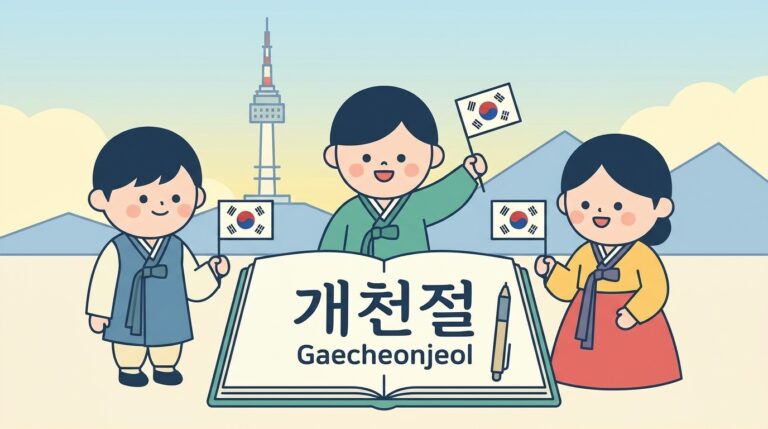
Celebrate Gaecheonjeol Like a Local: Easy Korean Phrases for National Foundation Day
Phase 1: Welcome to Daily Hangul!
안녕하세요! I am your Daily Hangul editor, your friendly native bestie here to guide you through Korean language and culture!
Imagine walking down the streets of Seoul on October 3rd. You notice Korean national flags—the Taegeukgi—fluttering proudly from apartment balconies and public buses. You check your phone and see that cafes are bustling, but offices are quiet. You ask your Korean friend if it’s a special day, and they smile and say, “Today is Gaecheonjeol!” But wait… what does that mean, and how do you talk about it without sounding like a textbook from 1995?
Many beginner learners feel anxious when national holidays pop up in Korea. Should you say happy birthday to Korea? Is it rude if you don’t know the story behind it? Don’t worry! In this guide tailored specifically for A1 beginners, we will break down simple, heartwarming phrases you can use naturally. By the end of this lesson, you’ll be able to ask about holiday plans, talk about the national flag, and understand a core piece of Korea’s history with confidence.
Phase 2: Core Expressions Deep Dive
1. 개천절 축하해요! (Gaecheon-jeol chu-kha-hae-yo!)
- Pronunciation: [Gae-cheon-jeol choo-kha-hae-yo] (Sounds like “Gay-chuhn-juhl choo-kha-hay-yo”)
- Meaning: Literal: “Congratulations on Gaecheonjeol!” | Real Nuance: “Happy National Foundation Day!”
- K-Culture Moment: Used in friendly festive greetings, broadcast banners, or social media captions on October 3rd.
- Editor’s Insight: While Koreans don’t usually throw massive parties for this holiday, sending a quick message like this to a Korean friend shows great interest in their culture!
- Situation Spectrum: Casual ⚠️ / Semi-formal ✅ / Formal ✅
- 🤔 Think About It: Does your country celebrate a day marking its mythical or official founding? How do you greet people on that day?
2. 오늘 쉬는 날이에요? (O-neul swi-neun na-ri-e-yo?)
- Pronunciation: [Oh-neul swi-neun na-ri-e-yo] (Rhymes roughly with “Oh-neul swee-neun nah-ree-ay-yo”)
- Meaning: Literal: “Is today a resting day?” | Real Nuance: “Is today a day off? / Is it a public holiday?”
- K-Culture Moment: Asked to colleagues or friends when you are unsure if shops or schools are open.
- Editor’s Insight: This is an extremely high-frequency phrase in daily life. You can use it for any red-calendar day (Gonghyuil)!
- Situation Spectrum: Casual ✅ / Semi-formal ✅ / Formal ⚠️
- 🤔 Think About It: How do you politely check if someone has work today in your native language?
3. 태극기 달았어요? (Tae-geuk-gi da-ras-seo-yo?)
- Pronunciation: [Tae-geuk-gi da-ra-sseo-yo] (Sounds like “Tae-gook-gee dah-rah-ssuh-yo”)
- Meaning: Literal: “Did you hang the Taegeukgi?” | Real Nuance: “Did you fly the Korean flag today?”
- K-Culture Moment: A common small-talk question among neighbors or on Korean family group chats on national holidays.
- Editor’s Insight: Hanging the national flag outside the window on national holidays is a traditional practice in Korea, especially in apartment complexes.
- Situation Spectrum: Casual ✅ / Semi-formal ✅ / Formal ✅
- 🤔 Think About It: On what occasions do people in your home country hang flags outside their homes?
Phase 3: Textbook Korean vs Real Korean
Situation 1: Asking if a store is open on a holiday
* 📖 Textbook Korean: 오늘 영업을 합니까? (O-neul yeong-eob-eul hab-ni-kka? – Do you conduct business today?)
* 🗣️ Real Korean: 오늘 문 열어요? (O-neul mun yeor-eo-yo? – Are you open today?)
* 💡 Why is it different? The textbook version is overly formal for everyday shops or cafes. Asking if they “open the door” (mun yeor-eo-yo) is warm and natural.
Situation 2: Wishing someone a good day off
* 📖 Textbook Korean: 즐거운 국경일을 보내십시오. (Jeul-geo-un guk-gyeong-il-eul bo-nae-sip-si-o. – Have a pleasant national holiday.)
* 🗣️ Real Korean: 오늘 잘 쉬세요! (O-neul jal swi-se-yo! – Rest well today!)
* 💡 Why is it different? Koreans prefer friendly, well-wishing phrases focused on comfortable rest rather than stiff ceremonial declarations.
Phase 4: K-Culture Deep Dive & Non-Verbal Manners
4-1. Nunchi & Flag Manners
On Gaecheonjeol, you will see the Korean flag (Taegeukgi) everywhere. If you visit a Korean home or residence, notice how the flag is raised at the top of the flagpole (not at half-mast). Half-mast is reserved for memorial days like Hyeonchungil. Showing respect by acknowledging the flag with a light smile or nod demonstrates great cultural Nunchi (tact/sense).
4-2. Cultural Code: The Story of Dangun (단군)
Gaecheonjeol literally means “The Day the Heavens Opened.” According to Korean mythology, the legendary founder Dangun established the first Korean kingdom (Gojoseon) on this day. The myth involves a bear and a tiger who wanted to become human by eating only garlic and mugwort in a cave for 100 days. The bear persevered and became a woman, who later gave birth to Dangun! Next time you eat Korean garlic dishes, you can joke that garlic is part of Korean DNA!
Phase 5: Real-Life Roleplay Scenario
Setting: Minjun (a local Korean friend) and Sarah (an exchange student) are walking near a park on October 3rd.
Characters:
* 민준 (Minjun): Friendly local Korean friend
* 사라 (Sarah): Enthusiastic beginner Korean learner
- 민준: 사라야, 오늘 개천절인데 뭐 해?
(Sa-ra-ya, o-neul Gae-cheon-jeol-in-de mwo hae?)
(Sarah, today is Gaecheonjeol, what are you doing?)
🎭 Smiling while sipping iced Americano -
사라: 오늘 쉬는 날이에요? 몰랐어요!
(O-neul swi-neun na-ri-e-yo? Mol-ras-seo-yo!)
(Is today a day off? I didn’t know!)
🎭 Surprised look with wide eyes -
민준: 응, 한국의 개천절이야. 쉬는 공휴일이지!
(Eung, Han-guk-ui Gae-cheon-jeol-i-ya. Swi-neun gong-hyu-il-i-ji!)
(Yeah, it’s Korea’s Gaecheonjeol. A public holiday to rest!)
🎭 Nodding warmly -
사라: 개천절 축하해요! 무슨 날이에요?
(Gae-cheon-jeol chu-kha-hae-yo! Mu-seun na-ri-e-yo?)
(Happy Gaecheonjeol! What kind of day is it?)
🎭 Giving a friendly bow -
민준: 한국이 처음 만들어진 날을 기념하는 날이야.
(Han-guk-i cheo-eum man-deu-reo-jin na-reul gi-nyeom-ha-neun na-ri-ya.)
(It’s a day commemorating when Korea was first founded.)
🎭 Pointing to the flag fluttering nearby -
사라: 아! 그래서 태극기가 많군요.
(A! Geu-rae-seo Tae-geuk-gi-ga man-gun-yo.)
(Ah! That’s why there are many Taegeukgi flags.)
🎭 Looking around at flags -
민준: 맞아! 오늘 카페 가서 맛있는 거 먹을까?
(Ma-ja! O-neul ka-pe ga-seo mas-in-neun geo meog-eul-kka?)
(Right! Shall we go to a cafe and eat something delicious today?)
🎭 Pointing to a cozy cafe -
사라: 좋아요! 오늘 잘 쉬세요, 민준 씨!
(Jo-a-yo! O-neul jal swi-se-yo, Min-jun ssi!)
(Sounds good! Rest well today, Minjun!)
🎭 Giving a big bright smile
🔀 Interactive Choice Point:
How should Sarah respond when Minjun asks if she knows about Gaecheonjeol?
- Choice A: “개천절 축하해요! 오늘 쉬는 날이에요?” (Happy Gaecheonjeol! Is today a day off?)
- Choice B: “오늘 영업을 합니까?” (Are you conducting business today?)
- Choice C: “단군 신화 이야기해주세요!” (Tell me the myth of Dangun right now!)
Feedback:
* Choice A (Best): Perfect! It’s natural, friendly, and appropriate for an A1 learner.
* Choice B (Bad): Too formal and awkward when talking to a friend walking in the park.
* Choice C (Risk): A bit sudden! Save mythological deep-dives for when you sit down with coffee.
Phase 6: 10-Second Emotion Shadowing Drill
[😊 Cheerful & Curious]
개천절 / 축하해요! / 오늘 쉬는 날이에요?
(Gae-cheon-jeol / chu-kha-hae-yo! / O-neul swi-neun na-ri-e-yo?)-
[😲 Surprised & impressed]
아! / 그래서 / 태극기가 / 많군요!
(A! / Geu-rae-seo / Tae-geuk-gi-ga / man-gun-yo!) -
[Warm & Friendly]
오늘 / 맛있는 거 먹고 / 잘 쉬세요!
(O-neul / mas-in-neun geo meog-go / jal swi-se-yo!)
Phase 7: K-Culture Mini Dictionary
- 개천절 (Gae-cheon-jeol) | National Foundation Day | Korea’s national holiday on October 3rd celebrating the mythical founding of the nation.
- 태극기 (Tae-geuk-gi) | Korean National Flag | The official flag of South Korea featuring the Taegeuk symbol and four trigrams.
- 공휴일 (Gong-hyu-il) | Public Holiday / Red Day | Official non-working day designated by law.
- 단군 (Dan-gun) | Dangun Wanggeom | The legendary founder of Gojoseon, the first Korean kingdom.
Phase 8: Survival Kit for Travelers
Top 3 Survival Expressions
- 오늘 문 열어요? (O-neul mun yeor-eo-yo?) – Are you open today?
- 공휴일에도 해요? (Gong-hyu-il-e-do hae-yo?) – Do you operate even on public holidays?
- 잘 쉬세요! (Jal swi-se-yo!) – Rest well! / Have a good holiday!
Editor’s Travel Note
When traveling in Korea on public holidays like Gaecheonjeol, public transport runs as usual, but some small family-owned shops or pharmacies might close. Use the Naver Map App Navigation to check live business hours before heading out!
Phase 9: One Step Deeper
In Korea, holidays like Gaecheonjeol are not just about staying home and sleeping in; they represent a shared identity rooted in the concept of Hongik Ingan (홍익인간)—meaning “to broadly benefit human society.” This foundational philosophy inspires Korean community values and hospitality even today.
💬 Your Turn: Does your country have a national founding legend or holiday philosophy? Share it in the comments below!
Phase 10: FAQ & Common Mistakes
Q: Is Gaecheonjeol the same as Korean Independence Day?
A: No! Independence Day is Gwangbokjeol (August 15th). Gaecheonjeol (October 3rd) celebrates the original founding of the Korean nation thousands of years ago.
Q: Do buses and subways run on Gaecheonjeol?
A: Yes, public transportation runs smoothly on holiday schedules, so getting around Seoul is very easy.
Q: Can I say “생일 축하해요” (Happy Birthday) to Korea on Gaecheonjeol?
A: While cute, Koreans don’t usually say happy birthday to the country. Saying “개천절 축하해요!” or “오늘 잘 쉬세요!” is much more natural.
🚨 Common Mistakes TOP 3
- Mistake: Calling every holiday “Chuseok”.
Correct Action: Use the specific name like Gaecheonjeol. - Mistake: Hanging the Taegeukgi flag upside down.
Correct Action: Ensure the red half of the circle is on top and blue is on the bottom. - Mistake: Using stiff business language with close friends.
Correct Action: Swap stiff textbook sentences for natural casual-polite phrases ending in -yo.
Phase 11: Action Mission
- Bronze Mission: Read the 3 core expressions out loud 3 times using the Emotion Shadowing Drill.
- Silver Mission: Post a picture of a Korean flag on social media with the caption: “개천절 축하해요!”.
- Gold Mission: Use “오늘 문 열어요?” at a local Korean bakery or cafe on a holiday!
🎮 K-Culture Mission: Watch a Korean Vlog on YouTube recorded on October 3rd and spot how many Taegeukgi flags you can see hanging from buildings!
Phase 12: Interactive Quiz Challenge
1. Situation Quiz: What is the most natural friendly greeting on Gaecheonjeol?
– A) 새해 복 많이 받으세요!
– B) 개천절 축하해요! 오늘 잘 쉬세요!
– C) 생일 축하합니다!
Click to view Answer & Explanation
Correct Answer: B! Option A is for New Year, and Option C is for personal birthdays.
2. Fill-in-the-Blank: 오늘 태극기 ______? (Did you hang the flag?)
– A) 달았어요
– B) 먹었어요
– C) 잤어요
Click to view Answer & Explanation
Correct Answer: A! ‘달다’ (darda) means to hang or attach a flag.
3. True/False Culture Quiz: Gaecheonjeol is celebrated on October 3rd every year.
– [ ] True
– [ ] False
Click to view Answer & Explanation
Correct Answer: True! October 3rd is the fixed annual date for Gaecheonjeol.







