

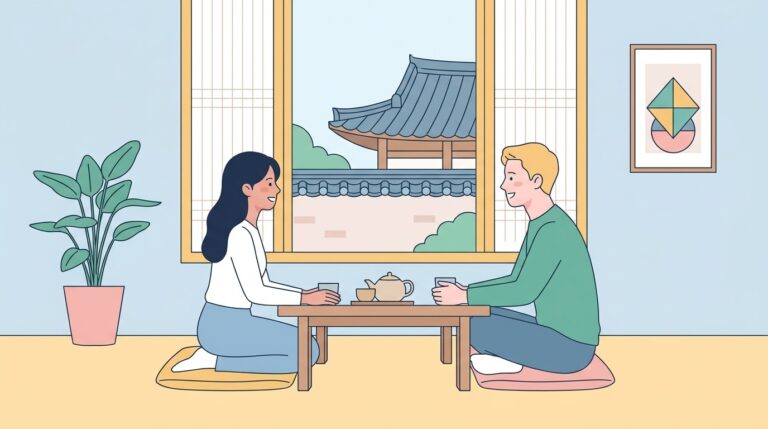
Phase 1: 공감 (Storytelling Opening)
안녕하세요! 매일한글 에디터입니다.
Imagine this scenario: You and your Korean spouse are sitting at the dinner table after a weekend visit to your in-laws (시댁 or 처가). You felt completely overwhelmed by implicit social expectations—who serves whom first, how to react when your mother-in-law makes a blunt comment about your lifestyle, or why your spouse suddenly acts so much more formal around their parents. Later, you try to talk about it, but the conversation turns into a frustrating argument because you lack the sophisticated, high-level vocabulary required to express deep emotional nuances without sounding overly critical or confrontational.
At a C2 level, communication isn’t just about grammatically correct sentences; it’s about mastering delicate linguistic diplomacy. Navigating cultural friction in a multicultural marriage requires understanding deeply rooted societal concepts such as 눈치 (Nunchi – social tact), 정 (Jeong – deep emotional bond), and 고부갈등 (conflicts between mother-in-law and daughter-in-law). Based on real feedback from international spouses living in Korea, mastering these subtle expressions allows you to transform potentially tense family conflicts into moments of profound mutual understanding and connection.
Phase 2: 핵심 표현 3선 심층 분석
1. 서로의 문화적 차이를 인정하고 받아들이다 (Seo-ro-ui mun-hwa-jeok cha-i-reul in-jeong-ha-go ba-da-deul-i-da)
- Pronunciation: [Seo-ro-ui mun-hwa-jeok cha-i-reul in-jeong-ha-go ba-da-deul-i-da] (Sounds like: “suh-roh-ui moon-hwa-juhk cha-ee-reul in-jung-hah-goh bah-dah-deul-ee-dah”)
- Meaning: Literally “To acknowledge and accept each other’s cultural differences.” In nuance, it means actively embracing individual cultural backgrounds rather than merely tolerating them.
- K-Culture Moment: Frequently heard in relationship counseling shows like 금쪽 상담소 (Dr. Oh’s Golden Counseling) or family drama climaxes when couples decide to stop trying to force each other into their own cultural molds.
- Editor’s Insight: At C2, replace simple verbs like ‘이해하다’ (to understand) with ‘인정하고 받아들이다’ (to acknowledge and embrace). It projects maturity and high emotional intelligence.
- Situation Spectrum: Casual ⚠️ | Semi-formal ✅ | Formal ✅
- 🤔 Think About It: In your native culture, is marriage considered a union between two individuals or two entire families? How does this shift your approach to resolving conflict?
2. 말하지 않아도 알 것이라 지레짐작하다 (Mal-ha-ji a-na-do al geos-i-ra ji-re-jim-jak-ha-da)
- Pronunciation: [Mal-ha-ji a-na-do al geos-i-ra ji-re-jim-jak-ha-da] (Sounds like: “mahl-hah-jee ah-nah-doh ahl guhs-ee-rah jee-reh-jeem-jahk-hah-dah”)
- Meaning: Literally “To jump to conclusions assuming the other person knows without being told.” It refers to the toxic habit of expecting unspoken telepathy (심통 or 눈치).
- K-Culture Moment: A key phrase used in modern Korean marriage seminars when discussing how high-context communication leads to misunderstandings in international marriages.
- Editor’s Insight: ‘지레짐작하다’ means to jump to conclusions prematurely. Combining it with ‘말하지 않아도 알 것’ highlights the common pitfall of Korean implicit communication expectations.
- Situation Spectrum: Casual ✅ | Semi-formal ✅ | Formal ✅
- 🤔 Think About It: Does your partner expect you to “read the room” (눈치) rather than asking directly? How can you express your need for explicit verbal communication politely?
3. 고부간/장서간의 갈등을 중재하다 (Go-bu-gan / Jang-seo-gan-ui gal-deung-eul jung-jae-ha-da)
- Pronunciation: [Go-bu-gan / Jang-seo-gan-ui gal-deung-eul jung-jae-ha-da] (Sounds like: “goh-boo-gahn / jahng-seo-gahn-ui gahl-deung-eul joong-jae-hah-dah”)
- Meaning: To mediate conflicts between mother-in-law and daughter-in-law (고부간) or between mother-in-law and son-in-law (장서간).
- K-Culture Moment: Standard terminology in K-drama plots and psychological advice columns discussing the crucial role of the middle spouse in balancing parental respect and martial protection.
- Editor’s Insight: The middle spouse isn’t just a spectator; in Korean culture, they must be an active mediator (중재자). Using ‘중재하다’ elevates your discussion of marital dynamics to an expert level.
- Situation Spectrum: Casual 🚫 | Semi-formal ✅ | Formal ✅
- 🤔 Think About It: What is the designated role of a spouse when conflict arises with in-laws in your culture?
Phase 3: 교과서 한국어 vs 진짜 한국어
Situation 1: Expressing exhaustion from unspoken cultural expectations at family gatherings
- 📖 교과서 한국어: “시댁 문화가 아직 익숙하지 않아서 힘들어요.” (I am tired because I am not used to the in-law culture yet.)
- 🗣️ 진짜 한국어: “말을 안 해주시니까 속마음을 몰라서 눈치만 보게 돼요.” (Since no one tells me directly, I can’t read their minds and end up just walking on eggshells.)
- 💡 왜 다를까? Textbook Korean sounds overly generic. Native speakers express emotional fatigue by describing the specific psychological strain of ‘눈치만 보다’ (walking on eggshells / reading the room endlessly).
Situation 2: Asking your spouse to stand up for you in front of their parents
- 📖 교과서 한국어: “당신 부모님께 제 입장을 설명해 주세요.” (Please explain my position to your parents.)
- 🗣️ 진짜 한국어: “당신이 중간에서 내 입장을 잘 좀 대변해 줬으면 좋겠어.” (I really need you to represent my stance properly in the middle.)
- 💡 왜 다를까? ‘중간에서 대변하다’ (to act as a voice in the middle) captures the nuanced role of a Korean spouse acting as a protective buffer between the foreign partner and the traditional family.
Phase 4: K-Culture 딥다이브 & 비언어적 매너
4-1. 눈치(Nunchi) & Non-Verbal Etiquette at In-Law Gatherings
- Eye Contact & Posture: Direct, intense eye contact with traditional Korean elders can sometimes be perceived as defensive or aggressive during a serious conversation. Maintain a soft gaze toward their cheek/chin area and tilt your chin slightly down to convey respect (경청하는 태도).
- Pouring Drinks & Hand Placement: When receiving a drink or dish from in-laws, always use two hands (or place your left hand gently under your right wrist/forearm). This subtle gesture instantly softens potential tensions.
4-2. Cultural Code Analysis: The Evolution of 시댁 Dynamics in Modern K-Dramas
In classic K-Dramas, the mother-in-law (시어머니) was depicted as an absolute authority figure demanding full assimilation. However, modern K-Dramas (such as 작은 아씨들 or family sitcoms) portray a major shift: young couples actively discuss 거리두기 (healthy emotional distance) and demand 상호 존중 (mutual respect). Understanding this evolution helps you realize that setting boundaries with Korean in-laws is no longer taboo—it is a healthy modern adaptation!
Phase 5: 실전 롤플레이 시나리오
Setting: A quiet cafe after a weekend family dinner at the in-laws’ house.
Characters:
* 민우 (Min-woo): Korean spouse who felt caught between his mother and his foreign wife.
* 엘레나 (Elena): Foreign spouse striving for healthy boundaries without causing disrespect.
- 민우: 🎭 (한숨을 쉬며 차를 한 머금는다) 오늘 우리 엄마 집에서 좀 불편했지? 엄마가 자꾸 음식 타령해서 미안해.
(Min-woo: (Sighs, sipping tea) Was it uncomfortable at my mom’s place today? I’m sorry she kept nagging about the food.) - 엘레나: 🎭 (진지한 눈빛으로 민우를 바라보며) 괜찮아. 하지만 단순한 음식 이야기가 아니라 문화적 차이에서 오는 갈등 같아.
(Elena: (Looking seriously at Min-woo) It’s okay. But I think it’s a conflict coming from cultural differences, not just about food.) - 민우: 🎭 (당황하며) 엄마는 그냥 너랑 더 친해지고 싶어서 그러시는 건데… 너무 예민하게 받아들이지 마.
(Min-woo: (Flustered) Mom is just doing that to get closer to you… Don’t take it too sensitively.) - 엘레나: 🎭 (고개를 저으며 톤을 낮춘다) 예민한 게 아니야. 말하지 않아도 다 알 거라고 지레짐작하는 문화가 나한테는 부담스러워.
(Elena: (Shaking head, lowering voice) I’m not being sensitive. The cultural expectation that I should know everything without being told is overwhelming for me.) - 민우: 🎭 (생각에 잠긴 듯) 그렇구나… 내가 중간에서 역할을 제대로 못 했네. 어떤 점이 가장 힘들었어?
(Min-woo: (Thoughtful) I see… I guess I didn’t play my mediator role well. What was the hardest part for you?) - 엘레나: 🎭 (민우의 손을 잡으며) 어머님이 나쁜 뜻이 아니라는 건 알아. 하지만 당신이 중간에서 내 입장을 잘 대변해 줘야 내가 외롭지 않아.
(Elena: (Holding Min-woo’s hand) I know your mother means no harm. But you need to represent my stance properly so I don’t feel isolated.) - 민우: 🎭 (고개를 끄덕이며) 맞아. 우리가 서로의 문화적 차이를 인정하고 받아들이려면 내가 더 노력해야 해. 고마워, 말해줘서.
(Min-woo: (Nodding) You’re right. For us to acknowledge and embrace our cultural differences, I need to try harder. Thank you for speaking up.) - 엘레나: 🎭 (미소를 지으며) 응, 앞으로는 서운한 게 있으면 바로 솔직하게 대화로 풀어가자.
(Elena: (Smiling) Yeah, from now on, if anything hurts our feelings, let’s solve it through honest communication right away.)
🔀 Interactive Choice Point
**How should Elena respond when Min-woo says
Frequently Asked Questions (FAQ)
Q: What does "서로의 문화적 차이를 인정하고 받아들이다 (Seo-ro-ui mun-hwa-jeok cha-i-reul in-jeong-ha-go ba-da-deul-i-da)" mean in Korean and how do you pronounce it?
A: In Korean, "서로의 문화적 차이를 인정하고 받아들이다 (Seo-ro-ui mun-hwa-jeok cha-i-reul in-jeong-ha-go ba-da-deul-i-da)" is pronounced [Seo-ro-ui mun-hwa-jeok cha-i-reul in-jeong-ha-go ba-da-deul-i-da] and means: Literally "To acknowledge and accept each other's cultural differences." In nuance, it means actively embracing individual cultural backgrounds rather than merely tolerating them.
Q: What does "말하지 않아도 알 것이라 지레짐작하다 (Mal-ha-ji a-na-do al geos-i-ra ji-re-jim-jak-ha-da)" mean in Korean and how do you pronounce it?
A: In Korean, "말하지 않아도 알 것이라 지레짐작하다 (Mal-ha-ji a-na-do al geos-i-ra ji-re-jim-jak-ha-da)" is pronounced [Mal-ha-ji a-na-do al geos-i-ra ji-re-jim-jak-ha-da] and means: Literally "To jump to conclusions assuming the other person knows without being told." It refers to the toxic habit of expecting unspoken telepathy (심통 or 눈치).
Q: What does "고부간/장서간의 갈등을 중재하다 (Go-bu-gan / Jang-seo-gan-ui gal-deung-eul jung-jae-ha-da)" mean in Korean and how do you pronounce it?
A: In Korean, "고부간/장서간의 갈등을 중재하다 (Go-bu-gan / Jang-seo-gan-ui gal-deung-eul jung-jae-ha-da)" is pronounced [Go-bu-gan / Jang-seo-gan-ui gal-deung-eul jung-jae-ha-da] and means: To mediate conflicts between mother-in-law and daughter-in-law (고부간) or between mother-in-law and son-in-law (장서간).







