

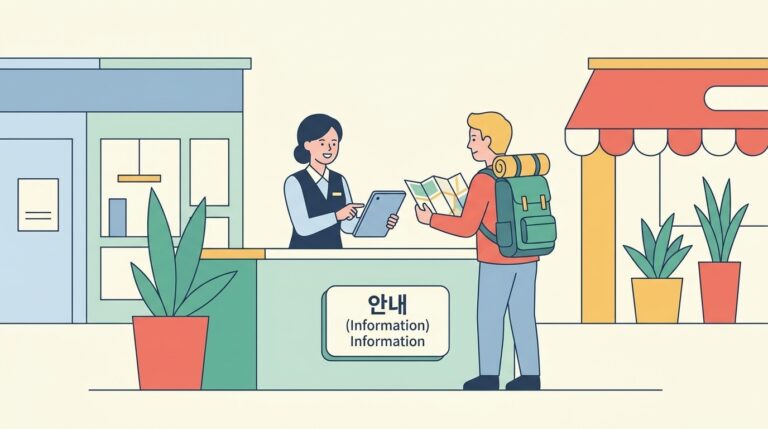
Lost in a Korean Mall? Master Info Desk Phrases in 5 Minutes!
안녕하세요! This is your Daily Hangul editor!
Picture this: You just landed at Incheon International Airport, or perhaps you are standing inside the breathtaking Starfield COEX Mall in Seoul. The neon lights are dazzling, the scent of fresh pastries fills the air, but suddenly you realize… you desperately need to find the restroom or the luggage storage. You look around, spot a sleek modern information desk, but as you approach the friendly staff member, your mind goes completely blank. Sound familiar?
Don’t panic! Navigating public places in South Korea can feel overwhelming for beginners, but asking for directions at an information desk is actually one of the easiest ways to gain confidence in real-world conversations. Based on real learner feedback and years of guiding travelers in Korea, mastering just three core phrases will completely transform your travel experience from stressful to seamless. Let’s make sure you never get lost in Korea again!
Phase 2: Core Expressions Deep Dive
1. 화장실 어디에 있어요? (Hwajangsil eodie issoyo?)
- Pronunciation: [Hwa-jang-sil eo-di-e it-seo-yo?] (Think of ‘Hwa’ like ‘water’ and ‘jangsil’ like ‘chamber’, sounding like ‘it’s-oh-yo’ at the end)
- Meaning: “Where is the restroom?” (Literal: Restroom where at exists?)
- K-Culture Moment: Seen constantly in K-Dramas when characters visit bustling department stores or subway hubs.
- Editor’s Insight: ‘화장실’ (Hwajangsil) literally translates to ‘makeup room’, showing how Korean culture values polite phrasing for public facilities.
- Situation Spectrum: Casual 🚫 | Semi-formal ✅ | Formal ✅
- 🤔 Think About It: Why do you think Korean uses location markers like ‘에’ (e) before asking where something exists?
2. [장소] 어디예요? ([Jangso] eodieyo?)
- Pronunciation: [Jang-so eo-di-ye-yo?]
- Meaning: “Where is [Place]?”
- K-Culture Moment: Used at K-Pop concert venues when looking for merchandise booths or main entrances.
- Editor’s Insight: This is the ultimate shortcut formula! Just put any noun—like ‘엘리베이터’ (elevator) or ‘출구’ (exit)—right before ‘어디예요?’.
- Situation Spectrum: Casual ⚠️ | Semi-formal ✅ | Formal ✅
- 🤔 Think About It: Notice how dropping subjects makes Korean sentences faster and more contextual compared to English!
3. 저기요, 도와주세요 (Jeogiyo, dowajuseyo)
- Pronunciation: [Juh-gi-yo, do-wa-ju-se-yo] (Sounds like ‘Jug-gy-yo, dough-wah-joo-say-yo’)
- Meaning: “Excuse me, please help me.”
- K-Culture Moment: The magic phrase used in restaurants, info desks, and street stalls across Seoul.
- Editor’s Insight: ‘저기요’ literally means “Over there!”, but functions like a polite “Excuse me!” to get someone’s attention naturally.
- Situation Spectrum: Casual ⚠️ | Semi-formal ✅ | Formal ✅
- 🤔 Think About It: In your native culture, how do you politely grab an employee’s attention without sounding rude?
Phase 3: Textbook Korean vs. Real Korean
Situation 1: Asking where the elevator is
- 📖 Textbook Korean: 엘리베이터가 어디에 위치해 있습니까? (Where is the elevator located?)
- 🗣️ Real Korean: 엘리베이터 어디예요? (Where’s the elevator?)
- 💡 Why is it different? Real speakers prefer short, fluid sentences over stiff grammatical verbs like ‘위치하다’ (to be located).
Situation 2: Asking for help
- 📖 Textbook Korean: 저를 도와주실 수 있으십니까? (Would you be able to help me?)
- 🗣️ Real Korean: 저기요, 잠깐만 도와주세요! (Excuse me, please help me for a second!)
- 💡 Why is it different? Korean conversation values speed and direct warmth rather than complex modal verbs.
Phase 4: K-Culture Deep Dive & Non-Verbal Manners
4-1. Nunchi & Gestures at the Info Desk
When approaching an information desk staff member in South Korea, eye contact accompanied by a soft head nod (인사, Insa) is essential. When pointing towards a direction or handing over a map, always use both hands or support your right wrist with your left hand—this shows immense respect in Korean culture!
4-2. Culture Code: The High-Tech K-Info Desk
From Hyundai Department Store to Incheon Airport, Korean info desks are tech-infused spaces where AI robots and digital kiosk screens coexist with warm human staff. Knowing basic Korean builds an instant emotional connection with staff who are always eager to assist foreign visitors!
Phase 5: Real-Life Roleplay Scenario
Setting: Starfield Mall Information Desk in Seoul. You approach Min-ho, a friendly staff member wearing a clean uniform.
- Turn 1 (You): 저기요, 안녕하세요! (Jeogiyo, annyeonghaseyo!) 🎭 [Nodding polite head] (Excuse me, hello!)
- Turn 2 (Min-ho): 안녕하세요! 무엇을 도와드릴까요? (Annyeonghaseyo! Mueoseul dowadeorilkkayo?) 🎭 [Smiling warmly] (Hello! How can I help you?)
- Turn 3 (You): 화장실 어디에 있어요? (Hwajangsil eodie issoyo?) 🎭 [Looking inquiringly] (Where is the restroom?)
- Turn 4 (Min-ho): 오른쪽으로 가시면 엘리베이터 옆에 있습니다. (Oreunjjogeuro gasimyeon ellibeito yeope isseumnida.) 🎭 [Pointing right with open palm] (If you go right, it is next to the elevator.)
- Turn 5 (You): 아, 오른쪽 엘리베이터 옆이요? (A, oreunjjok ellibeito yeop-iyo?) 🎭 [Repeating to double check] (Ah, next to the right elevator?)
- Turn 6 (Min-ho): 네, 맞습니다! (Ne, matseumnida!) 🎭 [Nodding encouragingly] (Yes, that’s correct!)
- Turn 7 (You): 감사합니다! (Gamsahamnida!) 🎭 [Bow slightly] (Thank you!)
- Turn 8 (Min-ho): 좋은 하루 되세요! (Joeun haru doeseo-yo!) 🎭 [Waving gently] (Have a nice day!)
🔀 Interactive Choice Point
What should you say if you didn’t understand the staff member’s fast explanation?
* Option A: 천천히 다시 말해주세요. (Cheoncheonhi dasi malhaejuseyo – Please speak slowly again.)
* Option B: 뭐라고? (Mworago? – What did you say?)
* Option C: 그냥 계세요. (Geunyang gyeseyo – Just stay there.)
Feedback:
* Option A (Best): ✅ Perfect polite request for beginners!
* Option B (Bad): 🚫 Very rude informal speech to a stranger.
* Option C (Risk): ⚠️ Awkward usage that doesn’t make sense in context.
Phase 6: 10-Second Emotion Shadowing Drill
Practice saying these out loud with natural pauses (/) and emotions!
[😊 Polite & Seeking Attention]저기요 / 안녕하세요! (Jeogiyo / Annyeonghaseyo!)[🤔 Curious & Urgent]화장실 / 어디에 있어요? (Hwajangsil / eodie issoyo?)[🙏 Grateful & Bright]정말 / 감사합니다! (Jeongmal / gamsahamnida!)
Phase 7: K-Culture Mini Dictionary
- 안내 데스크 (Annae Deseukeu) | Information Desk | The primary hub for directions and assistance in Korean venues.
- 화장실 (Hwajangsil) | Restroom / Bathroom | Essential facility term every visitor must memorize.
- 엘리베이터 (Ellibeito) | Elevator | Loanword borrowed from English, easy to pronounce!
- 오른쪽 / 왼쪽 (Oreunjjok / Oenjjok) | Right / Left | Directional terms crucial for navigating shopping hubs.
Phase 8: Traveler’s Survival Kit
Survival Expressions TOP 3
- 여기 어디예요? (Yeogi eodieyo?) – Where am I right now?
- 지도 있어요? (Jido issoyo?) – Do you have a map?
- 감사합니다 (Gamsahamnida) – Thank you!
Editor’s Travel Note
Before roaming around Seoul, make sure to get the Naver Map Navigation App Download on your phone. KakaoMap and Naver Map work infinitely better than Google Maps in Korea for indoor facility routing!
Phase 9: One Step Deeper
In Korean culture, asking for directions isn’t just about exchanging spatial data—it’s a micro-demonstration of community respect. Using formal speech endings like ‘-요’ (-yo) or ‘-습니다’ (-seumnida) acknowledges the helpful role of service workers, reflecting the deeply rooted Korean value of mutual politeness in shared spaces.
💬 Your Turn: What facility do you usually look for first when entering a giant shopping mall in a foreign country? Tell us in the comments below!
Phase 10: FAQ & Common Mistakes
Q: Can I use “Excuse me” in English at Korean Info Desks?
A: Most staff at major airports or malls understand basic English, but opening with “저기요” (Jeogiyo) shows immediate respect and gets faster results!
Q: Is pointing with one finger okay when asking for directions?
A: Pointing with a single index finger can be perceived as slightly aggressive in Korea. It is best to use an open hand with fingers together.
Q: What if I don’t understand the Korean response?
A: Smile and say “영어 가능해요?” (Yeong-eo ganeung-haeyo? – Is English possible?).
🚨 Common Mistakes TOP 3
- Mistake: Calling an employee “너” (Neu – You).
- Correct Action: Use “저기요” (Jeogiyo) without using personal pronouns.
- Mistake: Using casual speech (반말) like “화장실 어디야?”.
- Correct Action: Always attach ‘-요’ (-yo) at the end: “화장실 어디예요?”.
- Mistake: Pointing directly at staff faces.
- Correct Action: Keep hands low and open.
Phase 11: Action Mission & Engagement
- 🥉 Bronze Level: Practice saying “화장실 어디에 있어요?” 3 times out loud.
- 🥈 Silver Level: Share this guide on social media with your travel buddy!
- 🥇 Gold Level: Use “저기요, 도와주세요” at a Korean store or online Korean speaking practice today!
🎮 K-Culture Mission: Watch any episode of a K-Drama set in an airport or office, and spot how characters call for attention using “저기요”!
Phase 12: Interactive Quiz Challenge
- What is the polite word for “Restroom” in Korean?
- True or False: Pointing with one index finger is the most polite gesture in Korea.
- Fill in the blank: “______ 어디예요?” (Where is the elevator?)
Click to reveal answers!
- 화장실 (Hwajangsil)
- False (Open palm gestures are much more polite!)
- 엘리베이터 (Ellibeito)






