

Phase 1: Empathy (Story Opening)
안녕하세요! 매일한글 에디터입니다. Welcome back to another real-life Korean culture guide!
Imagine this: You just spent an amazing afternoon with a Korean running club or language exchange group in Hongdae. Everyone worked hard, laughed, and wrapped up the main activity. Then, the club leader smiles and asks the group: “오늘 뒷풀이 가실 분?” (Who is coming to the after-party today?)
Suddenly, your heart races. Should I go? What if my Korean isn’t good enough? What do people actually do there? You want to join, but you hesitate because you don’t know the right words or etiquette.
Don’t worry at all! 뒷풀이 (Duitpuli – After-Party) is where true Korean friendships are forged over delicious food and lively conversations. It is informal, warm, and the absolute best place to practice your spoken Korean. Based on feedback from hundreds of foreign learners, this A2 beginner-friendly guide gives you the exact phrases, cultural manners, and confidence you need to jump into any Korean club after-party with ease!
Phase 2: Deep Dive into 3 Core Expressions
1. 뒷풀이 가요? (Duitpuli gayo?)
- Pronunciation: [dweet-poo-ree gah-yoh] (Sounds like “sweet” with a ‘d’ + “pooh-ree”)
- Meaning: “Are we going to the after-party?”
- Literal vs Nuance: ‘뒷’ (back) + ‘풀이’ (releasing/unwinding). Literally “releasing stress afterwards,” but in practice it means the social after-party.
- K-Culture Moment: Seen frequently in K-Dramas when university club members head to a local Korean BBQ joint after a big sports game or performance.
- Editor’s Insight: Adding a soft, curious tone to “가요?” shows enthusiasm without sounding demanding.
- Situation Spectrum: Casual ✅ | Semi-formal ✅ | Formal ⚠️
- 🤔 Think About It: In Korean social culture, doing the main activity builds teamwork, but sharing food at 뒷풀이 builds personal friendship. How does your country build post-event bonding?
2. 2차 어디로 가요? (I-cha eodi-ro gayo?)
- Pronunciation: [ee-chah ee-dee-roh gah-yoh] (Number 2 ‘ee’ + ‘chah’)
- Meaning: “Where are we going for Round 2?”
- Literal vs Nuance: Korean nights out are often split into rounds (1차 = 1st round/dinner, 2차 = 2nd round/pub or cafe, 3차 = 3rd round/Noraebang).
- K-Culture Moment: Moving from a noisy grill restaurant to a cozy pub or dessert cafe around 10 PM.
- Editor’s Insight: Asking this shows you are fully part of the crew and enjoying the night!
- Situation Spectrum: Casual ✅ | Semi-formal ✅ | Formal 🚫
- 🤔 Think About It: Why do you think Korean night culture involves changing venues multiple times instead of staying in one place?
3. 저 먼저 들어가 볼게요. (Jeo meon-jeo deul-eo-ga beol-gae-yo.)
- Pronunciation: [jeoh meohn-jeoh deuhl-eoh-gah behohl-gae-yoh]
- Meaning: “I will head home first.”
- Literal vs Nuance: Literally “I will try entering (home) first.” In Korea, directly saying “I’m leaving” can sound too blunt. Using “들어가다” (to enter home) makes your exit sound polite and gentle.
- K-Culture Moment: When a club member needs to catch the last subway train around 11 PM.
- Editor’s Insight: This is the ultimate polite exit line that every learner must memorize!
- Situation Spectrum: Casual ✅ | Semi-formal ✅ | Formal ✅
- 🤔 Think About It: Notice how Korean exit phrases focus on returning home safely rather than simply walking away.
Phase 3: Textbook Korean vs Real Korean
Situation 1: Asking to join the group
- 📖 교과서 (Textbook): 같이 가도 됩니까? (Gat-i gado doep-nim-kka? – Am I permitted to go together?)
- 🗣️ 진짜 (Real Korean): 저도 같이 가도 돼요? (Jeo-do gat-i gado dwae-yo? – Can I come along too?)
- 💡 왜 다를까? (Why?): The textbook version sounds like asking a military commander for permission! The real version is natural, friendly, and perfect for A2 learners.
Situation 2: Expressing fatigue and leaving early
- 📖 교과서 (Textbook): 저는 피곤해서 집에 갑니다. (Jeo-neun pi-gon-hae-seo jib-e gap-ni-da. – I am tired so I am going home.)
- 🗣️ 진짜 (Real Korean): 오늘 너무 재미있었어요! 저 먼저 들어가 볼게요. (O-neul neo-mu jae-mi-is-seo-sseo-yo! Jeo meon-jeo deul-eo-ga beol-gae-yo. – I had so much fun today! I’ll head home first.)
- 💡 왜 다를까? (Why?): Simply saying “I’m tired” can kill the festive mood. Complimenting the event first shows warmth and consideration for others.
Phase 4: K-Culture Deep Dive & Non-Verbal Manners
4-1. Nunchi (눈치) & Table Manners
- Two-Hand Rule: When someone pours a drink or hands you a dish at 뒷풀이, hold your glass with two hands or place your non-dominant hand gently on your wrist/chest.
- Turning Away: When taking a sip in front of older members or club leaders, slightly turn your head to the side as a sign of respect.
4-2. Culture Code: The Bonding Power of “Anju” (안주)
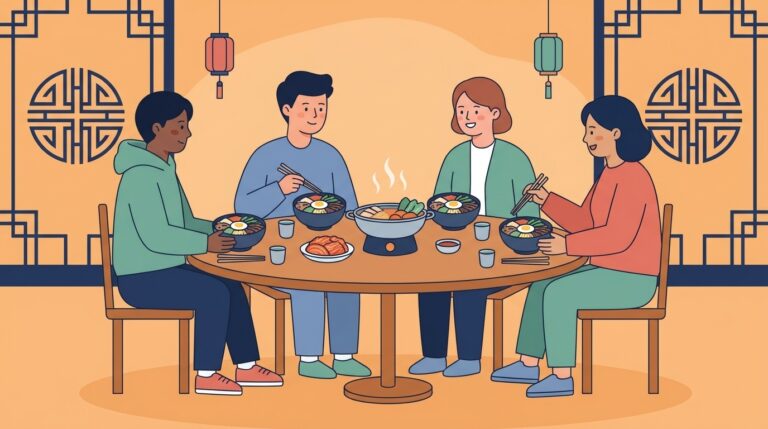
In Korea, food served with drinks is called 안주 (Anju). Korean club members love sharing dishes like pork belly, savory pancakes (전), or stew. Sharing food from a single hot pot creates a sense of 정 (Jeong – deep social affection), dissolving any awkwardness quickly!
Phase 5: Real Roleplay Scenario
Setting: After a Saturday photography club meetup in Seongsu-dong.
NPC Character: Minjun (민준) – Friendly Club Leader.
- Minjun: 오늘 출사 즐거웠죠? 이제 뒷풀이 가실 분? 🎭 (looking around cheerfully)
- You: 저도 같이 가도 돼요? 🎭 (smiling brightly)
- Minjun: 그럼요! 당연하죠! 근처 삼겹살집으로 갈까요? 🎭 (pointing down the street)
- You: 좋아요! 1차는 삼겹살이네요! 🎭 (nodding with enthusiasm)
- (1 hour later at the restaurant)
- Minjun: 자, 다 같이 건배! 2차는 카페 가거나 맥주 마셔요. 🎭 (raising glass)
- You: 건배! 그런데 저 오늘 막차 때문에 2차는 못 가요. 🎭 (apologetic smile)
- Minjun: 아쉽지만 괜찮아요! 다음에 또 봐요!
🔀 Interactive Branching Choice:
When leaving at the end of 1차, what do you say?
* Option A: “오늘 너무 재미있었어요! 저 먼저 들어가 볼게요.” (Best Choice)
* Feedback (Best): Perfect! You complimented the event and used the ideal polite exit phrase.
* Option B: “나 갈게, 안녕!” (Bad Choice)
* Feedback (Bad): Too informal (반말) for a club leader and group setting! Use 존댓말 (polite speech).
* Option C: “저는 집으로 갑니다.” (Risk Choice)
* Feedback (Risk): Correct grammar, but feels cold and detached.
Phase 6: 10-Second Emotion Shadowing Drill
Practice reading these out loud with rhythm and feeling! ( / indicates a natural pause)
[😊 Excitement]저도 / 뒷풀이 / 같이 가도 돼요?[🍻 Cheerful]오늘 / 정말 재미있었어요! / 건배![🥺 Polite Softness]죄송해요, / 저 오늘 / 먼저 들어가 볼게요!
Phase 7: K-Culture Mini Dictionary
- 뒷풀이 (Duit-pu-ri) | After-party | Social gathering after any primary event or club meeting.
- N차 (N-cha) | Round N | Refers to successive venues during a night out (1차, 2차, 3차).
- 건배 (Geon-bae) | Cheers | Traditional toast phrase when raising glasses together.
- 막차 (Mak-cha) | Last Train/Bus | Crucial word when managing late-night transportation in Korea.
Phase 8: Traveler’s Survival Kit
TOP 3 Survival Phrases
- “1차만 가도 돼요?” (Can I only stay for Round 1?)
- “음료수 마셔도 돼요?” (Can I drink soft drinks instead of alcohol?)
- “막차 몇 시예요?” (What time is the last train/bus?)
Editor’s Travel Note
Always check transport schedules in advance! You can check the Naver Map App Download Page or search the Seoul Metro Route Guide to ensure you don’t miss your last train after 2차!
Phase 9: “One Step Deeper” (Thoughtful Mini Essay)
In Korean culture, joining a club is less about individual skill and more about belonging to a community. The after-party (뒷풀이) reflects this communal heart: food is shared from common dishes, conversation flows freely without rigid status barriers, and everyone takes care of one another. Participating in 뒷풀이 shows your willingness to open up and connect on a personal level.
💬 Your Turn: What is the after-party culture like in your home country? Leave a comment below and share your thoughts!
Phase 10: FAQ & Common Mistakes
Q: Is attending 뒷풀이 compulsory for foreign members?
A: Not at all! It is voluntary. However, attending even just 1차 (the first round) for 1 hour is the best way to make close Korean friends.
Q: What if I don’t drink alcohol?
A: No problem! Soda (사이다/콜라) or water is completely accepted. Just say “저는 술 못 마셔요, 음료수로 할게요” (I can’t drink alcohol, I’ll have a soda).
Q: How do people pay for 뒷풀이?
A: Usually one person pays the full bill first, and then calculates N빵 (N-bbang – split equally). They will share bank transfer details in the club chat group.
🚨 Common Mistakes TOP 3
- Leaving without telling the club leader
- Correct Action: Always say goodbye to the leader with “저 먼저 들어가 볼게요!”
- Using informal speech (반말) to older members
- Correct Action: Stick to polite ~요 endings (e.g., “감사해요”, “즐거웠어요”).
- Pouring your own drink when someone offers
- Correct Action: Hold your glass with both hands and let them pour for you first as a courtesy gesture.
Phase 11: Action Mission & Engagement
- 🥉 Bronze Mission: Practice saying “저도 같이 가도 돼요?” in front of a mirror 3 times.
- 🥈 Silver Mission: Post your favorite Korean food to eat at an after-party in the comments below using Korean!
- 🥇 Gold Mission: Next time you attend a club in Korea, stay for 1차 and politely exit using “저 먼저 들어가 볼게요!”
🎮 K-Culture Mission: Watch a club scene in a K-drama (like Itaewon Class or Twenty-Five Twenty-One) and spot how members talk during an after-party!
Phase 12: Interactive Quiz Challenge
Q1. What is the polite way to announce you are heading home early from an after-party?
Show Answer & Explanation
Answer: “저 먼저 들어가 볼게요!”
Explanation: This phrase lets people know you are returning home safely while keeping a soft, respectful tone.
Q2. True or False: You MUST drink alcohol at a Korean club after-party.
Show Answer & Explanation
Answer: False!
Explanation: Drinking soda or fruit juice is totally normal and accepted at Korean social gatherings.







