

Navigating Korean Apartment Culture: How to Handle Balcony Remodeling Like a Local
Phase 1: Empathy & Storytelling
안녕하세요! 매일한글 에디터입니다. (Hello! I’m your lead editor at Daily Hangul.)
Picture this: You’ve settled into a sleek, modern apartment in Seoul. The sun is shining, your iced Americano is brewed, and you’re ready for a relaxed weekend. Suddenly—DRILL! BANG! CRASH! The walls vibrate, and a loud hammer hits the floor above you. You check the elevator notice board, and there it is: a brightly colored paper titled 베란다 확장 공사 안내 (Balcony Extension Construction Notice). In Korea, over 60% of the population lives in apartment complexes, and extending balconies (beranda hwakjang) to create bigger living rooms is an extremely common rite of passage. However, construction noise can quickly turn friendly neighborly relations sour if not handled with proper tact and etiquette.
Navigating apartment renovations requires specific social manners, subtle Korean empathy, and polite speech. When you learn how to communicate respectfully with your neighbors during a renovation, you don’t just avoid complaints—you gain genuine respect and build warm neighborhood bonds. This guide is crafted from real expat experiences and local insights to help you comfortably handle balcony expansion situations like a true insider!
Phase 2: Core Expressions Deep Dive
1. 공사 소음 때문에 죄송합니다
- Pronunciation: [Gong-sa so-eum ttae-mu-ne joe-song-ham-ni-da] (Sounds like: Gong-sah so-oom ttae-moo-neh jo-song-hahm-nee-dah)
- Meaning: Literal: “I am sorry because of construction noise.” / Nuance: “We sincerely apologize for any disturbance our renovation work might cause you.”
- K-Culture Moment: In Kdramas depicting apartment life, newly moved-in characters visit their immediate upstairs, downstairs, and next-door neighbors holding a box of trash bags or rice cakes while repeating this phrase.
- Editor’s Insight: 공사 means construction/work, and 소음 means noise. Adding 때문에 (because of) softens the tone by attributing the discomfort to the unavoidable work process rather than personal hostility.
- Situation Spectrum: Casual 🚫 / Semi-formal ⚠️ / Formal ✅
- Thinking Point: How do people in your home country handle construction noise? Is it customary to apologize in advance, or do residents just endure it?
2. 베란다 확장 공사를 해요
- Pronunciation: [Be-ran-da hwak-jang gong-sa-reul hae-yo]
- Meaning: Literal: “We are doing balcony expansion construction.” / Nuance: “We are remodeling our apartment to extend the balcony area into the living space.”
- K-Culture Moment: You will often hear this exact sentence when contractors or homeowners hand out agreement consent forms (동의서) to neighboring residents.
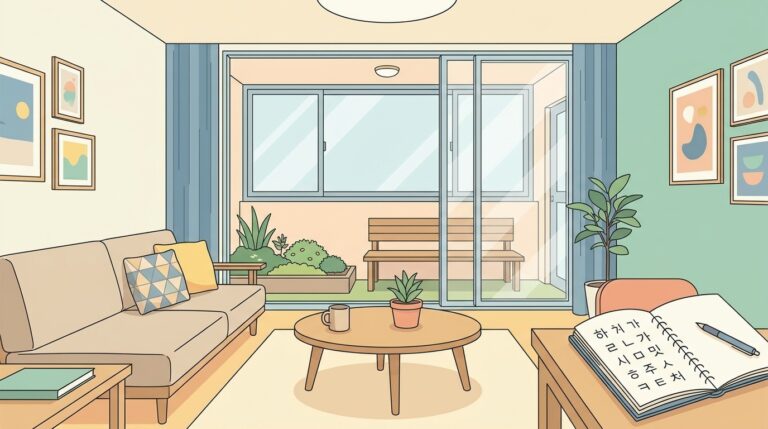
- Editor’s Insight: 확장 means expansion or extension. In Korean apartments, the balcony is often enclosed with sliding glass doors; extending it creates a larger indoor living room footprint.
- Situation Spectrum: Casual ⚠️ / Semi-formal ✅ / Formal ✅
- Thinking Point: Notice how the verb 해요 (do/are doing) makes the sentence approachable and clear without sounding overly legal or rigid.
- Thinking Point: Is structural balcony modification popular in your country, or are external balconies kept as outdoor spaces?
3. 양해 부탁드립니다
- Pronunciation: [Yang-hae bu-tak-deu-rim-ni-da]
- Meaning: Literal: “We request your understanding/forgiveness.” / Nuance: “We kindly ask for your patience and generous understanding regarding this situation.”
- K-Culture Moment: Printed on almost every official noise notice posted in apartment elevators across South Korea.
- Editor’s Insight: 양해 (understanding/consideration) paired with 부탁드립니다 (I humbly request) is the gold standard for polite public notices in Korean culture.
- Situation Spectrum: Casual 🚫 / Semi-formal ⚠️ / Formal ✅
- Thinking Point: Expressing a proactive request for understanding before an inconvenience occurs is a core pillar of Korean community harmony.
Phase 3: Textbook Korean vs Real Korean
Situation 1: Apologizing for noisy work
- 📖 Textbook Korean: 소음을 만들어 죄송합니다. (So-eum-eul man-deul-eo joe-song-ham-ni-da.)
- 🗣️ Real Korean: 공사 때문에 많이 시끄러우시죠? 죄송해요. (Gong-sa ttae-mu-ne man-i si-kkeu-reo-u-si-jo? Joe-song-hae-yo.)
- 💡 Why the difference?: Textbook phrases sound mechanical. Real Koreans acknowledge the other person’s discomfort first by asking “It’s very noisy because of the construction, right?” which shows high empathy (Nunchi).
Situation 2: Asking when the noisy drilling will end
- 📖 Textbook Korean: 공사가 언제 끝납니까? (Gong-sa-ga eon-je kkeut-nam-ni-ka?)
- 🗣️ Real Korean: 혹시 소음 큰 작업은 언제쯤 끝날까요? (Hok-si so-eum keun jak-eob-eun eon-je-jjeum kkeut-nal-kka-yo?)
- 💡 Why the difference?: Asking directly “When does construction end?” can sound demanding or aggressive. Adding 혹시 (by any chance) and specifying 소음 큰 작업 (heavy noise work) softens the question into a polite query.
Phase 4: K-Culture Deep Dive & Non-verbal Etiquette
4-1. Nunchi & Etiquette
When preparing for balcony extension work, custom dictates visiting neighbors living directly above, below, and on the same floor. Handing over a small gift is standard. What kind of gift? Surprisingly, official municipal 종량제 봉투 (standard government garbage bags, usually a bundle of 10 or 20 ten-liter bags) or bakery roll cakes are the most popular choices! Garbage bags are highly practical in Korea because everyone needs them.
* Body Language: Hold gifts with both hands. Offer a slight bow (around 30 degrees) while speaking.
* Eye Contact: Maintain gentle eye contact while making brief pauses to glance down respectfully as you bow.
4-2. Cultural Code Analysis: Balcony Extensions (베란다 확장)
In Korea, apartments are prized for maximum space efficiency. The balcony (베란다) originally served as a thermal buffer zone and drying area. However, modern flooring heating (온돌, Ondol) allows balconies to be integrated into main living rooms seamlessly. Before starting construction, apartment regulations require gathering written consent (동의서) from at least 50% of the building residents. This reinforces the Korean social contract that your living space is deeply interconnected with your neighbors.
Phase 5: Real-life Roleplay Scenario
Setting: You (an expat resident organizing a balcony expansion) visit your downstairs neighbor (NPC: Mrs. Park, a friendly elderly neighbor) to get consent and offer an apology gift.
- You: 안녕하세요, 아랫집에 사는 미노라고 합니다. (An-nyeong-ha-se-yo, a-raet-jib-e sa-neun Mi-no-ra-go ham-ni-da.)
🎭 Action: Bow politely with both hands holding a gift bag.
(Hello, I’m Mino from the floor right above you.) - Mrs. Park: 아, 네! 무슨 일이세요?
(Ah, hello! What brings you here?) - You: 다음 주부터 저희 집 베란다 확장 공사를 하게 되었어요. (Dae-eum ju-bu-teo jeo-hui jip be-ran-da hwak-jang gong-sa-reul ha-ge doe-eoss-eo-yo.)
(We are having balcony extension construction done in our apartment starting next week.) - Mrs. Park: 아~ 베란다 확장요? 공사 기간이 얼마나 걸려요?
(Ah, balcony expansion? How long will the construction take?) - You: 약 2주 정도 걸릴 예정입니다. 소음 때문에 많이 시끄러우실 것 같아 미리 인사드리러 왔어요. (Yak i-ju jeong-do geol-ril ye-jeong-im-ni-da. So-eum ttae-mu-ne man-i si-kkeu-reo-u-sil geot gat-a mi-ri in-sa-deu-ri-reo wass-eo-yo.)
(It is expected to take about 2 weeks. I came to greet you in advance because it might be noisy.) - Mrs. Park: 아이구, 소음이 크겠네요. 그래도 미리 말해주시니 고맙네요.
(Oh dear, it might be loud. But thank you for telling me in advance.) - You: 이건 작은 성의예요. 공사 동의서에 서명 한 번 부탁드려도 될까요? (I-geon jak-eun seong-ui-ye-yo. Gong-sa dong-ui-seo-e seo-myeong han beon bu-tak-deu-ryeo-do doel-kka-yo?)
🎭 Action: Hand over the gift package along with the consent clipboard.
(This is a small gift of appreciation. Could I humbly ask for your signature on the construction consent form?) - Mrs. Park: 그래요, 힘내서 공사 잘 마쳐요!
(Sure thing, hope your renovation goes smoothly!)
🔀 Interactive Branching Moment
If Mrs. Park hesitates because her grandchild sleeps in the afternoon, how do you respond?
* Option A: “낮 2시부터 4시까지는 소음 큰 작업을 피하도록 업체에 전달할게요.” (I’ll inform the contractors to avoid noisy work between 2 PM and 4 PM.)
* Option B: “공사 시간은 제가 마음대로 정할 수 없어요.” (I cannot control the construction schedule.)
* Option C: “그러면 공사를 취소하겠습니다.” (Then I will cancel the construction.)
Feedback:
* Option A (Best): Perfect! Demonstrates proactive flexibility and deep consideration for neighborly well-being.
* Option B (Risk): Too cold and defensive. It creates instant neighbor friction.
* Option C (Bad): Unnecessarily extreme reaction!
Phase 6: 10-Second Emotional Shadowing Drill
Practice these lines aloud to capture natural Korean rhythm and phrasing!
[🥺 Apologetic & Sincere]
공사 소음 때문에 / 정말 죄송합니다.
(Gong-sa so-eum ttae-mu-ne / jeong-mal joe-song-ham-ni-da.)-
[😊 Warm & Polite]
미리 양해해 주셔서 / 진심으로 감사드립니다!
(Mi-ri yang-hae-hae ju-seo-seo / jin-sim-eu-ro gam-sa-deu-rim-ni-da!) -
[🤝 Helpful & Reassuring]
최대한 빠르게 / 깨끗하게 마무리지을게요.
(Choe-dae-han kkkae-kkeut-ha-ge / kkkae-kkeut-ha-ge ma-mu-ri-ji-eul-ge-yo.)
Phase 7: K-Culture Mini Dictionary
- 베란다 확장 (Beranda Hwakjang) | Balcony Extension | Renovation work removing interior sliding doors and extending floor heating into the balcony space.
- 층간소음 (Cheunggan Soeum) | Inter-floor Noise | Noise transmitted between stacked apartment units; a major social topic in contemporary Korea.
- 동의서 (Dong-uiseo) | Consent Form | Official document signed by neighbors agreeing to upcoming apartment interior repairs.
- 입주자 대표회의 (Ipjuja Daepyohoe-ui) | Tenant Representative Council | The resident council governing apartment complex regulations, renovations, and maintenance rules.
Phase 8: Survival Kit for Travelers & Expats
TOP 3 Emergency Expressions
- 몇 시까지 공사하나요? (Myeot si-kkaji gong-sa-ha-na-yo?) – Until what time will construction go on today?
- 엘리베이터 공지 확인해 주세요. (El-li-be-i-teo gong-ji hwak-in-hae ju-se-yo.) – Please check the notice posted in the elevator.
- 주말에는 공사를 하지 않습니다. (Ju-mal-e-neun gong-sa-reul ha-ji an-seum-ni-da.) – Construction is not conducted on weekends.
Editor’s Travel & Living Note
If you hear sudden drilling noise in your apartment, check your building entrance or elevator walls first! Most management offices post digital or printed announcements. Want to find official neighborhood hardware stores or local interior design offices near you? Use the Naver Map App Download to search for 인테리어 (Interior) or 철물점 (Hardware Store).
Phase 9: One Step Deeper
Korean apartment living reflects a fascinating blend of privacy and collective harmony. While modern apartments offer private gated spaces, shared walls mean that one person’s home renovation directly impacts twenty other families. By taking the initiative to hand out trash bags or small cakes while asking for understanding, Koreans preserve Jeong (정) and mutual trust. Respecting shared space isn’t just about avoiding complaints—it’s about nurturing community warmth in concrete towers.
💬 Your Turn: How do neighbors handle noise or house remodeling where you live? Leave a comment below and share your local culture!
Phase 10: FAQ & Common Mistakes
Q: Can construction take place on weekends in Korean apartments?
A: Generally, no! Most apartment management offices in Korea strictly prohibit heavy structural construction or loud drilling on weekends and public holidays to protect residents’ rest.
Q: What is the best time to visit neighbors to ask for agreement signatures?
A: Early evening between 6:30 PM and 8:00 PM is ideal, as most working adults have returned home but are not yet preparing for sleep.
Q: What should I do if a neighbor complains despite having signed the consent form?
A: Acknowledge their frustration calmly using “많이 불편하시죠? 죄송합니다” (It must be very uncomfortable, I’m sorry), and contact your renovation manager to check if sound-dampening mats can be installed during work.
🚨 Common Mistakes Warning Board
- Mistake 1: Leaving noise notices only in English.
Correct Action: Always include clear Korean text or use standard management notices. - Mistake 2: Handing over consent forms without a small gift or sincere greeting.
Correct Action: Pair your request with a simple gesture like garbage bags or light snacks. - Mistake 3: Assuming construction can run late into the evening.
Correct Action: Work must strictly wrap up by 5:00 PM or 6:00 PM on weekdays.
Phase 11: Action Mission
- Bronze Level: Practice pronouncing 공사 소음 때문에 죄송합니다 3 times in front of your mirror.
- Silver Level: Write down a mock balcony noise apology notice in Korean on a sticky note.
- Gold Level: Next time you hear neighbor construction, spot the official 동의서 or notice board in an elevator and read the start/end dates in Korean!
🎮 K-Culture Mission: Watch an episode of a daily Korean drama or modern vlog, and spot scenes where residents hand over roll cakes or gift bags to neighbors!
Phase 12: Interactive Quiz Challenge
Question 1 (Situation Judgment)
You need to visit your downstairs neighbor to apologize for upcoming balcony renovation noise. What is the most culturally appropriate gift?
– A) An expensive bottle of imported wine
– B) A practical bundle of standard government garbage bags (종량제 봉투) or roll cake
– C) Cash in an unsealed envelope
Click to reveal answer
Correct Answer: B
Explanation: In Korean apartment culture, useful everyday items like standard garbage bags or bakery goods show practical consideration without burdening the receiver.
Question 2 (Fill in the Blank)
Fill in the blank: “공사 소음 때문에 미리 ______ 부탁드립니다.” (We ask for your understanding in advance regarding construction noise.)
– A) 양해 (Yanghae)
– B) 축하 (Chukha)
– C) 배달 (Baedal)
Click to reveal answer
Correct Answer: A
Explanation: 양해 means understanding/patience in social situations.
Question 3 (True or False)
True or False: In Korea, you can freely perform noisy balcony demolition work on Sunday mornings as long as it’s inside your own flat.
Click to reveal answer
Correct Answer: False
Explanation: Weekend construction noise is prohibited in almost all Korean apartment complexes to respect neighbors’ rest.







