

안녕하세요! I’m your lead editor at Daily Hangul, your 10-year resident cultural navigator in Korea!
Picture this: You’ve just moved into a cozy officetel or shared apartment in Seoul with a friendly Korean roommate. Everything is dreamy—late-night chimaek (chicken and beer), watching K-dramas together, and exploring Hongdae on weekends. But then Sunday morning hits. You look at the bathroom sink, then at your roommate, and an awkward silence settles in. Who is going to scrub the tiles today?
If you’ve ever felt tongue-tied trying to negotiate household chores in Korean without sounding too strict or overly formal, you are definitely not alone! This is one of the most frequent pain points reported by our B1 learners living or studying in Korea. Navigating roommate dynamics requires a delicate blend of clarity, politeness, and playful banter.
In this guide, based on real feedback from hundreds of international students and expats, you’ll master natural, authentic Korean phrases to settle chore duty smoothly—without harming your friendships!
Phase 2: Core Expressions Deep Dive
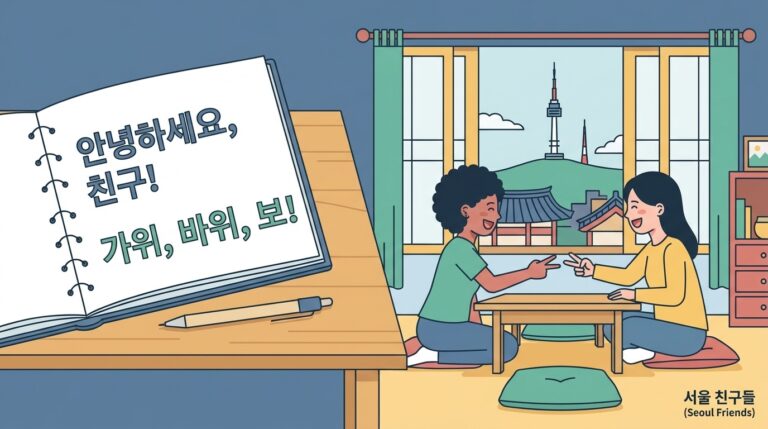
1. 가위바위보로 정하자! (Gawibawibo-ro jeonghaja!)
- Pronunciation: [Ga-wi-ba-wi-bo-ro jeong-ha-ja] (Sounds like “gah-wee-bah-wee-boh-roh jeong-hah-jah”)
- Meaning: Literal: “Let’s decide by scissors-rock-paper!” / Nuance: “Let’s play Rock-Paper-Scissors to settle this!”
- K-Culture Moment: From variety shows like Running Man to roommate reality shows, Koreans resolve almost every minor dilemma—from buying snacks to taking out the trash—with a quick round of Gawibawibo.
- Editor’s Insight: Using
~로 정하자(let’s decide by…) keeps things lighthearted and completely fair. It removes personal bias so no one feels singled out. - Situation Spectrum: Casual (✅) / Semi-formal (⚠️ – use 가위바위보로 정해요) / Formal (🚫)
- 🤔 Think About It: In your home country, how do you spontaneously resolve ties or chores with friends? Is there a game as universally accepted as Rock-Paper-Scissors?
2. 이번 주 화장실 청소는 네 차례야. (Ibeon ju hwajangsil cheongso-neun ne charye-ya.)
- Pronunciation: [I-beon ju hwa-jang-sil cheong-so-neun ne cha-rye-ya]
- Meaning: Literal: “This week’s bathroom cleaning is your turn.” / Nuance: “It’s your turn to clean the bathroom this week.”
- K-Culture Moment: You’ll hear this in slice-of-life K-dramas when housemates review their weekly chore chart hanging on the fridge.
- Editor’s Insight: Note that
네(your) is pronounced as [ne] or casually [ni] in spoken Korean to distinguish it from내(my – [nae]). - Situation Spectrum: Casual (✅) / Semi-formal (⚠️ – use 네 차례예요) / Formal (🚫)
- 🤔 Think About It: Does stating responsibilities directly sound too blunt in your culture, or do you prefer clear schedules?
3. 내가 양보할 테니까 다음엔 네가 해. (Naega yangbohal tenikka daeumen nega hae.)
- Pronunciation: [Nae-ga yang-bo-hal te-ni-kka da-eum-en ne-ga hae]
- Meaning: Literal: “Since I will yield, you do it next time.” / Nuance: “I’ll cover it this time, but you take the next turn!”
- K-Culture Moment: Common in roommate discussions where one person is busy preparing for exams or working overtime.
- Editor’s Insight:
양보하다means to yield or compromise. Pairing~할 테니까(since I’ll do X) creates a smooth bargain that builds mutual trust (Jeong). - Situation Spectrum: Casual (✅) / Semi-formal (⚠️) / Formal (🚫)
- 🤔 Think About It: How does trading favors reflect the Korean social value of give-and-take (Gibeu-aen-teikeu)?
Phase 3: Textbook Korean vs. Real Native Korean
Scenario 1: Agreeing to handle cleaning today
- 📖 Textbook Korean: 제가 오늘 화장실을 청소하겠습니다. (Je-ga o-neul hwa-jang-sil-eul cheong-so-ha-ges-seum-ni-da.)
- 🗣️ Real Native Korean: 오늘 화장실 청소는 내가 맡을게! (O-neul hwa-jang-sil cheong-so-neun nae-ga ma-teul-ge!)
- 💡 Why the difference? The textbook expression sounds like an official military announcement. Native speakers use
맡다(to take charge of) with~을게(promising future intention) to sound proactive and warm among friends.
Scenario 2: Suggesting taking weekly turns
- 📖 Textbook Korean: 규칙적으로 순서를 정합시다. (Gyu-chik-jeok-eu-ro sun-seo-reul jeong-hap-si-da.)
- 🗣️ Real Native Korean: 우리 매주 돌아가면서 하자. (U-ri mae-ju do-ra-ga-myeon-seo ha-ja.)
- 💡 Why the difference?
돌아가면서 하다(to do while rotating) is the natural, everyday phrase for taking turns. The textbook phrase sounds like a corporate compliance manual!
Phase 4: K-Culture Deep Dive & Non-Verbal Manners
4-1. Nunchi & Gestures
When negotiating chores in Korea, Nunchi (눈치 – tactile social perception) is key.
* The Gawibawibo Stance: When initiating Gawibawibo, raise your right fist at chest height, bouncing it rhythmically while chanting “가위… 바위… 보!”. Ending with a cheerful laugh prevents any tension.
* Softening Demands: Instead of pointing fingers, gesture toward the chore chart with an open palm. Add a cute whine (aegyo) like “오늘 진짜 바쁜데~” (I’m really busy today~) to soften requests.
4-2. Cultural Code: The Housemate Accord
In modern Korea, living with housemates (룸메) relies heavily on communal harmony. Rather than passive-aggressive sticky notes, Koreans prefer light banter followed by quick group action. Cleanliness in shared spaces (especially wet-room style Korean bathrooms) is viewed as respect for the shared Gongdongche (community).
Phase 5: Practical Roleplay Scenario
Setting: Sunday afternoon in a shared apartment living room. Minjun is lying on the couch scrolling through YouTube; you are looking at the dusty bathroom.
- Turn 1 (You): 민준아, 오늘 화장실 청소 누구 담당이지? (Minjun-a, o-neul hwa-jang-sil cheong-so nu-gu dam-dang-i-ji?)
- 🎭 Action: Pointing gently toward the bathroom door with a friendly smile.
- Translation: Minjun, whose turn is it to clean the bathroom today?
- Turn 2 (Minjun): 글쎄, 지난주에 내가 하지 않았나? (Glse, ji-nan-ju-e nae-ga ha-ji a-nat-na?)
- 🎭 Action: Scratching his head awkwardly and sitting up.
- Translation: Hmm, didn’t I do it last week?
- Turn 3 (You): 아니지, 지난주엔 내가 했어! 앱표 확인해봐. (A-ni-ji, ji-nan-ju-en nae-ga haes-seo! Aep-pyo hwa-gin-hae-bwa.)
- 🎭 Action: Showing your phone screen with the chore app open.
- Translation: No way, I did it last week! Check the schedule on the app.
- Turn 4 (Minjun): 아, 진짜? 내가 착각했네. 미안! (A, jin-jja? Nae-ga chak-gak-haen-ne. Mi-an!)
- 🎭 Action: Laughing embarrassed and clapping his hands together once.
- Translation: Oh, really? I mixed it up. Sorry!
- Turn 5 (You): 괜찮아. 깔끔하게 가위바위보로 결정할까? (Gwaen-chan-a. Kkal-kkeum-ha-ge ga-wi-ba-wi-bo-ro gyeol-jeong-hal-kka?)
- 🎭 Action: Raising your fist playfully in the air.
- Translation: It’s okay. Shall we cleanly settle it with Rock-Paper-Scissors?
- Turn 6 (Minjun): 좋았어! 지는 사람이 화장실 청소하기다! (Jo-as-seo! Ji-neun sa-ram-i hwa-jang-sil cheong-so-ha-gi-da!)
- 🎭 Action: Getting competitive and shaking his fist.
- Translation: Deal! Loser cleans the bathroom!
- Turn 7 (You & Minjun together): 가위… 바위… 보! (Ga-wi… ba-wi… bo!)
- 🎭 Action: Showing hands simultaneously. (You threw Scissors, Minjun threw Paper!)
- Translation: Rock… paper… scissors!
- Turn 8 (Minjun): 아까워라! 내가 졌네. 오늘 깔끔하게 청소해둘게! (A-kka-wo-ra! Nae-ga jyeot-ne. O-neul kkal-kkeum-ha-ge cheong-so-hae-dul-ge!)
- 🎭 Action: Groaning dramatically, then standing up with a bucket.
- Translation: So close! I lost. I’ll clean it up spotless today!
🔀 Interactive Branching Point
What would you say if your roommate says they are too tired to clean today?
- Choice A: “약속은 약속이니까 지금 바로 해.” (A promise is a promise, do it right now.)
- Choice B: “그러면 오늘은 쉬고, 내일 가위바위보 다시 하자!” (Then rest today, and let me swap turns with you if you take garbage duty!)
- Choice C: “알겠어. 내가 오늘 할 테니까 다음 주에 네가 두 번 해!” (Got it. I’ll do it today, so you do it twice next week!)
Feedback:
- Choice A (Risk 🚨): Too rigid! It creates friction and sounds cold among roommates.
- Choice B (Best 👍): Flexible and friendly! Shows understanding while keeping chores fair through practical trade-offs.
- Choice C (Bad ⚠️): Demanding two turns later can sound harsh and transactional.
Phase 6: 10-Second Emotional Shadowing Drill
Repeat after me! Pay close attention to pauses (/) and dynamic emotional delivery:
[😊 Cheerful & Energetic]오늘 화장실 청소는 / 가위바위보로 정하자! (O-neul hwa-jang-sil cheong-so-neun / ga-wi-ba-wi-bo-ro jeong-ha-ja!)[🥺 Playful Compromise]내가 오늘 대신할 테니까 / 다음엔 네가 해줘~ (Nae-ga o-neul dae-sin-hal te-ni-kka / da-eum-en ne-ga hae-jwo~)[🎉 Triumphant]나 가위바위보 이겼다! / 이번 주는 네 차례야! (Na ga-wi-ba-wi-bo i-gyeot-da! / I-beon ju-neun ne cha-rye-ya!)
Phase 7: K-Culture Mini Dictionary
- 당번 (Dangbeon) | Noun | Duty person / Person on shift. (e.g., “오늘 청소 당번 누구야?” = Who’s on cleaning duty today?)
- 가위바위보 (Gawibawibo) | Noun | Rock-Paper-Scissors. The ultimate Korean decision-maker.
- 룸메 (Rumme) | Noun (Slang) | Short for ‘Roommate’. Used affectionately in everyday conversation.
- 몰아주기 (Mol-ajugi) | Noun | “Winner takes all” or
Frequently Asked Questions (FAQ)
Q: What does "가위바위보로 정하자! (Gawibawibo-ro jeonghaja!)" mean in Korean and how do you pronounce it?
A: In Korean, "가위바위보로 정하자! (Gawibawibo-ro jeonghaja!)" is pronounced [Ga-wi-ba-wi-bo-ro jeong-ha-ja] and means: Literal: "Let's decide by scissors-rock-paper!" / Nuance: "Let's play Rock-Paper-Scissors to settle this!"
Q: What does "이번 주 화장실 청소는 네 차례야. (Ibeon ju hwajangsil cheongso-neun ne charye-ya.)" mean in Korean and how do you pronounce it?
A: In Korean, "이번 주 화장실 청소는 네 차례야. (Ibeon ju hwajangsil cheongso-neun ne charye-ya.)" is pronounced [I-beon ju hwa-jang-sil cheong-so-neun ne cha-rye-ya] and means: Literal: "This week's bathroom cleaning is your turn." / Nuance: "It's your turn to clean the bathroom this week."
Q: What does "내가 양보할 테니까 다음엔 네가 해. (Naega yangbohal tenikka daeumen nega hae.)" mean in Korean and how do you pronounce it?
A: In Korean, "내가 양보할 테니까 다음엔 네가 해. (Naega yangbohal tenikka daeumen nega hae.)" is pronounced [Nae-ga yang-bo-hal te-ni-kka da-eum-en ne-ga hae] and means: Literal: "Since I will yield, you do it next time." / Nuance: "I'll cover it this time, but you take the next turn!"







