

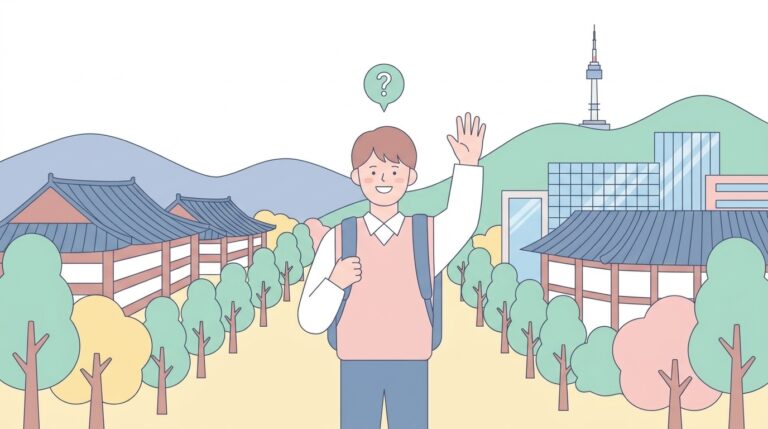
How to Ask Questions on a Korean Campus Like a Native Friend
Phase 1: Empathy & Storytelling Opening
안녕하세요! I’m your head editor from Daily Hangul, your 10-year local culture navigator in Seoul! Imagine this: You are sitting in a bustling lecture hall at a university in Sinchon. The professor just assigned a group project, and your classmates are quickly talking among themselves. You need to ask a simple question like “Excuse me, where is the student hall?” or “Is this seat taken?”, but your mind goes completely blank. You freeze because you don’t want to sound rude or too formal, like a walking textbook!
Don’t worry at all—every single international student goes through this exact moment. Asking questions on a Korean campus isn’t just about grammar; it’s about warmth, timing, and showing respect without feeling rigid. Based on feedback from hundreds of students at Daily Hangul, mastering just three flexible question patterns will instantly boost your confidence from feeling lost to feeling like a campus insider. Let’s make sure you never hesitate to speak up again!
Phase 2: Deep Dive into 3 Core Expressions
1. 저기요, 질문 하나만 해도 될까요? (Jeogi-yo, jilmun hanaman haedo doel-kkayo?)
- Pronunciation: juh-gee-yo, jeel-moon ha-na-man hae-doh doel-kka-yo? (Sounds like “yoh” gently resting at the end of a breath).
- Meaning: Literal: “Over there, can I make just one question?” / Real Nuanace: “Excuse me, may I ask a quick question?”
- K-Culture Moment: You will see this constantly in campus K-Dramas whenever a freshman approaches a senior student (선배) near the campus library or cafeteria.
- Editor’s Insight: Adding “하나만” (just one) lowers the burden on the listener, making Koreans much more open and helpful!
- Situation Spectrum: Casual 🚫 | Semi-formal ✅ | Formal ✅
- 🤔 Think About It: Why do Koreans start questions with “저기요” (Over there) instead of directly saying “Hey you”? It creates a polite buffer space between speaker and listener.
2. 혹시 이거 어떻게 해요? (Hoksi igeo eotteohke haeyo?)
- Pronunciation: hok-shee ee-geoh uh-ttuh-ke hae-yoh? (Softer “hok-shee” like a gentle whisper).
- Meaning: Literal: “By any chance, how do I do this?” / Real Nuance: “Could you show me how to do this?”
- K-Culture Moment: Used endlessly during university orientation when trying to register for courses or use the campus printing station.
- Editor’s Insight: “혹시” (by any chance) is the magic Korean word for politeness. It acts like a soft cushion before asking for help.
- Situation Spectrum: Casual ✅ | Semi-formal ✅ | Formal ⚠️
- 🤔 Think About It: Does your native language have a single magic word like “혹시” that instantly softens any request?
3. 이것 좀 가르쳐 주실 수 있나요? (Igeot jom gareuchyeo jusil su innayo?)
- Pronunciation: ee-geot jom ga-reu-chyeo joo-sheel soo een-na-yoh?
- Meaning: Literal: “Can you teach me this a little?” / Real Nuance: “Would you mind explaining this to me?”
- K-Culture Moment: Perfect when studying at the campus library with a study buddy or asking a teaching assistant after class.
- Editor’s Insight: Notice the small word “좀” (a little). Even if you need full assistance, saying “a little” shows humility.
- Situation Spectrum: Casual 🚫 | Semi-formal ✅ | Formal ✅
- 🤔 Think About It: In Korea, asking someone to teach you (가르치다) is seen as a compliment to their knowledge!
Phase 3: Textbook Korean vs. Real Native Korean
Situation 1: Asking where a classroom is
- 📖 Textbook: 강의실이 어디에 있습니까? (Gang-ui-siri eodie isseumnida-kka?)
- 🗣️ Real Native: 혹시 301호 강의실 어디인지 아세요? (Hoksi sam-baek-il-ho gang-ui-sil eodi-injei a-seo-yo?)
- 💡 Why the difference? The textbook phrase sounds like an exam audio recording. Using “혹시 ~ 아세요?” (Do you happen to know…?) is how actual college students talk warmly.
Situation 2: Asking a classmate if a seat is free
- 📖 Textbook: 이 자리가 비어 있습니까? (I jari-ga bieo isseumnida-kka?)
- 🗣️ Real Native: 여기 자리있어요? (Yeogi jari isseo-yo?)
- 💡 Why the difference? In daily campus life, asking “Is there a seat here?” with a soft rising intonation is much more natural and concise.
Phase 4: K-Culture Deep Dive & Non-Verbal Manners
4-1. Nunchi (눈치) & Gestures
When asking a question on a Korean campus, eye contact and micro-gestures matter! Do not wave your hand aggressively from far away. Instead, lightly tilt your head (about 15 degrees) and make eye contact, placing one hand softly near your chest or holding your elbow with your other arm when asking a senior or professor.
4-2. Culture Code: Campus Sunbae-Hoebae Dynamics
In Korean universities, the connection between upperclassmen (선배, Sunbae) and underclassmen (후배, Hoebae) is key. When asking questions to a Sunbae, starting with “선배님, 혹시…” (Sunbae-nim, by any chance…) will open doors instantly—they might even end up buying you lunch or coffee!
Phase 5: Real-Life Roleplay Scenario
Setting: Student Center Lounge at Yonsei University. You are trying to find the International Student Office.
NPC: Minjun (a friendly 3rd-year Korean university student holding a laptop).
- Turn 1 (You): 저기요, 혹시 실례지만 하나만 물어봐도 될까요? (Jeogi-yo, hoksi sillyejiman hanaman mureobwado doel-kkayo?)
- 🎭 Action: Gently bowing head with a soft smile
- Turn 2 (Minjun): 네! 그럼요. 어떤 거요? (Ne! Geureom-yo. Eotteon geoyo?)
- Turn 3 (You): 외국인 지원 센터가 어디에 있는지 아세요? (Oegugin jiwon senteo-ga eodie inneun-ji a-seo-yo?)
- Turn 4 (Minjun): 아, 거기 학생회관 2층에 있어요! 여기서 나가서 우회전하시면 돼요. (A, geogi haksaenghwe-gwan ichung-e isseo-yo! Yeogiseo nagaseo u-hwe-jeon-hasimyeon dwae-yo.)
- Turn 5 (You): 아, 2층이요? 혹시 걸어서 얼마나 걸려요? (A, i-chung-i-yo? Hoksi georeoseo eolmana geollyeoyo?)
- Turn 6 (Minjun): 걸어서 3분도 안 걸려요. 금방 가요! (Georeoseo sam-bun-do an geollyeoyo. Geumbang gayo!)
- Turn 7 (You): 아 정말요? 감사합니다! 도움이 많이 됐어요. (A jeongmal-yo? Gamsahamnida! Do-um-i mani dwaesseoyo.)
- Turn 8 (Minjun): 별말씀을요! 좋은 하루 보내세요~ (Byeol-mal-sseum-eul-yo! Joeun haru bonaeseo-yo~)
🔀 Interactive Choice Point
What will you say if Minjun explains the directions too fast and you didn’t catch it?
- Option A: 죄송하지만 조금만 천천히 말씀해 주실 수 있나요? (Best Choice! Polite, clear, and natural).
- Option B: 뭐라고요? 다시 말해요. (Risk! Sounds demanding and lacking politeness).
- Option C: (Just nod awkwardly and walk away lost) (Bad Choice! Don’t be afraid to ask again!).
Phase 6: 10-Second Emotion Shadowing Drill
Practice these lines with the indicated emotional markers and rhythm pauses (/)!
[😊 Friendly & Polite]저기요 / 혹시 질문 하나만 해도 될까요? (Jeogi-yo / hoksi jilmun hanaman haedo doel-kkayo?)[🥺 Shy but Curious]죄송한데 / 이것 좀 / 다시 설명해 주실 수 있어요? (Joesong-hande / igeot jom / dasi seol-myeong-hae jusil su isseo-yo?)[🎉 Relieved & Grateful]아, 그렇군요! / 정말 감사합니다! (A, geureok-gun-yo! / Jeongmal gamsahamnida!)
Phase 7: K-Culture Mini Dictionary
- 선배 (Sunbae) | Upperclassman / Senior | Used to address students in higher school years with respect.
- 강의계획서 (Gang-ui-gye-hoek-seo) | Syllabus | The essential document you ask questions about in the first week of class.
- 학식 (Haksik) | Campus Cafeteria Food | Short for 학생 식당; asking “오늘 학식 맛있어요?” is a great icebreaker.
- 동아리 (Dong-a-ri) | Student Club | Campus clubs where asking questions helps you make lifelong Korean friends.
Phase 8: Student & Traveler Survival Kit
Survival Top 3 Phrases
- 이거 맞아요? (Igeo maj-ayo?) – Is this correct?
- 어디로 가야 해요? (Eodi-ro gaya haeyo?) – Where should I go?
- 다시 한번 말해 주세요. (Dasi hanbeon malhae juseyo.) – Please say it once more.
Editor’s Campus Travel Note
When navigating university campuses in Seoul (like SNU or Yonsei), generic global map apps often lack detailed building numbers. We highly recommend downloading the Naver Map App Download Page before your term starts to find specific lecture halls easily!
Phase 9: One Step Deeper (Campus Culture Essay)
In Korean culture, asking a question is not seen as an interruption, but as an expression of engagement and humbleness. Koreans use softening words like “혹시” (by any chance) or “실례지만” (excuse me but) to show consideration for the other person’s time. By incorporating these small linguistic cushions, you show that you understand Jeong (정) and mutual respect.
💬 Your Turn: What is the polite way to ask for help in your home culture? Leave a comment below and share your thoughts!
Phase 10: FAQ & Common Mistakes
Q: Can I use “저기요” (Jeogiyo) when asking a professor a question?
A: No! “저기요” is great for fellow students or staff in informal settings. For professors, use “교수님” (Gyosunim) followed by your question!
Q: What if I forget the exact Korean word during a question?
A: Use hands and say “이거…” (Igeo…) while showing your phone or document. Koreans are very patient and helpful when you try!
Q: Is it okay to use English on campus?
A: Many Korean college students speak English, but starting your question in Korean first shows great respect and opens hearts fast!
🚨 Common Mistakes Alert!
- Mistake 1: Calling a upperclassman “당신” (Dangsin).
- Correct Action: Call them “선배님” (Sunbaenim) or use their name + 씨.
- Mistake 2: Ending questions without “~요” or “~습니까” to people you don’t know well.
- Correct Action: Always keep the ~요 ending at the A2 level!
- Mistake 3: Saying “너 이름이 뭐야?” to a newly met classmate.
- Correct Action: Say “이름이 어떻게 되세요?” (Ireum-i eotteohke doese-yo?).
Phase 11: Action Mission & Engagement
- 🥉 Bronze Mission: Say “혹시 질문 하나만 해도 될까요?” aloud 5 times in front of a mirror.
- 🥈 Silver Mission: Leave a comment below asking us a question using “혹시 ~ 있나요?”.
- 🥇 Gold Mission: Watch a campus-themed K-drama (like Cheese in the Trap or Twenty-Five Twenty-One) and spot 2 question phrases!
🎮 K-Culture Mission: Next time you hear a K-Pop idol speak in a livestream, listen for how often they say the word “혹시”!
Phase 12: Interactive Quiz Challenge
Q1. Situation Quiz
You want to politely ask a student sitting next to you if you can borrow a pen. Which phrase is best?
* A) 연필 줘. (Yeonpil jwo.)
* B) 혹시 펜 하나만 빌릴 수 있을까요? (Hoksi pen hanaman billil su isseul-kkayo?)
* C) 펜 어디 있어? (Pen eodi isseo?)
🔍 Click to check answer & explanation
Answer: B
Explanation: Option B uses both softening words “혹시” and polite asking form “~수 있을까요?”, making it the perfect polite request!
Q2. True or False
Calling your university professor “저기요” is the standard polite greeting.
* [ ] True
* [ ] False
🔍 Click to check answer & explanation
Answer: False
Explanation: Always address your university professors as “교수님” (Gyosunim), never “저기요”.







