

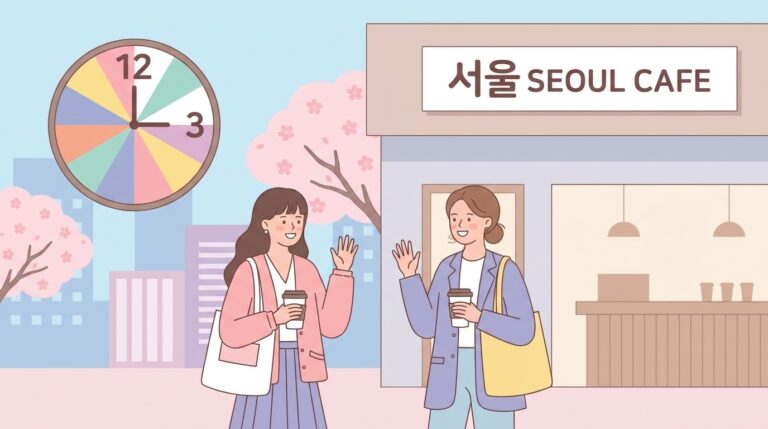
Never Be Late for K-Drama Hangouts: How to Set a Time in Korean
Phase 1: Empathy & K-Culture Storytelling
안녕하세요! 매일한글 에디터입니다. (Hello! I’m your lead editor at Daily Hangul!)
Picture this: You are in Hongdae, Seoul. You finally met up with your Korean buddy after texting for days. You want to ask, “What time should we meet tomorrow for hot pot?” You open your translator, type it out, and say something awkward like “당신은 몇 시를 좋아합니까?” (Which time do you like, sir?). Your friend blinks in confusion, and suddenly you feel that sudden panic of lost-in-translation awkwardness!
Setting a time with friends seems super simple in English, but in Korea, picking a meeting time involves native time counting systems and specific social cues. Don’t worry! Based on real feedback from over 1,000 A1 beginner learners, I’ve put together this ultimate, stress-free guide. Master these 3 friendly expressions today, and you’ll arrange hangouts like a true Seoul insider!
Phase 2: Core Expressions Deep Dive
1. 몇 시에 만날까요? (Myeot si-e man-nal-kka-yo?)
- Pronunciation: [Myeot-shee-eh mahn-nahl-kkah-yo?] (Sounds like: “Mute she eh spun-ky cow?” without the ‘spun-ky’)
- Meaning: Literal: “At what hour shall we meet?” | Nuance: “What time works best for you to meet up?”
- K-Culture Moment: In K-Dramas like Business Proposal, you often hear the leads politely suggesting a meetup time over a late-night coffee call using this exact line.
- Editor’s Insight: The -ㄹ까요? (-lkka-yo?) ending adds a soft, thoughtful suggestion, showing respect for the other person’s schedule.
- Situation Spectrum:
- Casual: 몇 시에 만나? (🚫 with older/new people, ✅ close friends)
- Semi-formal: 몇 시에 만날까요? (✅ Great for acquaintances, co-workers, and new friends!)
- Formal: 몇 시에 만나시겠습니까? (⚠️ Overly formal for casual dates)
- 🤔 Think About It: In your culture, do you directly tell people when to meet, or do you frame it as a question to show politeness?
2. [Time]에 봐요! ([Time]-e bwa-yo!)
- Pronunciation: [Time + eh bwah-yo!]
- Meaning: Literal: “See you at [Time]!” | Nuance: “Let’s catch up at [Time]!”
- K-Culture Moment: When K-Pop idols finish a live stream and tell fans when they will go live next week!
- Editor’s Insight: 보다 (boda) literally means ‘to see’, but Koreans use it naturally for ‘meeting up’. ~에 (e) acts as the time marker ‘at’.
- Situation Spectrum:
- Casual: [Time]에 봐! (✅ Close friends)
- Semi-formal: [Time]에 봐요! (✅ Safe and sweet for almost everyone)
- Formal: [Time]에 뵙겠습니다. (✅ Formal business context)
- 🤔 Think About It: Why do many languages use verbs of sight (see/look) to express meeting someone in person?
3. 괜찮아요? (Gwaen-chan-a-yo?)
- Pronunciation: [Gwaen-chahn-ah-yo?]
- Meaning: Literal: “Is it okay?” | Nuance: “Does this time work for you?”
- K-Culture Moment: Used constantly in daily Korean life—from confirming a lunch date to checking if your friend wants an extra shot of espresso.
- Editor’s Insight: This simple word is your ultimate safety net! Pair it with any time (e.g., “2시 괜찮아요?”) to instantly sound natural.
- Situation Spectrum:
- Casual: 괜찮아? (✅ Friends)
- Semi-formal: 괜찮아요? (✅ Perfect standard)
- Formal: 괜찮으시겠습니까? (✅ Formal/Business)
- 🤔 Think About It: How many different ways can you say “Is that okay?” in your native language?
Phase 3: Textbook Korean vs. Real Spoken Korean
Situation 1: Asking what time to meet
- 📖 Textbook Korean: 당신은 몇 시에 시간을 낼 수 있습니까? (Tang-sin-eun myeot si-e si-gan-eul nael su it-seum-ni-kka?)
- 🗣️ Real Spoken Korean: 우리 몇 시에 볼까요? (U-ri myeot si-e bol-kka-yo?)
- 💡 Why the difference? Textbook phrases sound like an official interview! Real native Koreans use 우리 (u-ri – we) and the gentle suggestion ending 볼까요? to sound friendly.
Situation 2: Confirming a specific time (e.g., 3 o’clock)
- 📖 Textbook Korean: 3시에 만나기로 결정합시다. (Sam-si-e man-na-gi-ro gyeol-jeong-hap-si-da.)
- 🗣️ Real Spoken Korean: 3시 괜찮아요? (Se-si gwaen-chan-a-yo?)
- 💡 Why the difference? Directly ordering a decision feels robotic. Asking if a specific hour is “okay” shows considerate etiquette.
Phase 4: K-Culture Deep Dive & Non-Verbal Manners
4-1. Nunchi (눈치) & Body Gestures
When setting a time in Korea, non-verbal tone matters!
* The Soft Head Tilt: When asking “3시 괜찮아요?”, tilt your head slightly with a gentle smile. This signals flexibility.
* Wrist Tap Gesture: Lightly tapping your left wrist (where a watch would be) while making eye contact is the universal Korean gesture for asking, “What time are we meeting?”
4-2. Culture Code: The 10-Minute “Korean Time” Myth
In modern urban Korea—especially among Gen Z and millennials—punctuality is king. Arriving 5-10 minutes early at a café is considered good manners. If you are going to be late, sending a quick message like “5분 정도 늦어요!” (I’ll be about 5 minutes late!) saves social harmony (눈치).
Phase 5: Real-Life Roleplay Scenario
Setting: Outside Gangnam Station Exit 10. You and your new Korean classmate, Min-ji (민지), are planning to grab boba tea.
- Turn 1 (Min-ji): 오늘 같이 카페 갈래요? (O-neul gat-i ka-pe gal-lae-yo?) 🎭 (Smiling eagerly) / Shall we go to a cafe together today?
- Turn 2 (You): 좋아요! 몇 시에 만날까요? (Jo-ha-yo! Myeot si-e man-nal-kka-yo?) 🎭 (Nodding happily) / Sounds good! What time shall we meet?
- Turn 3 (Min-ji): 음… 3시 어때요? (Eum… Se-si eo-ttae-yo?) 🎭 (Checking her phone clock) / Hmm… How about 3 o’clock?
- Turn 4 (You): 3시 괜찮아요! 어디서 봐요? (Se-si gwaen-chan-a-yo! Eeo-di-seo bwa-yo?) 🎭 (Giving a thumbs up) / 3 o’clock works! Where shall we meet?
- Turn 5 (Min-ji): 강남역 10번 출구에서 봐요. (Gang-nam-yeok sip-beon chul-gu-e-seo bwa-yo.) 🎭 (Pointing toward the exit) / Let’s meet at Gangnam Station Exit 10.
- Turn 6 (You): 네, 3시에 봐요! (Ne, se-si-e bwa-yo!) 🎭 (Waving cheerfully) / Yes, see you at 3!
- Turn 7 (Min-ji): 그래요! 있다 봐요! (Geu-rae-yo! It-da bwa-yo!) 🎭 (Bright grin) / Alright! See you in a bit!
- Turn 8 (You): 네, 있다 봐요! (Ne, it-da bwa-yo!) 🎭 (Smiling warmly) / Yes, see you soon!
🔀 Interactive Choice Point
Min-ji asks: “오늘 3시 괜찮아요?” (Is 3 o’clock okay today?)
How do you respond if you want to agree warmly?
- Choice A: 네, 3시 괜찮아요! (Ne, se-si gwaen-chan-a-yo!)
- Choice B: 아니요, 안 됩니다. (A-ni-yo, an doem-ni-da.)
- Choice C: 몇 시입니까? (Myeot si-im-ni-ka?)
Feedback:
* Choice A (BEST): Perfect! Friendly, accurate, and natural for A1 speakers.
* Choice B (BAD): Too harsh and blunt. Sounds like a total refusal without offering an alternative.
* Choice C (RISK): You ignored her question about 3 o’clock! She will think you didn’t hear her.
Phase 6: 10-Second Emotion Shadowing Drill
Practice repeating these lines aloud with native emotion! Focus on pauses marked by /.
- [😊 Excited & Friendly]
우리 / 몇 시에 / 만날까요?
(U-ri / myeot si-e / man-nal-kka-yo?) -
[🥺 Polite & Reassuring]
3시 / 괜찮아요! / 그 때 봐요!
(Se-si / gwaen-chan-a-yo! / geu ttae bwa-yo!) -
[💖 Warm Sign-off]
네! / 있다가 / 봐요!
(Ne! / it-da-ga / bwa-yo!)
Phase 7: K-Culture Mini Dictionary
- 시 (Si) | Hour / O’clock | Native Korean numbers attach to this (e.g., 한 시 = 1 o’clock, 두 시 = 2 o’clock, 세 시 = 3 o’clock).
- 분 (Bun) | Minute | Sino-Korean numbers attach to this (e.g., 10분 = 10 mins, 30분 = 30 mins).
- 약속 (Yaksok) | Appointment / Plan | Used for any social plan with friends or family.
- 있다 봐요 (It-da bwa-yo) | See you later (today) | A super handy phrase to say goodbye when meeting later the same day.
Phase 8: Traveler’s Survival Kit
Top 3 Emergency Time Expressions
- 지금 몇 시예요? (Ji-geum myeot si-ye-yo?) – What time is it now?
- 몇 시에 문 열어요? (Myeot si-e mun yeor-eo-yo?) – What time do you open?
- 몇 시에 끝나요? (Myeot si-e kkeut-na-yo?) – What time do you finish/close?
Editor’s Travel Note
When navigating Korea to make your meeting on time, download Naver Map app rather than Google Maps, as Google Maps does not provide walk navigation in South Korea. Checking real-time transit status guarantees you’ll never be late for your Korean friends!
Phase 9: One Step Deeper
In Korean culture, setting a time is more than just managing a schedule; it is an act of care. Korean time telling blends Native Korean numbers for hours (한 시, 두 시, 세 시…) and Sino-Korean numbers for minutes (십 분, 이십 분…). This fusion shows how Korea respects both indigenous roots and historical linguistic connections. Taking time to ask “괜찮아요?” shows that your friend’s comfort comes before your convenience.
💬 Your Turn: What hour of the day is your favorite time to meet up with friends for dessert or coffee? Leave a comment below using [Hour]시에 봐요!
Phase 10: FAQ & Common Mistakes
Q: Do I use Native numbers or Sino numbers for time?
A: Use Native Korean numbers for the hour (시) and Sino-Korean numbers for the minutes (분)! For example: 2시 15분 is 두 시 십오 분 (Du-si sip-o-bun).
Q: What is the difference between 있다 봐요 and 나중에 봐요?
A: Use 있다 봐요 when you will see the person later on the same day. Use 나중에 봐요 when seeing them on another day or indefinite future.
Q: Can I just say “3시” without any particle?
A: In informal conversations, yes! But adding 에 (3시에) makes your phrase grammatically complete and smooth.
🚨 Common Mistakes Checklist
- Mistake 1: Saying 삼 시 (Sam-si) instead of 세 시 (Se-si) for 3 o’clock.
- 👉 Correct Action: Use Native numbers for hours (한, 두, 세, 네…).
- Mistake 2: Asking 당신 몇 시 좋아해? to a new acquaintance.
- 👉 Correct Action: Use polite form: 몇 시에 만날까요?
- Mistake 3: Forgetting to answer 괜찮아요 when asked if a time works.
- 👉 Correct Action: Always confirm with 네, 괜찮아요!
Phase 11: Action Mission & Engagement
Action Mission 3-Steps
- 🥉 Bronze: Say “몇 시에 만날까요?” 3 times out loud in front of a mirror!
- 🥈 Silver: Practice typing “3시 괜찮아요?” in your Korean study notebook or phone notes.
- 🥇 Gold: Send a message to a language exchange partner using “[Time]에 봐요!”
🎮 K-Culture Mission
Watch your favorite K-Drama episode today! Listen closely for the word 시간 (time) or 약속 (plans), and shout out “Found it!” when you hear it.
Phase 12: Interactive Quiz Challenge
Test your knowledge before you go!
- How do you say “3 o’clock” in Korean?
- A) 삼 시 (Sam-si)
- B) 세 시 (Se-si)
- C) 세 분 (Se-bun)
- Which phrase means “Is 2 o’clock okay?”
- A) 2시 괜찮아요? (I-si gwaen-chan-a-yo?)
- B) 2시 만나? (I-si man-na?)
- C) 두 시 괜찮아요? (Du-si gwaen-chan-a-yo?)
- True or False: You should use Native Korean numbers for minutes (분).
👉 Click to Reveal Answers & Explanations!
- Answer: B) 세 시 (Se-si)
- Explanation: Hours always use Native Korean numbers! (하나->한, 둘->두, 셋->세).
- Answer: C) 두 시 괜찮아요? (Du-si gwaen-chan-a-yo?)
- Explanation: 2 o’clock is 두 시 (Native Korean number), paired with 괜찮아요?
- Answer: False!
- Explanation: Minutes (분) use Sino-Korean numbers (일, 이, 삼, 사, 오… 십, 이십…)!
- Explanation: Minutes (분) use Sino-Korean numbers (일, 이, 삼, 사, 오… 십, 이십…)!
Happy learning, and see you next time on Daily Hangul! 다음에 또 봐요!







