

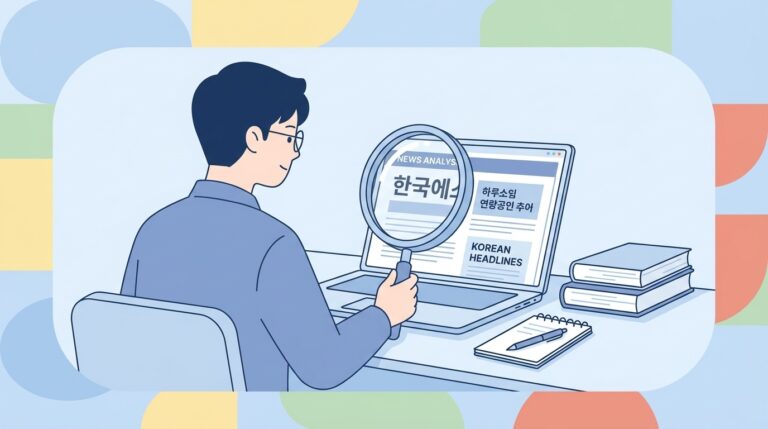
Phase 1: Empathy & Contextual Prelude
안녕하세요! 매일한글 에디터입니다. Have you ever scrolled through Korean news portals like Naver or Daum and stumbled upon sensational headlines claiming a “miracle cure discovered in Korea” or a “revolutionary physics breakthrough” that seems too good to be true? In Korea’s hyper-connected digital landscape, science reporting often leans toward sensationalism (선정성) to capture immediate clicks.
Navigating these discussions at a C2 (Advanced) level requires more than just high-level vocabulary; it demands subtlety, diplomatic tone, and cultural dexterity to express critical skepticism, request fact-checking, and challenge unverified claims without sounding hostile. Grounded in real feedback from advanced learners who engage with Korean researchers, media analysts, and intellectual peers, this guide gives you the precise rhetorical tools to master scientific skepticism in Korean.
Phase 2: In-Depth Analysis of 3 Key Expressions
1. 언론플레이에 휘둘리지 않고 팩트를 체크해야 합니다.
- Pronunciation: [eon-lon-peu-lae-i-e hwi-dul-li-ji ahn-go paek-teu-reul che-keu-hae-ya ham-ni-da] (Sounds like “un-lon-play-eh hwee-dool-lee-jee ahn-go fact-eul check-hae-ya ham-ni-da”)
- Meaning: Direct: “Without being swayed by media play, we must check the facts.” | Actual: “We shouldn’t buy into media spin; we need to verify the raw facts.”
- K-Culture Moment: Frequently heard on Korean current affairs programs like Sseuljeon or media critique podcasts when analyzing viral tech news.
- Editor’s Insight: ‘언론플레이’ (often abbreviated as ‘언플’) refers to strategic media manipulation or PR spin. Pairing it with ‘휘둘리다’ (to be swayed/controlled) emphasizes intellectual autonomy.
- Situation Spectrum: Casual: ⚠️ (Use ‘언플에 낚이지 말고’ instead) / Semi-formal: ✅ / Formal: ✅
- 🤔 Think About It: How does your native language express resistance against media hype surrounding unvetted scientific news?
2. 교차 검증을 거치지 않은 가설에 불과합니다.
- Pronunciation: [gyo-cha geom-jeung-eul geo-chi-ji ah-neun ga-seol-e bul-gwa-ham-ni-da]
- Meaning: Direct: “It is merely a hypothesis that hasn’t undergone cross-verification.” | Actual: “It’s just an unverified hypothesis lacking peer cross-checking.”
- K-Culture Moment: Academic seminars or televised debates between Korean science communicators reviewing preprints.
- Editor’s Insight: ‘교차 검증’ (cross-verification/triangulation) is an essential high-level term in academic debate. Using ‘불과하다’ firmly demotes an unverified claim’s authoritative weight.
- Situation Spectrum: Casual: 🚫 / Semi-formal: ⚠️ / Formal: ✅
- 🤔 Think About It: Why is formal indirectness essential when deconstructing an opponent’s argument in Korean academic settings?
3. 자극적인 헤드라인에 비해 신뢰성이 현저히 떨어집니다.
- Pronunciation: [ja-geuk-jeog-in he-deu-ra-in-e bi-hae sin-noe-seong-i hyeon-jeo-hi tteo-reo-jim-ni-da]
- Meaning: Direct: “Compared to the provocative headline, credibility drops significantly.” | Actual: “The sensational headline severely undermines its scientific credibility.”
- K-Culture Moment: Korean tech reviewers evaluating overhyped product launches or scientific press releases.
- Editor’s Insight: The adverb ‘현저히’ (markedly/conspicuously) is a signature C2 term that brings gravitas and objective weight to your analytical critiques.
- Situation Spectrum: Casual: 🚫 / Semi-formal: ✅ / Formal: ✅
- 🤔 Think About It: How do elevated Sino-Korean adverbs transform your persuasive voice in professional discussions?
Phase 3: Textbook Korean vs. Real Korean
Situation 1: Calling out clickbait science reporting
- 📖 교과서 한국어: 이 뉴스는 사실이 아닙니다. (This news is not true.)
- 🗣️ 진짜 한국어: 전형적인 낚시성 기사라 팩트 체크가 시급해요. (It’s classic clickbait, so a fact-check is urgently needed.)
- 💡 왜 다를까?: Native speakers use ‘낚시성’ (fishing/clickbait) and ‘팩트 체크’ to describe contemporary media phenomena accurately and dynamically.
Situation 2: Expressing doubt regarding unverified scientific data
- 📖 교과서 한국어: 과학적 증거를 확인해야 합니다. (We must check scientific evidence.)
- 🗣️ 진짜 한국어: 출처가 불분명해서 데이터의 신뢰도를 장담하기 어렵네요. (The source is unclear, so we can’t guarantee the data’s reliability.)
- 💡 왜 다를까?: Expressing doubt through polite limitation (‘장담하기 어렵다’) maintains social harmony while delivering a precise critical judgment.
Phase 4: K-Culture Deep Dive & Non-Verbal Manners
4-1. Nunchi & Gestures for Intellectual Debate
When expressing scientific doubt in Korean formal or corporate settings, maintain open eye contact with a gentle tilt of the head. Avoid aggressive pointing or harsh facial expressions. Use open-palm hand gestures to indicate collaborative analysis rather than dismissive confrontation.
4-2. Culture Code: “속보 경쟁” (The Rush for Breaking News)
Korea’s high-speed digital ecosystem fuels fierce competition among news outlets for breaking news (속보). This often leads to preliminary paper drafts being reported as groundbreaking reality before scientific peer review is complete. Recognizing this media landscape empowers you to discuss media literacy intelligently in Korea.
Phase 5: Real-Life Roleplay Scenario
Setting: Discussing a viral “miracle battery material” news report with Dr. Min (민 박사), a senior Korean research institute colleague.
- Turn 1 (민 박사): 이번에 발표된 신소재 기사 보셨어요? 에너지 밀도가 10배나 높다는데요. 🎭 (손가락으로 스마트폰 기사를 가리키며 흥미로운 표정으로)
- Turn 2 (You C2): 네, 봤습니다. 하지만 자극적인 헤드라인에 비해 신뢰성이 현저히 떨어지는 느낌이에요. 🎭 (차분하게 고개를 내저으며)
- Turn 3 (민 박사): 그렇습니까? 언론에서는 세기적 발명이라고 대대적으로 보도하던데요.
- Turn 4 (You C2): 교차 검증을 거치지 않은 단계라 단순한 언론플레이일 가능성을 배제할 수 없습니다. 🎭 (자료를 가리키며 진지한 어조로)
- Turn 5 (민 박사): 일리가 있네요. 논문 전문이나 동료 평가(Peer Review) 결과가 공개되었나요?
- Turn 6 (You C2): 아직 프리프린트 상태라, 데이터의 신뢰도를 구체적으로 팩트 체크해 볼 필요가 있습니다. 🎭 (안경을 고쳐 쓰며 분석적으로)
- Turn 7 (민 박사): 역시 통찰력이 뛰어나시네요. 섣부른 결론을 내리기 전에 신중하게 접근해야겠습니다.
- Turn 8 (You C2): 맞습니다. 자극적인 보도에 휘둘리지 않고 학술적 근거를 면밀히 살펴봐야죠. 🎭 (미소를 지으며 긍정의 고개를 끄덕임)
🔀 Interactive Decision Point
Dr. Min asks if you should immediately issue a public statement warning against the report. How do you respond?
* Choice A: “무조건 거짓말이니까 블로그에 비판하는 글을 바로 올립시다!”
* Choice B: “공식적인 검증 학술지가 나올 때까지 판단을 유보하고 추이를 지켜보는 게 좋겠습니다.”
* Choice C: “상관없으니까 일단 SNS에 널리 공유해서 소문을 냅시다.”
Feedback:
* Choice A (Bad): Too impulsive and aggressive; compromises scientific objectivity and professional decorum.
* Choice B (Best): Perfect C2 choice! Uses sophisticated formal vocabulary (‘판단을 유보하다’) and shows professional diplomacy.
* Choice C (Risk): Promotes unverified rumors and lacks critical skepticism.
Phase 6: 10-Second Emotion Shadowing Drill
- [🧐 신중하고 비판적으로] 자극적인 헤드라인에 / 휘둘리지 말고 / 팩트를 교차 검증해야 합니다.
- [🤔 깊이 고민하며] 출처가 불분명해서 / 이 연구 결과를 / 선뜻 믿기는 어렵네요.
- [💡 단호하지만 예의 바르게] 교차 검증을 거치지 않은 가설은 / 학술적 가치가 / 제한적일 수밖에 없습니다.
Phase 7: K-Culture Mini Dictionary
- 낚시성 기사 (Naksi-seong gisa) | Clickbait article | Sensationalized headlines crafted to entice user clicks.
- 팩트 체크 (Paekteu chekeu) | Fact-checking | Verifying factual accuracy in journalism or public rhetoric.
- 언론플레이 (Eonlon-play) | Media spin | Strategic PR manipulation aimed at shaping public opinion.
- 교차 검증 (Gyocha geomjeung) | Cross-verification | Triangulating data across independent, reputable sources.
Phase 8: Survival Kit for Intellectual Conversations
Survival TOP 3
- “이 정보의 출처가 정확한가요?” (Is the source of this information accurate?)
- “확인되지 않은 소문일 수 있어요.” (It might be an unverified rumor.)
- “공식 발표를 기다려 보는 게 좋겠어요.” (It would be best to wait for an official announcement.)
Editor’s Travel & Research Note
To verify breaking news or academic research in Korea, bypass user forums and navigate directly to official platforms. Search primary Korean news releases on the 네이버 뉴스 공식 웹사이트 or consult verified academic hubs like RISS or KISTI.
Phase 9: A Step Deeper
Korean culture values rapid innovation and technology, which occasionally fuels zealous media coverage of preliminary scientific findings. However, contemporary Korean intellectuals balance this national enthusiasm with refined critical skepticism. By mastering indirect hedges and elevated Sino-Korean vocabulary, you can critique ideas incisively while honoring interpersonal harmony (인화).
💬 Your Turn: How do intellectuals in your culture challenge media hype without sounding overly aggressive? Share your thoughts in the comments below!
Phase 10: FAQ & Common Mistakes
Q: Is it appropriate to use ‘언론플레이’ in formal corporate meetings?
A: While ‘언론플레이’ is suitable for informal or semi-formal discussions, formal presentations should use ‘선정적 언론 보도’ (sensational press coverage) or ‘과장 보도’ (exaggerated reporting).
Q: How can I sound politely skeptical when speaking with a superior?
A: Direct your critique at the data rather than the person. Frame your response with hedges like “~일 가능성도 고려해 볼 필요가 있습니다” (We may need to consider the possibility that…).
Q: What is the difference between ‘팩트 체크’ and ‘사실 확인’?
A: ‘팩트 체크’ is widely used in journalism, digital media, and contemporary spoken discourse. ‘사실 확인’ is a formal Sino-Korean administrative term used in legal or official documentation.
🚨 Common Mistakes TOP 3
- Mistake: Bluntly saying “이 기사는 거짓말이에요!” in professional settings.
- Correct Action: Use “확인되지 않은 자극적 보도일 수 있습니다.”
- Mistake: Literal translation of “fact check” as “사실 점검” in media commentary.
- Correct Action: Use the accepted terms “팩트 체크” or “교차 검증”.
- Mistake: Overusing casual slang like “낚임” during academic seminars.
- Correct Action: Use formal terms like “선정주의적 보도에 의한 오인”.
Phase 11: Action Missions
- Bronze Mission: Practice reading the Phase 6 emotion shadowing drill aloud three times with proper pauses (
/). - Silver Mission: Write a 3-sentence critique of a sensational headline in Korean and post it on your study SNS.
- Gold Mission: Participate in a Korean online discussion (e.g., Naver Cafe, Blind) and politely introduce a fact-checking viewpoint using Phase 2 key expressions.
- 🎮 K-Culture Mission: Watch an episode of a popular Korean science YouTube channel (e.g., 안될과학) and note down three instances where the speakers use terms like ‘검증’, ‘가설’, or ‘데이터’!
Phase 12: Interactive Quiz Challenge
Question 1 (Situation Quiz)
Which expression is most appropriate when politely expressing skepticism about an unverified breaking headline during an academic seminar?
a) 완전 거짓말이네요!
b) 교차 검증을 거치지 않은 가설에 불과할 수 있습니다.
c) 이 뉴스 완전 낚시예요.
🔍 정답 및 해설 보기 (Click to view Answer & Explanation)
정답: b)
해설: Option b uses C2 level formal vocabulary suitable for academic seminars, whereas options a and c are overly emotional or overly informal.
Question 2 (Fill-in-the-Blank)
자극적인 헤드라인에 비해 __________이(가) 현저히 떨어집니다.
a) 신뢰성
b) 자극성
c) 대중성
🔍 정답 및 해설 보기 (Click to view Answer & Explanation)
정답: a) 신뢰성 (Credibility/Reliability)
해설: ‘신뢰성’ correctly completes the sentence meaning “Compared to the provocative headline, its credibility is markedly low.”
Question 3 (True/False Culture Quiz)
In Korean professional settings, directly pointing out a mistake by saying “당신 틀렸어요” (You are wrong) is encouraged as long as your facts are scientifically accurate. (True / False)
🔍 정답 및 해설 보기 (Click to view Answer & Explanation)
정답: False
해설: Korean professional etiquette prioritizes polite indirectness. It is far more professional to critique the dataset or source (‘데이터의 검증이 필요합니다’) rather than directly confronting the individual.







