

Master Korean Taxi Phrases: How to Say “Keep the Change” Like a Local!
Phase 1: Empathetic Opening
안녕하세요! I’m your Daily Hangul editor, your friendly 10-year Korean culture navigator!
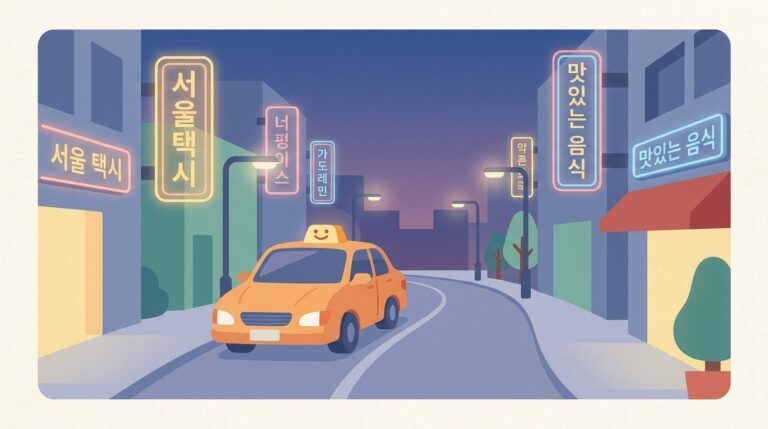
Picture this: You just touched down in Seoul after a long flight. You catch a classic orange taxi at Incheon Airport, heading into the vibrant neon lights of Hongdae. The driver—a kindly Ajeossi (middle-aged gentleman)—patiently listens to your destination and gets you there safely. The meter shows 9,200 KRW, and you hand him a 10,000 KRW bill. You want to tell him warmly, “Keep the change!” But suddenly, your mind goes blank. Will you sound rude? Is tipping normal in Korea? You end up standing on the street with 800 won in coins, wishing you knew the exact magic phrase.
Don’t worry! Many foreign travelers face this exact moment of hesitation. In Korea, tipping isn’t traditional, but rounded-up small change is a sweet gesture of gratitude. Based on feedback from hundreds of beginner learners, I’ve created this simple guide so you can handle taxi rides smoothly and confidently!
Phase 2: Core Expressions Deep Dive
1. 잔돈 됐어요 (Jandon dwaess-eoyo)
- Pronunciation: [Jan-don dwae-sseo-yo] (Sounds like ‘Jahn-don’ + ‘dway-sseh-yo’)
- Meaning: Literal: “Small change is okay.” / Nuance: “Keep the change, please!”
- K-Culture Moment: Seen in many K-Dramas when a tired protagonist gets out of a cab after a long day and gives a polite smile to the driver.
- Editor’s Insight: Jandon means coin change. Dwaess-eoyo means “it’s fine/sufficient.” Combining them creates the most natural way to leave change.
- Situation Spectrum: Casual ⚠️ | Semi-formal ✅ | Formal ✅
- 🤔 Think About It: Why does saying “it is okay” sound more soft and polite in Korean than directly saying “take this money”?
2. 괜찮아요, 잔돈은 가지세요 (Gwaenchan-ayo, jandon-eun gajiseyo)
- Pronunciation: [Gwaen-chan-ah-yo, jan-don-eun gah-ji-seh-yo]
- Meaning: Literal: “It’s okay, please take the change.”
- K-Culture Moment: Used when you feel extra grateful, such as when the driver helped you load heavy luggage into the trunk.
- Editor’s Insight: This phrase is very clear and soft. Using Gwaenchan-ayo (It’s okay) first sets a friendly, warm tone.
- Situation Spectrum: Casual ⚠️ | Semi-formal ✅ | Formal ✅
- 🤔 Think About It: How does starting a sentence with an apology or reassurance soften social interactions in Korea?
3. 감사합니다, 수고하세요! (Gamsahamnida, sugohaseyo!)
- Pronunciation: [Gam-sa-ham-ni-da, su-go-ha-seh-yo]
- Meaning: “Thank you, keep up the good work!”
- K-Culture Moment: The standard exit phrase used by almost every Korean passenger leaving a taxi or shop.
- Editor’s Insight: Even if you pay by credit card and have no physical change, saying Sugohaseyo shows great warmth and respect for the driver’s hard work.
- Situation Spectrum: Casual 🚫 | Semi-formal ✅ | Formal ✅
- 🤔 Think About It: How does acknowledging someone’s labor (Sugo) build community warmth in busy city life?
Phase 3: Textbook Korean vs. Real Native Korean
Situation 1: Leaving Small Change
- 📖 Textbook Korean: 잔돈은 당신이 가지십시오. (Jandon-eun dangsin-i gajisippsio.)
- 🗣️ Real Native Korean: 잔돈은 됐어요! (Jandon-eun dwaess-eoyo!)
- 💡 Why the difference? Textbook phrasing often sounds like a script from an old movie. Dangsin (you) can sound unnatural or aggressive. 됐어요 is natural, short, and polite!
Situation 2: Waving Off Change When Paying Cash
- 📖 Textbook Korean: 거스름돈을 주지 않아도 됩니다. (Geoseureumdon-eul juji an-ado doemnida.)
- 🗣️ Real Native Korean: 괜찮아요! 그냥 두세요. (Gwaenchan-ayo! Geunyang duseyeo.)
- 💡 Why the difference? Geoseureumdon is a formal technical word for change. Real Koreans prefer the shorter Jandon or simply Gwaenchan-ayo (It’s okay) with a small gesture.
Phase 4: K-Culture Deep Dive & Mannerisms
4-1. Nunchi (Tact) & Body Language
When saying “잔돈 됐어요”:
1. Gently Wave Your Hand: Hold your hand up vertically with palms facing slightly outward and wave side-to-side once or twice.
2. Head Nod: Combine the phrase with a gentle head nod (15-degree bow).
3. Quick Exit: Say it right as you hand over cash, then step out cleanly so the driver doesn’t feel obligated to count out coins.
4-2. Korea’s No-Tip Culture Code
In South Korea, tipping at restaurants or cafes does not exist and can even cause confusion! Taxis are the rare exception where leaving small coin change (e.g., 500-800 KRW) from cash payments is welcomed as a sweet bonus. However, card payment is standard today—over 90% of rides use cards or mobility apps!
Phase 5: Real-life Roleplay Scenario
Setting: A night taxi ride from Gangnam Station to your hotel. Driver is Mr. Kim.
- Turn 1 (Driver): 손님, 다 왔습니다. (Sonnim, da wasseumnida.) / Guest, we have arrived. 🎭 [Looks back with a smile]
- Turn 2 (You): 얼마예요? (Eolmayeyo?) / How much is it? 🎭 [Check the meter displaying 9,300 won]
- Turn 3 (Driver): 구천삼백 원입니다. (Gucheon-sambaek won-imnida.) / It is 9,300 won. 🎭 [Points at meter]
- Turn 4 (You): 여기 만 원이요. (Yeogi man won-iyo.) / Here is 10,000 won. 🎭 [Handing cash bill gently]
- Turn 5 (Driver): 네, 잠시만요. 잔돈… (Ne, jamsimanyo. Jandon…) / Yes, hold on. Change… 🎭 [Reaches for coin box]
- Turn 6 (You): 아, 잔돈은 됐어요! (A, jandon-eun dwaess-eoyo!) / Ah, keep the change! 🎭 [Slight hand wave and nod]
- Turn 7 (Driver): 아구, 감사합니다! (Agu, gamsahamnida!) / Oh, thank you so much! 🎭 [Smiles warmly]
- Turn 8 (You): 감사합니다. 수고하세요! (Gamsahamnida. Sugohaseyo!) / Thank you, keep up the good work! 🎭 [Exits car smoothly]
🔀 Interactive Choice Point
What should you do if the driver still tries to hand you coins after you said “잔돈 됐어요”?
* Option A: Take the coins silently and walk away looking sad.
* Option B: Smile, wave your hand again, and say “괜찮습니다! 수고하세요!”
* Option C: Yell “No tipping!” in English.
Feedback:
* Option A (Bad): You miss out on showing your friendly intent!
* Option B (BEST): Reaffirming warmly with Gwaenchan-seumnida makes the driver feel appreciated!
* Option C (Risk): May startle the driver who might not speak English.
Phase 6: 10-Second Emotion Shadowing Drill
Practice reading these out loud with rhythm and emotion!
[😊 Friendly & Cheerful]잔돈은 / 됐어요! (Jan-don-eun / dwae-sseo-yo!)[🙏 Warm & Respectful]괜찮아요, / 수고하세요! (Gwaen-chan-ah-yo, / su-go-ha-seh-yo!)[👋 Quick & Polite]감사합니다! / 안녕히 계세요! (Gam-sa-ham-ni-da! / An-nyeong-hi gye-seh-yo!)
Phase 7: K-Culture Mini Dictionary
- 잔돈 (Jandon): Small cash change/coins remaining after purchase.
- 택시 (Taeksi): Taxi/Cab. Standard colors in Seoul are orange (silver/white also common).
- 기사님 (Gisanim): Respectful term for drivers (Taxi driver, bus driver, personal driver).
- 카카오 T (Kakao T): Korea’s top ride-hailing app used by locals and tourists alike.
Phase 8: Traveler’s Survival Kit
Top 3 Taxi Survival Phrases
- 여기서 내려주세요. (Yeogiseo naeryeojuseyo.) – Please drop me off here. [Pro Tip: Point at a safe corner]
- 카드로 결제할게요. (Kadeuro gyeoljehalgeyo.) – I’ll pay by card. [Pro Tip: Tap your card on the terminal between seats]
- 영수증 주세용. (Yeongsujeung juseyo.) – Please give me the receipt. [Pro Tip: Handy if you accidentally leave belongings behind!]
Editor’s Travel Note
For effortless navigation around Seoul and Busan, make sure to set up the Kakao T ride hailing app installation guide before your trip. Connecting your international card makes paying seamless without worrying about cash change!
Phase 9: One Step Deeper
In modern Korean culture, language is built around recognizing mutual effort. Saying Sugohaseyo (Recognizing labor) acknowledges that the driver navigated heavy city traffic to get you safely to your destination. It transforms a transaction into a warm human connection.
💬 Your Turn: Have you ever used local taxi expressions when traveling? Share your experiences in the comments below!
Phase 10: FAQ & Common Mistakes
Q: Can I leave big tips like 10,000 KRW in Korea?
A: Large tipping is uncommon and might cause drivers confusion. Keeping change up to 1,000-2,000 won is natural; excessive tipping isn’t expected.
Q: Is it okay to say ‘잔돈 됐어요’ to restaurant staff?
A: Restaurant staff will almost always return exact change. It’s best reserved for taxis when paying cash!
Q: How do I address taxi drivers politely?
A: Call them Gisanim (기사님). Avoid calling them Ajeossi directly when addressing them.
🚨 Common Mistakes TOP 3
- Mistake: Saying “잔돈 가지세요” bluntly without a smile.
- Correct Action: Add a gentle hand wave and say Gwaenchan-ayo, jandon-eun 됐어요 with a smile.
- Mistake: Forgetting to say Sugohaseyo when leaving.
- Correct Action: Always say Gamsahamnida, sugohaseyo! as you exit.
- Mistake: Trying to give cash tips on credit card transactions.
- Correct Action: Just express verbal gratitude; cash tips on card payments are unnecessary.
Phase 11: Action Mission & K-Culture Challenge
- 🥉 Bronze Level: Repeat “잔돈 됐어요” out loud 5 times in front of a mirror!
- 🥈 Silver Level: Practice the Phase 5 roleplay dialogue with a study partner.
- 🥇 Gold Level: On your next trip to Korea, pay cash for a short taxi ride and say “잔돈 됐어요, 수고하세요!”
🎮 K-Culture Mission: Watch a scene in a modern Korean drama where characters take a cab. Can you spot them saying Gisanim or Sugohaseyo?
Phase 12: Interactive Quiz Challenge
Q1. What is the most natural way to tell a taxi driver to keep small cash change?
A) 잔돈은 당신이 버리세요.
B) 잔돈 됐어요!
C) 돈 더 주세요.
Click to reveal answer
Answer: B!







