

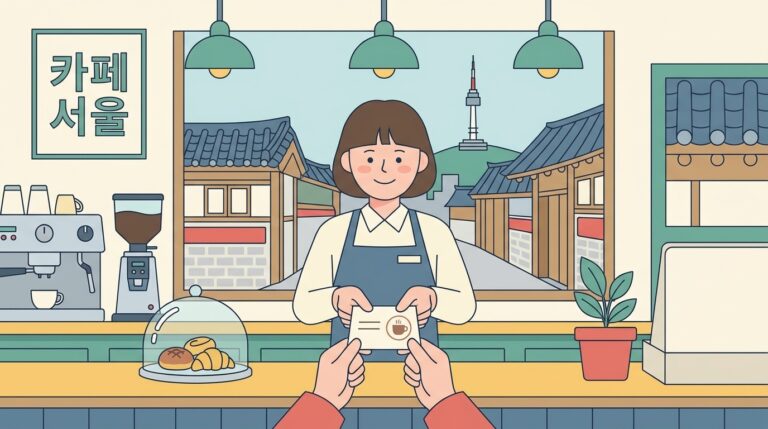
Never Lose Your Free Coffee: Master Korean Cafe Stamp Cards Like a Local
Phase 1: Empathy (Storytelling Opening)
안녕하세요! I’m your Daily Hangul editor and your Korean culture navigator! Have you ever stood in a trendy cafe in Hongdae or Seongsu, finished ordering your iced Americano, and suddenly the barista points to a small digital tablet or holds up a tiny paper card while asking you something rapidly? You freeze, smile awkwardly, say “괜찮아요” (It’s okay), and walk away—only to realize later that your Korean friend just got a free latte because they collected 10 stamps!
In Korea, cafe loyalty stamp systems (쿠폰 도장) are everywhere. Whether it’s a cozy neighborhood spot or a popular chain, collecting stamps is practically a national hobby. Missing out on free drinks just because of a language barrier is a real pain point for Korean learners. But don’t worry! This guide is built on real feedback from beginner learners just like you. By learning a few simple A2-level phrases, you will confidently claim your stamps and blend right into Seoul’s vibrant cafe scene like a true local!
Phase 2: Deep Dive into 3 Key Expressions
1. 쿠폰 도장 찍어 주세요. (Kupon dojang jjigeo juseyo.)
- Pronunciation: [Koo-pon doh-jang jjee-geo joo-seh-yo] (Think of “jjik” like the quick snap sound of a rubber stamp!)
- Meaning: “Please stamp my coupon card.” (Literal: Coupon stamp please press.)
- K-Culture Moment: In K-Dramas, you often see characters handing over a cute paper card at their favorite neighborhood cafe to get their daily stamp.
- Editor’s Insight: This is the most classic phrase when dealing with physical paper cards. Even if you just hold up your card and say this politely, baristas will instantly understand.
- Situation Spectrum: Casual ⚠️ | Semi-formal ✅ | Formal ✅
- 🤔 Think About It: Why do Koreans prefer quick, short requests at cafe counters? How does efficiency (빨리빨리 culture) shape modern everyday phrases?
2. 포인트 적립해 주세요. (Pointeu jeongnip-hae juseyo.)
- Pronunciation: [Poh-in-teu jeong-neep-hae joo-seh-yo] (Notice how ‘Jeongnip’ sounds like ‘jong-neep’)
- Meaning: “Please save/accumulate points for me.”
- K-Culture Moment: At franchise cafes like Mega Coffee or Compose Coffee, the barista will point to a touch tablet where you type your phone number to earn digital stamps.
- Editor’s Insight: Many modern Korean cafes no longer use paper cards. Instead, they use digital point systems linked to your phone number!
- Situation Spectrum: Casual ⚠️ | Semi-formal ✅ | Formal ✅
- 🤔 Think About It: In your country, do cafes use paper cards or digital phone number lookups more often?
3. 이거 다 모으면 무료예요? (Igeo da moeumeyeon muryo-yeyo?)
- Pronunciation: [Ee-geo dah moh-eum-myeon moo-ryoh-yeh-yo?]
- Meaning: “If I collect all of these, is it free?”
- K-Culture Moment: A fun line to use when showing off your nearly full coupon card to a barista or friend!
- Editor’s Insight: ‘다’ means ‘all’ and ‘무료’ means ‘free of charge’. This is a super handy phrase to confirm your reward drink.
- Situation Spectrum: Casual ✅ | Semi-formal ✅ | Formal ⚠️
- 🤔 Think About It: How does asking simple questions in Korean help build friendly relationships with staff at your favorite daily spots?
Phase 3: Textbook Korean vs. Real Native Korean
Situation 1: Asking if they have a loyalty stamp card
- 📖 Textbook Korean: 쿠폰 카드가 있습니까? (Kupon kadeuga isseumnikka?)
- 🗣️ Real Native Korean: 혹시 쿠폰 있어요? (Hoksi kupon isseoyo?)
- 💡 Why is it different? Textbook Korean often uses overly formal ending forms (
-습니까). Real native Koreans prefer soft starter words like혹시(by any chance) combined with polite everyday endings (-있어요).
Situation 2: Entering your phone number for digital stamps
- 📖 Textbook Korean: 전화번호를 입력하겠습니다. (Jeonhwabeonhoreul imryeok-hagesseumnida.)
- 🗣️ Real Native Korean: 번호 여기에 누르면 돼요? (Beonho yeogi-e nureumyeon dwaeyo?)
- 💡 Why is it different? Native speakers focus on visual action. Instead of formal declarations, they simply point at the tablet screen and ask if tapping their number there works!
Phase 4: K-Culture Deep Dive & Non-Verbal Etiquette
4-1. Nunchi (눈치) & Key Gestures
When the barista asks if you want stamps, you don’t always need long sentences. Good gesture manners go a long way:
1. Two-Handed Delivery: Hand over your paper coupon card using both hands (or holding your elbow with one hand). This shows respect.
2. The Pointing Tap: If a tablet is facing you, gently point to the screen and give a slight head nod to ask, “Here?”
3. Eye Contact & Nod: When receiving your stamped card back, accept it with both hands and make a slight bow (about 15 degrees) while saying “감사합니다!”
4-2. Culture Code: The “Cafe Hopping” & Loyalty System
In Korea, cafe culture is more than just grabbing morning caffeine—it’s a lifestyle hub for studying, social meetings, and relaxed dates. Because competition among cafes is intense, almost every non-chain cafe offers generous stamp promotions (often buy 10, get 1 free coffee or 2,000 KRW discount). Earning stamps represents building a routine and becoming a ” 단골 ” (dangol – regular customer) at your favorite local sanctuary!
Phase 5: Real-Life Roleplay Scenario
Setting: A cozy wooden cafe in Yeonnam-dong. Barista Min-soo (민수) is behind the counter.
- Turn 1 (Staff): 안녕하세요! 주문하시겠어요? (Annyeonghaseyo! Jumun-hasigesseoyo? – Hello! Ready to order?)
- Turn 2 (Learner): 아이스 아메리카노 한 잔 주세요. (Aiseu amerirano han jan juseyo. – One iced Americano, please.)
🎭 Pointing at the menu board with a polite smile - Turn 3 (Staff): 드시고 가세요, 테이크아웃이세요? (Deusigo gaseyo, teikeua-ut-iseyo? – For here or to go?)
- Turn 4 (Learner): 먹고 갈게요. (Meokgo galgeyo. – For here.)
🎭 Nodding and pointing to an empty table - Turn 5 (Staff): 네, 결제 도와드릴게요. 쿠폰 있으세요? (Ne, gyeolje dowadreilgeyo. Kupon isseuseoyo? – Okay, I’ll help with payment. Do you have a coupon card?)
- Turn 6 (Learner): 아, 쿠폰 도장 찍어 주세요! (A, kupon dojang jjigeo juseyo! – Ah, please stamp my coupon card!)
🎭 Handing over paper stamp card with both hands - Turn 7 (Staff): 네, 여기 도장 찍어 드렸습니다. (Ne, yeogi dojang jjigeo deuryeosseumnida. – Yes, I stamped it right here for you.)
🎭 Stamping card and handing it back - Turn 8 (Learner): 감사합니다! (Gam-sa-ham-ni-da! – Thank you!)
🎭 Receiving the card back with two hands and bowing slightly
🔀 Interactive Branching Point
What would you say if you forgot your paper card at home?
- Option A: “아, 다음에 한꺼번에 찍을게요!” (Ah, I’ll get them stamped together next time!)
- Option B: “그냥 됐어요.” (Just leave it.)
- Option C: “카드가 집에서 없어요!” (Card isn’t at home!)
Feedback:
* Option A (BEST): Perfect! It sounds natural and polite. Baristas will often give you a temporary card or stamp twice next time.
* Option B (BAD): A bit blunt and slightly cold. Adding “괜찮아요” (It’s okay) makes it much nicer.
* Option C (RISK): Grammatically awkward (집에 없어요 is better than 집에서 없어요). It gets the message across, but sounds unnatural.
Phase 6: 10-Second Emotional Shadowing Drill
Practice saying these lines with the exact mood to sound like a native speaker!
[😊 Brightly & Enthusiastically]
저 / 쿠폰 도장 / 찍어 주세요!
(Jeo / kupon dojang / jjigeo juseyo!)-
[🤔 Curious & Expectant]
이거 / 다 모으면 / 무료 음료 / 돼요?
(Igeo / da moeumeyeon / muryo eumryo / dwaeyo?) -
[🥺 Cute & Regretful]
아! / 오늘 / 쿠폰 카드를 / 두고 왔어요!
(A! / oneul / kupon kadeureul / dugo wasseoyo!)
Phase 7: K-Culture Mini Dictionary
- 도장 (Dojang) | Stamp / Seal | Refers to both modern rubber ink stamps on cafe cards and official legal personal seals used in Korea.
- 적립 (Jeongnip) | Accumulation / Saving points | Used constantly at cafes, supermarkets, and convenience stores when saving reward points.
- 단골 (Dangol) | Regular customer | Being a ‘단골’ at a neighborhood cafe often earns you free extra shots, warmer service, or friendly small talk.
- 무료 쿠폰 (Muryo Kupon) | Free Drink Coupon | The golden ticket earned after completing 10 stamps!
Phase 8: Traveler’s Survival Kit
Survival Top 3 Expressions
- 도장 찍어 주세요. (Dojang jjigeo juseyo.) – Stamp this, please.
- 전화번호로 적립돼요? (Jeonhwabeonhoro jeongnip-dwaeyo?) – Can I save points using my phone number?
- 새로 하나 만들어 주세요. (Saero hana mandureo juseyo.) – Please make a new card for me.
Editor’s Travel Note
When exploring Korea, download the Naver Map app to search for cozy local independent cafes near your location. Many independent cafes offer the cutest handmade stamp cards! Keep your paper cards inside your phone case so you never forget them when grabbing a coffee.
Phase 9: One Step Deeper (Thoughtful Reflection)
In Korean culture, the act of stamping a loyalty card is a small warm handshake between business and customer. It turns a simple monetary transaction into a continuing relationship. By taking a card and returning to the same counter, you express appreciation for their coffee, and the barista rewards your loyalty. Language is ultimately a tool to build human connections—so embrace every stamp as a small bridge into Korean daily life!
💬 Your Turn: Do you prefer collecting physical paper stamps or digital phone points when you visit cafes?
Phase 10: FAQ & Common Mistakes
Q: Can foreign tourists without a Korean phone number save cafe points?
A: Yes! If a cafe uses paper cards, anyone can collect stamps regardless of nationality. If a cafe uses a digital phone system, you can often enter your foreign roaming number or simply ask for a paper card by saying “종이 쿠폰 있어요?” (Do you have a paper coupon?).
Q: Do stamps expire in Korean cafes?
A: Most independent cafe paper coupons do not expire quickly, but franchise digital points often last for 6 to 12 months. It’s best to ask “유효기간 있어요?” (Is there an expiration date?).
Q: Can I combine two separate half-filled paper coupon cards?
A: Yes! Most friendly local cafes will happily combine your stamps onto a single card. Just hand both over and say “합쳐 주세요” (Please combine them).
🚨 Common Mistakes TOP 3
- Mistake: Saying “도장 주세용” in formal settings.
- Correct Action: Keep it clear with “도장 찍어 주세요”.
- Mistake: Trying to tap your credit card onto the tablet screen meant for phone numbers.
- Correct Action: Payment reader is separate! The tablet screen is strictly for typing phone numbers for point saving.
- Mistake: Forgetting to use two hands when receiving your card.
- Correct Action: Always use both hands to receive items from staff to show good manners.
Phase 11: Action Mission & Engagement
- 🥉 Bronze Mission: Practice saying “쿠폰 도장 찍어 주세요” 3 times out loud with shadowing gestures.
- 🥈 Silver Mission: Post a picture of a Korean cafe coupon card on your social media and tag
#DailyHangulCafe. - 🥇 Gold Mission: On your next cafe visit in Korea, successfully request a stamp using pure Korean without switching to English!
🎮 K-Culture Mission: Watch a modern Korean slice-of-life drama scene set in a cafe and spot whether the characters use digital phone input or paper stamp cards!
Phase 12: Interactive Quiz Challenge
Quiz 1: Situational Choice
You want to ask the barista to save points using your phone number. What should you say?
* A) 전화번호 주세요. (Give me your phone number.)
* B) 번호로 적립해 주세요. (Please save points with my number.)
* C) 전화번호 누르세요. (Type your phone number.)
🔍 Click to reveal Answer & Explanation
Correct Answer: B
Explanation: Option B is polite and accurate. Option A sounds like you are asking out the barista on a date!
Quiz 2: Fill in the Blanks
“도장 ____ 주세요.” (Please stamp it for me.)
* A) 먹어
* B) 찍어
* C) 보여
🔍 Click to reveal Answer & Explanation
Correct Answer: B (찍어)
Explanation: The verb for stamping a seal or ink stamp in Korean is 찍다 (jjikda).
Quiz 3: True / False Culture Quiz
In Korea, it is considered rude to accept your stamped coupon card back with both hands.
🔍 Click to reveal Answer & Explanation
Correct Answer: FALSE
Explanation: Handing and receiving items with both hands is a essential sign of respect in Korean etiquette!







