

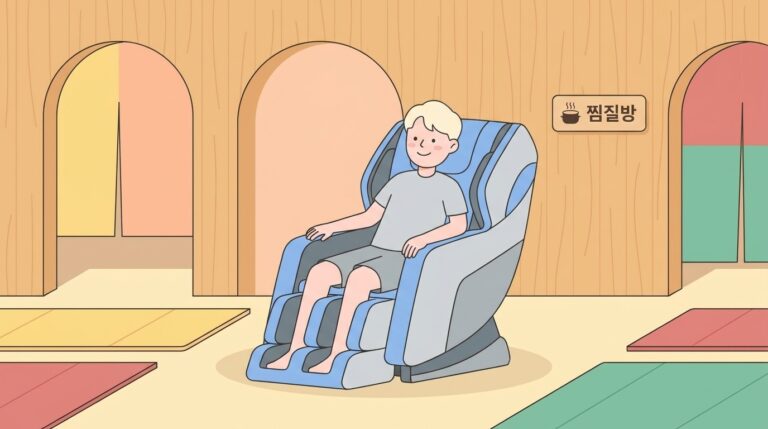
Phase 1: Welcome to the Jjimjilbang!
안녕하세요! 매일한글 에디터입니다. Have you ever entered a Korean bathhouse (Jjimjilbang) after a long day of sightseeing, wrapped yourself in a cozy sheep-head towel, and spotted a row of sleek, futuristic massage chairs glowing near the snack bar? You step up, eager to relax your tired calves, but suddenly panic hits: How do you pay? Can you use your wrist key tag? What if someone is waiting, or the machine stops mid-session? Using massage chairs in a Korean Jjimjilbang is an iconic relaxing experience, yet many international travelers miss out simply because they don’t know what to say or how the system works. Don’t worry! Based on real feedback from intermediate learners, this guide will equip you with authentic, natural expressions so you can claim your relaxation spot like a local pro.
Phase 2: Core Expressions Deep Dive
1. 자리 있어요? (Jari issoyo?)
- Pronunciation: [ja-ri it-seo-yo?] (Sounds like “ja-ree” + “it-sow-yo”)
- Meaning: Literal: “Is there a seat?” / Actual: “Is this seat taken?” or “Is anyone using this?”
- K-Culture Moment: Frequently heard in popular Korean dramas whenever characters enter a crowded lounge or communal Jjimjilbang area searching for a spot.
- Editor’s Insight: In Korea, asking if a space is occupied shows great manners and avoids awkward double-booking situations.
- Situation Spectrum: Casual ⚠️ | Semi-formal ✅ | Formal ✅
- 🤔 Think About It: Why do Koreans prefer asking about space rather than directly asking “Are you moving?”
2. 키 태그로 결제돼요? (Ki tae-geu-ro gyeol-je-dwae-yo?)
- Pronunciation: [key tag-ro gyeol-jeh-dway-yo?]
- Meaning: Literal: “Is payment possible with key tag?” / Actual: “Can I pay using my RFID wristband?”
- K-Culture Moment: In modern Jjimjilbangs, you don’t carry cash; you tap your electronic key band and pay everything at checkout!
- Editor’s Insight: Knowing this prevents you from carrying coins or credit cards into wet or relaxed zones.
- Situation Spectrum: Casual ⚠️ | Semi-formal ✅ | Formal ✅
- 🤔 Think About It: How has cashless wristband technology shaped Korean bathhouse culture?
3. 이것 어떻게 써요? (I-geot ot-teoh-ge sseo-yo?)
- Pronunciation: [ee-geot oh-tteo-keh sseo-yo?]
- Meaning: Literal: “How do I use this?” / Actual: “Could you show me how this operates?”
- K-Culture Moment: A friendly icebreaker when dealing with modern Korean touchscreens or digital buttons.
- Editor’s Insight: Koreans are warm and helpful; asking politely often gets you a full hands-on demonstration!
- Situation Spectrum: Casual ⚠️ | Semi-formal ✅ | Formal ✅
- 🤔 Think About It: Is asking for help from strangers common in public spaces in your culture?
Phase 3: Textbook Korean vs. Real Korean
Situation 1: Asking how to turn on the machine
- 📖 Textbook Korean: 이 안마 의자를 어떻게 작동시킵니까? (I anma uijareul otteohge jakdongsikimnikka?)
- 🗣️ Real Korean: 이거 어떻게 켜요? (Igeo otteohge kyeoyo?)
- 💡 Why different? Native speakers prefer short, active verbs like 켜다 (to turn on) instead of formal vocabulary like 작동시키다 (to operate).
Situation 2: Asking if someone is done using the chair
- 📖 Textbook Korean: 사용이 끝나셨습니까? (Sayong-i kkeutnasseumnikka?)
- 🗣️ Real Korean: 다 쓰셨어요? (Da sseusyeosseoyo?)
- 💡 Why different? Real-life speech uses natural honorific forms of common verbs like 쓰다 (to use) for effortless interaction.
Phase 4: K-Culture Deep Dive & Non-verbal Manners
4-1. Nunchi (눈치) & Gestures
When approach a massage chair, make brief eye contact with the person nearby. A gentle nod (목인사) with a light hand gesture toward the empty chair shows politeness. If a chair is humming but no one is seated, check if a towel or water bottle is placed on it—that’s the universal Korean marker for “reserved spot”!
4-2. Culture Code Analysis: The Healing Oasis (힐링)
In fast-paced Korean life, Jjimjilbangs serve as budget-friendly wellness retreats. Koreans visit to sweat out stress, drink ice sikhye (sweet rice beverage), and get a 15-minute full-body massage. The massage chair area is considered a quiet sanctuary, so lower your voice and enjoy the peaceful vibe.
Phase 5: Real Role-play Scenario
Setting: A warm, buzzing Jjimjilbang relaxation zone in Seoul. You want to try an advanced massage chair next to a friendly Korean local (NPC Min-jun).
- You: 저기요, / 혹시 여기 / 자리 있어요? (Jeogiyo, hoksi yeogi jari issoyo?) – 🎭 [Politely dipping head while pointing gently]
- Min-jun: 아, 네! / 안 써요. / 앉으세요. (A, ne! An sseoyo. Anjeuseyo.) – 🎭 [Smiling and making room]
- You: 감사합니다. / 혹시 이거 / 키 태그로 결제돼요? (Gamsahamnida. Hoksi igeo ki tae-geu-ro gyeol-je-dwae-yo?) – 🎭 [Holding up wristband tag]
- Min-jun: 네, / 거기 센서에 / 태그하시면 돼요. (Ne, geogi seon-seo-e tae-geu-ha-si-myeon dwae-yo.) – 🎭 [Pointing to the glowing red scanner]
- You: 아하! / 혹시 / 얼마예요? (Aha! Hoksi eolmayeyo?) – 🎭 [Looking at the display screen]
- Min-jun: 이천 원에 / 십오 분이에요. (I-cheon won-e sip-o-bun-i-e-yo.) – 🎭 [Holding up two fingers]
- You: 그렇군요! / 감사합니다. / 시원하네요! (Geureohgunyo! Gamsahamnida. Siwonhaneyo!) – 🎭 [Tapping wrist key and sinking into the seat]
- Min-jun: 피로가 잘 풀릴 거예요! / 편히 쉬세요. (Piroga jal pullil geoyeyo! Pyeoni swiseyo.) – 🎭 [Giving a friendly thumbs up]
🔀 Interactive Choice:
What do you say after your massage session finishes and another person approaches?
– Option A: 다 썼어요, 앉으세요! (Da sseosseoyo, anjeuseyo!)
– Option B: 하지 마세요! (Haji maseyo!)
– Option C: 손대지 마세요. (Sondaeji maseyo.)
Feedback:
* Option A: Best! Warm, natural, and polite. Indicates you are finished and offers the seat.
* Option B: Bad! Means “Don’t do it!” which sounds surprisingly aggressive.
* Option C: Risk! Means “Do not touch,” making you sound like a security guard!
Phase 6: 10-Second Emotion Shadowing Drill
- [😊 기쁘고 기대하며] 이거 / 진짜 시원하네요! (Igeo / jinjja siwonhaneyo!)
- [🥺 궁금하고 쑥스럽게] 저기요, / 이것 어떻게 켜요? (Jeogiyo, / igeot otteohge kyeoyo?)
- [😌 편안하고 만족스럽게] 피로가 / 싹 풀렸어요. (Piroga / ssak pulryeosseoyo.)
Phase 7: K-Culture Mini Dictionary
- 안마 의자 (Anma Uija) | Massage Chair | Automated massage recliner found in bathhouses and rest areas.
- 키 태그 (Ki Tae-geu) | RFID Key Tag | Wristband key used for lockers and digital payments inside bathhouses.
- 힐링 (Healing) | Relaxation/Self-care | Trendy Korean word describing activities that alleviate physical and mental stress.
- 시원하다 (Siwonhada) | Refreshing/Relieving | Multi-purpose adjective used when massage relieves muscle soreness or water feels nice.
Phase 8: Traveler’s Survival Kit
Survival Expressions TOP 3
- 켜는 방법 좀 알려주세요. (Kyeoneun bangbeop jom allyeojuseyo.) – Please show me how to turn it on. (Pro Tip: Use when touchscreen options look confusing)
- 잔액 부족이에요. (Janaek bujok-i-e-yo.) – Balance is insufficient. (Pro Tip: Means your locker key tag limit needs top-up at front desk)
- 시원하게 잘 받았어요. (Siwonhage jal bada-sseo-yo.) – That was thoroughly refreshing! (Pro Tip: Great thing to say when chatting with fellow visitors)
Editor’s Travel Note
Before heading to legendary sauna spots like Dragon Hill Spa or Aquafield, check your phone! Download the Naver Map Navigation App to find top-rated Jjimjilbangs near you. Remember that almost all modern saunas use wrist tag scanning, so you can settle your total bill conveniently at the exit counter.
Phase 9: One Step Deeper
In Korea, relaxation isn’t just an individual act—it’s a shared social ritual. Using communal spaces like massage chair zones requires maintaining harmony through soft voices and respectful turn-taking. This reflects the deep-rooted cultural concept of Jeong (정) and mutual consideration for others in public places.
💬 Your Turn: Have you ever tried a massage chair in Korea or your home country? Share your experience in the comments below!
Phase 10: FAQ & Common Mistakes
Q: Can I pay with cash directly into the massage chair?
A: Most modern Korean Jjimjilbangs strictly use RFID key tags. Cash slots are rare now!
Q: How long does one session usually last?
A: Standard sessions run for 10 to 15 minutes per key tag scan (usually costing 2,000 to 3,000 KRW).
Q: What should I do if the chair stops unexpectedly?
A: Politely ask a nearby guest or staff member by saying “작동이 멈췄어요” (It stopped working).
🚨 Common Mistakes Top 3:
1. Saying “Rest here” using wrong honorifics. (Correct Action: Say “편히 쉬세요”).
2. Leaving personal items like towels on chairs for hours. (Correct Action: Only hold seats while actively using them).
3. Pressing buttons repeatedly without scanning key tag first. (Correct Action: Tap key tag to authorize power first).
Phase 11: Action Missions
- Bronze Level: Practice saying “자리 있어요?” 3 times in front of your mirror.
- Silver Level: Share this blog post on social media with your favorite Korean sauna food photo!
- Gold Level: Use “키 태그로 결제돼요?” on your next trip to a Korean bathhouse.
🎮 K-Culture Mission: Spot a massage chair scene in a K-Drama (like Crash Landing on You) and write down the phrase used by the actors!
Phase 12: Interactive Quiz Challenge
Question 1: Situation Judgment
How do you ask if an empty massage chair is available?
Click to view Answer & Explanation
여기 자리 있어요? (Yeogi jari issoyo?) is the most natural and polite way to ask if a seat is taken.
Question 2: Fill in the Blank
“이것 어떻게 ____?” (How do I use this?)
Click to view Answer & Explanation
써요 (sseoyo). The full sentence is “이것 어떻게 써요?”
Question 3: True or False
In Korean Jjimjilbangs, you must always carry paper cash inside the sauna to use massage chairs.
Click to view Answer & Explanation
False! Almost all modern bathhouses use electronic RFID key bands that record your purchases for final checkout.







