

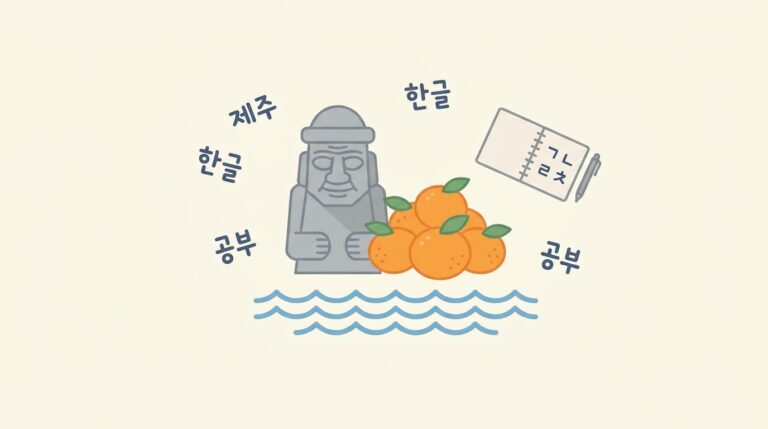
Unlocking Jeju Dialect Secrets: How to Sound Like a True Local in Jeju Island
안녕하세요! 매일한글 에디터입니다. Have you ever tuned into popular K-Dramas like Our Blues (우리들의 블루스) or Welcome to Samdal-ri (웰컴투 삼달리) and found yourself scratching your head thinking, “Wait, is that even Korean?” You are definitely not alone! Jeju Island (제주도) is famous not only for its stunning emerald ocean and mouth-watering black pork but also for its uniquely fascinating language: Jejueo (제주 방언). Because Jeju is an island isolated from the mainland by ocean waters, its dialect preserved ancient Korean speech forms and developed unique vocabulary that even native Seoul speakers often cannot understand without subtitles!
Mastering a few key Jejueo phrases at the B2 intermediate level will elevate your Korean journey from basic textbook conversations to deep, soulful cultural connections. Local islanders will welcome you with wide smiles and extra servings of tangerines the second you drop a local Jeju greeting. This guide is built directly on real experience and learner feedback to help you understand the heart behind Jeju’s vibrant dialect.
Phase 2: Core Phrases Deep Dive
1. 혼저옵서예 (Honjeo opseoye)
- Pronunciation: [Hon-jeo-op-seo-ye] (Sounds like “Home-jaw-op-seoy-yay”)
- Meaning: “Welcome!” (Literal: Please come quickly / Standard Korean: 어서 오세요)
- K-Culture Moment: You will see this phrase embroidered on traditional banners at Jeju International Airport and called out warmly by market vendors as you stroll through Dongmun Market.
- Editor’s Insight: While ‘혼저’ sounds like standard Korean ‘혼자’ (alone), in Jeju dialect it actually means ‘quickly’ (어서). So you are inviting guests to quickly enter your home or shop with a open heart!
- Situation Spectrum: Casual 🚫 / Semi-formal ✅ / Formal ✅
- 🤔 Think About It: How does Jeju’s geographical history as an island community influence its tradition of warm, welcoming hospitality?
2. 폭싹 속았수다 (Poksak sogat-suda)
- Pronunciation: [Pok-ssak so-gat-su-da] (Emphasize ‘Pok-ssak’ with a soft pop sound)
- Meaning: “Thank you so much for your hard work!” (Literal: You were completely tricked/suffered deeply / Standard Korean: 정말 수고하셨습니다)
- K-Culture Moment: Seen in K-dramas when elderly Haenyeo (female divers) emerge from freezing ocean waters after a long day of gathering seafood.
- Editor’s Insight: Don’t panic! The word ‘속았수다’ sounds like standard ‘속다’ (to be tricked), but in Jeju, it historical stems from suffering labor pain. Saying this acknowledges someone’s immense dedication and sweat.
- Situation Spectrum: Casual ⚠️ / Semi-formal ✅ / Formal ✅
- 🤔 Think About It: Why would a community evolve a phrase meaning “suffered deeply” into their highest expression of heartfelt gratitude?
3. 무사? (Musa?)
- Pronunciation: [Mu-sa?] (Sounds like “Moo-sah?” with a gentle rising pitch)
- Meaning: “Why?” / “What’s the matter?” (Standard Korean: 왜? / 무슨 일 있어?)
- K-Culture Moment: Local Jeju friends sipping hot hallabong tea in a oceanfront cafe, asking each other why someone looks worried or late.
- Editor’s Insight: Short, punchy, and instantly recognizable. Island languages tend to shorten vowels and syllables for efficient communication against windy island weather!
- Situation Spectrum: Casual ✅ / Semi-formal ⚠️ / Formal 🚫
- 🤔 Think About It: Why do island dialects around the world often prefer concise, short phonetic sounds compared to mainland dialects?
Phase 3: Textbook Korean vs Real Jeju Korean
Situation 1: Greeting a guest entering your guesthouse
- 📖 Textbook Korean: 어서 오세요! 환영합니다. (Eoseo oseyeo! Hwanyeonghamnida.)
- 🗣️ Real Jeju Korean: 혼저옵서예! 편안히 쉬옵서. (Honjeo opseoye! Pyeon-an-hi swiopseoy.)
- 💡 Why it differs: Jejueo retains medieval Korean honorific suffix forms like ‘-옵서’ which feel antique, poetic, and deeply respectful.
Situation 2: Asking a peer if they have eaten lunch
- 📖 Textbook Korean: 밥 먹었어요? (Bap meogeosseoyo?)
- 🗣️ Real Jeju Korean: 밥 먹었언? (Bap meogeot-eon?)
- 💡 Why it differs: Casual past-tense questions among Jeju peers modify standard ‘-었어?’ into ‘-언?’, creating a melodic and friendly sentence ending.
Phase 4: K-Culture Deep Dive & Non-verbal Etiquette
4-1. Nunchi & Gestures
When interacting with elders in Jeju, non-verbal cues carry immense warmth. When an elder greets you with “혼저옵서예!”, nod gently with both hands folded lightly at your front. If someone says “폭싹 속았수다” to you after you help carry heavy bags, respond with a humble smile, lowering your shoulders and placing a hand over your heart to signal mutual respect.
4-2. Cultural Code: Haenyeo & Community Spirit
Jeju’s dialect is deeply intertwined with the Haenyeo (해녀) culture—free-diving women who harvest sea life without oxygen tanks. Their collective work ethos created a tight-knit safety network where direct, affectionate communication was vital for survival. When you hear Jejueo spoken in local fish markets, you are listening to centuries of ocean resilience!
Phase 5: Real-Life Roleplay Scenario
Setting: A vibrant tangerine stand in Jeju Traditional Olle Market.
Characters: You (Intermediate Student) & Grandma Sunja (A warm, local Jeju vendor).
- Student: 안녕하세요! 이 한라봉 얼마예요?
(Annyeonghaseyo! I hallabong eolmayeyo?)
[🎭 Pointing curiously at the bright orange tangerines] - Grandma Sunja: 삼다수처럼 신선한 거라! 혼저옵서예!
(Samdasucheoreom sinseonhaen gera! Honjeo opseoye!)
[🎭 Smiling warmly and handing you a peeled fruit sample slice] - Student: 와, 정말 달아요! 오늘 고생 많으신데, 폭싹 속았수다!
(Wa, jeongmal darayo! Oneul gosaeng maneusinde, poksak sogat-suda!)
[🎭 Bowing slightly after taking a delicious bite] - Grandma Sunja: 어우야! 육지 사람이 제주 말을 어찌 이리 잘해? 무사 이리 잘해?
(Eouya! Yukji sarami jeju mareul eotji iri jalhae? Musa iri jalhae?)
[🎭 Clapping hands in surprise and sheer delight] - Student: 매일한글에서 제주도 방언을 재미있게 공부했어요!
(Maeil Hangul-eseo Jeju-do bangeoneul jaemiitge gongbuhaesseoyo!)
[🎭 Smiling proudly and confidently] - Grandma Sunja: 기특하네! 이건 덤으로 더 줄게.
(Giteukhane! Igeon deomeuro deo julge.)
[🎭 Scooping two extra giant citrus fruits into your paper bag] - Student: 정말 감사합니다, 할망! 맛있게 먹을게요.
(Jeongmal gamsahamnida, halmang! Masitge meogeulgeyo.)
[🎭 Receiving the gift holding the bag with both hands] - Grandma Sunja: 또 오라게! 조심히 가라!
(Tto orage! Josimhi gara!)
[🎭 Waving energetically as you wave back]
🔀 Interactive Choice Point
Grandma Sunja offers you extra free fruits (덤). How do you respond?
- Option A: Refuse stiffly: “아니에요, 괜찮습니다. 돈 더 드릴게요.”
Feedback (Risk): While polite in standard business context, refusing 덤 in a traditional market can hurt the vendor’s warm affection (정). - Option B: Accept warmly: “와, 할망 최고! 폭싹 속았수다!”
Feedback (Best): Perfect! Using the local word for grandmother (할망) and thanking her effort creates instant rapport. - Option C: Demand more: “덤으로 세 개 더 주시면 안 돼요?”
Feedback (Bad): Appears greedy and disrupts the natural atmosphere of hospitality.
Phase 6: 10-Second Emotion Shadowing Drill
Practice reading these aloud with the designated emotion and rhythm pauses (/):
[😊 Warmly & Welcoming]
혼저 / 옵서예! / 제주도에 / 잘 오셨수다!
(Honjeo / opseoye! / Jeju-doe / jal osyeotsuda!)-
[🥺 Deep Appreciation]
오늘 하루도 / 너무 / 폭싹 / 속았수다!
(Oneul harudo / neomu / poksak / sogat-suda!) -
[🤔 Curious & Friendly]
무사 / 이리 / 맛있언? / 더 먹고 싶어!
(Musa / iri / masisseon? / deo meokgo sipeo!)
Phase 7: K-Culture Mini Dictionary
- 할망 (Halmang) | Grandmother / Respected Female Elder | Used affectionally across Jeju island instead of standard ‘할머니’.
- 덤 (Deom) | Free Bonus Item | The heart of Korean market culture; extra items given freely to show warm friendship.
- 삼다도 (Samdado) | Island of Three Abundances | Nickname for Jeju referring to its historic abundance of Wind (바람), Stones (돌), and Women (여성).
- 육지 (Yukji) | The Mainland | How Jeju locals refer to any Korean mainland region outside of Jeju Island.
Phase 8: Travel Survival Kit
Top 3 Survival Jejueo Expressions
- 무사 마씀? (Musa masseum?) – Why is that so? (Polite)
- 제주 말 참 좋으우다! (Jeju mal cham joeuuda!) – Jeju dialect sounds so lovely!
- 안녕히 계십서 (Annyeonghi gyesipseo) – Goodbye respectfully in Jeju style.
Editor’s Travel Note
When navigating local Jeju buses or finding secret coastal cafes in small villages, standard map applications might miss real-time routes. Make sure to use the 네이버 지도 앱 다운로드 (Naver Map App Download) for accurate travel routes and bus arrival times across Jeju Island!
Phase 9: A Deeper Look (Humanities Essay)
Language is a living archive of human geography. Because Jeju was separated from mainland Korea by rough ocean waves, its vocabulary preserved ancient forms dating back to the Goryeo and Joseon dynasties. In fact, UNESCO classifies Jejueo as a critically endangered language. When language learners like you take time to learn expressions like “폭싹 속았수다”, you are active participants in keeping a unique cultural heritage alive. Connecting with locals through their unique linguistic heritage bridges historical distance with warmth.
💬 Your Turn: Which Jeju dialect phrase sounded most surprising or musical to your ears? Share your thoughts in the comments below!
Phase 10: FAQ & Common Mistakes
Q: Is Jejueo considered a dialect or a distinct language?
A: Linguists officially classify Jejueo as a distinct Koreanic language because it is mutually unintelligible with Standard Seoul Korean, though culturally categorized as a dialect in Korea.
Q: Will people in Seoul understand me if I use Jeju expressions?
A: Famous phrases like 혼저옵서예 are universally recognized across Korea, but using obscure local Jeju words in Seoul will likely result in puzzled looks!
Q: Do young people in Jeju speak Jejueo fluently?
A: Most young locals speak Standard Korean with a mild island intonation, while older generations in traditional villages speak authentic Jejueo.
🚨 Common Mistakes Alert!
- ❌ Mistake 1: Thinking 폭싹 속았수다 means “I got scammed”.
Correct Action: Remember it means “Thank you for working so hard!” - ❌ Mistake 2: Using casual Jeju sentence endings (-언?) with elderly market vendors.
Correct Action: Use polite honorifics (-옵서예) when addressing elders. - ❌ Mistake 3: Assuming 혼저 means 혼자 (alone).
Correct Action: Treat 혼저 as an invitation meaning “quickly / warmly”.
Phase 11: Action Missions
- 🥉 Bronze Mission: Practice saying “혼저옵서예!” in front of a mirror 3 times with a bright smile.
- 🥈 Silver Mission: Write a Korean study journal entry using “오늘도 폭싹 속았수다!” at the end.
- 🥇 Gold Mission: Watch an episode of K-Drama Our Blues and write down 2 Jejueo phrases you spot in the dialogue.
- 🎮 K-Culture Mission: Search for Jeju traditional folk songs (제주 민요) on YouTube and listen to the rhythmic island accent!
Phase 12: Interactive Quiz Challenge
Test your Jeju dialect power before you head out!
Q1. What is the true meaning of “폭싹 속았수다” in Jeju dialect?
a) You tricked me completely!
b) Thank you deeply for your hard work!
c) Please give me a discount!
Q2. Fill in the blank: The classic Jeju welcoming greeting is “____옵서예!”
Q3. True or False: Jejueo is identical to Seoul standard grammar.
👉 Click here to reveal answers & explanations!
- A1: b) Thank you deeply for your hard work! (It acknowledges deep effort and sweat).
- A2: 혼저 (혼저옵서예 means Welcome!).
- A3: False! (Jejueo preserves unique medieval Korean words and distinct grammatical endings).







