

Phase 1: Empathy & K-Story Opening
안녕하세요! 매일한글 에디터입니다. (Hello! This is your Daily Hangul Editor!)
Imagine this: You finally ordered that stylish oversized cardigan you saw in your favorite K-Drama on a Korean online shopping app like Coupang or Naver Shopping. You waited eagerly, and it arrived in just 24 hours! But when you open the box and try it on… oh no! The sleeves are way too short, or the shade of beige looks totally different from the screen. You open the app to tap ‘Request Exchange’ (교환 신청), but you are faced with a customer service chat box or a phone number.
Navigating Korean online shopping returns and exchanges can feel intimidating for beginner learners. Many of our students tell us they kept clothes that didn’t fit simply because they were too afraid to write to customer service in Korean! But don’t worry. Exchanging items is extremely fast and friendly in Korea once you know a few core phrases. Based on real learner feedback, today we’ll master how to request an exchange smoothly, politely, and like a true native online shopper!
Phase 2: Core Expressions Deep Dive
1. 사이즈를 바꾸고 싶어요
- Pronunciation: [Sai-ju-reul ba-kku-go si-peo-yo] (Sounds like ‘Sigh-joo-reul bah-kkoo-go see-poh-yoh’)
- Meaning: Literal: “I want to change the size.” / Real Nuance: “I’d like to exchange this for another size, please.”
- K-Culture Moment: You’ll hear this constantly in Korean shopping vlogs or online CS chats when someone orders clothes from K-fashion brands like Musinsa.
- Editor’s Insight: Combining the noun 사이즈 (size) with -고 싶어요 (-want to) makes a soft, polite request without sounding demanding.
- Situation Spectrum: Casual ⚠️ | Semi-formal ✅ | Formal ✅
- 🤔 Think About It: In Korean online shopping, direct requests are usually wrapped with polite endings like -요 or -주세요 to maintain harmony with customer service representatives.
2. 다른 색상으로 교환해 주세요
- Pronunciation: [Da-reun saek-sang-eu-ro gyo-hwan-hae ju-se-yo] (Sounds like ‘Tah-reun saek-sahng-eu-roh gyoh-hwahn-hae joo-seh-yoh’)
- Meaning: Literal: “Please exchange for a different color.” / Real Nuance: “Could you please exchange this for another color?”
- K-Culture Moment: Used frequently when clicking the exchange option in shopping apps and choosing color alternatives.
- Editor’s Insight: 교환 (exchange) is the official commercial term. Adding -해 주세요 (please do for me) creates a respectful request.
- Situation Spectrum: Casual 🚫 | Semi-formal ✅ | Formal ✅
- 🤔 Think About It: Notice how Korean uses formal Sino-Korean words like 색상 (color) in commercial transactions instead of simple everyday words like 색.
3. 택배 회수가 언제 오나요?
- Pronunciation: [Taek-bae hoe-su-ga eon-je o-na-yo?] (Sounds like ‘Taek-bae hweh-soo-gah eon-jeh oh-nah-yoh?’)
- Meaning: Literal: “When does the courier pickup come?” / Real Nuance: “When will the courier pick up the package for return?”
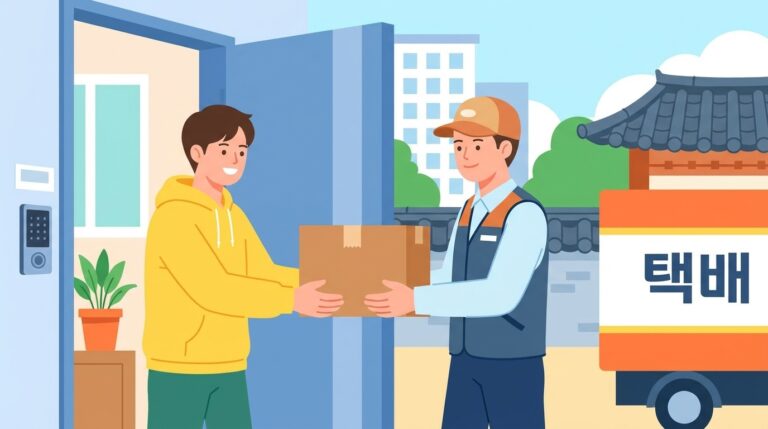
- K-Culture Moment: In Korea’s super-fast delivery ecosystem, couriers usually pick up returns directly from your doorstep!
- Editor’s Insight: 회수 means ‘retrieval/collection’. Asking with -나-yo? sounds warm and inquisitive rather than aggressive.
- Situation Spectrum: Casual ⚠️ | Semi-formal ✅ | Formal ✅
- 🤔 Think About It: Doorstep pickup (문 앞 회수) is standard in Korea, reflecting the high-trust, fast-paced logistics culture.
Phase 3: Textbook Korean vs. Real Korean
Situation 1: Asking to swap sizes in a CS chat
- 📖 Textbook Korean: 이것을 다른 크기로 바꾸어 주십시오. (I-geos-eul da-reun keu-gi-ro ba-kku-eo ju-sip-si-o.)
- 🗣️ Real Korean: 저… 사이즈 변경 가능한가요? (Jeo… sa-i-ju byeon-gyeong gan-eung-han-ga-yo?)
- 💡 Why different? Textbook Korean uses heavy formal endings rarely typed in modern chat boxes. Real Koreans use soft starters (저…) and noun-focused expressions (변경 가능한가요? = Is a change possible?).
Situation 2: Asking about exchange shipping fees
- 📖 Textbook Korean: 교환 배송료는 얼마입니까? (Gyo-hwan bae-song-ryo-neun eol-ma-im-ni-kka?)
- 🗣️ Real Korean: 교환 배송비는 얼마인가요? (Gyo-hwan bae-song-bi-neun eol-ma-in-ga-yo?)
- 💡 Why different? While 배송료 is correct, native speakers almost universally say 배송비 (delivery fee) in online chat inquiries.
Phase 4: K-Culture Deep Dive & Non-verbal Manners
4-1. Nunchi & Online Manner Etiquette
When exchanging items online in Korea, fast communication is appreciated, but polite tone marks high Nunchi (social intuition). Always start your message with a quick greeting like “안녕하세요!” before jumping into your request. When returning the item, neatly repackage it and leave it right outside your door (문 앞).
4-2. Culture Code: Korea’s Doorstep Exchange System
Korea’s e-commerce ecosystem is famous for its ‘Rocket Return’ and automated door-to-door courier service. You don’t need to visit a post office! Once you request an exchange in an app like Musinsa or Coupang, the courier rider will pick up the package right from your doorstep, often within 24 to 48 hours.
Phase 5: Real Roleplay Scenario
Setting: Chatting with a Customer Service Representative (고객센터) on a Korean clothing shopping app.
- CS Staff (NPC): 안녕하세요! 무엇을 도와드릴까요? (Hello! How can I help you today?)
- Learner: 🎭 [Politely typing] 안녕하세요. 옷 사이즈를 바꾸고 싶어요. (Hello. I want to change the clothes size.)
- CS Staff: 네, 고객님! 주문번호와 원하시는 사이즈를 알려주세요. (Sure! Please let us know your order number and desired size.)
- Learner: 🎭 [Checking order info] 주문번호는 1234이고, M 사이즈로 교환해 주세요. (Order number is 1234, and please exchange it to size M.)
- CS Staff: 네, M 사이즈 재고 있습니다. 상품은 문 앞에 놓아주시겠어요? (Yes, size M is in stock. Could you place the item in front of your door?)
- Learner: 🎭 [Confirming doorstep pickup] 네, 문 앞에 두겠습니다. 택배 회수가 언제 오나요? (Yes, I will leave it at the door. When will the courier pickup come?)
- CS Staff: 내일 오전에 방문할 예정입니다. 교환 배송비 5,000원이 발생합니다. (They are scheduled to visit tomorrow morning. An exchange shipping fee of 5,000 KRW will apply.)
- Learner: 🎭 [Understanding fees] 네, 알겠습니다. 감사합니다! (Yes, understood. Thank you!)
🔀 Interactive Choice Point
The CS representative asks: “교환 사유가 상품 하자입니까, 단순 변심입니까?” (Is the exchange reason a product defect or simple change of mind?)
* Option A: 그냥 마음에 안 들어요. (I just don’t like it.)
* Option B: 사이즈가 안 맞아서 단순 변심 교환이에요. (The size doesn’t fit, so it’s a change of mind exchange.)
* Option C: 옷이 파손되었어요! 너희 실수야! (The clothes are damaged! It’s your mistake!)
Feedback:
* Best Choice (Option B): Accurate, clear, and polite! Clearly stating 단순 변심 (change of mind) helps calculate shipping fees correctly without conflict.
* Bad Choice (Option A): Too blunt. It might sound slightly informal or blunt in customer service settings.
* Risk Choice (Option C): Accusatory tone. Even if an item is damaged, Korean CS prefers a polite statement like “상품에 하자가 있어요” (There is a defect in the product).
Phase 6: 10-Second Emotion Shadowing Drill
[🥺 Politely & Hesitantly]안녕하세요… / 사이즈 변경 / 가능한가요? (An-nyeong-ha-se-yo… / sa-i-ju byeon-gyeong / gan-eung-han-ga-yo?)[😊 Friendly & Clear]M 사이즈로 / 교환해 주세요! (M sa-i-ju-ro / gyo-hwan-hae ju-se-yo!)[🤔 Curious]택배 회수가 / 언제 오나요? (Taek-bae hoe-su-ga / eon-je o-na-yo?)
Phase 7: K-Culture Mini Dictionary
- 교환 (Gyo-hwan) | Exchange | Swapping an item for a different size, color, or item.
- 반품 (Ban-pum) | Return / Refund | Returning the product completely to get a money refund.
- 배송비 (Bae-song-bi) | Shipping Fee | Delivery cost, usually around 3,000 ~ 6,000 KRW for returns/exchanges.
- 고객센터 (Go-gaek-sen-teo) | Customer Support Center | The CS help desk on apps and websites.
Phase 8: Survival Kit for Travelers & Expats
Top 3 Survival Expressions
- 교환 신청하고 싶어요. (I want to request an exchange.) – Gyo-hwan sin-cheong-ha-go si-peo-yo. (Pro Tip: Type this in any chat support window to start!)
- 문 앞에 두었습니다. (I left it in front of the door.) – Mun ap-e du-eos-seub-ni-da. (Pro Tip: Send a quick picture of the box outside your apartment!)
- 다른 색상 있어요? (Do you have another color?) – Da-reun saek-sang is-seo-yo?
Editor’s Travel Note
If you live in or visit Korea, downloading shopping apps like Musinsa or Coupang makes local life super convenient. Check out our guide on how to install and navigate Naver Shopping app usage guide for easy local e-commerce registration!
Phase 9: One Step Deeper (Culture Reflection)
In Korea, customer service is built around speed and convenience. The term 단순 변심 (simple change of mind) is a standard legal and commercial term used on every e-commerce platform. Korean society values clear communication of reasons so that logistics can move smoothly without delay. Understanding these specific shopping terms reflects how deeply convenience culture (편의 문화) is integrated into daily lifestyle.
💬 Your Turn: Have you ever ordered clothes online in Korea or from a K-fashion store? What size or color exchange expression do you think you will use first? Let us know in the comments below!
Phase 10: FAQ & Common Mistakes
Q: What is the difference between 교환 (Gyo-hwan) and 반품 (Ban-pum)?
A: 교환 means exchanging the item for another size or color, while 반품 means returning the item entirely to receive a full refund.
Q: Who pays for the exchange shipping fee (교환 배송비)?
A: If it’s due to a size/color change (단순 변심), the customer pays. If the item is defective (상품 하자), the seller pays.
Q: Can I exchange items bought during flash sales?
A: Usually yes, but some clearance sales (마감 세일) might state “교환 불가” (No exchange allowed) in small text.
🚨 Common Mistakes TOP 3
- Mistake: Saying “환불해 주세요” when you actually want a size swap.
- Correct Action: Use 교환 (Exchange), not 환불 (Refund).
- Mistake: Forgetting to write the order number (주문번호).
- Correct Action: Always provide your name and order number first in chat.
- Mistake: Using overly informal Korean (바꿔줘).
- Correct Action: Use polite forms like -해 주세요 when talking to CS staff.
Phase 11: Action Mission
- 🥉 Bronze: Practice saying “사이즈를 바꾸고 싶어요” out loud 3 times in front of a mirror.
- 🥈 Silver: Write a mock exchange message in Korean in the comments of this post!
- 🥇 Gold: Open a Korean shopping app or website and locate the ‘교환 신청’ (Request Exchange) button on a product page.
🎮 K-Culture Mission: Watch a vlog of a Korean fashion haul on YouTube and spot when they mention 교환 or 택배!
Phase 12: Interactive Quiz Challenge
Quiz 1. Situation Judgment
You received an XL shirt, but you need a Large. What should you tell customer service?
* A) 반품해 주세요.
* B) L 사이즈로 교환해 주세요.
* C) 배송비를 주세요.
🔍 Click to view Answer & Explanation
Correct Answer: B) L 사이즈로 교환해 주세요.
Explanation: Option B correctly requests an exchange to size L. Option A asks for a refund, and Option C asks for delivery money!
Quiz 2. Fill in the Blank
택배 ______가 언제 오나요? (When does the courier pickup come?)
* A) 회수 (hoe-su)
* B) 주문 (ju-mun)
🔍 Click to view Answer & Explanation
Correct Answer: A) 회수 (hoe-su)
Explanation: 회수 means retrieval or collection of parcels.
Quiz 3. True or False
In Korea, you usually have to take your package to a post office to complete an online shopping exchange. (True / False)
🔍 Click to view Answer & Explanation
Correct Answer: False!
Explanation: Most Korean shopping platforms arrange doorstep retrieval (문 앞 회수) directly via courier services!







