

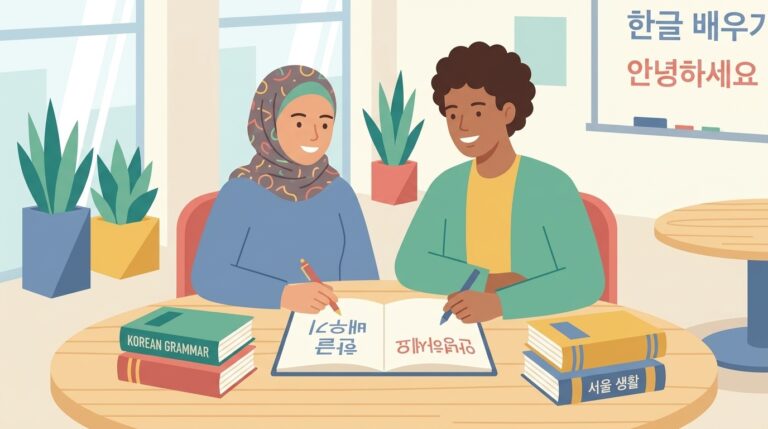
Phase 1: Empathy (Opening Story)
안녕하세요! I’m your Daily Hangul editor and your personal Korean culture navigator! Have you ever sat in a Korean class or language meetup when the teacher suddenly claps their hands and smiles warmly, saying, “자, 짝과 함께 하세요!” (Now, please work with a partner!)? Immediately, your mind goes blank. Your heart beats faster. You look to your left, then to your right. Everyone seems to be making eye contact, pairing up smoothly, while you sit there wondering, “What do I even say to ask someone to be my partner in Korean?”
Don’t worry! This is the exact moment every Korean learner faces at the A1 beginner level. Partner work is not just about finishing a language drill; it is your very first taste of Korean team culture and building social connection! In Korea, doing things together—whether studying, eating, or completing classroom tasks—is deeply rooted in our daily life. In this guide, based on real classroom experiences and feedback from hundreds of beginner students, you will learn 3 ultra-simple, natural phrases that will transform those awkward silences into friendly warm-ups. By the end of this post, you’ll feel confident turning to your classmate, smiling, and starting your partner exercise with total ease!
Phase 2: Deep Dive into 3 Core Expressions
1. 같이 해요 (Gachi haeyo)
- Pronunciation: [Ga-chi hae-yo] (Sounds like “gah-chee” similar to ‘gotcha’ without the ‘a’, plus ‘hae-yo’)
- Meaning: “Let’s do it together.” (Literal: Together do)
- K-Culture Moment: You will hear this phrase constantly in Korean reality shows like Running Man whenever team members partner up for a mission, or in K-dramas when coworkers head out to grab lunch together.
- Editor’s Insight: This is your magic key! Instead of struggling with long grammar structures, saying “같이 해요” with a warm smile is the warmest, most natural way to invite someone to pair up with you.
- Situation Spectrum: Casual ⚠️ | Semi-formal ✅ | Formal ✅
- 🤔 Think About It: In English, we often ask “Do you want to be my partner?” as a question. In Korean, proposing a shared action (“Let’s do it together!”) feels much warmer and more natural.
2. 제 짝이에요 (Je jjag-ieyo)
- Pronunciation: [Je jjak-i-e-yo] (Pronounce ‘jjak’ with a sharp, crisp ‘jj’ sound like ‘jack’ with extra energy)
- Meaning: “This is my partner.” (Literal: [This person] is my partner)
- K-Culture Moment: In Korean elementary schools and idol variety shows, your assigned partner is called your ‘짝’ (Jjak). It carries a sweet sense of camaraderie!
- Editor’s Insight: Use this when the teacher asks who your partner is, or when introducing your study buddy to someone else in class.
- Situation Spectrum: Casual ⚠️ | Semi-formal ✅ | Formal ✅
- 🤔 Think About It: The word ‘짝’ also means ‘one of a pair’ (like a pair of shoes). Calling someone your ‘짝’ implies you complete the pair together!
3. 준비됐어요? (Junbi-dwaesseoyo?)
- Pronunciation: [Joon-bi dwae-sseo-yo?]
- Meaning: “Are you ready?”
- K-Culture Moment: Heard right before starting games in K-Pop group web series, performance rehearsals, or before starting a timed classroom test.
- Editor’s Insight: Perfect right after you form a pair! Asking “준비됐어요?” shows great manners and checks if your classmate is ready to speak.
- Situation Spectrum: Casual ⚠️ | Semi-formal ✅ | Formal ✅
- 🤔 Think About It: Checking in on your partner’s readiness builds rapport and lowers anxiety for both of you before practicing out loud.
Phase 3: Textbook Korean vs. Real Korean
Situation 1: Asking someone to pair up
- 📖 Textbook Korean: 저와 함께 짝을 이루시겠습니까? (Jeo-wa ham-kke jjak-eul i-ru-si-gett-seumb-ni-ka? / Would you care to form a partnership with me?)
- 🗣️ Real Korean: 같이 해요! (Gachi haeyo! / Let’s do it together!)
- 💡 Why is it different? Textbook phrases are often overly formal or literary. In a real Korean classroom, simple and friendly everyday verbs make you sound much more approachable.
Situation 2: Starting your turn
- 📖 Textbook Korean: 제가 먼저 시작하겠습니다. (Je-ga meon-jeo si-jak-ha-geoss-seumb-ni-da. / I shall commence first.)
- 🗣️ Real Korean: 제가 먼저 할게요! (Je-ga meon-jeo hal-ge-yo! / I’ll go first!)
- 💡 Why is it different? While the textbook version is used in formal speeches, “제가 먼저 할게요” is the standard conversational way to take initiative politely.
Phase 4: K-Culture Deep Dive & Non-Verbal Manners
4-1. Nunchi (눈치) & Gestures
When working with a Korean partner or classmate, non-verbal cues matter just as much as words!
* Eye Contact & Nodding: Make gentle eye contact, give a slight bow (nodding your head forward about 15 degrees), and point lightly toward your worksheet.
* Two-Handed Courtesy: When handing a pen or textbook to your partner, use two hands (or support your right elbow with your left hand). This shows respect and good manners.
4-2. Culture Code: Team Culture (우리)
In Korea, the concept of 우리 (Uri – We/Our) is deeply cherished. When teachers say “짝과 함께 하세요,” it’s an invitation to build ‘우리’ energy. Working together isn’t a competition; helping your partner pronounce a tricky word creates an instant bond!
Phase 5: Practical Roleplay Scenario
Setting: A vibrant Korean language classroom in Seoul. Your teacher just asked everyone to pair up for a speaking activity.
NPC Character: Minji (a friendly classmate sitting next to you).
- Turn 1: Minji: 🎭 (Looks around nervously holding a textbook) 어… 짝이 없어요. (Uh… I don’t have a partner.)
- Turn 2: You: 🎭 (Smiling warmly and turning toward Minji) 저기요! 같이 해요. (Excuse me! Let me do it with you / Let’s do it together.)
- Turn 3: Minji: 🎭 (Brightens up with a big smile) 아, 좋아요! 같이 해요! (Oh, great! Let’s do it together!)
- Turn 4: You: 🎭 (Points gently at the textbook) 준비됐어요? (Are you ready?)
- Turn 5: Minji: 🎭 (Nods quickly) 네, 준비됐어요! 누가 먼저 해요? (Yes, I’m ready! Who goes first?)
- Turn 6: You: 🎭 (Raises hand slightly) 제가 먼저 할게요. (I will go first.)
- Turn 7: Minji: 🎭 (Claps lightly) 네, 좋아요! 시작하세요. (Yes, good! Please start.)
- Turn 8: You: 🎭 (Gives a confident thumbs up) 네! 같이 연습해요. (Yes! Let me practice together with you.)
🔀 Interactive Choice Point
Minji looks a bit confused by exercise question #2. What do you say?
- Option A: 같이 봐요! (Gachi bwayo! / Let me look at it together with you!)
- Option B: 왜 몰라요? (Wae mollayo? / Why don’t you know?)
- Option C: 혼자 하세요. (Honja haseyo. / Please do it alone.)
Feedback:
* Option A (BEST ✅): Perfect! “같이 봐요” shows great teamwork and empathy. Minji will appreciate your kindness.
* Option B (RISK ⚠️): Too direct! Asking “Why don’t you know?” can sound offensive or embarrassing to your partner.
* Option C (BAD 🚫): Ouch! Rejecting your partner defeats the purpose of “짝과 함께 하세요”!
Phase 6: 10-Second Emotion Shadowing Drill
Practice saying these lines out loud with the designated emotion for maximum memory retention!
[😊 Friendly & Welcoming]같이 / 해요! (Ga-chi / hae-yo!)[🙋♂️ Eager & Confident]제가 / 먼저 / 할게요! (Je-ga / meon-jeo / hal-ge-yo!)[✨ Supportive & Enthusiastic]좋아요! / 같이 / 연습해요! (Jo-a-yo! / ga-chi /yeon-seub-hae-yo!)
Phase 7: K-Culture Mini Dictionary
- 짝 (Jjak) | Partner/Pair | Used for study partners, soulmates (생애의 짝), or matching pairs.
- 선생님 (Seonsaengnim) | Teacher | The essential title used to address any instructor politely in Korea.
- 연습 (Yeonseub) | Practice | Essential classroom word! Often combined as “연습해요” (Let’s practice).
- 화이팅 (Hwaiting) | Fighting / Let’s do this! | The ultimate encouragement phrase used before starting a task together.
Phase 8: Student & Traveler Survival Kit
Top 3 Survival Phrases
- 천천히 말해 주세요. (Cheon-cheon-hi mal-hae ju-se-yo.) — Please speak slowly. (Pro Tip: Use this when your partner speaks too fast!)
- 한 번 더해 주세요. (Han beon deo-hae ju-se-yo.) — Please do it one more time. (Pro Tip: Great for repeating dialogues.)
- 맞아요! (Maj-a-yo!) — That’s right! (Pro Tip: Nod enthusiastically when your partner gets the answer right!)
Editor’s Travel & Classroom Note
If you are attending Korean language courses in Korea, keep your class schedule and campus maps handy! You can easily check transport routes to your language institute by installing the Naver Map Navigation App.
Phase 9:
Frequently Asked Questions (FAQ)
Q: What does "같이 해요 (Gachi haeyo)" mean in Korean and how do you pronounce it?
A: In Korean, "같이 해요 (Gachi haeyo)" is pronounced [Ga-chi hae-yo] and means: "Let's do it together." (Literal: Together do)
Q: What does "제 짝이에요 (Je jjag-ieyo)" mean in Korean and how do you pronounce it?
A: In Korean, "제 짝이에요 (Je jjag-ieyo)" is pronounced [Je jjak-i-e-yo] and means: "This is my partner." (Literal: [This person] is my partner)
Q: What does "준비됐어요? (Junbi-dwaesseoyo?)" mean in Korean and how do you pronounce it?
A: In Korean, "준비됐어요? (Junbi-dwaesseoyo?)" is pronounced [Joon-bi dwae-sseo-yo?] and means: "Are you ready?"






