

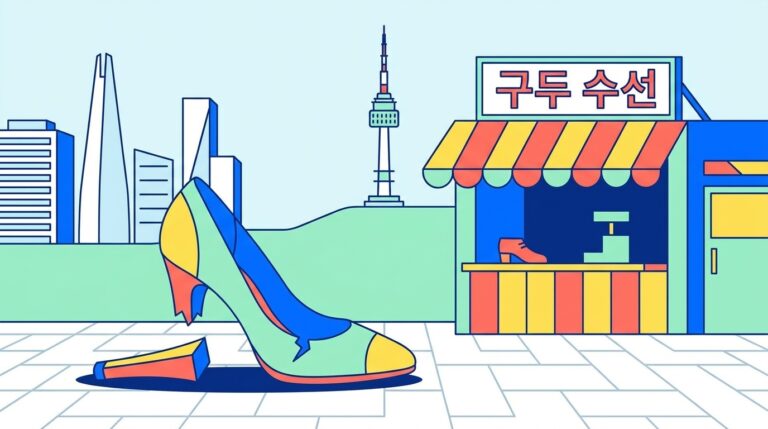
Broken Heel in Seoul? Master Korean Shoe Emergency Phrases
Phase 1: Empathy (Story-Driven Opening)
안녕하세요! I am your Daily Hangul Editor! Imagine walking gracefully down the bustling, aesthetic streets of Seongsu-dong or Hongdae. You are wearing your favorite outfit, taking aesthetic photos for Instagram, feeling like the lead character in a romantic K-Drama. Suddenly—SNAP! Your body tilts violently to the left. People turn around. You look down in horror, only to realize that the heel of your favorite pump or boot has completely snapped off!
Navigating a wardrobe malfunction in a foreign country can feel utterly terrifying, especially when you need to find a shoe repair booth (구두 수선대) or explain what happened to a local cobbler. But don’t panic! Today, we are turning this fashion disaster into your ultimate Korean learning milestone. Based on real feedback from intermediate learners who survived unexpected urban mishaps in Seoul, this guide will equip you with authentic, context-rich expressions. By the end of this post, you won’t just know how to get your shoes fixed; you will handle fashion emergencies with the smooth confidence of a native speaker!
Phase 2: Core Phrases Deep Dive
1. 굽이 부러졌어요 (Gubi bureojyeosseoyo)
- Pronunciation: [Gub-ee boo-reo-jyeos-seo-yo] (Sounds like “Goob-ee” as in ‘goofy’, followed by “boo-row-jyuoss-oh-yo”)
- Meaning: Literal: “The heel got broken.” | Nuance: “My heel snapped off!”
- K-Culture Moment: You often see this dramatic cliché in K-Dramas where the female lead snaps her heel right before an important meeting, leading to the male lead buying her comfortable sneakers.
- Editor’s Insight: ‘굽’ (gup) refers specifically to the heel of a shoe. ‘부러지다’ is used when rigid objects like bones, sticks, or pencil leads snap or break.
- Situation Spectrum: Casual: ⚠️ | Semi-formal: ✅ | Formal: ✅
- 🤔 Think About It: In English, we say “I broke my heel,” implying subject-action. Korean passive form ‘부러졌어요’ highlights the state of the object rather than taking personal blame. Why do you think Korean passive verbs are preferred in embarrassing situations?
2. 신발을 수선하고 싶어요 (Sinbareul suseonhago sipeoyo)
- Pronunciation: [Shin-ba-reul soo-seon-ha-go shi-peo-yo] (Sounds like “Shin-ba-reul” like ‘shin’ + ‘bar’, “soo-seon” like ‘sue-son’)
- Meaning: Literal: “I want to repair my shoes.” | Nuance: “I’d like to get my shoes fixed.”
- K-Culture Moment: Walking up to small, red street kiosks (구두 수선) near Seoul subway exits to ask the friendly ‘Ajeossi’ (middle-aged man) for a quick fix.
- Editor’s Insight: While ‘수리’ (suri) is used for electronics and machinery, ‘수선’ (suseon) is specifically used for fashion items like clothes, bags, and footwear.
- Situation Spectrum: Casual: ⚠️ | Semi-formal: ✅ | Formal: ✅
- 🤔 Think About It: Notice how Korean uses dedicated words for fixing different objects (수리 vs 수선). How does your native language differentiate repair terms?
3. 근처에 구두 수선소가 있나요? (Geuncheoe gudu suseonso-ga innayo?)
- Pronunciation: [Geun-cheo-e goo-doo soo-seon-so-ga een-na-yo?] (‘Geun’ sounds like ‘gun’, ‘cheo’ like ‘chuh’)
- Meaning: Literal: “Is there a shoe repair shop nearby?” | Nuance: “Do you know if there’s a shoe repair place around here?”
- K-Culture Moment: Asking a polite convenience store clerk when your smartphone battery is dead and you cannot look up maps.
- Editor’s Insight: ‘구두’ (gudu) specifically refers to dress shoes, leather shoes, or heels, distinct from ‘운동화’ (undonghwa – sneakers).
- Situation Spectrum: Casual: 🚫 | Semi-formal: ✅ | Formal: ✅
- 🤔 Think About It: Koreans frequently ask about facilities using ‘근처’ (nearby). It invites local helpful advice rather than strict directional navigation.
Phase 3: Textbook Korean vs Real Korean
Situation 1: Explaining that your heel snapped
- 📖 Textbook Korean: 제 구두의 뒤축이 파손되었습니다. (Je gudu-ui dwichugi paseondeo-essseumnida.)
- 🗣️ Real Korean: 아, 어떡해요! 구두 굽이 완결 부러졌어요. (A, eotteokhaeyo! Gudu gubi wanjeon bureojyeosseoyo.)
- 💡 Why the Difference? The textbook sentence uses super stiff business terminology like ‘파손’ (damage/breakage) and ‘뒤축’ (rear heel). Native Koreans use ‘완전’ (totally/completely) and ‘어떡해요’ (oh no, what should I do) to express immediate shock and reality.
Situation 2: Asking how long a repair will take
- 📖 Textbook Korean: 수선 작업에 얼마나 많은 시간이 소요됩니까? (Suseon jageobe olmana maneun sigani so-yodeo-imnikka?)
- 🗣️ Real Korean: 이거 고치는 데 얼마나 걸려요? (Igeo gochineun de olmana geollyeoyo?)
- 💡 Why the Difference? ‘고치다’ (to fix) is a versatile everyday verb preferred over rigid nouns like ‘수선 작업’. ‘얼마나 걸려요?’ is the quintessential phrase for asking time duration in Korea.
Phase 4: K-Culture Deep Dive & Non-Verbal Manners
4-1. Nunchi (눈치) & Gestures in Shoe Emergencies
When your heel snaps on a public walkway, Korean ‘Nunchi’ (social awareness) calls for subtle composure. Rather than panicking loudly, step softly onto your toes to keep your balance. When approaching a local cobbler (구두 수선 아저씨), bow lightly at a 15-degree angle while holding your damaged shoe in both hands. Handing items with both hands (두 손으로 드리기) demonstrates respect and politeness.
4-2. Cultural Code: Seoul’s Hidden Cobbler Booths
In Korea, especially around busy subway stations in Seoul (like Gangnam, Myeongdong, or Euljiro), you will notice tiny red or brown street booths roughly the size of a newspaper stand. These are official street cobblers (구두 수선대). They offer lightning-fast, high-quality heel replacements and shoe shines for amazingly affordable prices (usually around 5,000 to 10,000 KRW). Knowing this cultural secret turns a crisis into an authentic local adventure!
Phase 5: Real-Life Roleplay Scenario
Setting: A street cobbler booth near Seongsu Station exit 3. You walk in hopping slightly on one foot.
Characters: You (Learner), Cobbler (Ajeossi – Master Repairer)
- Turn 1 (You): 🎭 [Slightly embarrassed, pointing to shoe] 사장님, 안녕하세요! 걸어가다가 굽이 부러졌어요. (Sajangnim, annyeonghaseyo! Georeogadaga gubi bureojyeosseoyo.) – Hello master! My heel broke while I was walking.
- Turn 2 (Cobbler): 🎭 [Looks over glasses, inspects shoe] 아이구, 많이 놀랐겠네. 어디 봐요. 굽이 아예 빠졌네! (Aigu, mani nollatgenne. Eodi bwayo. Gubi aaye ppajienne!) – Oh dear, you must have been surprised. Let me see. The heel completely came off!
- Turn 3 (You): 🎭 [Worried face, checking watch] 오늘 중요한 약속이 있는데, 금방 고칠 수 있나요? (Oneul jungyo-han yaksogi inneunde, geumbang gochil su innayo?) – I have an important appointment today, can you fix it quickly?
- Turn 4 (Cobbler): 🎭 [Nodding confidently, tapping workbench] 그럼요! 10분이면 돼요. 잠깐 저기 의자에 앉아 계세요. (Geureomyo! Sipsibunimyeon dwaeyo. Jamkkan jeogi uijae anja gyeseyo.) – Of course! 10 minutes is all it takes. Have a seat over there for a moment.
- Turn 5 (You): 🎭 [Relieved smile, taking seat] 정말 다행이에요! 혹시 얼마예요? (Jeongmal dahaeng-ieyo! Hoksi eolmayaeyo?) – What a relief! How much will it be?
- Turn 6 (Cobbler): 🎭 [Holds up seven fingers] 양쪽 굽 다 튼튼한 걸로 갈아줄게요. 7천 원이에요. (Yangjjok gup da teunteunhan geollo garajulgeyo. Chil-cheon won-ieyo.) – I’ll replace heels on both shoes with sturdy ones. That will be 7,000 won.
- Turn 7 (You): 🎭 [Handing over card or cash with both hands] 네, 잘 부탁드립니다! 카드로 계산해도 되나요? (Ne, jal 부탁deureimnida! Kaduro gyesanhaedo dwaenayo?) – Great, please take good care of it! Can I pay by card?
- Turn 8 (Cobbler): 🎭 [Smiles warmly, receiving card] 네, 됩니다! 금방 해드릴게요. (Ne, dwaeyo! Geumbang haedeurilgeyo.) – Yes, you can! I’ll get it done right away.
🔀 Interactive Choice Point
What should you say after the repair is completed to show genuine gratitude like a true local?
- Option A: 감사합니다! 새 신발 같아요! (Gamsahamnida! Sae sinbal gat-a-yo!) — “Thank you! It feels like a brand new shoe!”
- Option B: 수고하셨습니다. 안녕히 계세요. (Sugohaseosseumnida. Annyeonghi gyeseyeo.) — “Thank you for your hard work. Goodbye!”
- Option C: 너무 늦게 고쳐주셨네요. (Neomu neutge gochyeojusyeotneyeo.) — “You fixed it too late.”
Feedback:
* Best Choice (Option A): Perfect! Expressing that the repair made your shoe look new delights the cobbler and shows high Korean conversational fluency.
* Good/Safe Choice (Option B): Polite and respectful. ‘수고하셨습니다’ acknowledges their effort properly.
* Risk Choice (Option C): Rude! Avoid complaining, especially when the repair was done rapidly on short notice.
Phase 6: 10-Second Emotion Shadowing Drill
Practice saying these lines with pitch, pauses (/), and natural emotion!
[🥺 Flustered & Sad]저기요… / 구du 굽이 / 부러졌어요… / 어떡하죠? (Jeogiyo… / gudu gubi / bureojyeosseoyo… / eotteokhajo?)[😮 Bold & Inquiring]혹시 / 근처에 / 구두 수선소 / 어디 있는지 / 아세요? (Hoksi / geuncheoe / gudu suseonso / eodi inneun-ji / aseyo?)[😊 relieved & Happy]와! / 완전 새 신발처럼 / 됐네요! / 정말 감사합니다! (Wa! / wanjeon sae sinbal-cheoreom / dwaenneyeo! / Jeongmal gamsahamnida!)
Phase 7: K-Culture Mini Dictionary
- 구두 수선대 (Gudu Suseondae) | Shoe Repair Stand | Small street kiosks in urban Korea where masters fix soles, heels, zippers, and polish shoes.
- 삼다수 삼선슬리퍼 (Samseon Seullipeo) | Three-stripe Slippers | Famous blue or black rubber slides found at any Korean convenience store for temporary shoe emergencies.
- 양말 (Yangmal) | Socks | Essential footwear accessory in Korea, especially since you must remove shoes at traditional restaurants or homes.
- AS (A-Ae-Seu) | After-Service / Customer Repair | Korean abbreviation for repair or maintenance services for products, including brand-name shoes.
Phase 8: Traveler’s Survival Kit
Top 3 Survival Phrases
- 슬리퍼 하나 주세요. (Seullipeo hana juseyo.) – Please give me one pair of slippers. (Use at convenience stores when your shoes break completely!)
- 테이프 있나요? (Teipu innayo?) – Do you have tape? (For emergency temporary holding).
- 계좌이체 되나요? (Gyejwa-iche dwaenayo?) – Can I pay via bank transfer? (Street stands sometimes prefer cash or direct transfer if card machines are offline).
Editor’s Travel Note
When your heel breaks in Korea, open your phone immediately! We strongly recommend checking the Naver Map app download to search for “구두수선” (Shoe Repair). Unlike Western map services, Naver Map accurately pinpoints tiny street booths and local shoe repair stands scattered throughout Seoul!
Phase 9: A Deeper Look (Cultural Insight)
In Korean fashion culture, neatness and presentation (단정함) are deeply valued. Walking around with a broken heel or dragging sole isn’t just uncomfortable; it makes locals feel empathetic towards your situation because appearance is respected as social etiquette. That is why shoe repair kiosks are strategically located near transit hubs, ensuring people can maintain their style seamlessly.
💬 Your Turn: Have you ever experienced a hilarious or terrifying fashion emergency while traveling abroad? Share your story in the comments below!
Phase 10: FAQ & Common Mistakes
Q: Can street cobblers in Korea fix high-end designer brands?
A: Yes! Many street cobblers in Seoul have 20 to 40 years of leather repair experience. However, for luxury warranty retention, visit an official department store (백화점) customer service desk.
Q: What should I do if my heel breaks in the middle of a night out in Hongdae?
A: Shoe repair stands close around 7-8 PM. Go straight to a 24-hour convenience store (CU, GS25, Seven Eleven) and buy cheap rubber slides (삼선슬리퍼) for around 3,000 to 5,000 KRW.
Q: How much does heel replacement normally cost?
A: Standard heel tip replacement usually costs between 5,000 KRW and 10,000 KRW cash.
🚨 Common Mistakes Warning Board
- Mistake 1: Calling sneakers ‘구두’ (Gudu).
- Correct Action: Use ‘운동화’ (Undonghwa) for sneakers and reserve ‘구두’ for formal leather/dress heels.
- Mistake 2: Saying ‘수리해주세요’ for clothes/shoes.
- Correct Action: Use ‘수선해주세요’ (Suseon-hae-juseyo) for fashion items.
- Mistake 3: Expecting card payment at every tiny street stand.
- Correct Action: Keep 10,000 KRW in cash ready when visiting street booths.
Phase 11: Action Mission & Engagement
3-Step Action Mission
- 🥉 Bronze: Record yourself saying “구두 굽이 부러졌어요” three times with emotion.
- 🥈 Silver: Find a Korean shoe repair stand on Naver Map and bookmark it.
- 🥇 Gold: Use “신발 수선” in a real practice sentence in your next Korean class or comment section!
🎮 K-Culture Mission
Watch a K-Drama episode and spot a scene where characters change shoes or visit a street stand. Notice what slippers they buy from the convenience store!
Phase 12: Interactive Quiz Challenge
Test your knowledge! Click on the spoiler toggle below to reveal the correct answers.
- What is the specific Korean word for repair used for fashion items like shoes and clothes?
- True or False: ‘구두’ (Gudu) refers to running sneakers.
- What is the best app to search for local street cobblers in Seoul?
👉 Click here to check the Answers & Explanations!
- Answer: 수선 (Suseon). While ‘수리’ is for electronics, ‘수선’ is used for fashion and textiles.
- Answer: False. Sneakers are called ‘운동화’ (Undonghwa); ‘구두’ refers to dress shoes/heels.
- Answer: Naver Map (네이버 지도). It accurately indexes small local street booths across Korea!







