

Phase 1: Empathy (Story-based Opening)
안녕하세요! 매일한글 에디터입니다. Have you ever stood in line at a bustling convenience store in Hongdae or sat at a cozy cafe in Seongsu-dong, ready to pay, only to be hit with a barrage of rapid-fire questions from the cashier?
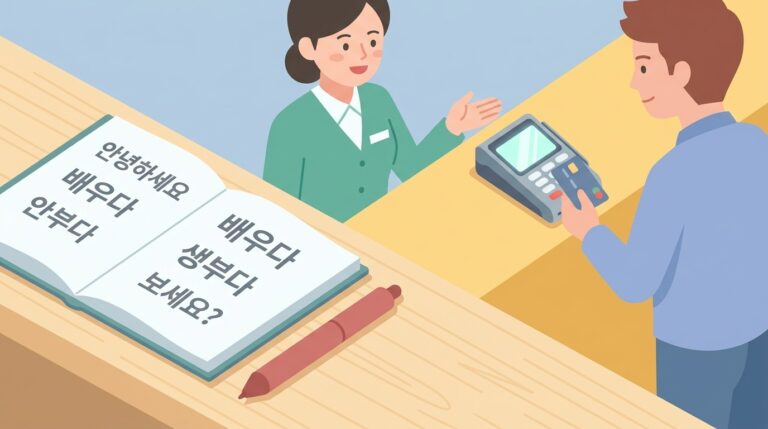
picture this: You pull out your plastic card, hand it over to buy your beloved Iced Americano and a K-drama style triangle gimbap. The cashier looks up and quickly asks, “체크카드로 하시겠어요, 신용카드로 하시겠어요?” (Would you like to pay with a check card or a credit card?) or “일시불로 해드릴까요?” (Shall I process it as a single payment?). You freeze. In your home country, a card is just a card, or at least you tap it without thinking about the underlying financial mechanics!
Navigating Korea’s payment culture can feel like an unexpected obstacle course, especially when terms like 체크카드 (Check Card / Debit Card) and 신용카드 (Credit Card) carry unique cultural and practical implications in everyday life. Understanding this distinction isn’t just about grammar—it’s your key to hassle-free shopping, snagging discounts, and feeling like a true local insider. Based on feedback from hundreds of intermediate Korean learners, this guide is crafted to clear up the confusion once and for all so you can step up to any Korean register with complete confidence!
Phase 2: Core Expressions Deep Dive
1. 체크카드 (Che-keu-ka-deu)
- Pronunciation: [che-keu-ka-deu] (Sounds like saying “Check Card” with a distinct Korean vowel pop at the end!)
- Meaning: Literal: Check Card | Real Nuance: Debit Card linked directly to a Korean bank account where money is deducted instantly.
- K-Culture Moment: In webtoons and K-dramas, university students and young professionals almost exclusively use their cute, custom-designed character 체크카드 (featuring Kakao Friends or Line Friends) to budget their daily monthly spending.
- Editor’s Insight: Unlike in many Western countries where debit cards are just basic bank cards, Korean 체크카드 come loaded with perks like cash-back on public transportation or movie ticket discounts!
- Situation Spectrum: Casual ✅ | Semi-formal ✅ | Formal ✅
- 🤔 Think About It: Why do you think Korean banks offer so many rewards and trendy pop-art designs for simple debit/check cards compared to your home country?
2. 신용카드 (Sin-yong-ka-deu)
- Pronunciation: [sin-yong-ka-deu] (Notice how ‘sin’ rhymes with ‘seen’, and ‘yong’ flows smoothly)
- Meaning: Literal: Trust/Credit Card | Real Nuance: Credit Card that billing happens at a set monthly date, often allowing installment payments (할부).
- K-Culture Moment: Remember those iconic K-drama scenes where a handsome CEO hands over his sleek black card? That’s the ultimate flex of a 신용카드!
- Editor’s Insight: In Korea, 신용카드 users often take advantage of interest-free installment options (무이자 할부) for larger purchases like electronics or designer clothes.
- Situation Spectrum: Casual ✅ | Semi-formal ✅ | Formal ✅
- 🤔 Think About It: What does the word ‘신용’ (trust/credit) tell us about financial relationships and social standing in Korean society?
3. 일시불로 해주세요 (Il-si-bul-ro hae-ju-se-yo)
- Pronunciation: [eel-shee-bool-roh hae-joo-seh-yoh] (Smoothly glide through ‘il-si-bul’ like one connected word)
- Meaning: Literal: Please do it as a one-time payment | Real Nuance: “I’d like to pay the full amount at once (no installments).”
- K-Culture Moment: When buying something slightly expensive at a retail store or department store, the cashier will almost always ask, “할부로 해드릴까요, 일시불로 해드릴까요?” You respond smoothly with this exact line.
- Editor’s Insight: If you pay with a 체크카드, it is automatically processed as 일시불. However, saying this line proactively makes you sound extremely fluent and experienced.
- Situation Spectrum: Casual ⚠️ | Semi-formal ✅ | Formal ✅
- 🤔 Think About It: In your country, is paying in installments at a cashier standard practice, or is full payment the default?
Phase 3: Textbook Korean vs. Real Native Korean
Situation 1: Choosing your card type at the register
- 📖 Textbook Korean: “저는 체크카드로 결제하겠습니다.” (I will pay with a debit card.)
- 🗣️ Real Native Korean: “체크카드로 계산할게요!” 또는 “체크카드로 할게요!”
- 💡 Why the difference?: While 결제 (settlement/payment) is accurate, native speakers in everyday settings prefer the warmer, natural verb 계산하다 (to pay/calculate) or simply ~로 할게요 (I’ll do with…).
Situation 2: Asking if credit card installments are available
- 📖 Textbook Korean: “신용카드 할부 결제가 가능합니까?”
- 🗣️ Real Native Korean: “신용카드 할부 돼요?” / “혹시 무이자 할부 돼요?”
- 💡 Why the difference?: In daily shopping, using short forms with 돼요? (Is it okay/possible?) lowers formality slightly while keeping it perfectly polite, making interaction fast and practical.
Phase 4: K-Culture Deep Dive & Mannerisms
4-1. Nunchi (눈치) & Gestures
When handing over your card—whether 체크카드 or 신용카드—always hand it with both hands or support your right wrist with your left hand. This subtle gesture shows respect to the clerk. Also, when placing your card on the card reader, wait for the chime sound before pulling it back! Cashiers in fast-paced places like Gangnam appreciate speed, but polite manners never go out of style.
4-2. Cultural Code: Card Discounts & “N-Bang” (N빵)
In Korea, cards are deeply linked with lifestyle perks. Koreans often own specific 체크카드 just for coffee shop discounts or subway rebates. Furthermore, when dining out in groups, paying individually or splitting the bill equally is colloquially called N빵 (N-bang). While one person often pays the bill first with their 신용카드 to collect reward points, everyone else instantly transfers their share via banking apps KakaoPay or Toss!
Phase 5: Real-World Roleplay Scenario
Setting: A trendy electronics shop in Yongsan. You are buying a cute Bluetooth speaker.
NPC Character: Cashier (친절한 점원) – Efficient and friendly.
- Turn 1 (Cashier): 손님, 계산 도와드릴까요? (May I help you pay, customer?)
- Turn 2 (You): 🎭 [Smiling and handing over the speaker with both hands] 네, 이걸로 계산해주세요. (Yes, please process this one.)
- Turn 3 (Cashier): 네, 55,000원입니다. 카드 찍으시거나 넣어주세요. (Sure, that’s 55,000 won. Please tap or insert your card.)
- Turn 4 (You): 🎭 [Inserting card into reader] 체크카드도 괜찮죠? (Debit card is fine, right?)
- Turn 5 (Cashier): 그럼요! 일시불로 결제 도와드릴까요? (Of course! Shall I process it as a full single payment?)
- Turn 6 (You): 🎭 [Nodding politely] 네, 일시불로 해주세요. (Yes, please do it as a single payment.)
- Turn 7 (Cashier): 결제 완료되셨습니다. 영수증 필요하세요? (Payment completed. Do you need a receipt?)
- Turn 8 (You): 🎭 [Taking card back with both hands] 아니요, 괜찮아요. 수고하세요! (No, I’m okay. Thank you, have a great day!)
🔀 Interactive Branch
When the cashier asks: “할부로 해드릴까요, 일시불로 해드릴까요?” How do you respond?
- Option A: “체크카드는 할부 안 되지 않나요? 일시불로 해주세요.”
- Feedback (Best ⭐): Perfect! Demonstrates intermediate understanding of Korean banking rules while giving a natural response.
- Option B: “몰라요, 그냥 아무거나 해주세요.”
- Feedback (Bad ❌): Saying “I don’t know, just do whatever” sounds abrupt and confusing to the clerk.
- Option C: “신용카드니까 12개월 할부로 해주세요!”
- Feedback (Risk ⚠️): Valid if using a credit card, but check if interest fees apply for a 12-month installment!
Phase 6: 10-Second Emotion Shadowing Drill
Practice saying these lines aloud with natural emotion and pause points (/):
[😊 Confident & Friendly]
저기요, / 체크카드로 / 계산할게요!
(Jeo-gi-yo / che-keu-ka-deu-ro / gye-san-hal-geyo!)-
[🤔 Curious & Polite]
혹시 / 신용카드 / 무이자 할부 / 돼요?
(Hok-si / sin-yong-ka-deu / mu-i-ja hal-bu / dwae-yo?) -
[😌 Crisp & Clear]
네, / 일시불로 / 해주세요. / 감사합니다!
(Ne / il-si-bul-ro / hae-ju-se-yo / gam-sa-ham-ni-da!)
Phase 7: K-Culture Mini Dictionary
- 체크카드 (Chekeu Kadeu): Debit card tied directly to bank balance. Zero debt risk, instant withdrawal.
- 신용카드 (Sinyong Kadeu): Credit card allowing deferred payments and multi-month installments.
- 할부 (Hal-bu): Installment payment method spread over months (e.g., 3개월 할부 = 3-month installment).
- 포인트 적립 (Poin-teu Jeok-rip): Accumulating reward points during card transactions—a national obsession in Korea!
Phase 8: Traveler’s Survival Kit
TOP 3 Survival Expressions
- 카드 돼요? (Ka-deu dwae-yo?) = Do you accept cards?
- Pro Tip: Essential at traditional market stalls or small street vendors!
- 영수증은 버려주세요. (Yeong-su-jeung-eun beo-ryeo-ju-se-yo.) = Please throw away the receipt.
- Pro Tip: Use this when you don’t need paper clutter in your wallet.
- IC칩 방향으로 넣어주세요. (I-C-chip bang-hyang-eu-ro neo-eo-ju-se-yo.) = Please insert it IC chip side first.
- Pro Tip: You’ll hear cashiers say this if you try to insert your card upside down!
Editor’s Travel Note
Before travelling to Korea, download bank apps or mobile payment apps. Check out the KB Kookmin Bank Global Service or Naver Map App Download Guide to find local ATM locations that support foreign cards easily!
Phase 9: One Step Deeper (Reflective Essay)
South Korea is virtually a cashless society. From buying a 1,000 won snack to paying for a taxi ride, cards dominate daily life. This rapid transition reflects Korea’s hyper-efficient Pali-Pali (hurry-hurry) culture and trust-based digital infrastructure. However, choosing between a 체크카드 and a 신용카드 isn’t just about money—it reflects personal lifestyle values between living within immediate means versus building long-term financial credit.
💬 Your Turn: Do you prefer using debit cards or credit cards in your daily life, and how does card payment culture in your home country compare to Korea’s cashless setup? Let us know in the comments below!
Phase 10: FAQ & Common Mistakes
Q: Can foreign tourists get a Korean 체크카드 (Debit Card)?
A: Yes! If you hold an Alien Registration Card (ARC) and open a local account at a Korean bank (like Hana, Shinhan, or KB), you can get a 체크카드 issued on the spot.
Q: Can I use my foreign credit card for 할부 (Installments) in Korea?
A: No, installment options (할부) are strictly managed by local Korean card issuers. Foreign cards will always default to single payments (일시불).
Q: What happens if I accidentally ask for 할부 on a 체크카드?
A: Don’t worry! The terminal will automatically process it as 일시불 (full single payment) because debit cards cannot carry balances over time.
🚨 Common Mistakes TOP 3
- Confusing ‘체크’ with ‘Check’ as in written checks: In Korea, 체크 in banking always refers to debit cards, not paper checks (수표).
- Tapping cards too quickly: Korean readers often require inserting the IC chip firmly or holding the contactless card steady for 1-2 seconds.
- Assuming every card works on transit: Make sure your card has the 대중교통 (Public Transit) feature activated before trying to tap into the Seoul subway!
Phase 11: Action Missions
- 🥉 Bronze Level: Practice saying “체크카드로 계산해주세요” out loud 3 times with clear pronunciation.
- 🥈 Silver Level: Share this post on your social media or language learning group with your favorite Korean financial term!
- 🥇 Gold Level: Next time you order at a Korean bakery or store, use “일시불로 해주세요” smoothly like a native speaker.
🎮 K-Culture Mission: Watch a scene from a realistic Korean workplace drama (like Misaeng or Extraordinary Attorney Woo) and spot how characters pay for team lunches using cards!
Phase 12: Interactive Quiz Challenge
Question 1 (Situation Judgment)
You are paying for a 200,000 KRW coat with your Korean debit card (체크카드). What should you say when paying?
– A) “3개월 할부로 해주세요.”
– B) “일시불로 계산해주세요.”
– C) “신용카드로 바꿔주세요.”
Question 2 (Fill in the Blank)
Fill in the blank: “카드 결제할 때 분할 납부하는 방식을 _____(이)라고 합니다.”
Question 3 (True or False)
True or False: Foreign cards can easily use interest-free installments (무이자 할부) at Korean department stores.
🔍 Click here to reveal Answers & Explanations!
- Answer: B
- Explanation: Debit cards (체크카드) can only process single full payments (일시불).
- Answer: 할부
- Explanation: Paying in monthly divided installments is called 할부.
- Answer: False
- Explanation: Installment options are exclusive to domestic Korean card issuers; foreign cards are automatically billed as 일시불.
- Explanation: Installment options are exclusive to domestic Korean card issuers; foreign cards are automatically billed as 일시불.







