

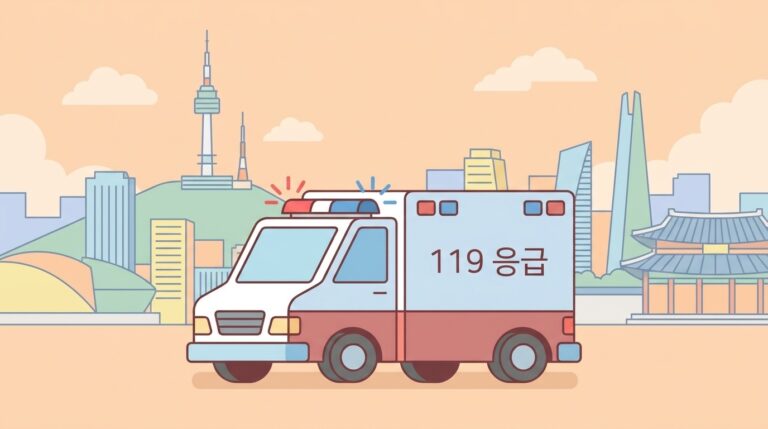
Phase 1: Empathy (Story-Driven Opening)
안녕하세요! I’m your chief editor at Daily Hangul (매일한글), your trusted Korean culture navigator! Imagine walking through the vibrant streets of Hongdae or quiet roads of Jeju after enjoying a delicious street food tour. Suddenly, you hear a loud screech—a traffic accident happens right in front of you. Your heart races, panic sets in, and you reach for your phone. You know Korea’s emergency number is 119, but when the dispatcher answers with a fast “119입니다. 어떤 도움이 필요하신가요?”, your mind goes blank.
This is one of the most stressful situations any language learner can face abroad. Based on feedback from hundreds of intermediate Korean learners, safety emergencies are where textbook Korean often fails because real life demands rapid, clear, and context-specific communication. In this guide, you will master exact, natural Korean expressions to report a road accident and request urgent assistance. Equipping yourself with these B1-level phrases will give you the peace of mind to navigate Korea safely like a local!
Phase 2: Deep Dive into 3 Core Expressions
1. 여기에 교통사고가 났어요.
- Pronunciation: Yeo-gi-e gyo-tong-sa-go-ga nas-seo-yo. (Pronounced like: “Yo-gee-eh gyo-tong-sah-goh-gah nahs-seh-yo”)
- Meaning: “There was a traffic accident here.”
- K-Culture Moment: Seen constantly in Korean police thrillers and emergency dramas (like The First Responders) when witnesses dial 119 immediately after a crash.
- Editor’s Insight: The key here is placing 여기에 (here) right at the beginning. In Korean emergency protocol, location comes before details so dispatchers can immediately start tracing your area signal.
- Situation Spectrum: Casual ⚠️ | Semi-formal ✅ | Formal ✅
- 🤔 Think About It: Why does Korean emergency communication prioritize location (여기에) over describing what happened? How does this reflect real-time efficiency in fast-paced Korean society?
2. 부상자가 있어요.
- Pronunciation: Bu-sang-ja-ga is-seo-yo. (Pronounced like: “Boo-sahng-jah-gah ees-seh-yo”)
- Meaning: “There are injured people / Someone is hurt.”
- K-Culture Moment: The moment an ambulance dispatcher hears “부상자” (injured person), the emergency triage level instantly escalates.
- Editor’s Insight: ‘부상자’ combines 부상 (injury) + 자 (person). Stating this immediately alerts the 119 center to send paramedical equipment alongside the vehicle.
- Situation Spectrum: Casual 🚫 | Semi-formal ✅ | Formal ✅
- 🤔 Think About It: In English, we often say “Someone is hurt.” Notice how Korean uses a formal noun like 부상자 even in spoken reports to maintain medical clarity.
3. 빨리 119를 보내주세요.
- Pronunciation: Ppal-li il-il-gu-reul bo-nae-ju-seo-yo. (Pronounced like: “Ppal-lee eel-eel-goo-reul boh-nae-joo-seh-yo”)
- Meaning: “Please send 119 (an ambulance/firefighter) quickly.”
- K-Culture Moment: In urgent drama climax scenes, characters repeatedly say this phrase while giving landmark descriptions to dispatched operators.
- Editor’s Insight: Expressing urgency in Korean is natural with 빨리 (quickly). Pairing it with -해 주세요 maintains polite honorifics, ensuring smooth and respectful communication during high-stress calls.
- Situation Spectrum: Casual ⚠️ | Semi-formal ✅ | Formal ✅
- 🤔 Think About It: In Korea, 119 covers both fire and medical rescue services. How does having a single unified emergency line simplify emergency response compared to your country?
Phase 3: Textbook Korean vs. Real Native Korean
Situation 1: Reporting the accident
- 📖 Textbook Korean: 저기에서 도로 교통사고를 목격했습니다. (Jeogieseo doro gyotongsagoreul mokgyeokhaessseumnida.)
- 🗣️ Real Native Korean: 여기 사고 났어요! 빨리요! (Yeogi sago nasseoyo! Ppalliyo!)
- 💡 Why the difference? Textbooks teach long passive/declarative forms like “I witnessed an accident.” In reality, native speakers omit unnecessary words and use rapid short phrases to deliver vital information instantly.
Situation 2: Requesting an ambulance
- 📖 Textbook Korean: 구급차 한 대를 보내 주시겠습니까? (Gugeupcha han daereul bonae jusigessseumnikga?)
- 🗣️ Real Native Korean: 구급차 좀 빨리 불러주세요! (Gugeupcha jom ppalli bulleojuseyo!)
- 💡 Why the difference? Overly formal indirect questions sound awkward when lives are on the line. Adding 좀 (softener/please) with -해 주세요 creates direct urgency with respectful tone.
Phase 4: K-Culture Deep Dive & Non-Verbal Manners
4-1. Nunchi (눈치) & Crisis Gestures
When reporting an accident in Korea, dispatcher efficiency relies heavily on exact location markers. If you don’t know the address, look around for street lamps, utility poles, or local building signs. Utility poles in Korea have unique 8-digit location numbers printed on them!
* Gestures & Posture: Stay calm, stand near a safe sidewalk, wave both arms overhead in a large ‘X’ or ‘V’ shape when you spot the arriving 119 ambulance lights.
4-2. Cultural Code: The 119 System & Translation Services
Did you know that Korea’s 119 emergency service offers automatic multi-language interpretation? If your Korean fails under pressure, simply say “English, please” or “통역 부탁해요” (Tong-yeok bu-tak-hae-yo). The 119 service will instantly connect a 3-way conference call with BBB Korea interpreters.
Phase 5: Real-World Roleplay Scenario
Setting: You are on a sidewalk near Gangnam Station when a taxi collisions with a scooter. You call 119.
Character: 119 Dispatcher (119 상황실 대원) – Calm, sharp, fast.
- 119 Dispatcher: 119입니다. 긴급 상황인가요?
(119-imnida. Ginggeup sanghwang-ingayo? / 119 emergency. Is this an emergency?)
🎭 Action: Tone is fast and professional. -
You: 네! 여기에 교통사고가 났어요!
(Ne! Yeogie gyotongsagoga nasseoyo! / Yes! There’s a traffic accident here!)
🎭 Action: Clear and urgent voice. -
119 Dispatcher: 정확한 위치가 어디인가요?
(Jeonghwak-han wichiga eodi-ingayo? / What is your exact location?)
🎭 Action: Prompting location details. -
You: 강남역 11번 출구 앞이에요.
(Gangnam-yeok sip-il-beon chulgu ap-ieyo. / In front of Gangnam Station Exit 11.)
🎭 Action: Pointing at the subway sign while speaking. -
119 Dispatcher: 다친 사람이 있습니까?
(Dachin sarami isseumnika? / Are there injured people?)
🎭 Action: Assessing medical priority. -
You: 네, 오토바이 운전자가 다쳤어요. 부상자가 있어요.
(Ne, otobai unjeonjaga dachyeosseoyo. Busangjaga isseoyo. / Yes, the scooter driver is hurt. There is an injured person.)
🎭 Action: Looking closely at the accident victim safely from the sidewalk. -
119 Dispatcher: 알겠습니다. 구급차가 바로 출동합니다. 환자를 건드리지 마세요.
(Algesseumnida. Gugeupchaga baro chuldonghamnida. Hwanjareul geondireoji maseyo. / Understood. An ambulance is dispatched immediately. Do not move the patient.) -
You: 네, 감사합니다. 빨리 와주세요!
(Ne, gamsahamnida. Ppalli wa-juseyo! / Yes, thank you. Please come quickly!)
🔀 Interactive Decision Branch
The Dispatcher asks: “부상자 상태가 어때요?” (How is the injured person’s state?) What do you say?
- Option A: “잘 모르겠어요, 그냥 구급차 보내주세요.” (I don’t know, just send an ambulance.)
- Option B: “의식은 있는데 피가 나요. 빨리 와주세요.” (They are conscious but bleeding. Please come fast.)
- Option C: “경찰도 불러야 하나요?” (Should I call the police too?)
Feedback:
* 🟢 Option B (Best): Excellent! Describing consciousness (의식) and visible conditions (피가 나요) gives paramedics critical triage information prior to arrival.
* 🟡 Option C (Risk): 119 will automatically notify 112 police if traffic accidents involve injuries, but answer the emergency question first!
* 🔴 Option A (Bad): Lacks vital details. Paramedics need quick status updates to prepare the right medical tools during transport.
Phase 6: 10-Second Emotion Shadowing Drill
Practice reading these out loud with emotional rhythm and cadence! (Slashes / indicate natural micro-pauses).
[🚨 Panic & Urgency]
여기에 / 교통사고가 났어요! / 빨리 오세요!
(Yeo-gi-e / gyo-tong-sa-go-ga nas-seo-yo! / Ppal-li o-se-yo!)-
[😰 Worried & Precise]
부상자가 있어요! / 의식은 있어요.
(Bu-sang-ja-ga is-seo-yo! / Ui-sig-eun is-seo-yo.) -
[🙏 Earnest Request]
강남역 근처예요! / 구급차 좀 보내주세요!
(Gang-nam-yeok geun-cheo-ye-yo! / Gu-geup-cha jom bo-nae-ju-se-yo!)
Phase 7: K-Culture Mini Dictionary
- 교통사고 (Gyotong-sago) | Traffic accident. Essential emergency noun.
- 구급차 (Gugeupcha) | Ambulance. (Combine with 불러주세요 to say “Call an ambulance”).
- 위치 (Wichi) | Location/Address. Crucial keyword when dispatchers ask where you are.
- 응급실 (Eunggeupsil) | Emergency Room (ER). Used when directing taxis or discussing hospitals.
Phase 8: Traveler Survival Kit
Top 3 Instant Survival Phrases
- 도와주세요! (Do-wa-ju-se-yo!) – Help me!
- 여기가 어디예요? (Yeo-gi-ga eo-di-ye-yo?) – Where am I right now?
- 한국어 잘 못해요. (Han-gug-eo jal mot-hae-yo.) – I don’t speak Korean well.
Editor’s Travel Note
Always keep a reliable navigation app handy. For accurate location lookup during emergencies, use the Naver Map App Download to copy exact road name addresses (도로명 주소) in Korean instantly.
Phase 9: One Step Deeper (Cultural Reflection)
In Korea, bystander intervention during accidents is deeply rooted in the cultural concept of Jeong (정) and collective social obligation. You will often see passersby rushing to block traffic, place safety markers, or assist until 119 arrives. Reporting an accident as a foreign resident or traveler is seen as a highly respected community contribution.
💬 Your Turn: Have you ever experienced or witnessed an emergency while traveling abroad? How did you communicate? Share your thoughts in the comments below!
Phase 10: FAQ & Common Mistakes
Q: Can I dial 119 from a foreign SIM card or without a roaming plan?
A: Yes! All mobile phones in Korea can dial 119 emergency services even without an active local SIM card or mobile data.
Q: What is the difference between dialing 112 and 119?
A: Dial 112 for Police (theft, physical dispute, crime). Dial 119 for Fire, Medical Ambulances, and Rescue Operations.
Q: What if I don’t know the building address around me?
A: Tell the dispatcher landmark exit numbers, store names (e.g., “Starbucks Gangnam Station branch”), or utility pole numbers nearby!
🚨 Common Mistakes Alert
- Mistake: Calling 911 directly.
Correct Action: Dial 119 (Ambulance/Fire) or 112 (Police) in South Korea. - Mistake: Trying to construct complex past-perfect grammar sentences.
Correct Action: Keep sentences under 5 words (여기에 사고 났어요!). - Mistake: Forgetting to state injured status.
Correct Action: Always clarify if there are injured individuals (부상자가 있어요).
Phase 11: Action Mission & Engagement
- 🥉 Bronze Mission: Practice reciting the 3 core phrases out loud 3 times with proper emotion.
- 🥈 Silver Mission: Save emergency numbers (119 & 112) into your phone contacts labeled in Korean.
- 🥇 Gold Mission: Check your current address on Naver Map right now and translate it into a emergency report phrase!
🎮 K-Culture Mission: Watch an episode of a Korean medical or emergency drama (e.g., Hospital Playlist or The First Responders) and spot the word 구급차 or 119!
Phase 12: Interactive Quiz Challenge
Test your skills before you go!
Q1. Which expression correctly means “There is an injured person”?
1) 교통사고예요.
2) 부상자가 있어요.
3) 경찰을 불러주세요.
Click for Answer & Explanation
Correct Answer: 2) 부상자가 있어요.
Explanation: ‘부상자’ specifically means injured person, making Option 2 correct!
Q2. Complete the blank: “여기에 __________가 났어요!” (There was a traffic accident here!)
Click for Answer & Explanation
Correct Answer: 교통사고
Explanation: ‘교통사고’ means traffic accident.
Q3. True or False: 119 in South Korea is only for reporting fires.
Click for Answer & Explanation
Correct Answer: False!
Explanation: 119 handles fire, medical emergency ambulances, and rescue operations simultaneously.







