

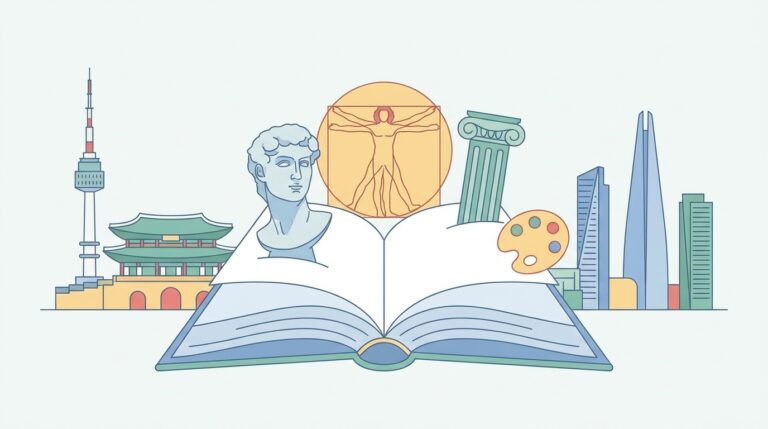
Renaissance Humanism in Modern Korean: Elevating Classical Humanities to C1 Korean Conversations
Phase 1: Empathy & Connection
안녕하세요! I’m your Daily Hangul editor and cultural navigator. Have you ever been sitting at a trendy minimalist café in Seongsu-dong, enjoying a deep conversation about Korean cinema or literature, only to find yourself stuck when trying to express nuanced philosophical concepts like human potential, self-actualization, or historical shift in perspective?
When foreign learners reach the C1 level, the biggest pain point isn’t basic grammar or vocabulary; it’s expressing abstract ideas with natural cultural finesse. You know how to say “I like reading books,” but do you know how to articulate “This K-drama subverts traditional dogma by highlighting agency and human dignity”? Renaissance Humanism (르네상스 휴머니즘) transformed Western thought by shifting focus from divine absolute power to individual human agency, potential, and critical thinking. Interestingly, modern Korean intellectual discourse frequently uses elevated humanities terminology inspired by this precise era to discuss personal growth, artistic independence, and social critique.
Based on feedback from hundreds of advanced Korean learners, mastering classical humanities vocabulary opens doors to high-level Korean podcasts, literary critiques, and meaningful intellectual discussions with Korean peers. Let’s bridges Renaissance Humanism concepts with sophisticated Korean idioms and turns of phrase!
Phase 2: Deep-Dive into 3 Essential Expressions
1. 인간 중심적 사고 (In-gan jung-sim-jeok sa-go)
- Pronunciation: [In-gan joong-shim-jeok sa-go] (Sounds like ‘in-gun’ + ‘zoom’ with an ‘sh’ + ‘saw-go’)
- Meaning: Human-centric thinking / Anthropocentric perspective.
- K-Culture Moment: Used in film critiques (like analyzing director Bong Joon-ho’s works) to describe themes prioritizing human emotion over cold system efficiency.
- Editor’s Insight: In C1 Korean, using ‘-적 사고’ (perspective/thinking) elevates your diction instantly from colloquial speech to academic/professional debate.
- Situation Spectrum: Casual 🚫 / Semi-formal ⚠️ / Formal ✅
- 🤔 Think About It: How does viewing society through a ‘human-centric’ lens in Korean differ from western individualism?
2. 자아실현 (Ja-a-sil-hyeon)
- Pronunciation: [Jah-ah-shil-hyeon] (Pronounce ‘jah-ah’ smoothly, then ‘shil-hyeon’ like ‘sheel-hyun’)
- Meaning: Self-actualization / Realizing one’s potential.
- K-Culture Moment: Frequently appears in contemporary Korean webtoons, career podcasts, and dramas when characters break free from familial obligations to pursue personal mastery.
- Editor’s Insight: Rooted in the Renaissance idea of virtù (human ability), ‘자아실현’ represents individual growth beyond mere survival or financial success.
- Situation Spectrum: Casual ⚠️ / Semi-formal ✅ / Formal ✅
- 🤔 Think About It: In Korean culture where community (우리) is emphasized, how does personal ‘자아실현’ create healthy balance?
3. 인문학적 소양 (In-mun-hak-jeok so-yang)
- Pronunciation: [In-mun-hak-jeok so-yang] (‘In-moon-hock-juck saw-yang’)
- Meaning: Humanities literacy / Cultured intellectual grounding.
- K-Culture Moment: Mentioned in book clubs, tech keynotes, and television talk shows like Alssulsinjob (Indispensable Trivia) to commend someone’s well-rounded knowledge.
- Editor’s Insight: ‘소양’ refers to foundational character traits and refined knowledge built over time, making this a supreme compliment for intellectuals.
- Situation Spectrum: Casual 🚫 / Semi-formal ✅ / Formal ✅
- 🤔 Think About It: What constitutes ‘literary cultivation’ in your native culture compared to Korean society?
Phase 3: Textbook Korean vs. Real Korean
Situation 1: Discussing a character’s internal development in a K-Drama
- 📖 Textbook Korean: 이 인물은 개인의 자유와 능력을 중요하게 생각합니다. (This character considers individual freedom and ability important.)
- 🗣️ Real Korean: 이 캐릭터는 기존 세태에서 벗어나 주체적인 자아실현을 갈망하고 있어요. (This character craves autonomous self-actualization away from existing social norms.)
- 💡 Why is it different? C1 speakers use terms like ‘주체적’ (autonomous) and ‘갈망하다’ (to crave/desire passionately) to express nuanced motivation accurately.
Situation 2: Praising an artistic or literary piece
- 📖 Textbook Korean: 이 책은 사람이 중심이라서 내용이 깊고 의미가 있습니다. (This book is deep and meaningful because humans are at the center.)
- 🗣️ Real Korean: 인간 본연의 가치를 조명하는 인문학적 혜안이 돋보이네요. (The humanities-based insight shedding light on fundamental human worth truly stands out.)
- 💡 Why is it different? Advanced speakers use ‘조명하다’ (to shed light on) and ‘혜안’ (insight/wisdom) for sophisticated aesthetic evaluation.
Phase 4: K-Culture Deep Dive & Non-Verbal Manners
4-1. Nunchi & Intellectual Gestures
When discussing deep humanities subjects like Renaissance Humanism in Korea, active listening and modest body language are essential:
* Eye Contact & Head Nods: Maintain moderate eye contact. Rapid small head nods indicate agreement, but slow, deliberate nods signal deep reflection on the speaker’s philosophical point.
* Posture: Slightly leaning forward when someone shares their insights demonstrates high respect for their ‘인문학적 소양’ (humanities literacy).
4-2. Cultural Code: The Korean Humanities Craze (인문학 열풍)
In South Korea, humanities are not restricted to university lecture halls. Bestselling books, television variety shows, and tech startup CEOs frequently reference Renaissance art and philosophy to inspire creativity and social empathy. Discussing how Da Vinci or Petrarch influenced modern thought reflects high intellectual refinement in Korean social circles.
Phase 5: Real-World Roleplay Scenario
Setting: A sophisticated humanities book club meeting in Bukchon Hanok Village.
NPC Character: Min-woo (민우), a 30-something Korean podcast host who loves classical philosophy.
- Turn 1 (Min-woo): 🎭 [glasses pushed up, holding a coffee cup thoughtfully] 이번 르네상스 휴머니즘 단원, 어떻게 읽으셨어요? 기존 신중심 사회와의 결별이 인상적이지 않나요?
- Turn 2 (Learner): 🎭 [nodding slowly with an engaged smile] 맞아요. 신의 그늘에서 벗어나 인간 본연의 가치를 재발견했다는 점이 정말 흥미로웠어요.
- Turn 3 (Min-woo): 🎭 [eyebrows raised in agreement] 정확합니다! 특히 예술과 문학에서 주체적인 인간상이 등장한 대목이 매력적이었죠.
- Turn 4 (Learner): 🎭 [leaning in slightly] 네, 개인의 자아실현과 개성을 존중하는 태도가 현대 사회의 기초가 된 것 같아요.
- Turn 5 (Min-woo): 🎭 [smiling brightly] C1 수준의 깊이 있는 해석이네요! 그렇다면 현대 한국 사회에서도 이런 휴머니즘적 시각이 필요하다고 보시나요?
- Turn 6 (Learner): 🎭 [speaking with confident calm] 당연하죠. 치열한 경쟁 속에서 서로의 인문학적 소양과 인간 존엄성을 되새기는 게 시급하다고 봅니다.
- Turn 7 (Min-woo): 🎭 [clapping gently] 와, 감탄했습니다. 표현 하나하나에 혜안이 담겨 있으시네요.
- Turn 8 (Learner): 🎭 [smiling humbly] 과찬이십니다. 민우 님의 명쾌한 설명 덕분에 더 깊이 이해할 수 있었어요.
🔀 Interactive Choice Branch
How do you respond when Min-woo asks you to compare Renaissance Humanism with modern digital media?
* Choice A: “요즘 유튜브 콘텐츠도 인간 중심적 사고를 보여준다고 생각해요.” (I think YouTube content nowadays also shows human-centric thinking.)
* Choice B: “글쎄요, 잘 모르겠는데 다음 주제로 넘어가죠.” (Well, I don’t know, let’s move to the next topic.)
* Choice C: “미디어의 범람 속에서도 개인의 주체적 자아실현을 다룬 콘텐츠가 큰 울림을 준다고 봅니다.” (Even amidst the flood of media, content dealing with autonomous self-actualization resonates deeply.)
Feedback:
- Choice A (Risk – Level ⚠️): Grammatically correct, but a bit plain for C1 discourse.
- Choice B (Bad – Level 🚫): Abruptly shuts down an intellectual exchange; socially unnatural.
- Choice C (Best – Level ✅): Perfect! Uses elevated terms like ‘범람’ (flood/overflow) and ‘울림을 주다’ (resonate deeply).
Phase 6: 10-Second Emotional Shadowing Drill
[😊 Confident & Inspired]
인간 본연의 / 가치를 / 재발견하는 것이 / 무엇보다 중요합니다.
(In-gan bon-yeon-ui / ga-chi-reul / jae-bal-gyeon-ha-neun geo-si / mueot-bo-da joong-yo-ham-ni-da.)-
[🤔 Thoughtful & Analytical]
치열한 경쟁 속에서도 / 인문학적 소양을 / 잃지 말아야 해요.
(Chi-yeol-han gyeong-jaeng sok-e-seo-do / in-mun-hak-jeok so-yang-eul / il-chi ma-ra-ya hae-yo.) -
[🥺 Humble & Warm]
상대방의 선택을 / 주체적인 자아실현으로 / 존중해주고 싶어요.
(Sang-dae-bang-ui seon-taek-eul / ju-che-jeok-in ja-a-sil-hyeon-eu-ro / jon-jung-hae-ju-go si-peo-yo.)
Phase 7: K-Culture Mini Dictionary
- 주체성 (Juche-seong) | Autonomy / Agency | The quality of acting independently. Crucial when discussing modern career paths in Korea.
- 혜안 (Hye-an) | Deep Insight / Wisdom | Refers to discerning judgment beyond surface-level facts.
- 통찰력 (Tong-chal-ryeok) | Penetrating Insight | Ability to understand complex truths clearly; often paired with academic discussions.
- 지평을 넓히다 (Ji-pyeong-eul neol-hi-da) | Broaden One’s Horizons | Used when reading books or experiencing culture expands your worldview.
Phase 8: Traveler’s Survival Kit
Top 3 Intellectual Conversations Survival Phrases
- “어떤 맥락에서 그렇게 생각하셨나요?” (In what context did you think that way?) — Use when seeking deeper clarification.
- “그 시각은 매우 신선하네요!” (That perspective is very refreshing!) — Perfect reaction phrase in literary gatherings.
- “인간적인 면모가 잘 드러나네요.” (The human aspect really shows through.) — Great when analyzing Korean films or stories.
Editor’s Travel Note
When traveling in Seoul to explore literary hubs like Kyobo Bookstore at Gwanghwamun or independent art spaces in Ikseon-dong, download the Naver Map App Download for real-time walking routes to historic Hanok libraries.
Phase 9: A Step Deeper (Reflection)
In historical Korea, Neo-Confucianism shaped human morality around social roles and familial hierarchy. However, modern Korean society embraces a dynamic synthesis: honoring collective harmony while striving for individual ‘자아실현’ (self-actualization) inspired by universal humanism. Recognizing this evolution helps you understand both Korean historical dramas and contemporary youth culture.
💬 Your Turn: Which character in a Korean drama or movie best represents
Frequently Asked Questions (FAQ)
Q: What does "인간 중심적 사고 (In-gan jung-sim-jeok sa-go)" mean in Korean and how do you pronounce it?
A: In Korean, "인간 중심적 사고 (In-gan jung-sim-jeok sa-go)" is pronounced [In-gan joong-shim-jeok sa-go] and means: Human-centric thinking / Anthropocentric perspective.
Q: What does "자아실현 (Ja-a-sil-hyeon)" mean in Korean and how do you pronounce it?
A: In Korean, "자아실현 (Ja-a-sil-hyeon)" is pronounced [Jah-ah-shil-hyeon] and means: Self-actualization / Realizing one's potential.
Q: What does "인문학적 소양 (In-mun-hak-jeok so-yang)" mean in Korean and how do you pronounce it?
A: In Korean, "인문학적 소양 (In-mun-hak-jeok so-yang)" is pronounced [In-mun-hak-jeok so-yang] and means: Humanities literacy / Cultured intellectual grounding.







